An Eerie Encounter with the Dullahan’s Death Coach

Lawrence Holohan and unknown young lady, possibly a granddaughter

When I was a teenager, still in high school, I became very interested in my Irish heritage and began tentatively researching my family tree. My grandfather was from Thomastown in County Kilkenny and married my grandmother after he met her in Norfolk while stationed there with the RAF. Sadly, he died quite young, only a few months before my mother was born. I think not knowing my grandfather was what made me even more determined to look into my Irish roots and the first port of call was talking to my grandaunt Phila, my grandfather’s younger sister. Phila was a fountain of family history knowledge, providing me with a family tree drawn from memory and writing down a few memories and stories about the relatives she remembered. One such story has intrigued me since and has led me to further research and create this blog post.

Lawrence Holohan was Phila’s grandpa, my 2nd great-grandfather. He was born in 1870 in Thomastown in the county of Kilkenny in Ireland. He lived in an area near Bennetsbridge, not far from Thomastown, called Newhouse. Records trace his ancestors back to this area at least until the turn of the 19th century.

My grandaunt wrote down quite a few of her memories about him, but the one that captivated me the most was this story, as follows:

“He was great for telling ‘ghost stories’. One I remember was of him walking home late one night, along a dark Irish lane, when he heard the sound of the local stagecoach coming. He stood aside to let it pass, but when it drew near, it was being driven by a ‘headless’ driver, so the story goes.”
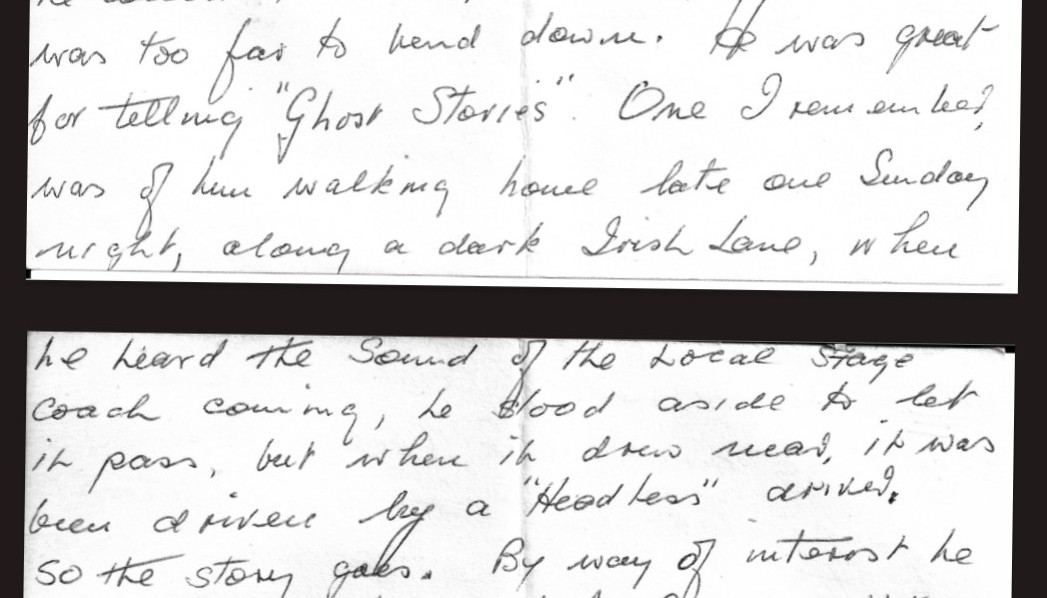
Aunty Phila’s handwritten notes

Lawrence died in 1956 and Phila has also now sadly passed away, so I cannot find out any more information on this wonderful ghost story from them, however, I have been able to look into some of the folklore of Ireland concerning headless coach drivers and headless horsemen.

It seems that stories of the headless coach have some history in the Bennettsbridge area, as I found a story originating from there in the National Folklore Collection, UCD. This was located in their Schools’ Collection and was written by 13-year-old Mary Nolan of nearby Danesfort in 1938:

“Headless Coach

In ancient times the old Irish people believed in many mythical things. They believed in Fairies and the “Headless Coach” and many things like that.

It is said that people in those days saw the ‘Headless Coach’ and this is the description they have of it. The Coach was very big and there was supposed to be dead people on it. The horses that were drawing it had no heads and that is why it was called the ‘Headless Coach’.

In the middle of the night some people heard it and they said it came up the Bennetts – Bridge road and it went down the Stoneyford road and it stopped at the Protestant Church. The people did not know where it came from.

The Coach made great noise as it travelled. Old people say it has to pass along the same way every four years.

People long ago told many stories about the ‘Headless Coach’ and they were kept by tradition.”

Was this the same apparition that Lawrence saw on that lonely lane, making its way to take a soul? It sounds as if the Headless Coach was a regular visitor along the roads he would have walked as a young man and he would have grown up hearing stories of its deathly journeys.

Ireland is a land shrouded in rich folklore, where tales of otherworldly beings and ghostly spectres abound. Among the many fascinating and eerie stories, two figures stand out for their chilling presence and association with death: the Dullahan and the Cóiste Bodhar Death Coach.

The Dullahan: The Headless Horseman

Dullahan, the headless horseman via Wikipedia (Croker, Thomas Crofton (1834) “XXIX. The Headless Horseman” in Fairy legends and traditions of the south of Ireland, John Murray, p. 239)

In Irish legend, the Dúlachán or Dullahan is a terrifying figure, often referred to as the “Gan Ceann” or “Headless One.” This malevolent being is said to roam the countryside, heralding imminent death with his appearance. The Dullahan was thought to be a sign of death, similar to the folklore of the banshee. Unlike the Banshee, which is known to warn of a coming death in certain families, the Dullahan does not come just to warn; he is the harbinger of someone’s certain death.  The Dullahan is depicted as a headless horseman, carrying his detached head under his arm or holding it high up in the air. The head’s eyes are said to be constantly moving, peering into the distance and revealing the fate of those whose demise is drawing near.

The first mention of the Dullahan appears in Thomas Crofton Croker’s book Fairy Legends and Traditions of the South of Ireland in 1828 and he is described as follows in the tale “The Headless Horseman”:

   ” ..such a head no mortal ever saw before. It looked like a large cream cheese hung round with black puddings: no speck of colour enlivened the ashy paleness of the depressed features; the skin lay stretched over the unearthly surface almost like the parchment head of a drum. Two fiery eyes of prodigious circumference, with a strange and irregular motion, flashed like meteors.”

Clothed in a tattered, black cloak, the Dullahan wielded a whip made from a human spine, which he used to strike fear into anyone who crossed his path. His horse’s hooves were said to spark flames as they gallop, leaving a sinister trail of fire in their wake. When the Dullahan stopped riding, it was believed that a soul was about to pass into the afterlife. It is claimed that witnesses would hear their name being called out, and if they looked back, they were destined to die.

Despite his forbidding demeanour, the Dullahan was said to be fearful of gold and would avoid areas where these precious metals are present. As a result, people would sometimes leave offerings of gold to protect themselves from the dreaded fate he carried.

Croker’s tale “The Headless Horseman” provides the best depiction of the Dullahan, presented with good humour. The protagonist of the story is Charley Culnane, who while out riding at night witnessed the apparition of a disembodied head of a horse ridden by the figure of a headless spectral rider:

“A figure, whose height (judging as well as the obscurity of the night would permit him) he computed to be at least eight feet, was seated on the body and legs of a white horse full eighteen hands and a half high … his vision failed in carrying him further than the top of the collar of the figure’s coat, which was a scarlet single-breasted hunting frock …]see further he could not, and after straining his eyes for a considerable time to no purpose, he exclaimed, with pure vexation, “By the big bridge of Mallow, it is no head at all he has!

“Look again, Charley Culnane, said a hoarse voice, that seemed to proceed from under the right arm of the figure.

Charley did look again, and now in the proper place, for he clearly saw, under the aforesaid right arm, that head from which the voice had proceeded, and such a head no mortal ever saw before.”

Surprisingly Charley then decided to challenge the headless horseman to a race, much to the delight of the ghostly rider:

“A hundred years it is since my horse and I broke our necks at the bottom of Kilcummer Hill, and ever since I have been trying to get a man that dared to ride with me, and never found one before.”

The horseman disappeared without taking Charley’s life and rewarded him with the promise of supernatural assistance in any future races in which Charley would take part.

There are also legends and tales concerning the “Headless Coach”, or in Irish Cóiste Bodhar, with its driver being the Dullahan.

The Cóiste Bodhar Death Coach: Harbinger of Doom

The Cóiste Bodhar, also known as the “Silent Coach” or “Death Coach”, is by legend a ghostly coach drawn by a team of headless, skeletal horses, and it travels silently through the night to collect the souls of the departed. Like the Dullahan, the Cóiste Bodhar is a harbinger of death and signals the end of a person’s life.

The sight of the Cóiste Bodhar is said to bring an eerie stillness to the surroundings as if nature itself is holding its breath. The coach is often described as being adorned with funereal symbols, and its windows are said to be draped in mournful black. Those who witness the spectral procession may be overcome with a sense of foreboding, as they know that someone’s demise is imminent.

In some versions of the tale, the Cóiste Bodhar is driven by a Dullahan, further intertwining the stories of these two chilling entities. According to WB Yeats in his book  Irish Fairy and Folk Tales (1893), the Dullahan drives the coach:

“This is a most gruesome thing. He has no head, or carries it under his arm. Often he is seen driving a black coach called coach-a-bower (Ir. Coite-bodhar), drawn by headless horses. It rumbles to your door, and if you open it a basin of blood is thrown in your face. It is an omen of death to the houses where it pauses. Such a coach not very long ago went through Sligo in the gray of the morning, as was told me by a sailor who believed he saw it. In one village I know its rumbling is said to be heard many times in the year.”

According to Croker, the Dullahan could be heard driving the Death Coach particularly hard on some nights when there were souls to be collected:

“The following account of the Dullahans and their coach was communicated to the writer by a lady resident in the neighbourhood of Cork:–

“They drive particularly hard wherever a death is going to take place. The people about here thought that the road would be completely worn out with their galloping before Mrs. Spiers died. On the night the poor lady departed they brought an immense procession with them, and instead of going up the road, as usual, they turned into Tivoli: the lodge-people, according to their own account, ‘were kilt from them that night.’ The coachman has a most marvellously long whip, with which he can whip the eyes out of anyone, at any distance, that dares to look at him. I suppose the reason he is so incensed at being looked at, is because he cannot return the compliment, ‘pon the ‘count of having no head. What a pity it is none but the Dullahans can go without their heads! Some people’s heads would be no loss to them, or anyone else.”

One compelling story by Croker concerning the Death Coach is that of “Hanlon’s Mill”. The protagonist Michael Noonan was walking back from Ballyduff, Co Cork from his trip to a shoemaker and passed the ruined mill of “Old Hanlon”. The ruin surprisingly seemed to be issuing clacking noises as if it were working away. Mick then met his neighbour Darby who asked him to take the horse and cart back. Mick passed by the River Awbeg and here noticed that the moon reflected on a pool of water had disappeared.  When he turned, he then saw, following beside his cart, a black coach drawn by six headless black horses, driven by a headless coachman clothed in black:

“How was Mick astonished at finding, close along-side of the car, a great high black coach drawn by six black horses, with long black tails reaching almost down to the ground, and a coachman dressed all in black sitting up on the box. But what surprised Mick the most was, that he could see no sign of a head either upon coachman or horses.”

The next morning, Mick received news from a local huntsman that Master Wrixon of Ballygibblin had died suddenly after a fit. So, according to legend, the appearance of the “Headless Coach” foreshadowed an imminent death once again.

Photo by u0410u043du0442u043eu043d u0425u0430u0442u043au0435u0432u0438u0447 on Pexels.com

Another interesting story occurred in 1876 in county Clare, collected by Thomas Johnson Westropp, in his 1910 “A Folklore Survey of County Clare”.  Here a servant for the MacNamara family of Ennistymon House was taking a stroll late at night when he heard the rumbling of wheels along the lane. Confused as to what vehicle would be out at such a late time of night, he then realised it must be the Cóiste Bodhar.

The servant then quickly ran and opened the three gates leading to Ennistymon House and threw himself face down on the ground as the death coach hurtled past him. Without stopping at Ennistymon House, it drove into the distance until it was out of sight and no longer heard. A day later news arrived that Sir Admiral Burton MacNamara had died in London.

Despite their fearsome reputation, the Dullahan and Cóiste Bodhar serve as a reminder of the ancient beliefs and superstitions that have shaped Irish culture. Did Lawrence Holohan really witness the Death Coach passing by on its solemn journey? Did it come to take the soul of a family member or friend of his? The answers are now lost in time. However, what we do know is that legend of the Dullahan and the Death Coach continues to captivate and frighten those who hear their eerie hoofbeats or the rumbling of wheels echoing in the darkness, making them two of the most enduring and haunting figures in Irish folklore.
Photo by Hakan Erenler on Pexels.com

I dedicate this post to my mother Susan Gayfer (01/06/1956-24/07/2023) who passed away suddenly and unexpectedly the on the day I finished writing the first draft and had been excited to read the finished product. She sadly did not live to read it.

References

A Paranormal Night of Discovery at The Mount Without, Bristol

Earlier this year I was lucky enough to secure tickets to a paranormal night of discovery event being held in the atmospheric venue that is ‘The Mount Without’. This was a two-part event hosted by the marvellous Dr Kate Cherrell. The first part of the event was an introduction to Victorian Spiritualism introduced by Kate and the second part of the event was a paranormal investigation, co-hosted by Kate and Jamaica Inn paranormal investigator Karin Beasant, giving attendees the chance to try their hand at experiments and contacting spirits from beyond the veil.

The Mount Without

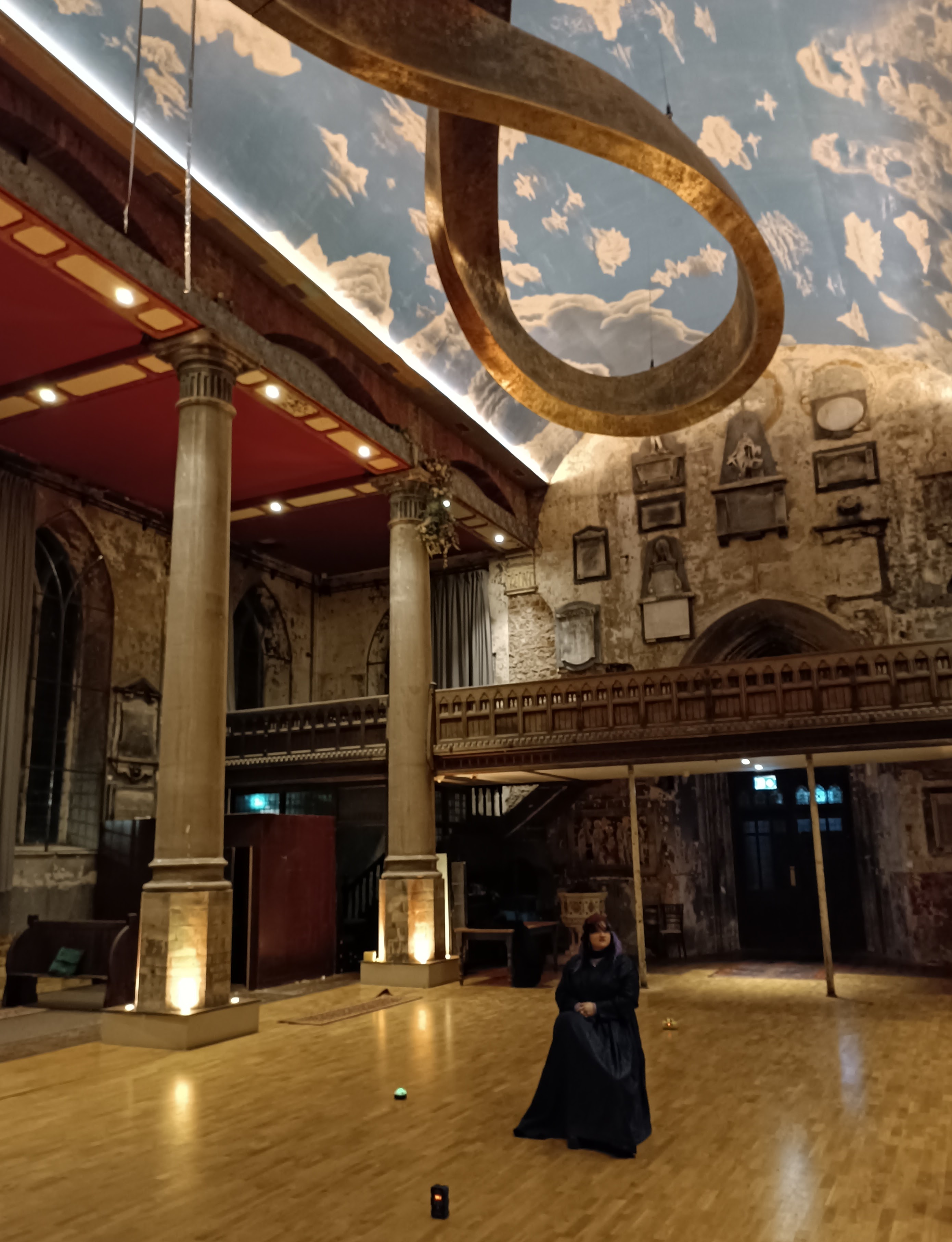
Saint Michael the Archangel on the Mount Without is an impressive church standing proud on St Michael’s Hill, looking over the city of Bristol. The first church on this site was likely Norman and built in 1147 by Robert Fitzhamon, who is famed for also building Tewksbury Abbey. The church was originally built outside the city walls and was therefore known as “The Mount Without”. The original church was then rebuilt in 1460 and the clock tower you see now is from that period.

Over the years the city of Bristol slowly grew up and around the church, as St Michael’s Hill became more populated with merchants and other residents. By 1775-1777 the church became too small to take the growing congregation and so the main body of the church was demolished and rebuilt by local builder, Thomas Paty. Around this time new graves were also created in the crypt and tombstones reused as ‘under slabs’ for the new graves. As the living population of Bristol grew, so did the population of the dead interred at the Church.

During the second world war, the church was damaged twice during the Bristol Blitz. In 1940 a 1000lbs bomb fell within feet of the Church and in 1941 an incendiary device set the roof alight destroying it. The church was repaired and in use until 1999 but the congregation dwindled over the years and was finally closed by the diocese.

The church lay empty, until squatters moved in and set it ablaze in October 2016. The dramatic blaze took at least 15 fire engines and many firefighters to extinguish. I could see the smoke from the blaze billowing in the sky near my home not too far away.

In 2017 the diocese wanted to find a new use for the building and asked for design bids from businesses, philanthropists and entrepreneurs. The church was finally reclaimed as the creative venue and events space that we see now, where it hosts artists, music and holistic events. This wonderful gothic revival church has been a gathering place for the people of Bristol for over 900 years and looks set to continue with that legacy.

An Introduction to Victorian Spiritualism

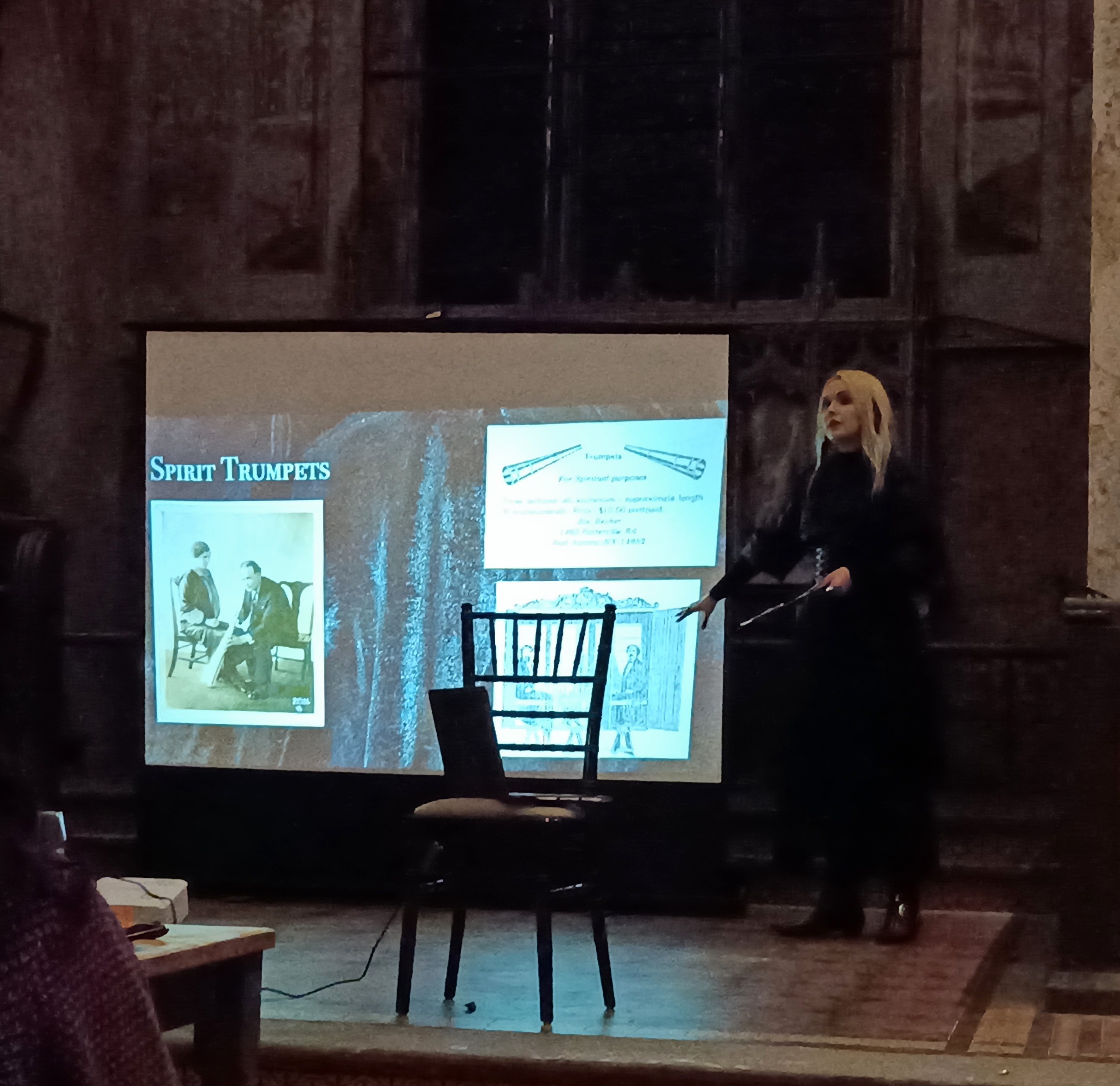
The evening kicked off with the introduction to Victorian spiritualism talk by Dr Kate Cherrell. This was a fascinating, informative and entertaining talk introducing us to the strange world of Victorian spiritualism including its history and types of spirit contact made in the 19th century. This was brought to life with a slide show, props and Kate’s sharp humour. I personally enjoyed hearing about spirit trumpets, the Fox sisters of Hydesville and witnessing Kate’s ectoplasm demonstration.

Spirit trumpets for example, or ‘séance trumpets’, were metal cones placed in the centre of a table during a séance to amplify any sounds issuing forth from the spirit realm. Sometimes a spirit would speak through a medium, who would bring the trumpet to their mouth to speak through. What larks!

The Paranormal Investigation

The second half of the night was the paranormal investigation; a chance to have hands on experience of communing with the spirit world. This started off with investigator Karin explaining the various gadgets, devises and paraphernalia used in investigation; from EMF readers, spirit boxes and motion sensors to planchettes and Ouija boards.

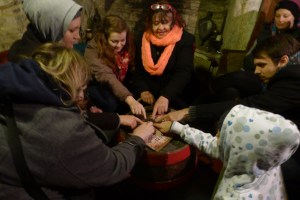
We split up into two groups and my group started off in the crypt with some table tipping. I’d never tried table tipping before, so this was all new to me. Table tipping is a form of psychic phenomenon in which a table can tilt, rise, wobble or rotate by the contact of the fingertips of individuals. It is a form of séance where sitters place their fingertips on the table and the table move without conscious muscular force. By relating the tilts to the alphabet or yes/no directions it is said to become possible to receive messages from beyond the veil.

We stood around a tall thin table with our finger tips gently rested on the top while Kate called out questions. It appeared that a religious man took a particular interest in talking to me and Kate asked him questions about his life before death. The table tilted and wobbled in answer to her queries, indicating he was originally from the north, had come to Bristol and stayed her while his family went to the New World. It was unclear if he had worked at the church or had just been a member of the congregation.

After the table tipping, we moved on to conduct a séance. For this we sat around a table with a spirit box and EMF readers on top, with shadow sensors dotted around the room near us. A bible was placed on the table also and we linked hands as a member of the group read a passage out from Corinthians. The hope was that we could invoke the spirits of this holy building by reading passages from the bible, triggering one of the various sensors. There were some beeps and possible triggering of sensors, but nothing too striking for me to note during this séance.

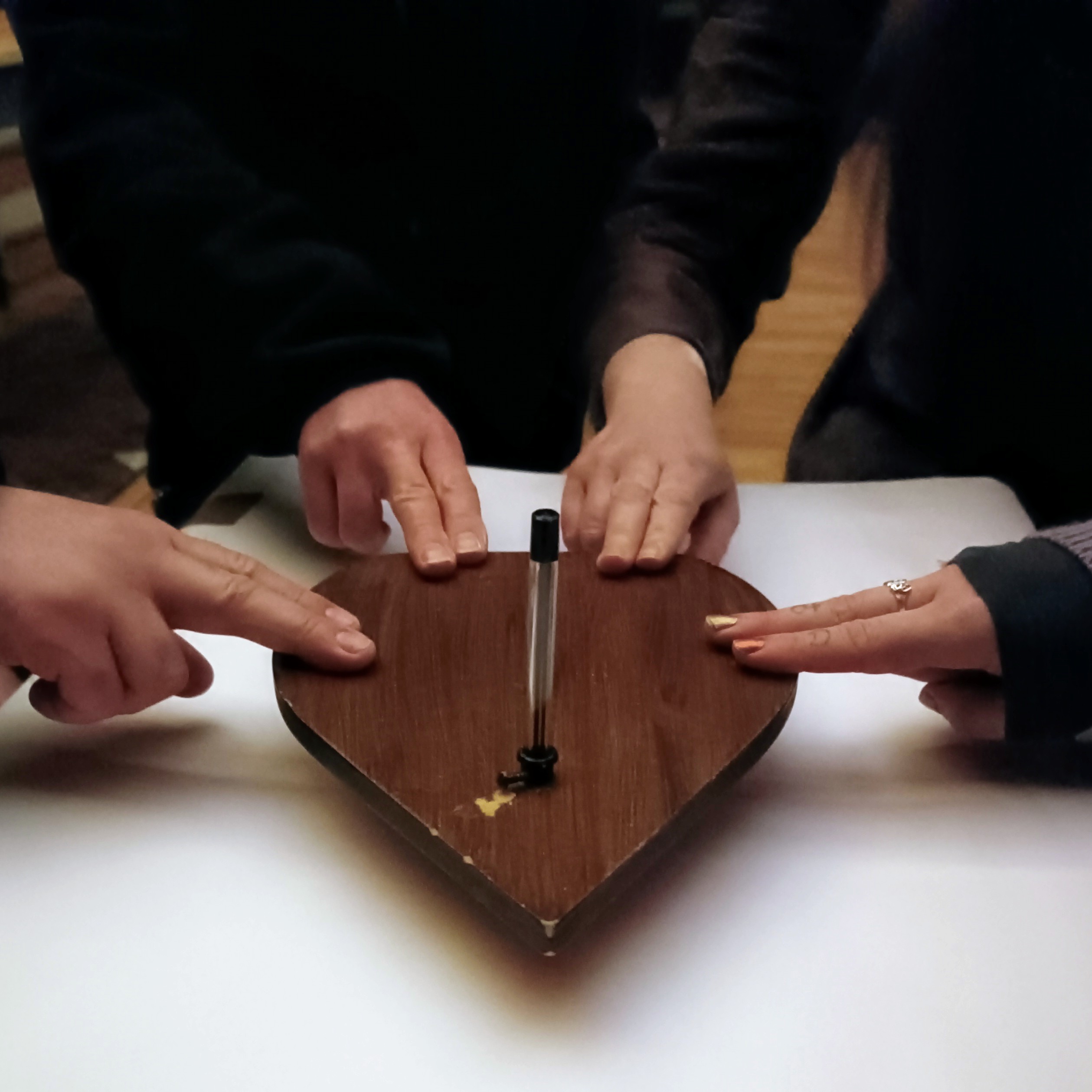
Next up, we headed upstairs in to the Nave of the church where we tried the planchette without much activity. The hope was that we would see some automatic writing. We all placed our fingers on the planchette and asked the spirits to move the planchette across the board, bringing messages from the other side. There was a small amount of movement, but not much unfortunately.

Following this we tried the “Estes Method”. The Estes method is where an investigator wears a blind fold to limit visual stimulation and also wears noise cancelling headphones connected to a sprit box; a device that is used to scan through radio frequencies and it is believed to be a communication tool between the spirit realm and the world of the living.  While the investigator is listening to the spirit box, other members of the group call out to the spirits with questions. The blindfolded investigator will call out any ‘answers’ coming through the headphones from the spirit box.  The idea is that the sensory deprivation eliminates any stimuli that could influence the blindfolded investigator.

In our experiment we sat in a circle near the alter, all wearing blind folds. One person had the spirit box and headphones. One person sat in the centre of the room dressed in an old-fashioned dress near the shadow sensors. We called out questions and for the spirts to touch someone.  After this some other ladies took it in turns to wear the old-fashioned dresses and sit in the centre of the room with the spirit box and a pal of mine in vintage style clothes also took his turn. We called out questions and even religious phrases in Latin to try to call for messages from the spirits. A few words were called out by the person with the spirit box including “like music” and other refences to music a few times.

To finish off we all sat in a circle where the chairs were positioned with one seat inside the circle and the next out.  One person sat at the altar, while other members called out to the spirits to approach and communicate.  The lady at the alter felt a cold spot next to her and a shadow sensor went off ahead of it. She said she felt like a hand was resting on her head at one point. Was this the spirits coming close to her or psychological suggestion?

I noted that the questions asked to the spirits often led to the Reverend William Knight. The Reverend Knight was a long serving rector of the parish, serving for almost sixty years before retiring in 1875. He died 3 years later and was buried in the church crypt. Could this have been him placing reassuring hand on the young lady’s head? There is also the story that a male figure has been seen looking out of the door near nave in past. Could this be the Reverend keeping a watchful eye over his beloved church even after death?

All in all, this was a fascinating and enjoyable night; from the whistle stop introductory talk based around Victorian spiritualism, to the hands-on experience of trying out paranormal investigation techniques. For me there was not enough activity to indicate that the spirits of the dead lurk in ‘The Mount’, waiting to communicate with the living. However, this location is steeped in history and atmosphere, so no doubt further investigation could prove me wrong. Perhaps on a late-night walk home past the Mount, I too one day will spot a dark figure looking out from the nave as I pass by.

With thanks to The Mount, Dr Kate Cherrell and Karin Beasant.

References:

2009-present Ghost Catcher Isles© All rights reserved. All my posts are copyright and if you do wish to refer to them or use anything from them on your site, please credit and link this site

The Care Home Entity

Photo by Pedro Figueras on Pexels.com

I’ve been interested in the paranormal since I was a child, even joining an amateur paranormal investigation team in Ireland for a year when I lived in Dublin, though remaining firmly in the ‘sceptic’ camp. The experiences I want to describe to you happened to my mother when I was around 13 years old and it is where my interest in the paranormal began.

My mum has worked as a care assistant and later in managerial roles in elderly people’s residential care homes in Norfolk for most of her adult life. She has had several unusual, creepy and unexplained experiences in several places, but the one that left its mark on her and me the most was in a care home in a busy touristic town on the Norfolk Broads. This care home was in a very old building that had once been part of a landed estate, and it comprised of gardens, a large house with multiple rooms and converted stables/sheds.

My mum worked as a relief assistant manager there for a period and part of the job required that she sleep over night. She had slept in different rooms in the main building before and had odd experiences; she had had her things moved and nightclothes folded and put on the bed on occasion and upon asking no staff had admitted to moving them. She said this room felt safe and friendly, like there was a friendly poltergeist there who wanted to be helpful. In one certain room, she had woken in the night to hear crying from the room above. Upon investigation, she was told that there was nobody in the room above. Although creepy, her experiences in these rooms did not leave her shaken and she was generally happy to sleep in them.

It was however, when my mum was required to sleep in the rooms in the converted stables/sheds that she had the experiences that left her shaken and scared. I remember seeing my mum when she returned from work the afternoon after her first night in that room and she looked awful. She looked exhausted and shaken up but would not tell me what had happened to her. It took her around 3 days for her to finally gain the strength to speak about it as she felt she would not be believed. I believe she experienced something in that room that she could not explain.

My mum told me that she had felt uncomfortable in that room from the first time she went in. She said it felt cold and unfriendly. On that first night she had finished up her tasks for the night and had gone to her room to settle in for the night. She said she had the bedside lamp on and was propped up in bed reading, which is her custom to help her relax before sleep. She said it felt cold in the room and she noticed something odd from over the top of her book. She said she saw a grey mist coalescing near the window and between the end of the bed. She felt frozen with fear and watched the mist grow until around 5ft in height, like figure. The mist seemed to shuffle towards her and this was more than enough for my mum and she told me she shot out of the bed and out of the room. She refused to return that night and slept as best she could in a chair in one of the lounges. She spoke to the night staff and they disclosed that other people had had strange experiences in that room.

Sadly, my mum had to return to that room as part of her job, so she decided she had to live with whatever was in the room. She said following that first incident she experienced knocking and banging on the door, but nobody there and staff confirming nobody had been to her room. She heard knocking and banging inside the room too, sometimes waking her up. She was so frightened she spoke to a local vicar about what to do and began sleeping with a Bible next to the bed and a glass of water to represent life.

Other relief assistant managers also had to slept in that room and at least 2 others disclosed that they had had experiences in there. One lady had felt what felt like someone get in bed beside her and somehow pass through her. Another had felt something pulling the duvet from the end of the bed.

My mum spoke to some locals who said that they believed an Italian prisoner of war had worked on the estate and had died in the stables. Could he still be there trying to get attention?

My mum said throughout the time she worked there she continued to experience things in that room, but they did calm after she spoke to it. She became so fed up with her sleep being disturbed and feeling afraid that she literally spoke to it, or at least to the room, telling it that she wasn’t there to harm it, she had to stay there for her job and if it ceased bothering her, she would not bother it. This seemed to calm things in there somewhat from then on and she was able to sleep with less disturbance.

The building there is no longer a care home for the elderly, but has a similar use, so she prefers to keep the place anonymous as she doesn’t want to cause alarm to anyone who stays there now. I wonder if the entity in that room and the spirits in the other rooms are still active?

Victim Support Sponsored Ghost Hunt, January 2014- The Ancient Ram Inn, Gloucestershire

On 11th January 2014 members of Victim Support’s South West Victim Care Unit held a sponsored ‘ghost hunt’ at the Ancient Ram Inn in Wotton-Under-Edge, Gloucestershire.

The Ancient Ram Inn is considered one of Britain’s most haunted B&Bs and is reputedly haunted by at least twenty ghosts. It is claimed that it is so haunted it can no longer be used as a functioning B&B and instead opens its doors to budding ghost hunters.

Members of the South West Victim Care Unit challenged themselves to see how long they could last out in this creepy building. A Ouija Board was used in “the bar” and several vigils were conducted in “the bishop’s room”. There were a few strange occurrences in the bishop’s room, such as a candle stick falling over, tapping noises coming from the fireplace, a brass bed warmer swinging and banging over the fireplace, a door knob rattling when nobody was at the door and long scratching noises coming from the door.

Were these down to a pranksters or spirits of the dead? You can find out for yourself if you spend a night at the Ancient Ram Inn.

Despite finding no concrete evidence of the afterlife, all members of the South West Victim Care Unit enjoyed their spooky experience, which raised £775 for Victim Support.

An more detailed write up of this investigation with additional photos will follow shortly.


Using the Ouija Board at the Ram Inn

Using the Ouija Board at the Ram Inn

2009-2014 Ghost Catcher UK & Ireland© All rights reserved. All my posts are copyright and if you do wish to refer to them or use anything from them on your site, please ask permission first

The Whispering Mummies of St Michan’s Church, Dublin

In 2010 I took my mother on a visit to an unusual and macabre attraction in Dublin: the mummies of St Michan’s church. Located near Dublin’s Four Courts, St Michan’s church is Dublin’s oldest parish church north of the River Liffey. Founded in 1095 and named after a Danish Bishop and built on the site of an ancient oak grove, the present church dates from 1685. Until the 16th century monks from Christchurch Cathedral the church congregation and from 1547 it was part of Christchurch Cathedral parish. Restored in 1998, St. Michan’s now belongs to the Protestant Church of Ireland. The church retains many of its original features such as the galleried interior and organ. The organ dates from 1724 and is one of the oldest in Ireland that is still in use. It is claimed that Handel practised for the first performance of ‘Messiah’ on this very organ.

Beneath the church lay the vaults, which are the main attraction to the church. Here many of Dublin’s most influential families from the 17th-19th centuries were interred. The Shears brothers, who were executed by the British following the Rising of 1798 and a copy of the execution warrant is also on display in the crypt, where it instructs the condemned men to be hung, drawn and quartered. Also interred in the vault are the Earl’s of Leitrim who lay in highly decorated coffins. Many of the bodies deposited in the vault are in such an excellent state of preservation that their features are discernible and they bones and skin intact. The conditions for mummification are caused by a combination of the dry atmosphere of the vaults, methane gas emanating from the ground and the limestone walls which are resistant to moisture acting together to dry out the bodies. The most famous mummies in the vault are those of the alleged crusader, the thief and the nun. The crusader, mummy believed to have been a soldier returned from the Crusades, has had his legs broken and crossed, in order for it to fit the coffin. He lies with one of his hands is lifted slightly in the air and legend has it that those who touch his finger will have good fortune. The mummy known as the thief has had his feet cut off and his right forearm is missing, some say as punishment for his crime. Recent scientific and historical research however, has disputed the validity of the stories surrounding the crusader and the thief.

Our visit to the church was on a wet and dismal day in June. After looking around the church our tour guide and 6 other people entered the underground vaults through a metal door and clambered down some very wet steps. There was a passage in front of us and in the dim light, alcove areas could be seen which contained the ornate coffins of the well to do departed. The tour guide explained who the coffins belonged to, what the family names and crests were and then we moved on toward the end of the passage, where we saw the open coffins and the mummified bodies. Towards the end of the tour my mother wandered to the end of the passage where there was a part that had not been excavated. She told me that while she was peering into this area she became aware of voices around her, “a sort of whispering, murmuring noise” and felt it was rather oppressive in the passage. She said she began to sense that there were many people around her, pressing close, which was not the case. She remembers “I did not feel frightened, just aware of this whispering and I could not make out any words, but I felt as if I was in a press of people. There was no wind entering the passage the metal door had been firmly shut behind us and I could not account for the noises.”

It is interesting to note that there have been previous reports of strange whisperings and voices heard within the vaults, as well as reports of being touched by unseen hands. Could it be that the vaults contain the restless spirits of the dead, or is it more likely that visitors to the vaults experience movements and sounds caused by ‘infrasound’? Infrasound refers to extreme bass waves or vibrations with a frequency below the audibility range of the human ear. Although these waves cannot be heard by the human ear, they can be felt and have been shown to produce a range of effects in some people including anxiety, extreme sorrow, and chills. Perhaps this would account for my mother’s feeling of oppressiveness in the passageway, the feeling of being in a press of people and hearing ghostly whispers.

Haunted vaults or not, my mother is undeterred: “I very much enjoyed it. I would not mind going again, but I certainly would not want to be there on my own….”

Visitor Information

Address: Church Street, Dublin, Dublin, Ireland

Public transport: Bus: 134 from Abbey St.

Tours: Mon-Fri 10-12:45, 2-4:45, Sat 10-12:45

Admission Prices:
Adults €4.00
Children €3.00
Students and Seniors €3.50
Family (2 Adults + 2 Children) €12.00

References

2009-2014 Ghost Catcher UK & Ireland© All rights reserved. All my posts are copyright and if you do wish to refer to them or use anything from them on your site, please credit this site.

Ross Castle Investigation November 2010

This investigation followed the regular format of walk arounds and vigils in individual rooms. However, this investigation was different in that the focus was on experimenting on a séance in the lower tower room.  The purpose was to communicate with spirits and a planchette and alphabet cards laid out on the table were used.

One concern of individuals taking part in this séance was that of safety. Therefore the member of the team; who had tried some controlled experiences or instructions in what it feels for spirits to come close; was chosen to lead the proceedings. The member of the team who has had experience of working in spiritual development circles explained that, just as with living people, not all spirits are friendly. Also, if the spirit in contact was murdered this may create strong unpleasant feelings among those who have not had such experiences with communicating with in the past. Therefore, those who were prepared to be ‘touched by spirit’ were chosen to take part in the séance.

Here it was attempted to make direct communication with spirit through the participants’ psyches or ‘higher selves’. Instead of deciphering feelings from spirit, questions were asked.  A protection ritual was led by the team leader, which sought to protect the participants with a white light. This meditation was used more to get the participants into the correct mindset for connecting with spirit, though it also sought to create a psychic protection barrier.

The participants were asked to keep an open stance, with legs uncrossed, feet on the floor and a finger always on the planchette. This was done in order to keep spirit energy flowing and to align chakras. Crossing legs or arms would create interference and disrupt energy flow.

According to the leader of the séance, spirit does not move the planchette, but communicates with the participants’ psyche or energy field to make them move the planchette where it wants it to go. Here spirit works with the participants’ spirits in order to physically move the planchette, as the spirit communicating has no physicality in order to do this itself.

The séance leader called for any spirit to come to the table. This could have been any spirit whatsoever, not necessarily a spirit attached to the location. It could have been a spirit connected to an individual in the room or any spirit that wished to communicate. Those spirits who did not wish to communicate were not forced to.

The details of the séance will be kept confidential at this time in order to allow further unbiased investigation. However, one event of interest occurred while speaking to a mischievous spirit. Here one member of the group had chosen to remain in the living room below. However, the mischievous spirit announced that it wished to play a game with this member of the group. A loud bang was heard from downstairs and upon checking it was found that a change in air pressure in the living room, due to the heat from the log fire, had caused a door to slam loudly on its own. Could this have been due to a mischievous spirit playing a prank on the individual in the room, or merely natural causes?

Those individuals who participated in the séance had minimal experience of using a planchette and were sceptical of such methods. It was clear that quietly all individuals at the table had been conducting their own experiments to catch out fakery. However, all individuals came away from the séance saying that if someone was controlling the planchette it was very cleverly done as it was almost impossible to push the planchette in a controlled way. Seemingly the planchette moved where the spirit in communication desired it. All in all it was a very interesting experience, worthy of further experimentation and research.


2009-2014 Ghost Catcher UK & Ireland© All rights reserved. All my posts are copyright and if you do wish to refer to them or use anything from them on your site, please ask permission first

333 Phenomena

Photo by Ivan Oboleninov on Pexels.com

Over the years there have been frequent reports of a variety of unusual phenomena experienced between 3-4am, particularly heightened at 3:33am. Such phenomena as individuals waking up at this time for no logical reason, reported experiences of ‘sleep paralysis’ and more frequent reports of paranormal activity are associated with this time frame.

3am is often referred to as “Dead Time” or the “Devil’s Hour” as it is the time when paranormal activity is at its peak. Demons are said to be more active at this time rather than spirits. The popular Christian theory is that Jesus Christ died at 3pm, the opposite of 3am, and so 3am is the most active time for demons who wish to defy Christ and mock the Holy Trinity.

3:33am is thought to be the time for the ultimate mockery of the Holy Trinity with it also being half of 666; the number of the Beast. It is said at this time the veil between the world of the living and the world of the dead is at its thinnest, allowing demons and spirits to communicate or cross over more easily than at other times.

Those who research the field of the paranormal state that spirits can be active 24/7 and that there is no concrete evidence to indicate that 3am is more active than any other time.  However, paranormal activity may appear to occur more often at night as conditions of darkness are more suitable for conducting paranormal research. It is easier to see light anomalies or apparitions in the darkness and many items of paranormal research equipment are better able to pick up on activity in dark conditions.  The senses are also intensified at night, which may give the impression that there is more paranormal activity occurring at that time due to everyday noises and tricks of the light creating mistaken paranormal experiences.

It has also been noted that many deaths occur between 3-5am as it is at this time that the body’s immune system is more vulnerable. Those who are terminally ill or very elderly are more likely to pass away at this time due to the body being weakened. Some researchers cite this as a theory as to why more spirits are active at this time, correlating with their times of death.

333 phenomena has also been reported by individuals who recognise repeated patterns of these numbers in their daily life such as waking up at 3:33am or seeing these numbers everywhere. Due to the theory that these numbers are a mockery of the Holy Trinity, individuals may have assigned religious meaning to these numbers causing psychological suggestion and leading the subconscious to pick out these patterns. This can go as far as subconsciously programming the body to wake up at this time.

It does seem naive for anyone to be able to claim that 3pm was the exact time of the death of Jesus, as at present religious scholars still disagree on what date this even took place. Therefore it seems imprudent for the number 3 to be ascribed mystical and religious meaning. Historically many people believed that midnight, the ‘witching hour’, was a period of greater activity for witches, demons and ghosts, with people avoiding going out at night due to this.  It seems likely that our primeval fear of the dark, when early humans were more vulnerable to predators, has been retained and as a consequence superstition and religion has been used to apply meaning to our fear of the dark and the unknown.

2009-2014 Ghost Catcher UK & Ireland© All rights reserved. All my posts are copyright and if you do wish to refer to them or use anything from them on your site, please ask permission first