Dreams of Treasure

Part 1: The Pedlar of Swaffham 
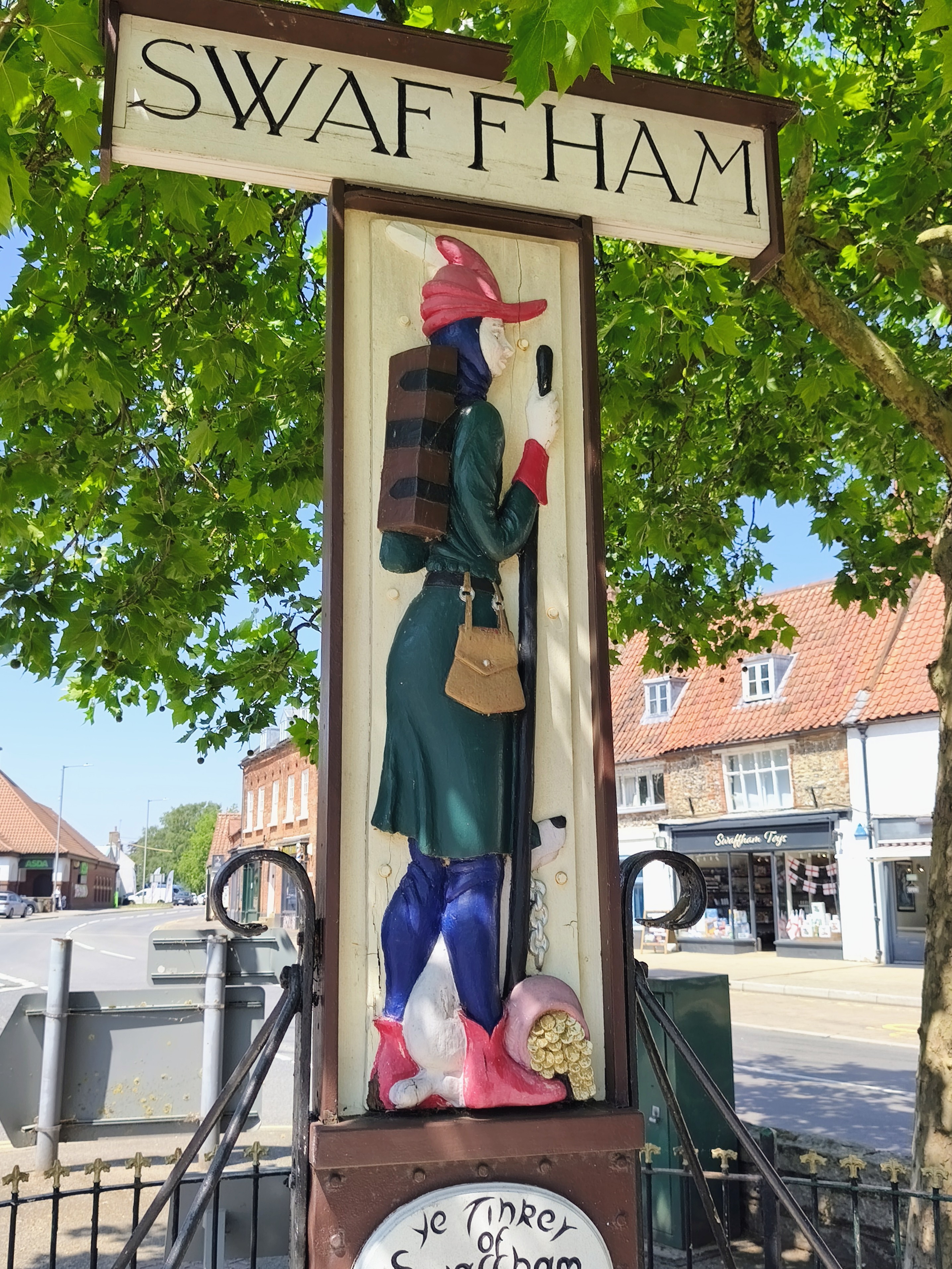
(Image: Swaffham Town Sign. Source: E.Holohan 2026)

A Story That Stayed With Me

When I was at primary school in rural Norfolk I remember hearing one of the first Norfolk folktales that ever captured my imagination: the Pedlar of Swaffham.

The story fascinated me. Over the years, I came to realise that although it felt so familiar to me, it was not nearly as well known elsewhere. Many people had heard of the famous tale of Dick Whittington and his cat, but very few people I met had ever heard of the Pedlar of Swaffham and his hound. Yet, as we shall discover, this story belongs to a much wider tradition of folklore and shares surprising similarities with legends from elsewhere.

I can still picture myself sitting cross legged on the classroom floor, listening intently as my teacher recounted the almost magical story of a poor pedlar whose life was transformed after following a dream. Then came the part that amazed me. My teacher told us that the story was based on a real person, and that the pedlar had paid for the rebuilding of the church in Swaffham. Better still, she said, you could still see him on the town sign.

To a child, that was extraordinary. How could someone who seemed to belong in a fairy tale have actually existed?

Stories like this have a way of staying with you, lodging themselves in your imagination. The Pedlar of Swaffham certainly did for me. Decades later while visiting Norfolk, I decided it was finally time to visit Swaffham itself to see whether I could still find traces of the legend and perhaps even of the man behind it.

Looking for the Pedlar
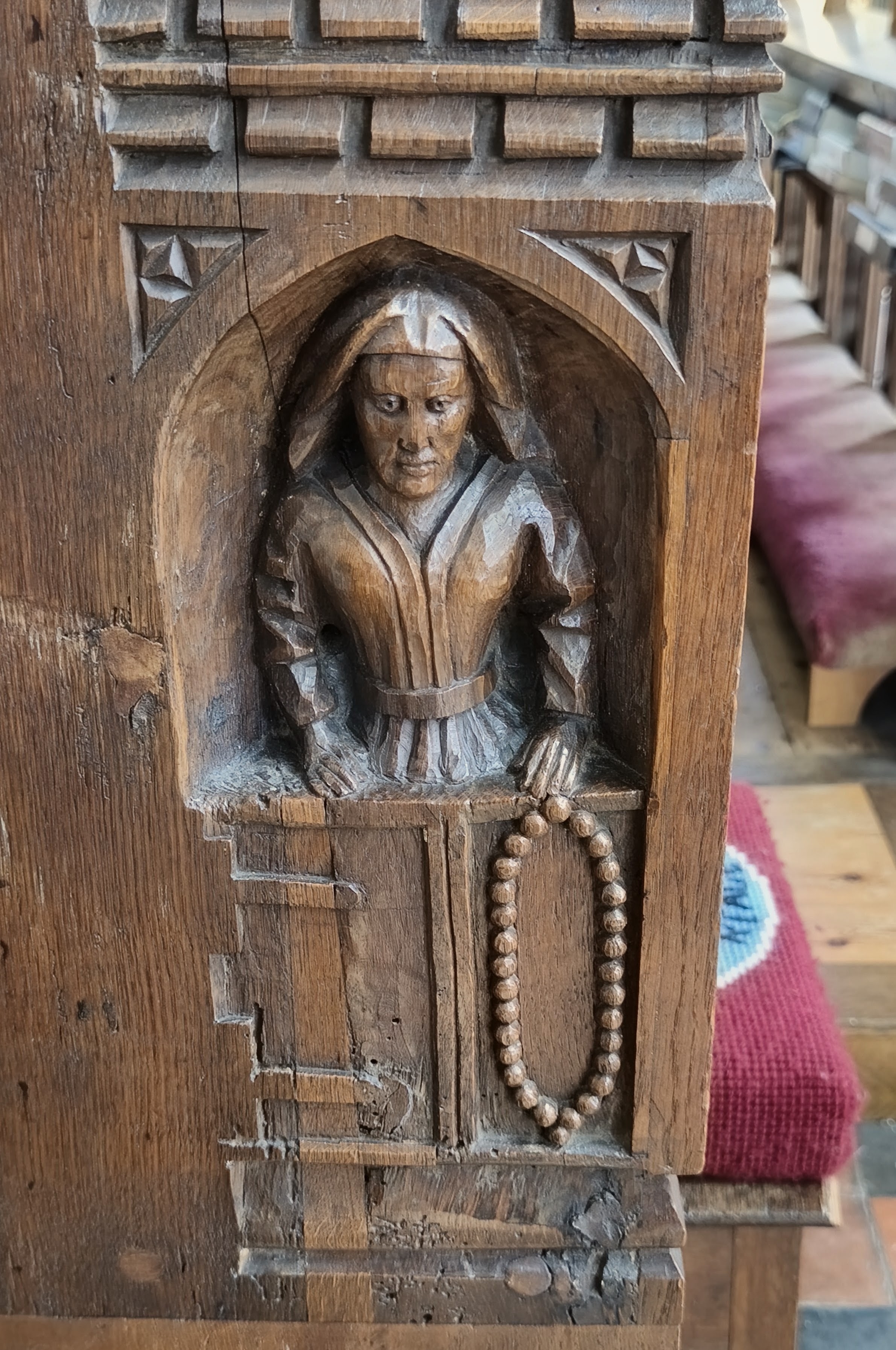
(Image: Carving believed to be John Chapman. Source: E.Holohan 2026)

While researching both the folklore and the historical origins of the Pedlar of Swaffham, I discovered that St Peter and St Paul’s Church contains carvings believed to depict the historical John Chapman, the man thought to have inspired the legend. That made the church my first destination.

Walking from the marketplace down a wide lane, the great tower of St Peter and St Paul’s gradually came into view, rising above the surrounding buildings. Stepping inside, I was immediately struck by the magnificent hammerbeam roof stretching overhead. The church was quiet, filled with the sort of peaceful atmosphere that encourages you to slow down and take everything in with reverence.

I then began my search for the famous carvings.

The first I found were on the bench ends. Some showed a folkloric depiction of the Pedlar of Swaffham wearing his close fitting rolled brim hat and carrying his pack. Nearby were carvings of his faithful dog. They were wonderful to see, but they were not the figures I had come looking for.

Further into the church, I finally found them. The carvings believed to represent the historical John Chapman show him peering from a window, while his wife looks out from a balcony above. It felt strangely moving to come face to face with someone who had lived in my imagination since childhood.

The Church Behind the Legend

The history of the man in the carving is closely linked to the history of the church itself.
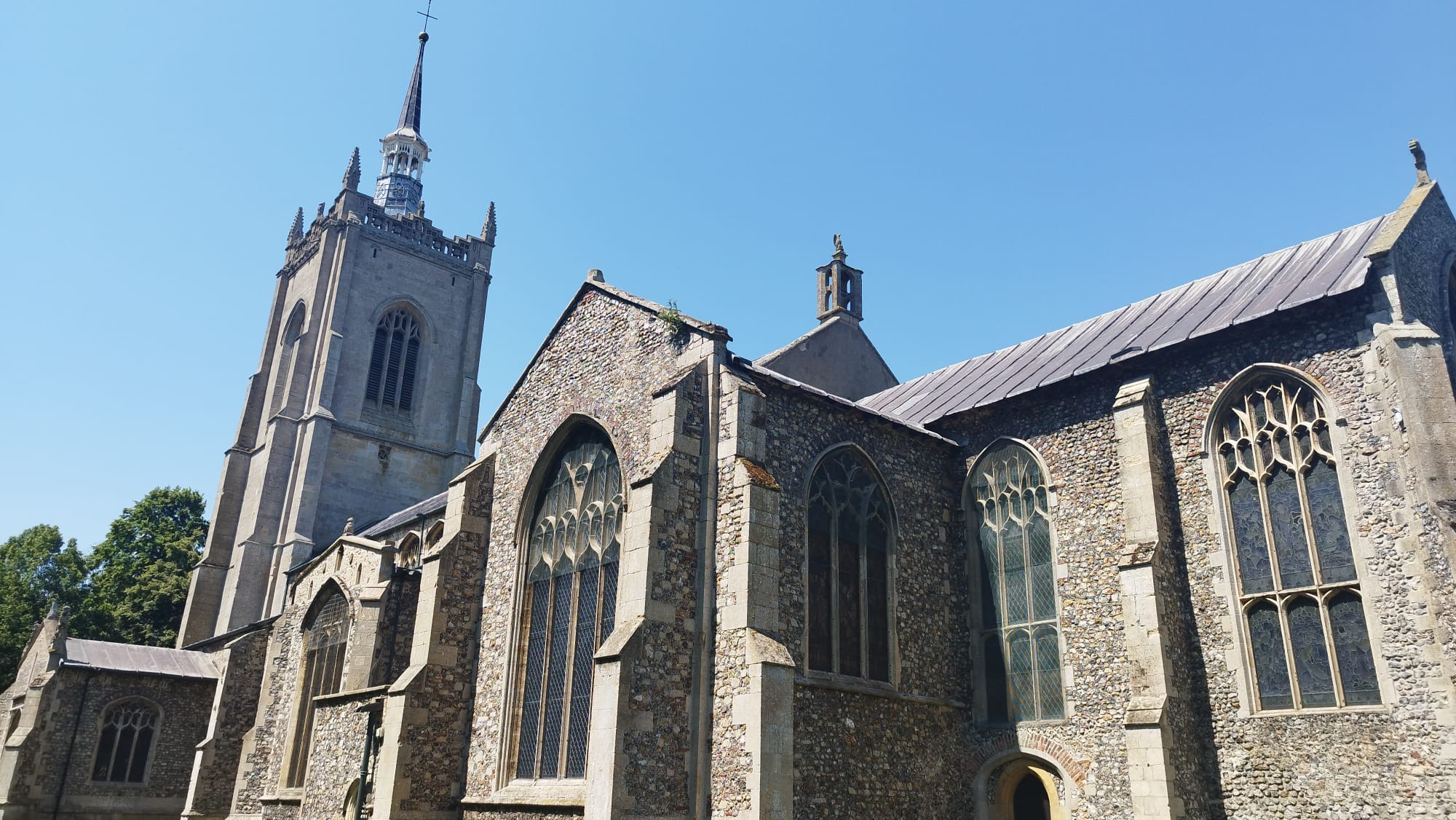
(Image: St Peter and St Paul’s Church, Swaffham. Source: E.Blackshaw 2026)

St Peter and St Paul’s Church was rebuilt during the fifteenth century, funded by a number of wealthy local benefactors. Among them was John Chapman, whose generosity helped finance the work and whose likeness is thought to survive within the church.

It is here that history and folklore begin to merge. The documented life of John Chapman became entwined with the local legend until it became difficult to separate the historical benefactor from the legendary pedlar. Together, they created one of Norfolk’s most loved folk stories.

Who was John Chapman? Why did he become known as the Pedlar of Swaffham? How did the story of one Norfolk merchant become one of England’s most enduring folktales?

Settle in and let us follow the dream that turned an ordinary pedlar into a legend.

The Pedlar’s Dream

John Chapman was a pedlar, a travelling merchant, who wandered around Norfolk in the fifteenth century, taking his goods from one market to another. On market days he would join the other traders selling everything from brooches and combs to silver mirrors, eggs, spices, mustard and freshly baked bread. With his packhorse loaded with wares, John would leave Swaffham early in the morning and spend the day selling what he could. He’d then stay overnight in simple lodgings and return home the next day.

One day he came home tired and disappointed. Business had been very poor and he had not sold a single thing, not even one copper pan.

After his meal he complained to his wife that money was becoming short and trade was getting harder. The long journey had worn him out, so he went straight upstairs to bed.

That night he had the strangest dream.
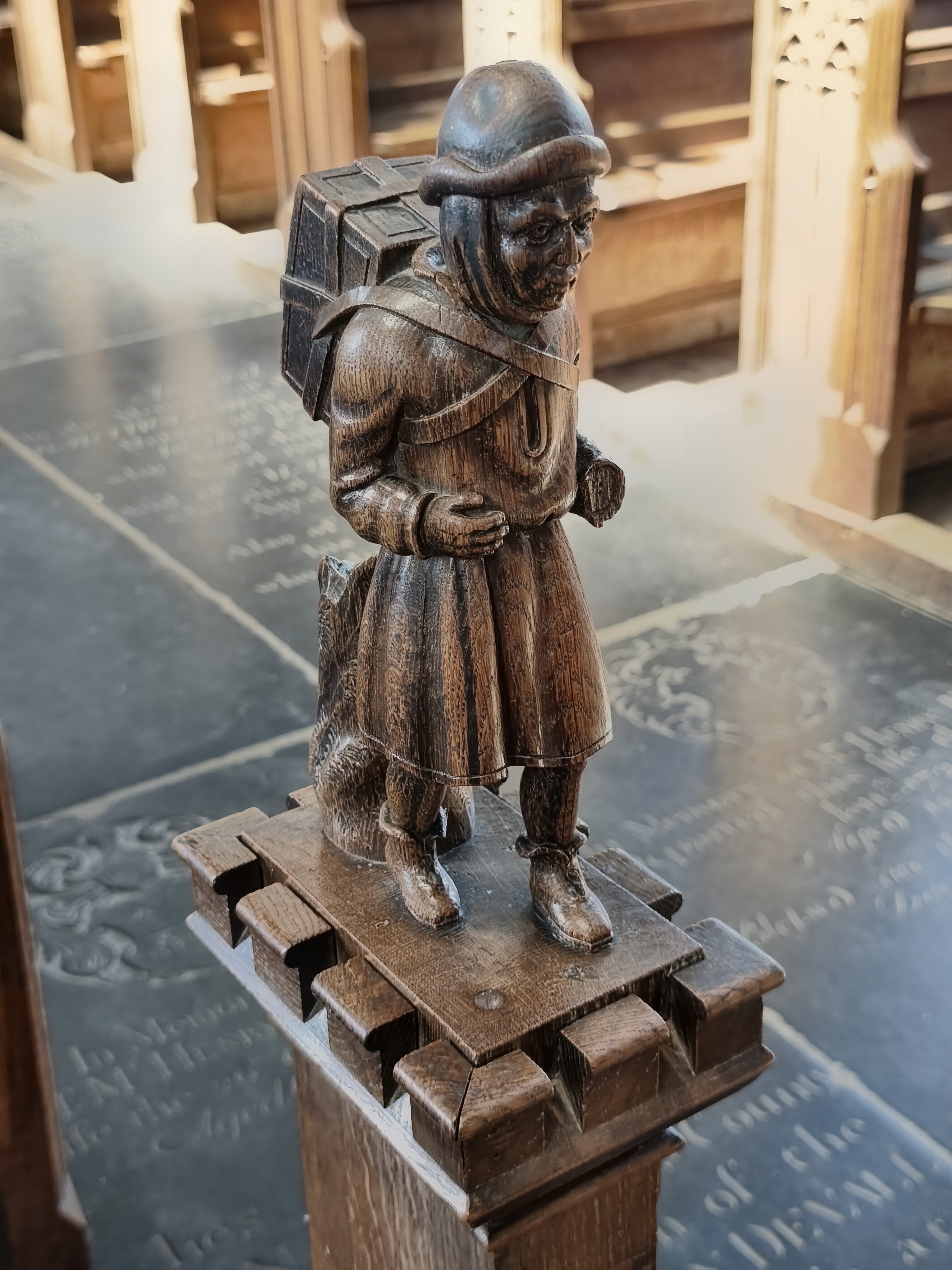
(Image: Pedlar of Swaffham bench end. Source: E.Holohan 2026)

The dream was so vivid that it felt completely real. A man appeared to him over and over again, telling him that if he travelled to London Bridge and stood there, he would hear something that would lead him to his fortune.

When he woke the dream stayed with him. He tried to put it out of his mind, but it kept returning. The next day he thought about it again. Then the day after that. The more he tried to ignore it, the more it seemed to pop into his head.

Eventually he could stand it no longer.

“I have to go to London Bridge,” he told his wife.

She thought the whole idea sounded preposterous, but she could see he had made up his mind. If travelling all that way would finally put the dream to rest, then she was not going to stop him.

So John packed a few clothes and some food for the journey, called to his faithful dog, and set off on the long road to London.

After many days of walking he finally arrived in the hustle and bustle of the great city. Before long he found London Bridge, but it was nothing like the bridge we know today. In those days it was lined with houses and shops, with people living and working all along it. It was one of the busiest places in England.

John found a place to stand and waited.

He watched everyone who passed, listening carefully to every conversation. Surely someone would say the words he had travelled all this way to hear.

One day passed. Then another. Still nothing happened.

On the third day a shopkeeper noticed him and asked why he had been standing on the bridge for so long.

John admitted that he was there because of a dream. The shopkeeper just laughed.

“My friend,” he said, “if I believed dreams, I’d be as foolish as you. Only a few nights ago I dreamed I should travel to the home of a man called John Chapman in Swaffham and dig beneath the tree behind his house. According to my dream, I’d find a great treasure there. But you don’t see me rushing off to Norfolk, do you?”
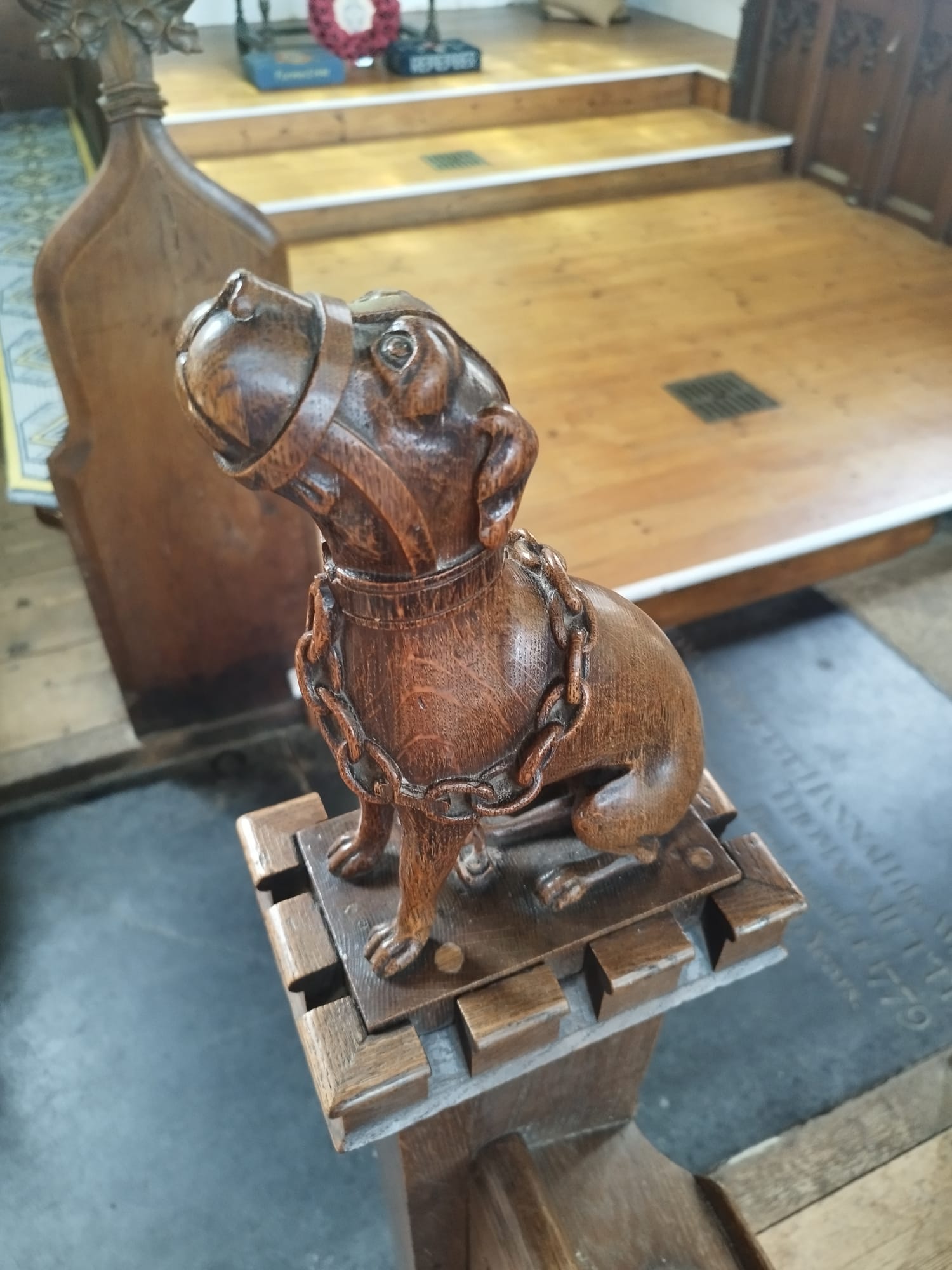
(Image: Chapman’s dog. Source: E.Holohan 2026)

The shopkeeper laughed again and went back to his business.

John stood speechless, scarcely believing his own ears. Without wasting another moment, he turned around and began the journey home.

As soon as he reached Swaffham he grabbed a spade and hurried to the apple tree behind his house. He dug as quickly as he could, hardly expecting to find anything, yet still hoping.

Then his spade struck something hard.

He uncovered a chest buried beneath the earth, filled with gold coins. He and his wife were overjoyed. But carved into the lid was an inscription in Latin that neither he nor his wife could understand. He started to worry that this might not be his fortune, but perhaps a curse inscribed. Hoping someone might recognise the words, John placed the chest in his window.

It wasn’t long before some educated young men who knew the language happened to pass by. They read the inscription and translated it.

“Under me doth lie, another much richer than I.”

John didn’t need telling twice.

He returned to the tree and dug even deeper. Soon he pulled up another chest, this one far larger than the first. Inside were coins, jewels and riches beyond anything he had ever imagined.

The pedlar’s fortune had finally been found.

According to the legend, John Chapman became one of Swaffham’s wealthiest men. Grateful for his good fortune, he helped pay for the rebuilding of St Peter and St Paul’s Church.

Whether every detail really happened is impossible to know. Over the centuries, history and folklore have become intertwined.  More than five hundred years later, the pedlar remains a symbol of Swaffham and is immortalised on the town sign. Visitors can still find the carvings said to represent the pedlar and his loyal dog, and his story continues to be told in Swaffham and far beyond.

As I walked from the church, I thought my journey with the Pedlar had come to an end. In reality, it was only just beginning. While researching the Swaffham legend I had come across another story of a prophetic dream and hidden treasure, but this time from a place with a very personal connection to my own life.

It made me wonder whether the Pedlar of Swaffham is just one version of a much older story, one that has travelled across countries and centuries.

That is a journey I’ll be exploring in the next part of this series. 
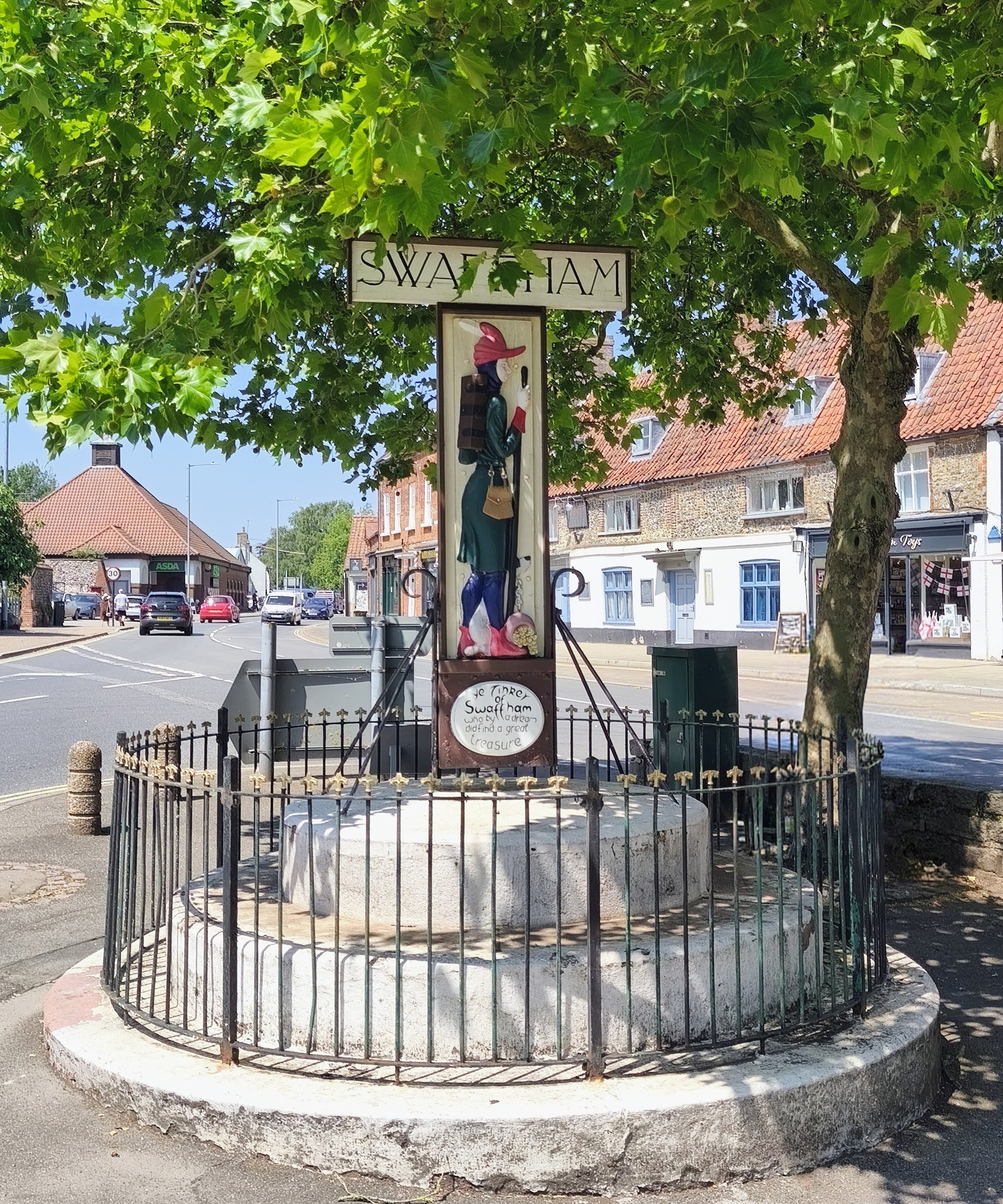
(Image: Swaffham Town Sign. Source: E.Holohan 2026)

Sources

The Phantom Hares of Spring

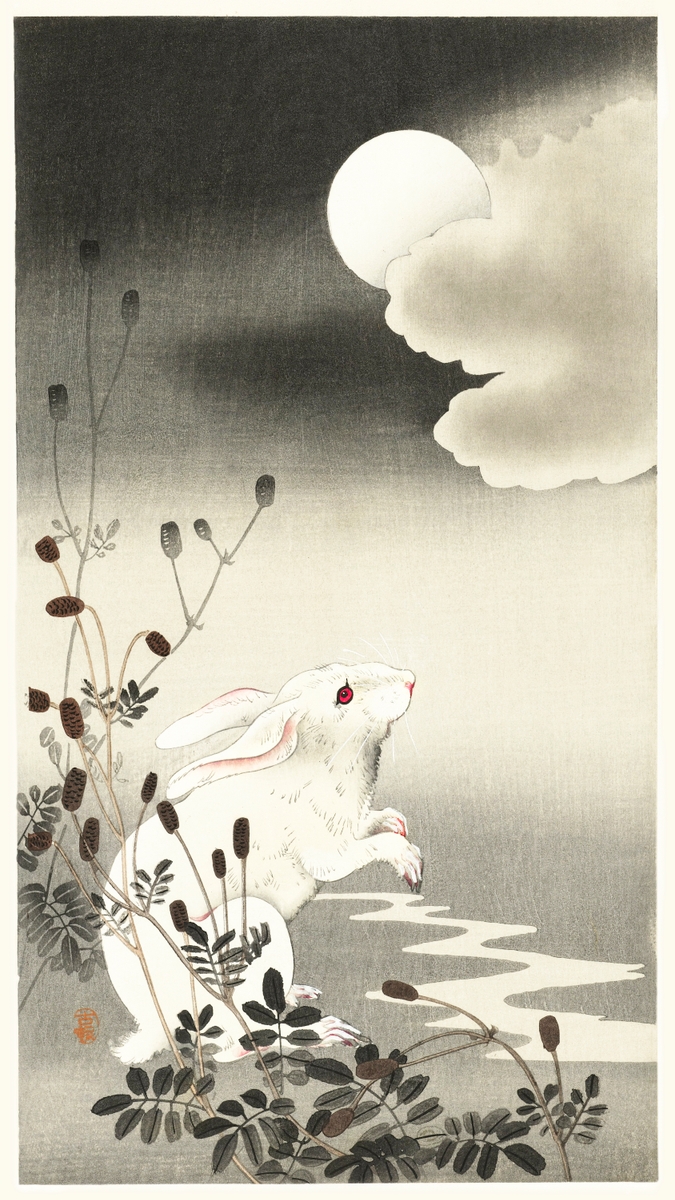
(Image: Rabbit at full moon (1900 – 1930) by Ohara Koson (1877-1945).
Source: The Rijksmuseum. Digitally enhanced by rawpixel.)

On quiet spring evenings, when the light begins to fade into dusk, hares emerge at the edges of fields and lope out from the hedgerows. For centuries, people across Britain and Ireland have watched these mysterious creatures and wondered if what they were seeing was just an animal, or something more.

At Easter, the cheerful Easter bunny visits, bringing us gifts of colourfully wrapped chocolate eggs. Children run in excitement around gardens, peering under hedges and amongst the golden daffodils, looking for these jolly treats left by the benevolent bunny. The Easter Bunny is the soft and fluffy, Victorian popularised version of something much older that has haunted the human imagination since ancient times. The hare bounds out to us from the shadows of Easter folklore as a symbol of renewal, fertility, and spring abundance. Beneath these positive symbols, however, there lies something far darker and much more superstitious. Across Britain and Ireland, we find that stories persist of spectral hares glimpsed from the dark treelines at dusk, tales of long-eared restless spirits still bound to the land, and beliefs that these creatures are portents of ill fortune. From the rugged cliffs of Cornwall to the windswept coastal tracks of Cumbria, these uncanny creatures blend both folklore and haunting.

The White Dobbie of Bardsea, Cumbria

Our first legend takes place on stormy nights on the coastal road between Bardsea and Ramside in Cumbria. Here, local lore tells of a sinister phantom known as “White Dobbie”. This is no kindly household spirit. This is something far more disturbing.  The White Dobbie appears as a gaunt, sorrowful-looking pilgrim with feverish eyes. Running ahead of him is a ghostly-looking scraggy white hare with bloodshot eyes. The mere sight of this ghoulish hare is said to be enough to terrify dogs and cause them to run away howling.

One local tale involving the White Dobbie happened within the sanctity of the church in Bardsea. A female bellringer here witnessed the spectral white hare leaping around the belfry as she tolled the passing bell for a death. The ominous White Dobbie stood next to her, sinisterly whispering, “Who for this time?” The phantom hare then leapt into the Dobbie’s pocket and stared out at her menacingly. The spectres only disappeared when two other people arrived at the belfry, surprising them. However, stories still tell of the Dobbie and the hare making appearances when the passing bell is rung or haunting the coastal roads. Local theories suggest that the Dobbie is the ghost of a murderer doomed to forever wander as punishment for their sin, while the hare contains the restless soul of their unfortunate victim. Cumbria, however, is not the only place where hares take on a more sinister form.

The Bolingbroke Hare, Lincolnshire

We turn our gaze across the country to Bolingbroke Castle in Lincolnshire, which is famously associated with a phantom white hare. In the 17th century, antiquarian Gervase Holles described a hare spirit that frequented the castle and grounds as “a certain truth” known to the local people. Local legend tells us that the hare is a transformed witch who had once been imprisoned at the castle. Historical accounts suggest the ghostly hare would leap over people or run between their legs, while any dogs sent after it would return to their owner crying. The spectral hare was frequently hunted by hounds, but could never be caught. Even to this day, some claim that the hare can be seen in the area during March, a month often linked with hares in folklore.

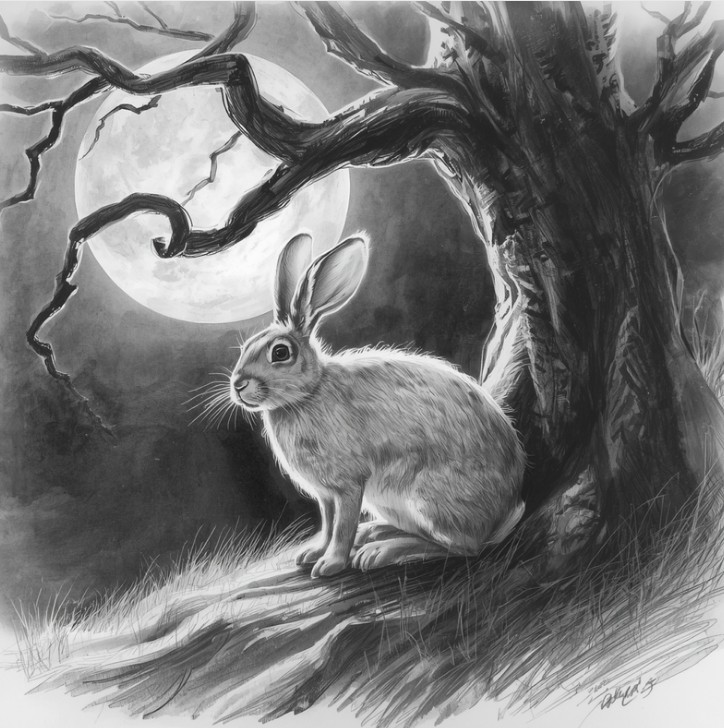
(Image: Hare at night. Source: Canva 2026)

Spectral Hares of Cornwall

Cornwall is rich in ghostly hare legends, but one such old traditional Cornish story tells the sad tale of “The Maiden’s Ghost”. A young woman who loved unwisely, died broken hearted after being deceived by her lover. Still forlorn, she is said to haunt her former suitor in the guise of a hare. The phantom hare was said to follow him everywhere, but could not be seen by anyone but him. As with all folklore, there are different versions of the tale. While the spectral hare sometimes saves her betrayer’s life, the haunting ultimately leads to his doom.

The “White Hare of Looe” is one fine example of the Maiden’s Ghost. The white hare here is a ghostly apparition that is said to be the spirit of a girl who took her own life after being jilted by a local man. The hare is said to roam the road between Talland Bay and one of the oldest pubs in Looe, The Jolly Sailor.

According to tradition, the white hare is the ghost of a girl called Sarah who fell head over heels in love with a local lad. Sadly, that local lad was handsome, easily bored, and had a roving eye. Despite promising to marry Sarah, he called off the wedding as he had fallen for the barmaid of the Jolly Sailor. This was too much for Sarah to bear, and stricken with heartbreak, she took her own life.

Sarah’s grief was too strong and extended beyond death, as her spirit returned in the form of a ghostly white hare. The apparition haunted the old road, and she would follow her former lover to and from the pub.

The hare would sometimes appear in front of her ex-lover and his new lady, and he began to suspect that the hare was much more than a curious living animal. The hare would gaze at him with sorrowful eyes, and guilt and shame weighed on him. After a time, the lad became sick and died from an unknown illness. Since then, it is said that meeting a white hare in this region may bring bad luck, misfortune, and sometimes death. Just imagine walking along that coastal road at night and catching a glimpse of something white moving ahead of you…

Shapeshifting, Otherworldly Beings

Hares lead a shadowy existence, preferring to feed in the fading light of dusk or at night, which lends a natural air of mystery to them as animals. The ancient Celts, for example, revered them as sacred creatures that were connected to divination and the otherworld.  Hares roam on the periphery of our vision and between the boundaries of day and night. Perhaps that’s why they are sometimes viewed as liminal beings, creatures that exist in the boundary between this world and the otherworld. This makes them ideal animals for ghost stories as they travel easily through the night, passing through the veil.

These curious creatures are also famous in northern European folklore as being one of the most common disguises of witches.  In the past, it was widely believed that witches could shapeshift by transforming into animals, especially hares, so they could roam the countryside unseen. Some historical court records even highlight this belief, for example, at the trial of Julian Cox in 1663, where witnesses claimed to have seen a hare disappear only to be replaced by a woman. Another recurring theme in shapeshifting stories involves hunters wounding a fleeing hare, only to later find a local woman with an identical wound.  The connection to shapeshifting blurs the line between human and animal, and human and spectral. Does this link to witches, therefore, reinforce hares as a symbol of the supernatural?

Unlike many other animals, hares may more often appear as ghosts and apparitions because of the transition in their status from revered, almost deity creatures, to devilish monsters. Some folklorists note that the gods of one era often become the devils of another. It’s not hard to imagine that hares may have once been seen as divine animals by early peoples, but later became objects of fear, suspicion, and ill omens under new belief systems as new religions took over.

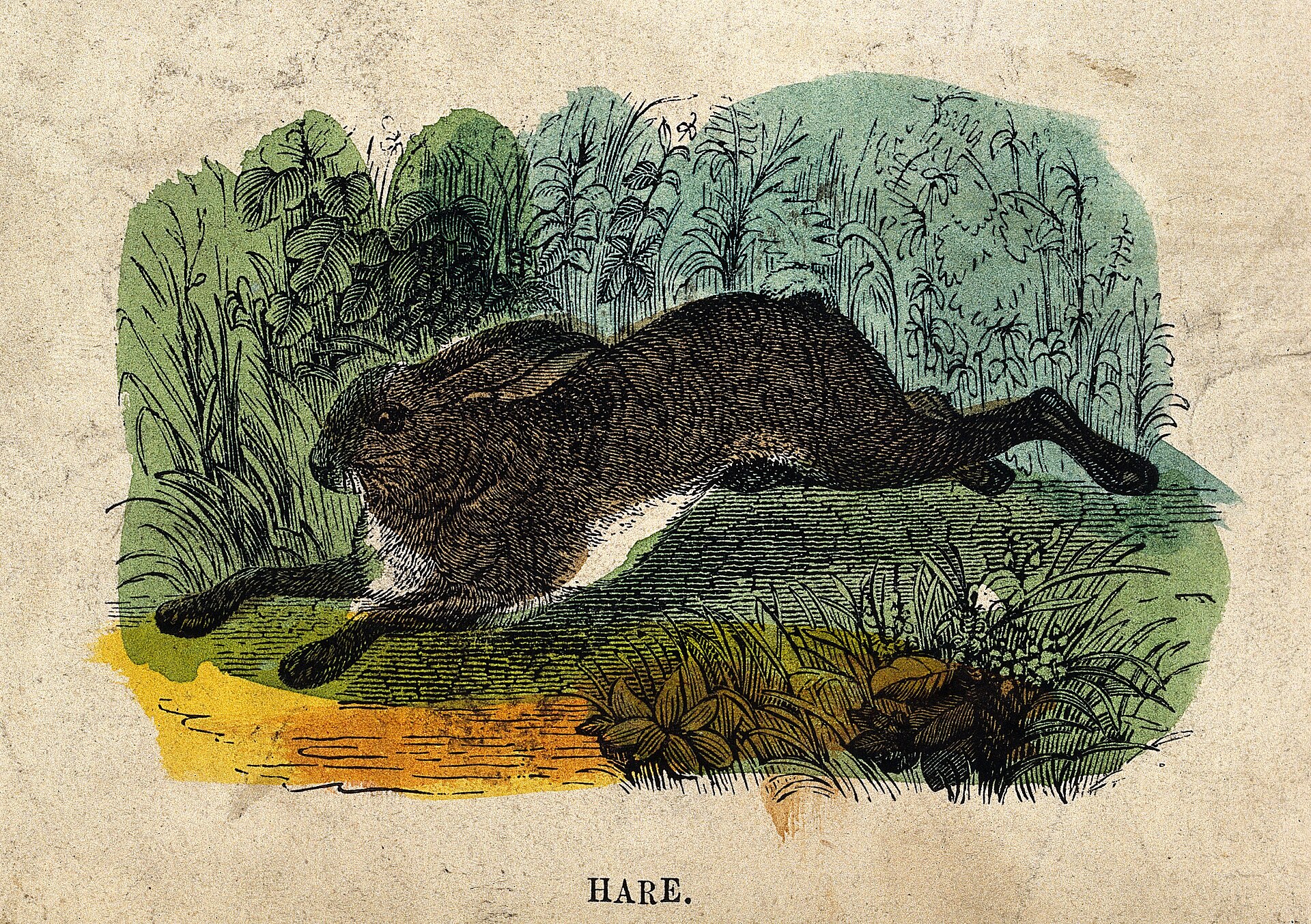
(Image: A hare. Coloured wood engraving. Source: Wellcome Collection gallery 2018-03-22)

Phantom hares are sometimes believed to contain the souls of the dead. In the Bardsea legend, for example, the white hare was thought to hold the unquiet spirit of the murdered victim. They are also seen as omens of tragedy, as their appearance in folklore is often a warning of a fatal accident or approaching storm. Rather than just a common animal ghost, this makes them a source of omens and portents. It was considered especially unlucky to see white hares at the turn of the 19th century, as they were believed to foretell misfortune or doom to the onlooker.

No Ordinary Animal

Hares have always existed on the edge of things. They move between the boundaries between field and woodland, day and night, and the familiar and the unknown.  It is therefore no surprise that folklore places them between two worlds as well: part animal, part spirit, and sometimes even containing a human’s soul.

From melancholy ghost stories in Cornwall to ominous sightings on quiet Cumbrian roads, these creatures carry more than just the symbolism of spring with them. They encapsulate something older and something less simple to explain. They bring unease and a feeling that not everything we see in the gloaming belongs entirely to this world. If you happen to catch sight of one at dusk, and see it watching back, you might hesitate and wonder whether you’ve seen just an ordinary animal, or something more.


Reference list

Dead Maids Crossroads: Duels, Dogs and Dark Folklore in Wiltshire

A tale of jealousy, violence, and a spectral hound.

(Image: Dead Maids Junction on the A36. Source: Maurice Pullin 2008)

Some place names are scenic. Others are puzzling. And then there are those that stop you mid-journey.

“Dead Maids.”

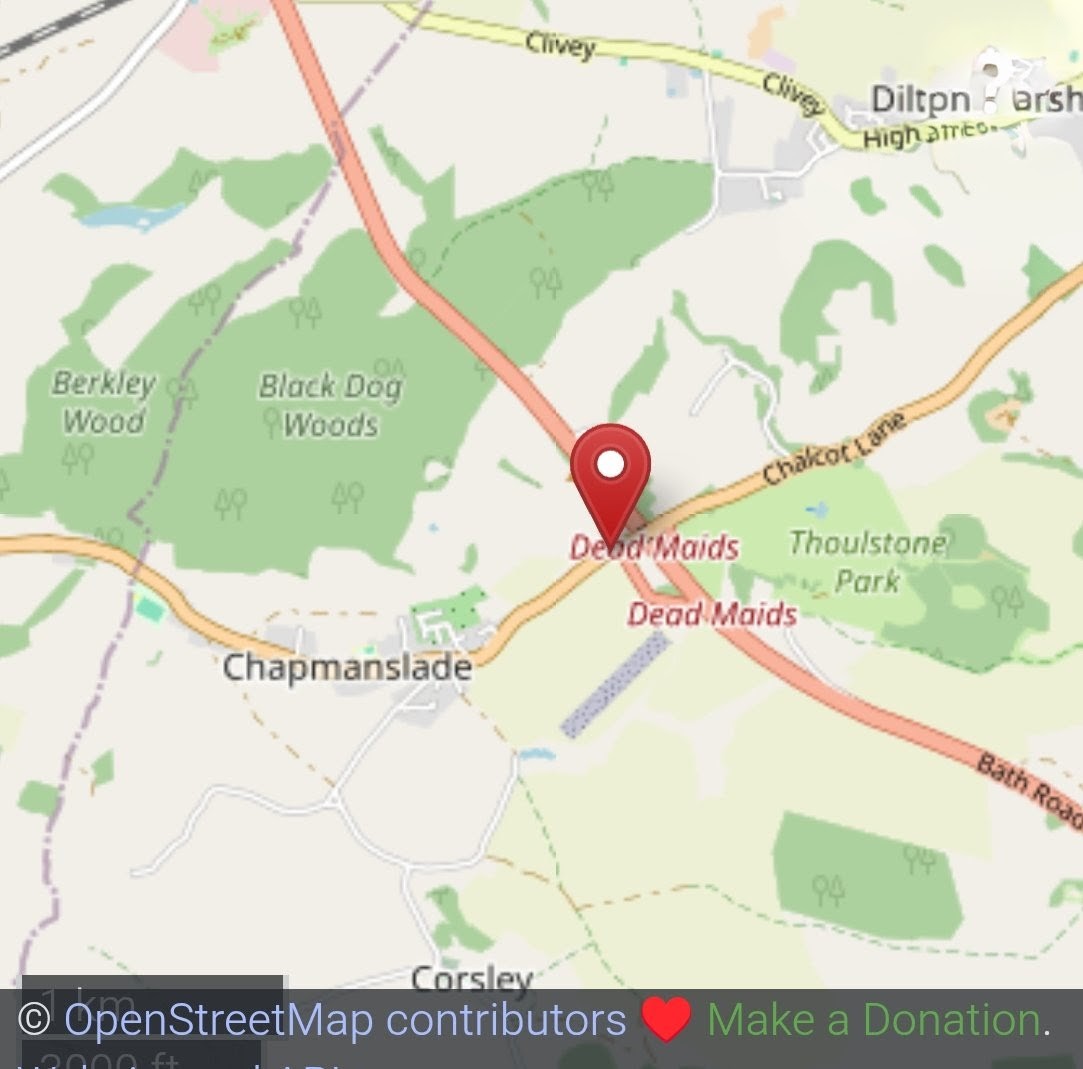
I first noticed the name while travelling through the quiet Wiltshire countryside near Salisbury, at a crossroads on the A36. Surrounded by rolling fields and woodland, nothing about the landscape seems sinister at first glance. Yet names like Dead Maids Crossroads, Black Dog Woods, and Black Dog Hill suggest something darker beneath the surface: a story rooted in violence, grief, and restless spirits.

In this stretch of countryside between Warminster and Bath, folklore seems to cling to the hedgerows, and the veil between history and haunting feels unnervingly thin.

A Duel at Dawn

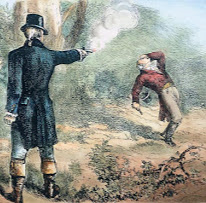
(Image: A Duel. Source: Historia de las Armas de Fuego 2015)

The most widespread legend of the area at Chapmanslade and Dilton Marsh is linked to the crossroads, known as “Dead Maids”. Local folklore tells of a farmer’s daughter, perhaps from what is now called “Dead Maids Farm”, who found herself in a love triangle, pursued by two eligible suitors between the late eighteenth and early nineteenth centuries. Initially, neither man knew of the other, and the farmer’s daughter enjoyed the affections of both for a time. Inevitably, this deception was unmasked, and the men quarrelled over who should win the hand of the girl in marriage. The girl could not choose between them, and it was agreed that a duel would decide the issue once and for all.

At dawn, the two suitors faced one another on a windswept hill while the faithful black dog of one of the men quietly watched on. The pistols were fired, and one of the men fell, shot through and killed instantly. As he fell, his trusty dog, driven by despair, exacted immediate justice on the apparent victor of the duel. The beast, desperate to avenge his master, savaged the victor and tore out his throat before vanishing into the dense, shadowed woods: never to be seen alive again.

Buried at the Crossroads

After the duel, the farmer’s daughter, grief-stricken and distraught at the violence she had incited, tragically took her own life. In those days, people who had ended their own lives were denied burial in consecrated ground, sometimes being interred at parish boundaries or crossroads. The multiple directions of crossroads were believed to confuse any troubled spirit, preventing it from rising and finding its way back to haunt the living.

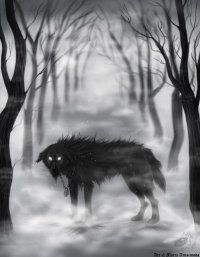
It is from this tragedy that the crossroads got its name, and it is said that the unfortunate dog later died of grief in those same woods, now named “Black Dog Woods”, and haunts them even to this day.

(Image: Map of Black Dog Wood & Dead Maids. Source: OpenStreetMap 2025)

The Black Dog of the Hill

Yet the tale of the duel and the grieving dog is not the only explanation for the name “Black Dog Hill”. Some claim it was the very hill where the sad duel was fought, but others tell the tale of a dastardly highwayman who hid in the shadows here. Before the A36 was straightened in the 1970s, the road here used to twist and turn up the hill. These sharp bends provided ideal cover for highwaymen.

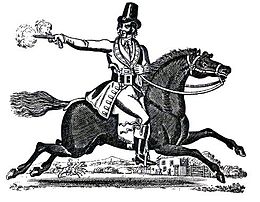
One particular rogue would lie in wait in the darkness with his companion, a large, highly trained black dog. As a stagecoach slowed down to navigate the bend, the beast would leap onto the vehicle and sink its teeth into the driver’s neck, bringing the coach to a halt. While the carriage was at a standstill, the highwayman would rob the passengers with little resistance.

(Image: A Highwayman. Souce: Wikimedia Commons 2008)

One day, however, the highwayman’s reign of fear was cut short when he was eventually shot dead. The fate of his trusty canine accomplice remains a mystery, but there are those who say Black Dog Hill is now haunted by a spectral black hound.

Whether born from tragedy at dawn or the violence of highway robbery, the black dog lingers here in local memory. Perhaps it is merely the human need to impose meaning on cruel twists of fate such as these. Or perhaps something older moves through these woods after dark.

Today, traffic passes quickly over Dead Maids Crossroads. Drivers rarely slow, and few know the stories attached to the name on the signpost. But folklore has a way of outlasting roads, maps, and modern scepticism.

And if you find yourself travelling that stretch at dusk, you might glance towards the treeline.
Just in case something dark and doglike is watching from the shadows.

(Image: Black Dog. Source: Maria Anisimoba 2012)

Sources

Punkie Night: Somerset’s Lantern Festival and Its Connection to Halloween, Samhain & Púca Night

Light flickering in the Autumn Dark

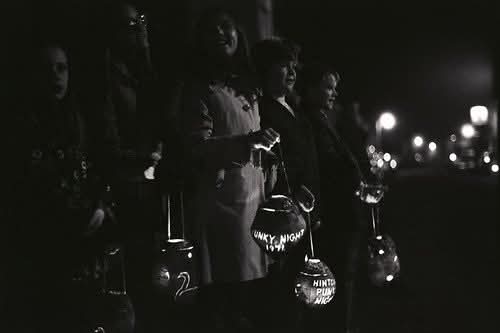
When the October sky over Somerset turns a bruised purple and the moon hangs low, the village streets spring to life with a glow that feels both ancient and mischievous. Children clutch glowing carved lanterns, their faces lit by flickering candles, while the air fills with a chant that has echoed through the countryside for generations:

“It’s Punkie Night tonight… Give us a candle, give us a light…”

(Image: Punkie Lanterns. Source: Punkie Night/Facebook)

This eerie procession, known as Punkie Night, is more than a quirky local festival; it is a living link to centuries-old customs that once guided lost souls, kept wandering malevolent spirits at bay, and turned the darkness of early winter into a community celebration. Here we’ll uncover the origins of the “punkie” lantern, trace the folklore from 19th‑century Somerset to the Celtic “Púca Night,” and explore how this regional tradition mirrors the modern Halloween rituals we know today.

What Exactly is Punkie Night?

Punkie Night is a lantern festival peculiar to Somerset, celebrated in villages such as Hinton St George. It takes place on the last Thursday of October every year.

The word “punkie” in Punkie Night originates from a local name for a lantern, with possible connections to “pumpkin,” “punky” (a term for a young child’s ghost), or the Old English word “punk” (timber or tinder).

On Punkie Night, local people carve glowing lanterns from ‘mangelwurzels’, a type of large beetroot grown for cattle feed. Once carved and lit from within by candles, these ‘punkies’ are carried through the street by children and adults alike, often wearing costumes. Traditionally, the punkies are borne through the streets or door to door in a noisy parade, where those carrying them call for treats or candles to light their lanterns, singing:

(Image: Magelwurzels. Source: Punkie Night/Facebook)

“It’s Punkie Night tonight,
It’s Punkie Night tonight,
Give us a candle, give us a light,
If you don’t, you’ll get a fright.

It’s Punkie Night tonight,
Adam and Eve wouldn’t believe,
It’s Punkie Night tonight.”

Iona Opie and Peter Opie described this Somerset custom beautifully in The Lore and Language of Schoolchildren (Oxford University Press, 1987):

“To children in south Somerset a punkie is a home-made mangel-wurzel lantern of more artistic manufacture than those commonly made elsewhere for Hallowe’en. Laboriously executed designs, or floral patterns, or even scenes with houses, horses, dogs, or ships, are cut on the surface of the mangels, so that when the flesh has been carefully scooped out—leaving just a quarter of an inch to support the skin—and the stump of a candle has been lighted within, the designs become transparencies, and the lanterns ‘glow in the dark with a warm golden light’. These lanterns (reported from Long Sutton and Hinton St. George) are carried by a loop of string secured through two holes near the top just beneath the lid of the lantern. At Hinton St. George, where Punkie Night is the fourth Thursday in October, some sixty children come out into the street with their lanterns, and parade through the village in rival bands, calling at houses and singing.”

A Tale of Lost Men and Heroic Wives

According to local lore, Punkie Night can be traced back to when a group of Hinton St George men ventured to the nearby Chiselborough Fair in the early 1800s. The men spent their time at the fair drinking and carousing, and when they tried to return home after night fell, they soon lost their way. Although their village was only a few miles away, they became lost in the darkness without lanterns to light their path and were unable to find their way home.

(Image: Punkie Parade. Source: Punkie Night/Facebook)

Their wives back in Hinton St George were distraught with worry and carved makeshift lanterns from mangelwurzels and took to the streets in search of their wayward husbands. Some say that when the men first spotted the light from the women’s lanterns glowing in the darkness, they mistook them for will o’ the wisps, or even restless spirits, and ran away in terror. Once they realised the flickering punkies were held by their heroic wives, they were soon guided home to safety.

Older Roots of Punkie Night and Shared Traditions

Punkie Night was first recorded in the 19th Century but may have much older roots. In Ireland, there is a Celtic celebration called “Púca Night” which has Otherworldly connections. Here, Púca refers to fairies and sprites, which were not necessarily clearly delineated ideas from ghosts and spirits in Irish folklore. Similar to Samhain, Halloween, and Punkie Night, the veil between the world of the living and the dead is believed to thin at this time. Lanterns were said to guide lost souls back to their homes and also ward off the spirits of the dead who would roam the land of the living during this liminal period.

In these traditions, there is also the shared custom of children and adults going door to door ‘souling’ to ask for something. In Púca Night and Halloween, children ask for sweets and candy, and on Punkie Night, a candle for their punkie was requested.

Both Punkie Night and Halloween also feature chanting or singing to request these gifts. In Punkie Night, children sing their traditional Punkie Night song, while modern trick or treaters might chant the popular naughty rhyme:

“Trick or treat,
Smell my feet,
Give me something good to eat!
If you don’t, I don’t care –
I’ll pull down your underwear!”

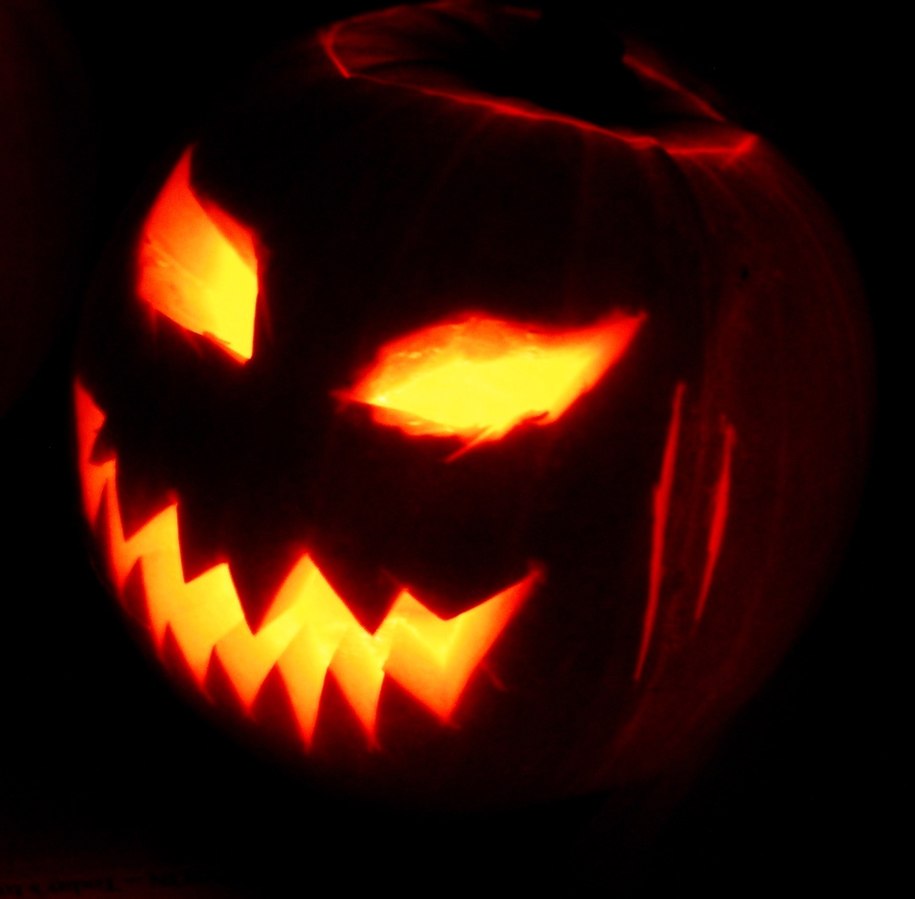
(Image: Jack-O-Latern. Source: Toby Ord, CC BY-SA 2.5, via Wikimedia Commons)

The carving of faces in punkies also has similarities to the customs of Samhain and modern Halloween. Scary faces were carved into turnip lanterns on Samhain and were placed in windows or carried outside to deter evil spirits. This has been adopted into modern Halloween traditions with carved pumpkin jack-o-lanterns being placed on window sills and on doorsteps.

These celebrations all incorporated themes of darkness, spirits of the dead, and the turning of the year. They belong to the season when the nights draw in, the harvest has ended, and people once believed that the dead and otherworldly spirits walked the earth. In this respect, Punkie Night can be seen as a regional English counterpart to Púca Night, Samhain, and Halloween. It is a survival of the same autumnal fears, folklore, and festivities that people experience at this time of year, but shaped by Somerset’s rhythms and spirit.

Why Punkie Night Endures

Punkie Night endures, weaving together folklore, community, and the timeless human fascination with light in the dark. From the crude lanterns carved by anxious wives in the 1800s to the elaborate mangelwurzel “punkies” paraded by today’s children, the festival captures a uniquely Somerset spirit while reflecting broader autumnal rites such as Samhain, Púca Night, and contemporary trick‑or‑treating. By preserving this tradition, the village of Hinton St George keep alive a story that celebrates resilience, imagination, and the comforting glow of shared history, proving that even as the nights grow longer, the light of community burns ever brighter.


Reference list

Old Man’s Day: Sweeping Up the Past

(Photo by u041 on Pexels.com)

Celebrate Old Man’s Day in Braughing!

Did you know that today, 2nd October, is “Old Man’s Day”? If you happen to be wandering through the Hertfordshire village of Braughing, you’re in for a treat! This day is a curious celebration filled with history, laughter, and a strong sense of community.

The tale begins with Mathew Wall, a young local farmer who, back in 1571, was mistakenly thought to be dead. Imagine this: a solemn procession making its way down Fleece Lane, with Mathew’s coffin being carried by pallbearers. Suddenly, one of the pallbearers slips on a fallen leaf, and the coffin clatters to the ground. To everyone’s shock, Mathew was very much alive, having been in a deep narcoleptic sleep or perhaps a coma. Imagine the relief and joy as he stood up from his coffin, ready to live another 24 years! He even went on to marry his sweetheart and start a family.

In gratitude for his miraculous second chance at life, Mathew made some unusual requests in his will, which the village still continues to honour today. One of these traditions is the sweeping of Fleece Lane. Local schoolchildren, with brooms and brushes in hand, come together to clear the leaves, giggling and chatting as they work away. They’re rewarded for their efforts with sweets, which makes the task all the more fun!

After the lane is swept, the children gather around Mathew Wall’s grave, where they sing songs and recite prayers. The church bells toll, creating an atmosphere of remembrance and celebration. It’s a heartwarming scene, filled with laughter and joy, as families and friends come together to honour this remarkable story.

Old Man’s Day is more than just a unique tradition; it’s a cherished part of Braughing’s community spirit. Local residents often swap nostalgic stories about their own childhood experiences of the day and how they joined in the festivities. It’s a lovely way to connect with the past and keep Mathew’s memory alive.

So, if you find yourself in Braughing on 2nd October, don’t miss out on the fun! Join in the celebrations and share a laugh with the locals. You’ll leave with a smile and perhaps a few sweets, too!


Sources

Jack in the Green: Keeping Folk Traditions Alive in Bristol

A Springtime Wander into Another World

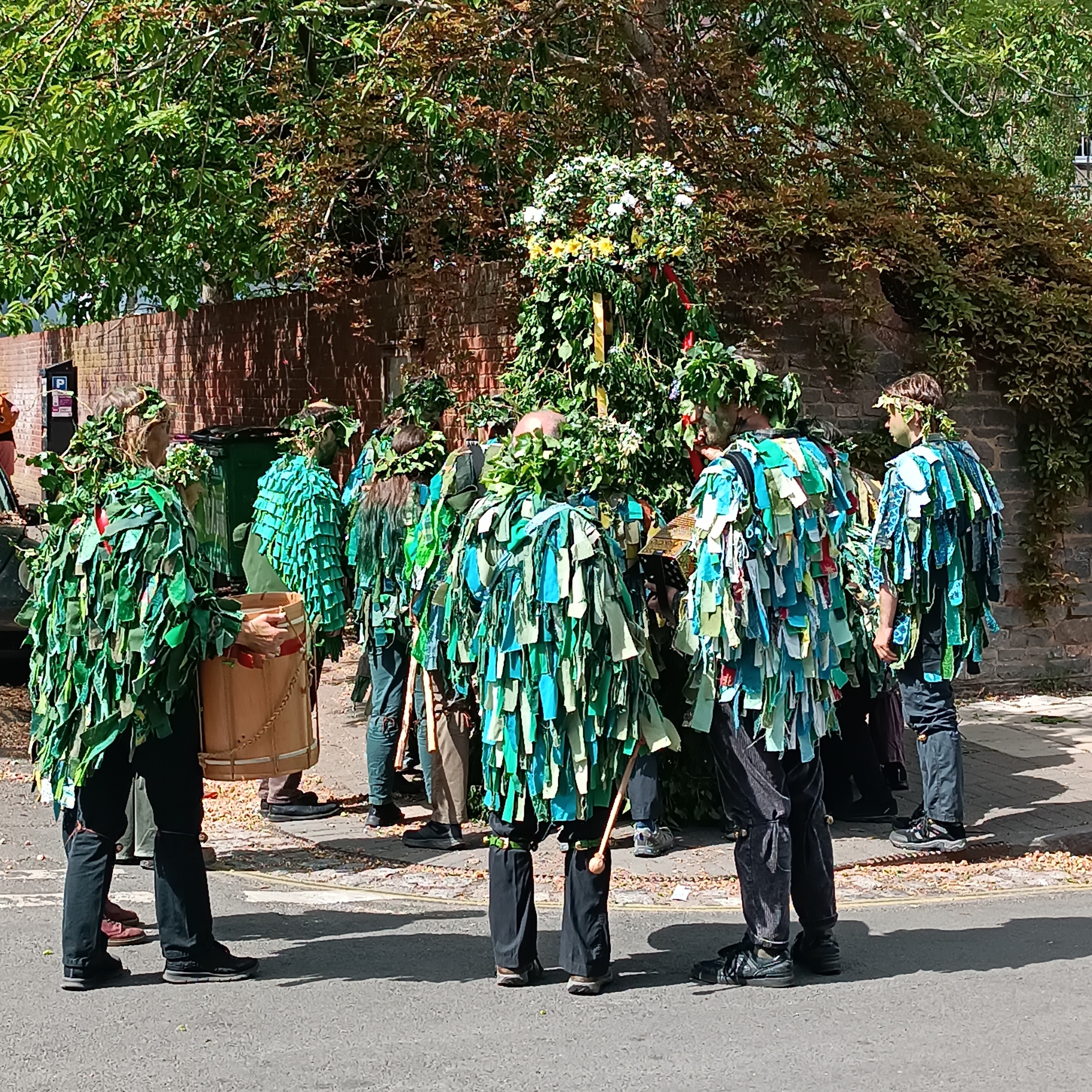
This May, I found myself caught up in something a little bit more magical than normal. I had just popped out for a walk into town when I heard the distant rattle of drums and the jingle of bells coming up the hill. Within moments, a leafy figure emerged around the corner; towering, green, and utterly hypnotic. Behind him came dancers, musicians, people in leafy crowns and cloaks, dogs wearing garlands, children skipping to the beat.

(Image: Bristol Jack in the Green. Source: ©E.Holohan 2025)

This was an encounter with the fascinating character, Jack in the Green. It passed right through my neighbourhood in Bristol, and for a while it felt like the city had been transported into a more ancient, greener version of itself.

There is something about this May festival that pulls at something deeper. In a world full of deadlines and distractions, encountering a celebration like this, which is full of colour, laughter, and ancient spirit, feels like stepping through a portal into another time.

So, what exactly is Jack in the Green? Where did it come from, and why does it still feel so relevant?

What Is Bristol’s Jack in the Green Festival?

Jack in the Green is a celebration of the coming of summer, rooted in old English folk traditions. It centres around a tall, leafy figure known as the Jack, who is completely clad in greenery. Think walking hedge, with just a hint of face peeking out, crowned in flowers and leaves.

Each year, on the first Saturday in May and around the May Day holiday, the Jack makes his way through parts of Bristol in a lively procession of dancers, drummers, musicians, and revellers all dressed in green.

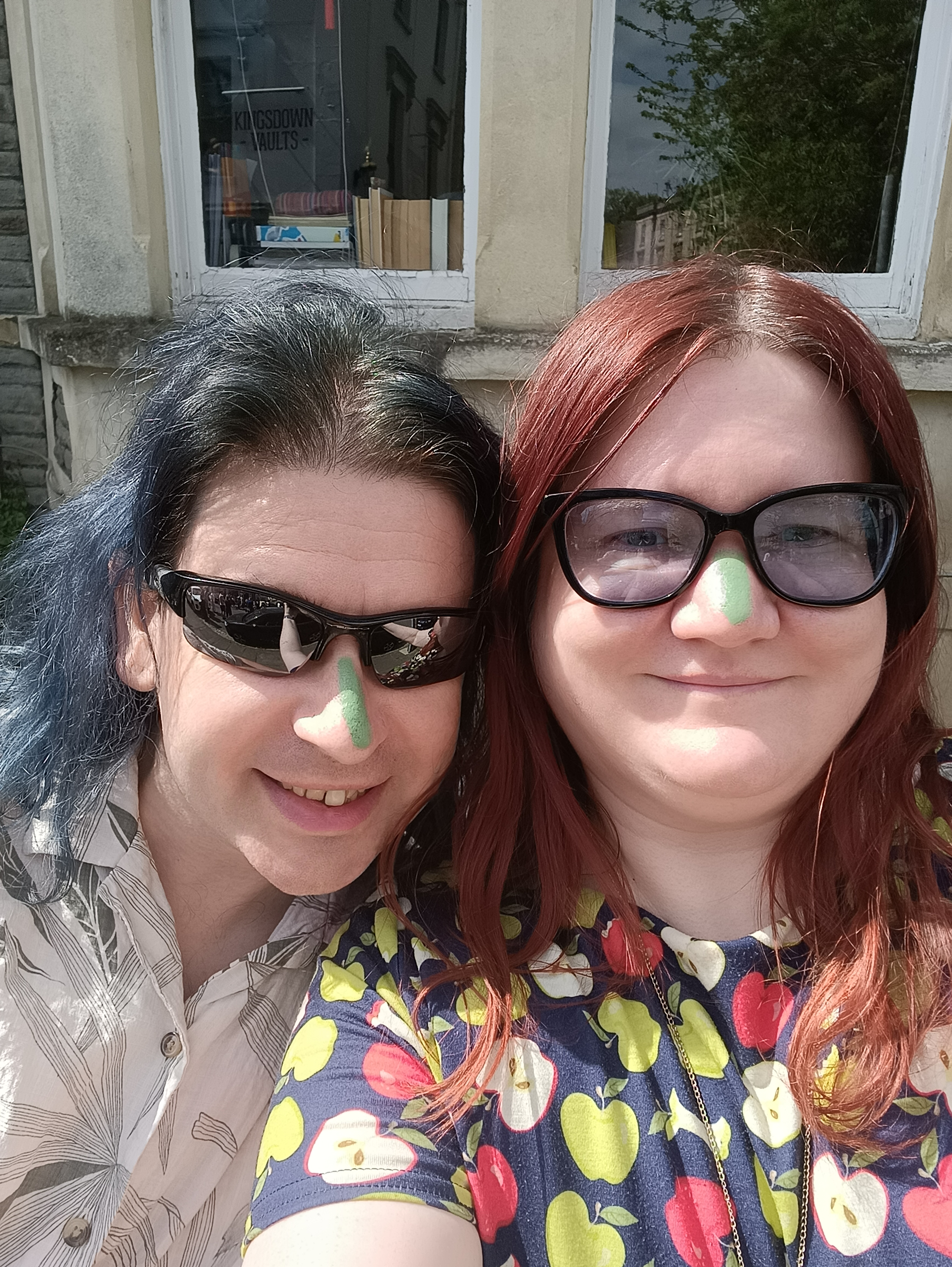
This year, the Jack began at the historic harbourside and the procession made its way through the centre and up via Kingsdown, Cotham and Redland, winding along the streets, picking up curious onlookers as it passed. Jack’s attendants even painted onlookers’ noses green as they passed by, which is said to bring them good luck this summer. I was lucky enough to get myself a green nose too!

Eventually, the parade ended in a local park in Horfield. Here, Jack’s attendants delighted onlookers with dancing and reciting Jack’s poem. Here, sadly, Jack finally died, marking the end of spring and the start of Summer. After dancing through the streets and meeting city folk, Jack brought the Summer to Bristol, but now rests in peace until next year. Finally, onlookers took foliage from Jack’s body for good luck and to celebrate the long-awaited arrival of summer.

This festival is not just something to watch; it’s very much something to join in. People dress up, paint their faces green, bring tambourines or whistles, and dance beside complete strangers. It’s joyful, chaotic, and full of heart. And it belongs to Bristol.

The History of Jack in the Green

Although it feels ancient, Jack in the Green actually has roots in the 18th century. It grew out of May Day traditions among chimney sweeps, milkmaids, and other working-class people in London and elsewhere.

In those days, May Day was one of the rare holidays working people had. Chimney sweeps would parade through the town with music and garlands, collecting money and celebrating the return of warmer days. This served an important function for the sweeps in particular, who would need this money over the summer when they’d have little income. Over time, these garlands evolved into something bigger and bolder: a full figure made of foliage, worn by someone dancing through the crowd.

(Image: The 1795 engraving of a Jack in the Green, London. Source: CC BY-SA 3.0)

By the early 20th century, however, these celebrations had mostly faded. Victorian attitudes were snobbish about anything too rowdy, and folk customs began to disappear in favour of a more sanitised versions of British traditions.

It was not until the 1970s, when there was a broader revival of interest in folk music and traditions, that Jack in the Green began to return. Hastings was one of the first to bring it back in a big way, and other towns and cities, including Bristol, followed their lead.

Here in Bristol, the tradition was revived in the 1990s, thanks to local folk groups and performers who saw value in reclaiming this little piece of seasonal magic. Local groups have helped shape the festival into what it is today; a brilliant blend of history, creativity, and local pride.

Possible Pagan Roots and Green Man Magic

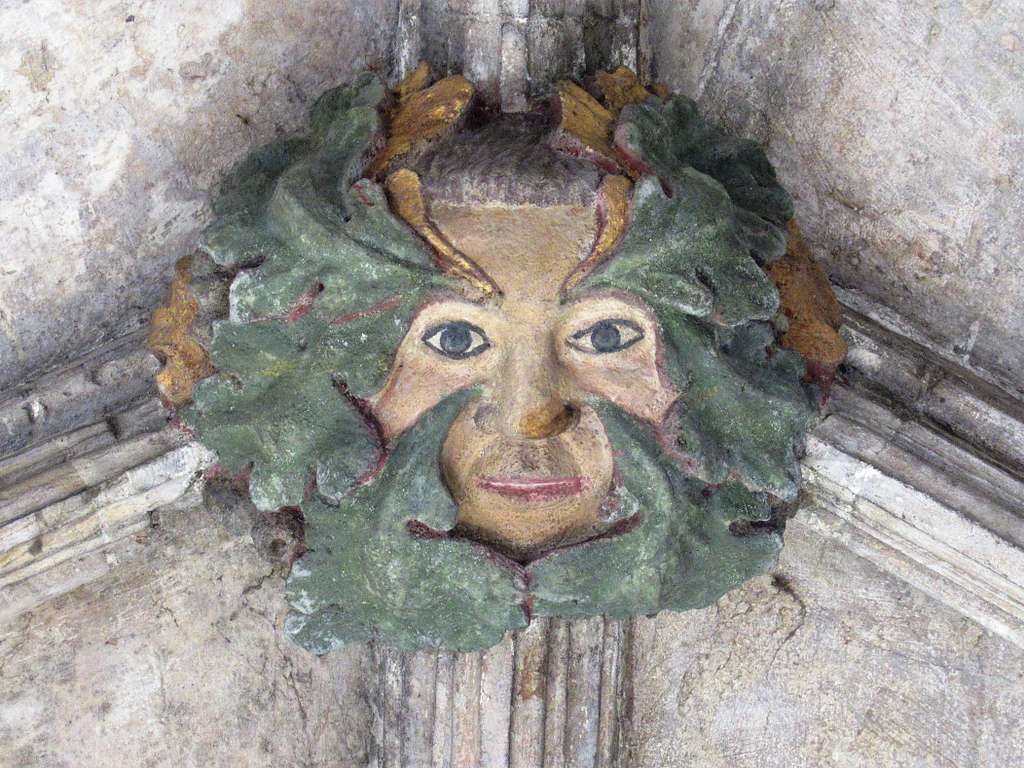
While Jack in the Green as we know it is not thousands of years old, it carries hints of much older beliefs. Many see links to the Green Man, who is a symbol you find carved in stone in churches across Britain and Europe. He is usually depicted as a face surrounded by leaves, often with greenery sprouting from his mouth. The Green Man is a symbol of nature, rebirth, and the never-ending cycle of the seasons.

There is also a strong seasonal connection to Beltane, the old Celtic festival that marks the start of summer. Celebrated around the first of May, Beltane was all about fertility, fire, and celebrating the land waking up after winter. Modern Jack in the Green processions are not direct continuations of those rites, but they certainly share the same spirit of honouring growth, community, and the turning of the year.

(Image: Norwich Cathedral cloisters, roof boss. Source: CC0.1.0 Univeral)

When you see the Jack dancing through the city streets, surrounded by bells and drums, it feels like something ancient stirs. You don’t need to believe in anything mystical to sense it; it’s there in the beat of the drums, the greenery and the joy.

Why We Still Need Jack in the Green

In a time when most of us spend our lives staring at screens, racing from one task to the next, a festival like this offers something rare: connection to place, people and nature. Jack in the Green reminds us of the things we often forget. That the seasons change. That we can share a laugh or a dance with a stranger and feel like we belong.

It brings people together with no barriers; just colour and music, and a shared moment. Children wave at the Jack like he’s a forest giant from a fairytale. Adults clap along and walk around with painted green noses. There’s space for everyone.

Let’s also not forget the symbolism. A figure made entirely of greenery parading through a modern city feels especially meaningful in an age where the natural world is under threat. The Jack becomes more than just a character; he is a reminder of what we stand to lose, and why it’s worth celebrating and protecting.

A Few Thoughts Before the Leaves Fall

As I walked home from my encounter with Jack in the Green with my painted green nose, the sounds of bells and drums fading behind me, I couldn’t help but smile. It wasn’t just about seeing something fun. It was about being part of something. Something old and new, silly and sacred, and wild and gentle all at once.

Bristol’s Jack in the Green is not trying to be trendy. It’s not polished or perfect. But it has a spirit, and in a world that often feels rushed and rootless, that’s exactly what we need more of.

Fancy Joining Next Year?

If you are in or near Bristol come next May, I would wholeheartedly recommend seeking out the Jack. Wear something green. Bring a rattle, a ribbon, or just yourself.

You can find updates from the organisers on: https://www.bristoljack.info/home

These traditions survive when people take part. So, let’s keep them alive because they bring joy, meaning, and magic to our everyday lives.

(Image: Lucky Green Noses. Source: ©E.Holohan 2025)

If you’d like to learn more about Bristol Jack in the Green, please check out the following documentary by Nicola Explores, “Bristol Folklore and Ritual: inside the Jack in the Green May Day Mayhem”


Reference list


Oweynagat Cave and the Irish Origins of Samhain and Halloween

(Neopagans in Ireland celebrating Samhain. Image Credit: Unknown author, CC BY-SA 4.0, via Wikimedia Commons)

Tucked away in the beautiful scenic landscape of County Roscommon, Ireland, lies a mysterious and legendary cave known as “Oweynagat” (pronounced “Oen-na-gat”), also known as ‘Cave of the Cats’. This ancient cave is believed to be the mythical entrance to the Otherworld, Ireland’s Gate to Hell, a supernatural realm in Irish mythology. Oweynagat is one of the most important places linked to the ancient Celtic festival of “Samhain”, the forerunner to the modern Halloween. Steeped in lore and shrouded in mystery, Oweynagat is a powerful symbol of Ireland’s ancient spiritual heritage and the very origins of Halloween.

The Mythology of Oweynagat

Oweynagat is part of Rathcroghan, a major archaeological complex that served as a royal site for the ancient Irish kingdom of Connacht. This area comprises over 250 archaeological features; it is an area surrounded by many ancient sites, monuments, holy wells and standing stones. Rathcroghan is deeply linked to Queen Medb, a famous warrior queen in Irish mythology, and features heavily in stories of the “Ulster Cycle”, one of the four great story cycles of Irish mythology.

(An ogham stone which forms the lintel of Oweynagat Cave. Image Credit: Cathalpeelo, CC BY-SA 4.0, via Wikimed)

Oweynagat is often described in these tales as the “gateway to the Otherworld.” Irish mythology describes the cave as a place where powerful forces of the supernatural were said to reside. During Samhain, it was believed that the veil between the human world and the Otherworld was at its thinnest, allowing spirits, fairies, and other entities to pass through more easily. The cave itself was seen as a physical gateway through which supernatural beings could enter the mortal realm, making it a focal point for rituals and lore featuring Samhain.

One of the most famous legends associated with Oweynagat in relation to Samhain is known as ‘The Adventures of Nera”. One Samhain night, Ailill and Medb, ancient rulers of Rathcroghan, dared anyone to tie a rope around the foot of a captive hanging on a nearby gallows. They promised a reward to anyone who succeeded. Nera, a brave warrior, accepted this challenge. Decked out in his armour, he approached the captive and managed to tie the rope, only for the captive to come to life, asking Nera for a drink as a last request.

Nera agreed and carried the captive on his back to find water. As they passed three houses, each were marked by strange omens such as a lake of fire surrounding one, the captive finally drank from a slop bucket in one of the homes. In a final act of revenge, he spat his last sip on the faces of the house’s occupants, who died instantly. Returning the captive to his execution site, Nera then witnessed a horrifying vision of his home in flames and his people slain by an otherworldly army. When he followed this mysterious army into the underworld of Oweynagat, he found himself before a faery king.

(Underworld Army. Image Credit: Bing AI)

The faery king ordered Nera to bring wood daily to a house within the faery mound, where Nera met and married a faery woman. She shared many of the secrets of the faery world, warning him that his vision of his people’s demise could come true if he didn’t alert them. When Nera finally returned, only moments had passed in the human world despite his long stay in the faery mound.

Ailill and Medb, taking Nera’s warning seriously, prepared to attack the faery mound the next Samhain. Nera returned to his faery wife, who revealed she was pregnant with his child and encouraged him to escape with his family from the faery realm before the attack. He agreed and watched as the men of Connacht destroyed the faery mound, retrieving the powerful Crown of Briun, one of Ireland’s three great treasures.

Nera, however, remained forever tied to the faery world, never to be seen again in the mortal realm. The tale ends with his fate sealed, waiting in the faery mound until the end of time. The cave has since been claimed to be the birthplace of Halloween due to this story being set at Samhain.

(The Morrigan. Image Credit: Nabilsai, 2024)

Another legend relating to the cave at Oweynagat is that it is the home of the Morrígan, a Celtic war goddess who, according to tradition, emerges from the cave each Samhain to bring chaos to the land.  Ailill and Medb’s cats, who were supposed to roam out of Oweynagat on Samhain, are among the other mythological animals connected to the cave. They represent the chaos and the forces of nature that were thought to be let loose on this night.

Samhain: The Roots of Halloween

Samhain celebrations have a long history that predates written records. Samhain heralded the start of the dark of winter and the conclusion of the harvest season for the Celts. It was thought to be observed between October 31st and November 1st, sunset to sunset. Due to it being a transitional period, there was thought to be little separation between this world and the Otherworld. The veil thinned, enabling communication between living people and supernatural entities.

According to legend, Oweynagat cave is thought to become a portal to the otherworld at this time of year, where faeries and mortals may enter each other’s respective worlds. According to folklorist and professor, Dorothy Bray, “Samhain was a time charged with great supernatural energy and ordinary natural laws were suspended. The idea of the otherworld developed into the idea of the afterlife, so Samhain became a time when the worlds of life and death meet, when the souls of the dead return and can be seen.”  


(Offerings to the spirits of the ancestors. Image Credit: ©E.Holohan 2024)

According to local archaeologist and historian, Daniel
Curley, “Monsters and manifestations would emerge, led by the goddess Morríghan,
to create a world ready for winter, including birds with foul breath that would
strip leaves from trees. Locals would stay indoors in fear of being dragged
into the other world when the ghouls had finished ravaging the land. If you had
to go outside you wore a costume and mask to look hideous. That way you would
be left alone and not dragged into the otherworld.”

Feasting, bonfires, and rituals honouring the ancestors were all part of Samhain. People made food and drink offerings outside their homes to calm any wandering spirits who were thought to be free to roam on this night. People sometimes wore frightening masks or costumes to either ward off or blend in with any supernatural creatures that had passed over into our world, and bonfires were lit to guide the way to lost spirits.

From Samhain to Halloween

Many ancient traditions were adapted and reinterpreted to conform to Christianity as it expanded over Ireland. On November 1st, the Church created All Saints’ Day, which is a day to commemorate saints and martyrs. The night before was called All Hallows’ Eve, which later transformed to “Halloween.”

Samhain rituals gave rise to modern Halloween traditions including trick-or-treating, pumpkin carving, and the wearing of spooky costumes. Wearing costumes to ward off any lost spirits gave rise to the Halloween custom of dressing up as monsters, ghosts, or other terrifying creatures. The modern custom of “trick-or-treating,” in which youngsters knock on doors looking for sweet treats, evolved from the habit of leaving out food offerings.

(Jack-O-Latern. Image Credit: Toby Ord, CC BY-SA 2.5, via Wikimedia Commons)

The jack-o’-lantern, another popular Halloween custom, has Irish origins too. In order to ward off evil spirits, people in Ireland used to carve swedes and place candles inside to make glowing lanterns. This custom was carried to America by Irish immigrants in the 19th century, and it eventually developed into the pumpkin lanterns we are accustomed to today

Oweynagat Cave Today

A trip to Oweynagat Cave provides a window into the past for those who are interested in learning more about the Irish origins of Halloween. Although the cave appears to be damp, murky and unassuming, it is simple to see why ancient humans sensed a power in its presence. Visitors may feel the weight of centuries’ worth of history, rituals and legend hanging in the air when they first enter Oweynagat cave.

Today, Halloween is mainly about entertaining costumes, sweets and light-hearted frights. However, Halloween’s origins lie much deeper; it has to do with ancestors, the cycles of nature, and myths surrounding the invisible realm. Oweynagat Cave is a mysterious reminder of the mythical beginnings of this well-known festival, as well as Ireland’s contributions to a festival now observed world over.

It is easy to imagine the ghosts of Rathcroghan’s ancient lands and possibly the cave’s mythical cats emerging from the depths of Oweynagat cave as Samhain draws near, serving as a powerful reminder that the real spirit of Halloween continues to reverberate throughout Ireland’s ancient landscapes.


Reference list