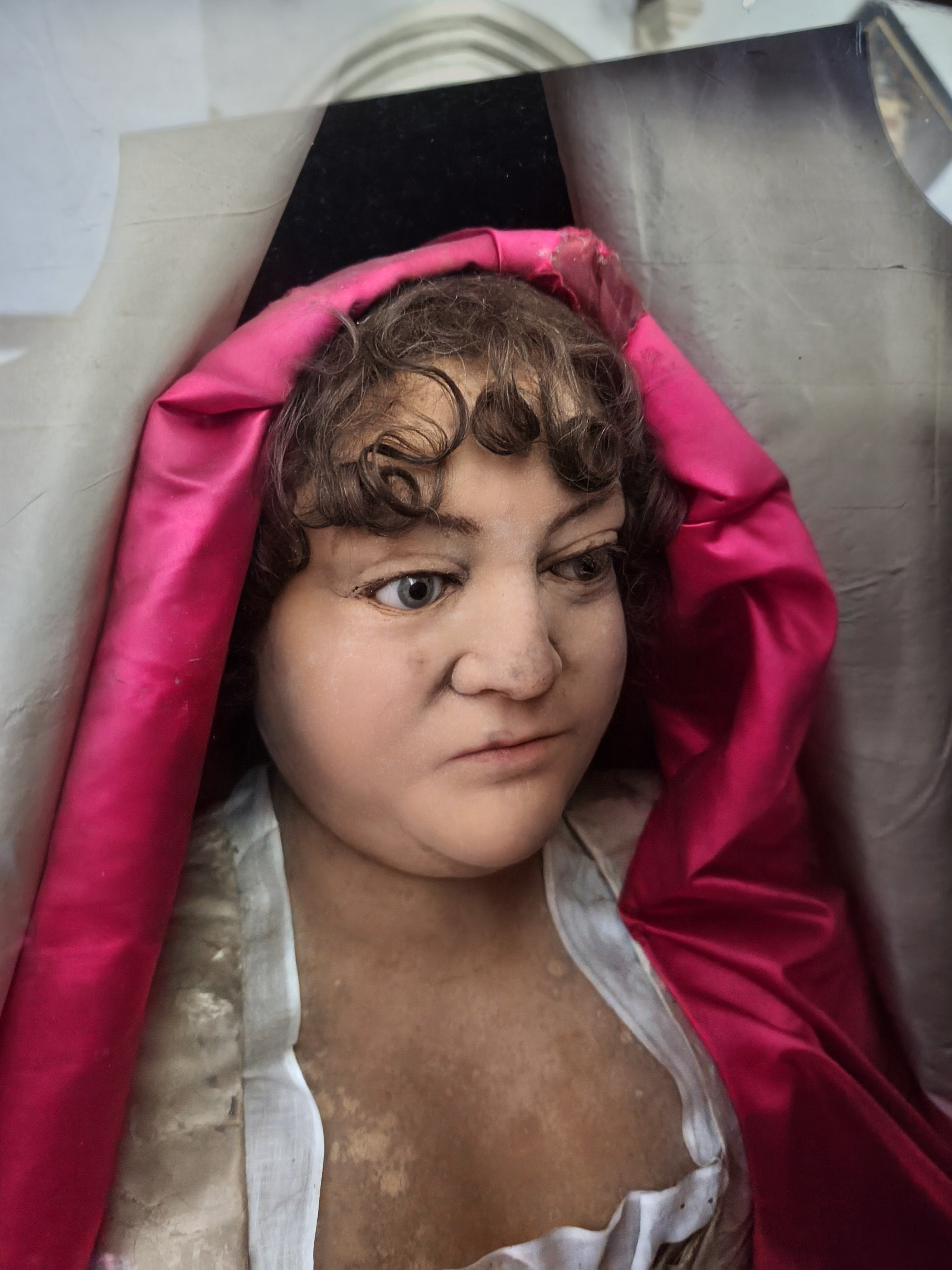
When I was a child, I had a fascination with the strange corners of history, and this, of course, has continued on into adulthood. The books I borrowed from the library were full of ghosts, folklore, unexplained mysteries and curious historical oddities. Among all the photographs that lodged themselves in my imagination, save for the spontaneous human combustion foot photo, one stood out above the rest. It was the wax effigy of Sarah Hare.
I remember being quite unsettled by it. In a time before I’d ever heard the phrase “uncanny valley,” I already knew exactly how it felt. She looked too real to be a statue yet far too lifeless to be a person. I found her slightly repulsive, but I could never quite look away.
So, when I recently found myself in Norfolk, visiting Holy Trinity Church at Stow Bardolph was top of my list. I wanted to see whether the real thing would have the same effect as those childhood photographs. And it absolutely did.
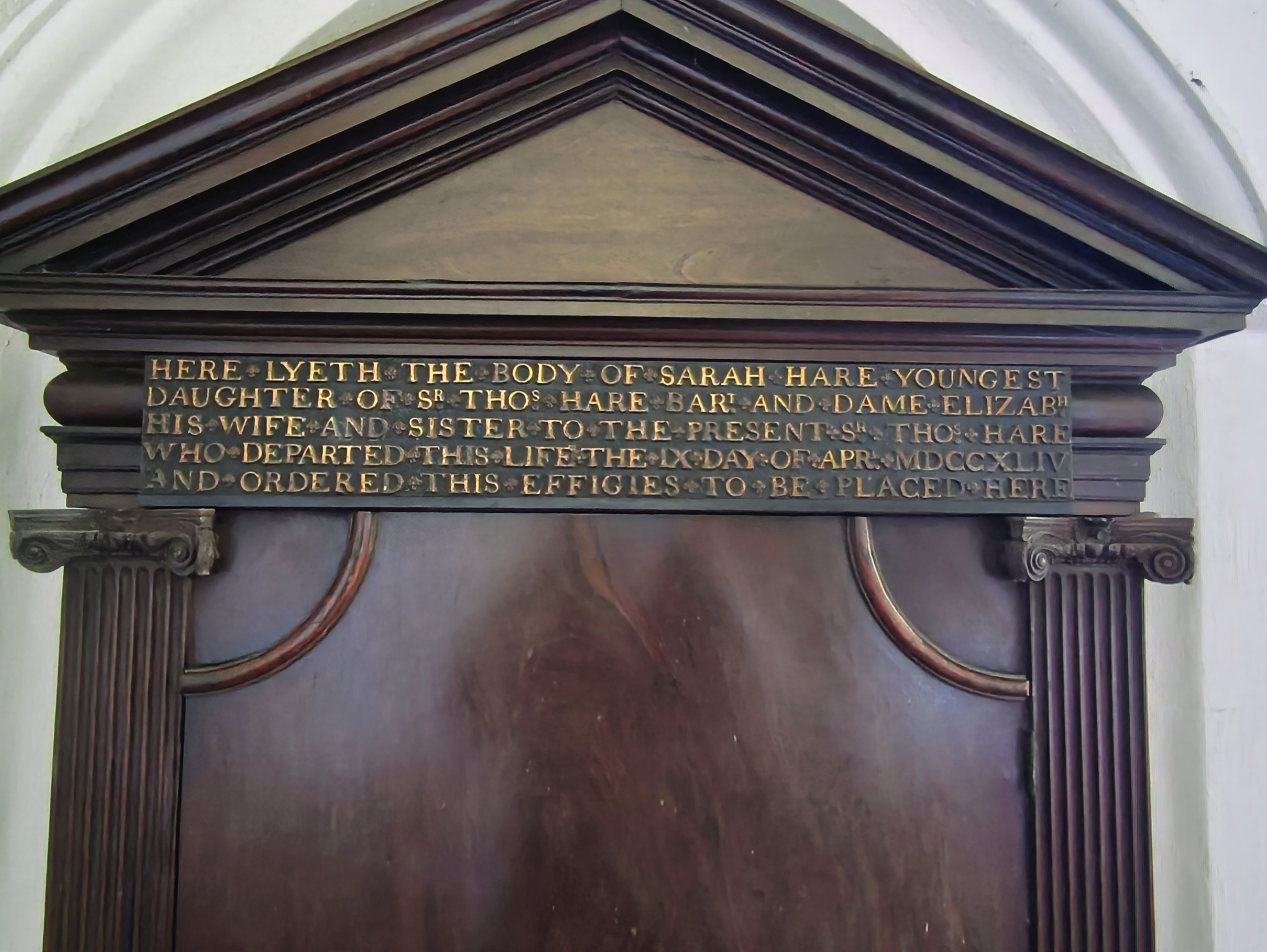
Sarah Hare was the youngest daughter of Sir Thomas Hare of Stow Hall. She never married, so was what was once called a “spinster”, and lived a fairly ordinary life. In 1744, aged 55, she died from blood poisoning after pricking her finger while sewing. Later, locals claimed it was divine punishment for the crime of sewing on a Sunday, although the far more likely explanation is that the wound simply became infected.
The year before her death she wrote a remarkably detailed will. Alongside gifts to the poor of the parish, she made one very unusual request. She wanted her face and hands reproduced in wax, her own hair placed upon her head, and the finished effigy displayed in a mahogany cabinet with a glass front close to where she was buried.
She wrote: “I desire to have my face and hands made in wax with a piece of crimson satin thrown like a garment in a picture, hair upon my head and put in a case of Mahogany with a glass before and fix’d up so near the place were my corps lyes as it can be with my name and time of death put upon the case in any manner most desirable…“
If she did not arrange it during her lifetime, she instructed that it should be done after her death. Her family honoured those wishes. If you don’t ask, you don’t get, I suppose. And oh boy, did she get.
Today visitors to the Hare family mausoleum find a plain mahogany cabinet tucked into one corner. Nothing about it hints at what lies inside. Then the doors are opened, and there she is…
No photograph quite prepares you for seeing Sarah face to face. Her blue eyes seem fixed upon you. Her skin shows every wart and blemish. Her double chin has not been smoothed away. She wears one of her own silk gowns along with the crimson satin she specifically requested, and what is thought to be her own hair frames her face beneath an old fashioned wig.
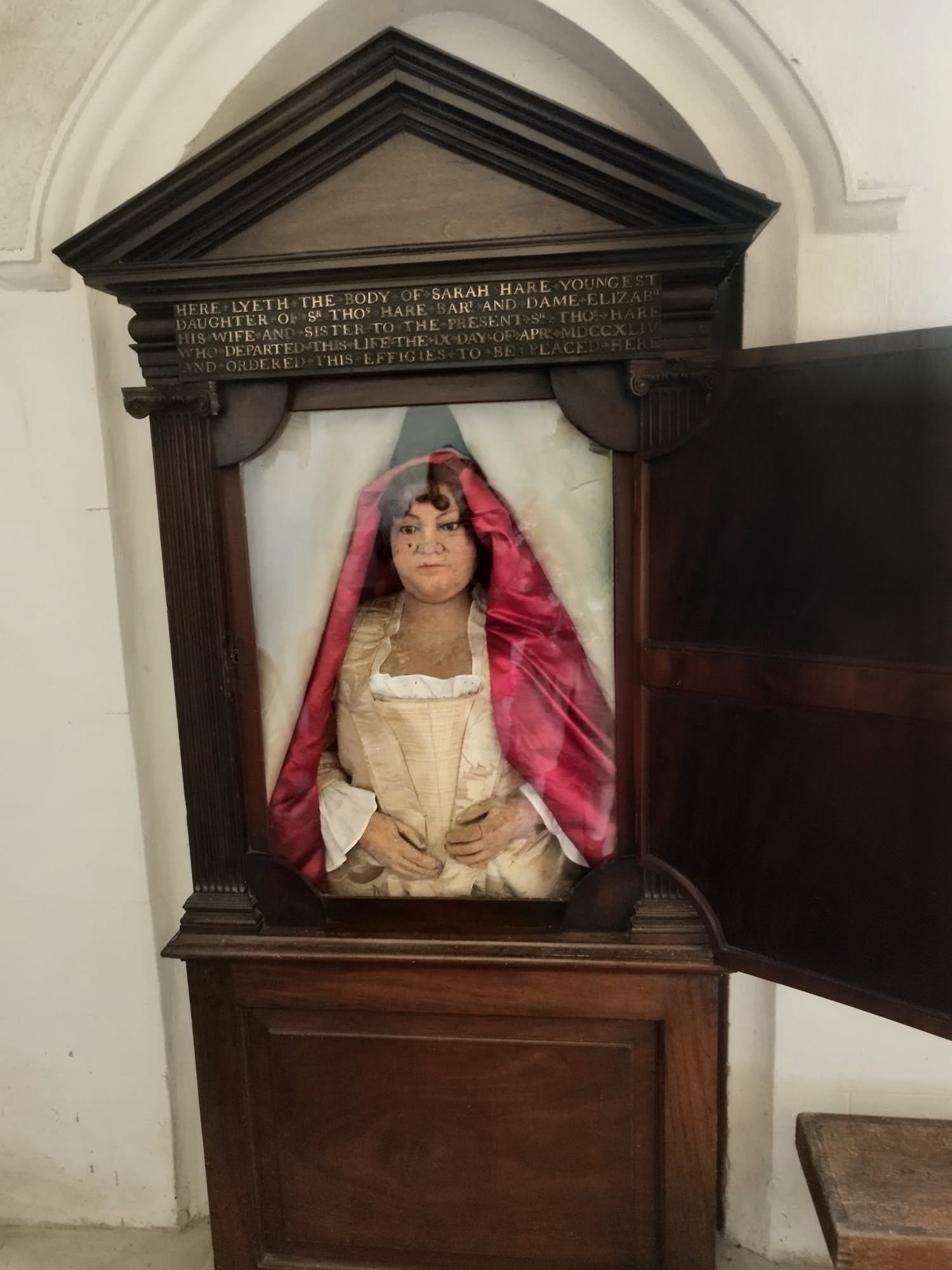
It is an astonishingly honest portrait, unadulterated by an idealising sculptor. In a time when many memorials celebrated wealth, beauty or achievement, Sarah chose something altogether different by asking to be remembered exactly as she was.
I wondered what her motives were. Was it vanity? I doubt it. If anything, the effigy avoids vanity completely. Nothing has been softened or flattered. Every blemish and imperfection remains. Perhaps it was simply a desire not to disappear entirely. After all, most of us hope to leave some trace that we were here, whether through family, creative work or acts of kindness. In Sarah’s case, she chose wax.
The effect is incredibly eerie. There is something deeply unsettling about meeting the gaze of someone who died almost three centuries ago, particularly when they appear so strikingly human.
There is also something strangely moving about it. Sarah has spent nearly 300 years silently watching visitors come and go. Seasons have changed and decades have flashed by. Yet Sarah still waits behind those cabinet doors. Time has not been entirely kind. The wax has required careful conservation and rodents once damaged her clothing before restoration work in the 1980s. Even so, she survives as the only funerary wax effigy in England outside Westminster Abbey.
Sarah Hare achieved the immortality she wanted, although probably in a way she could not have ever imagined. Thousands of curious visitors now make the journey to Stow Bardolph simply to meet her and look into her eyes.
As I left the Hare Chapel, I thought back to the child who had first stared uneasily at her photograph all those years ago. The real Sarah Hare was every bit as uncanny as I’d hoped she would be. Sometimes the strangest places really do live up to their reputation.
And occasionally, they exceed it.
Sources
- Brown, Haydn. “Norfolk Tales! | The EFFIGY of SARH HARE.” Norfolk Tales! Facebook.Com, 1 Feb. 2026, https://www.facebook.com/groups/norfolk.history.tales.myths/posts/26685817781007242. Accessed 29 July 2026.
- “Is This England’s Strangest Church Monument? | The Arts Society.” Theartssociety.Org, 2018, https://theartssociety.org/arts-news-features/englands-strangest-church-monument. Accessed 29 July 2026.
- “The Wax Effigy of Sarah Hare.” Atlas Obscura, 7 Mar. 2025, https://www.atlasobscura.com/places/the-wax-effigy-of-sarah-hare. Accessed 29 July 2026.
- Vic. “The Strange Wax Effigy of Sarah Hare, 18Th Century Spinster.” 12 Sept. 2011, https://janeaustensworld.com/2011/09/12/the-strange-wax-effigy-of-sarah-hare-18th-century-spinster/ Accessed 29 July 2026.
 Ghost Catcher Isles