Welcome to Ghost Catcher Isles, chronicling the weird, wonderful and eerie of the isles of Great Britain and the Republic of Ireland. Come with me on my adventures into the strange and paranormal
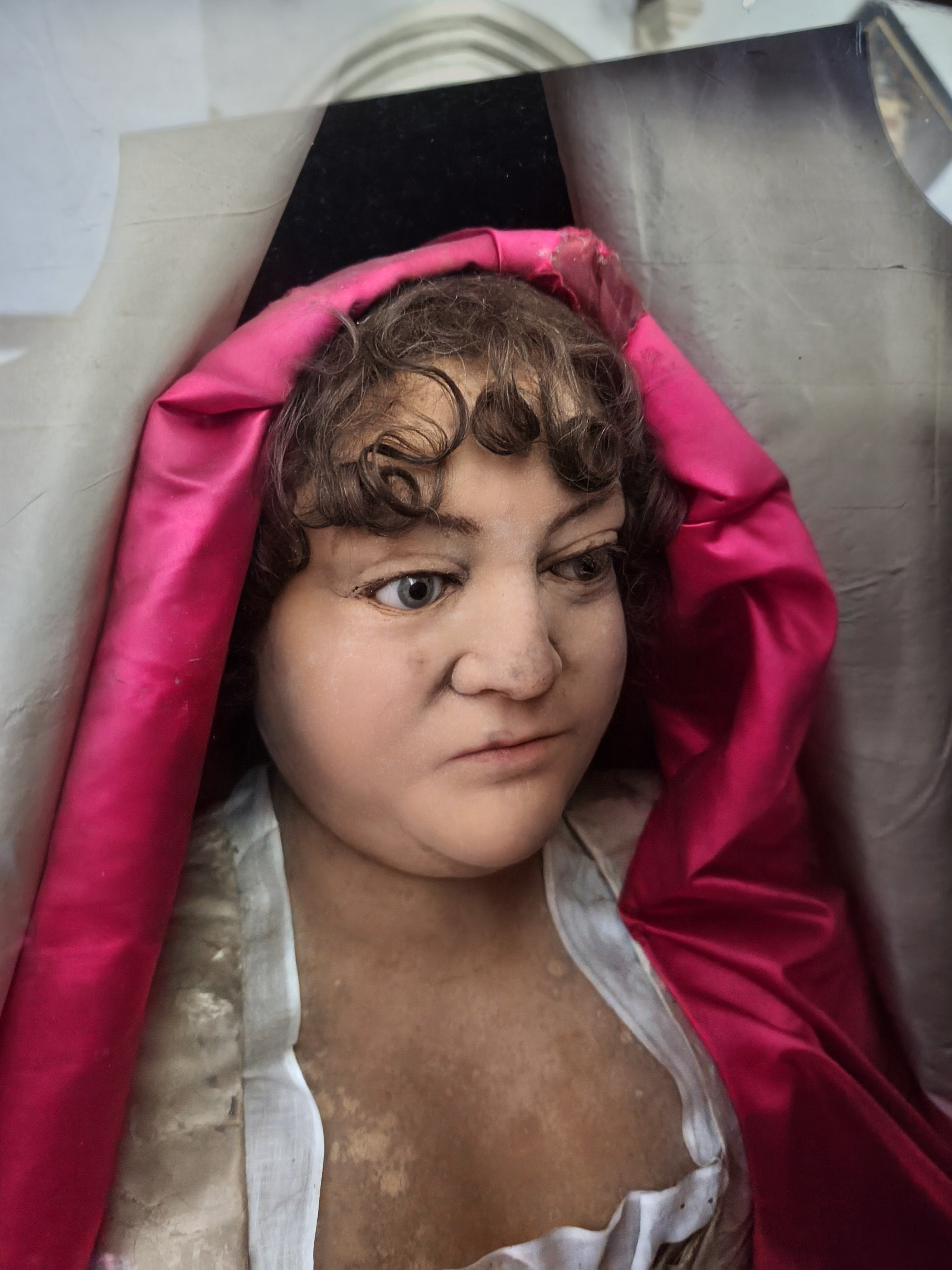
(Image: Effigy of Sarah Hare. Source: E.Holohan 2026)
When I was a child, I had a fascination with the strange corners of history, and this, of course, has continued on into adulthood. The books I borrowed from the library were full of ghosts, folklore, unexplained mysteries and curious historical oddities. Among all the photographs that lodged themselves in my imagination, save for the spontaneous human combustion foot photo, one stood out above the rest. It was the wax effigy of Sarah Hare.
I remember being quite unsettled by it. In a time before I’d ever heard the phrase “uncanny valley,” I already knew exactly how it felt. She looked too real to be a statue yet far too lifeless to be a person. I found her slightly repulsive, but I could never quite look away.
So, when I recently found myself in Norfolk, visiting Holy Trinity Church at Stow Bardolph was top of my list. I wanted to see whether the real thing would have the same effect as those childhood photographs. And it absolutely did.
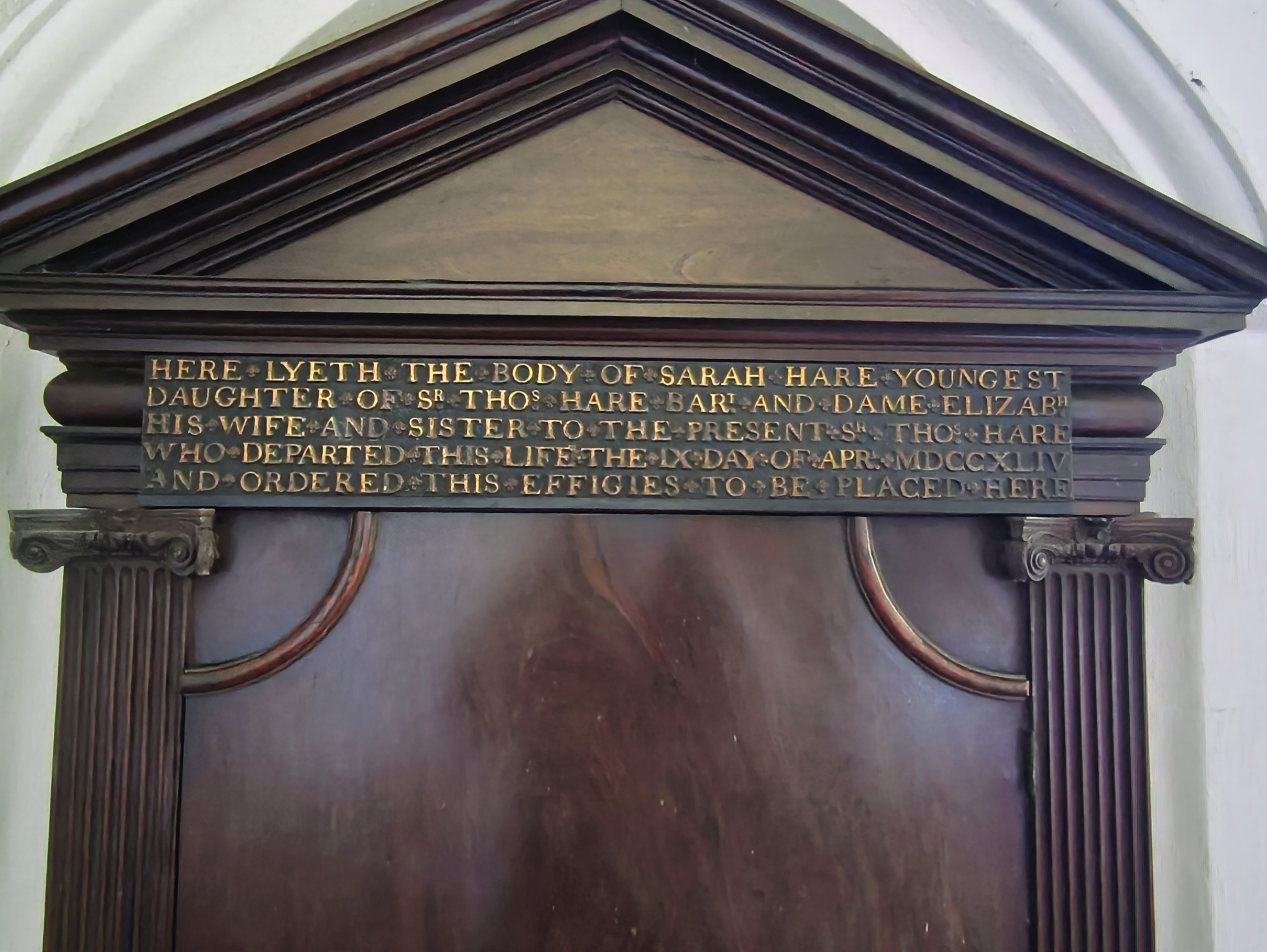
(Image: Inscription on Cabinet. Source: E.Holohan 2026)
Sarah Hare was the youngest daughter of Sir Thomas Hare of Stow Hall. She never married, so was what was once called a “spinster”, and lived a fairly ordinary life. In 1744, aged 55, she died from blood poisoning after pricking her finger while sewing. Later, locals claimed it was divine punishment for the crime of sewing on a Sunday, although the far more likely explanation is that the wound simply became infected.
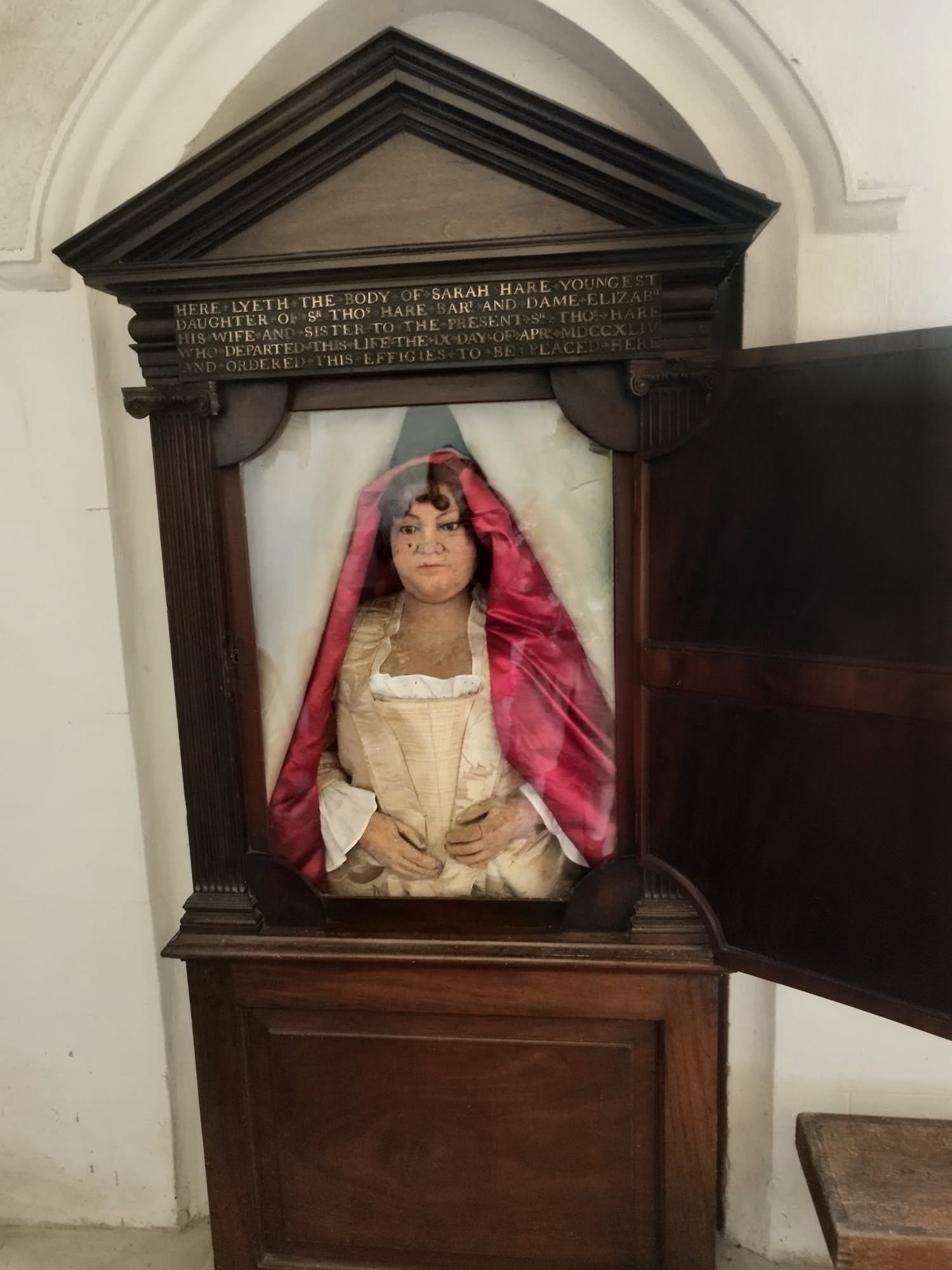
The year before her death she wrote a remarkably detailed will. Alongside gifts to the poor of the parish, she made one very unusual request. She wanted her face and hands reproduced in wax, her own hair placed upon her head, and the finished effigy displayed in a mahogany cabinet with a glass front close to where she was buried.
She wrote: “I desire to have my face and hands made in wax with a piece of crimson satin thrown like a garment in a picture, hair upon my head and put in a case of Mahogany with a glass before and fix’d up so near the place were my corps lyes as it can be with my name and time of death put upon the case in any manner most desirable…“
If she did not arrange it during her lifetime, she instructed that it should be done after her death. Her family honoured those wishes. If you don’t ask, you don’t get, I suppose. And oh boy, did she get.
Today visitors to the Hare family mausoleum find a plain mahogany cabinet tucked into one corner. Nothing about it hints at what lies inside. Then the doors are opened, and there she is…
No photograph quite prepares you for seeing Sarah face to face. Her blue eyes seem fixed upon you. Her skin shows every wart and blemish. Her double chin has not been smoothed away. She wears one of her own silk gowns along with the crimson satin she specifically requested, and what is thought to be her own hair frames her face beneath an old fashioned wig.
(Image: Effigy of Sarah Hare. Source: E.Blackshaw 2026)
It is an astonishingly honest portrait, unadulterated by an idealising sculptor. In a time when many memorials celebrated wealth, beauty or achievement, Sarah chose something altogether different by asking to be remembered exactly as she was.
I wondered what her motives were. Was it vanity? I doubt it. If anything, the effigy avoids vanity completely. Nothing has been softened or flattered. Every blemish and imperfection remains. Perhaps it was simply a desire not to disappear entirely. After all, most of us hope to leave some trace that we were here, whether through family, creative work or acts of kindness. In Sarah’s case, she chose wax.
The effect is incredibly eerie. There is something deeply unsettling about meeting the gaze of someone who died almost three centuries ago, particularly when they appear so strikingly human.
There is also something strangely moving about it. Sarah has spent nearly 300 years silently watching visitors come and go. Seasons have changed and decades have flashed by. Yet Sarah still waits behind those cabinet doors. Time has not been entirely kind. The wax has required careful conservation and rodents once damaged her clothing before restoration work in the 1980s. Even so, she survives as the only funerary wax effigy in England outside Westminster Abbey.
Sarah Hare achieved the immortality she wanted, although probably in a way she could not have ever imagined. Thousands of curious visitors now make the journey to Stow Bardolph simply to meet her and look into her eyes.
As I left the Hare Chapel, I thought back to the child who had first stared uneasily at her photograph all those years ago. The real Sarah Hare was every bit as uncanny as I’d hoped she would be. Sometimes the strangest places really do live up to their reputation.
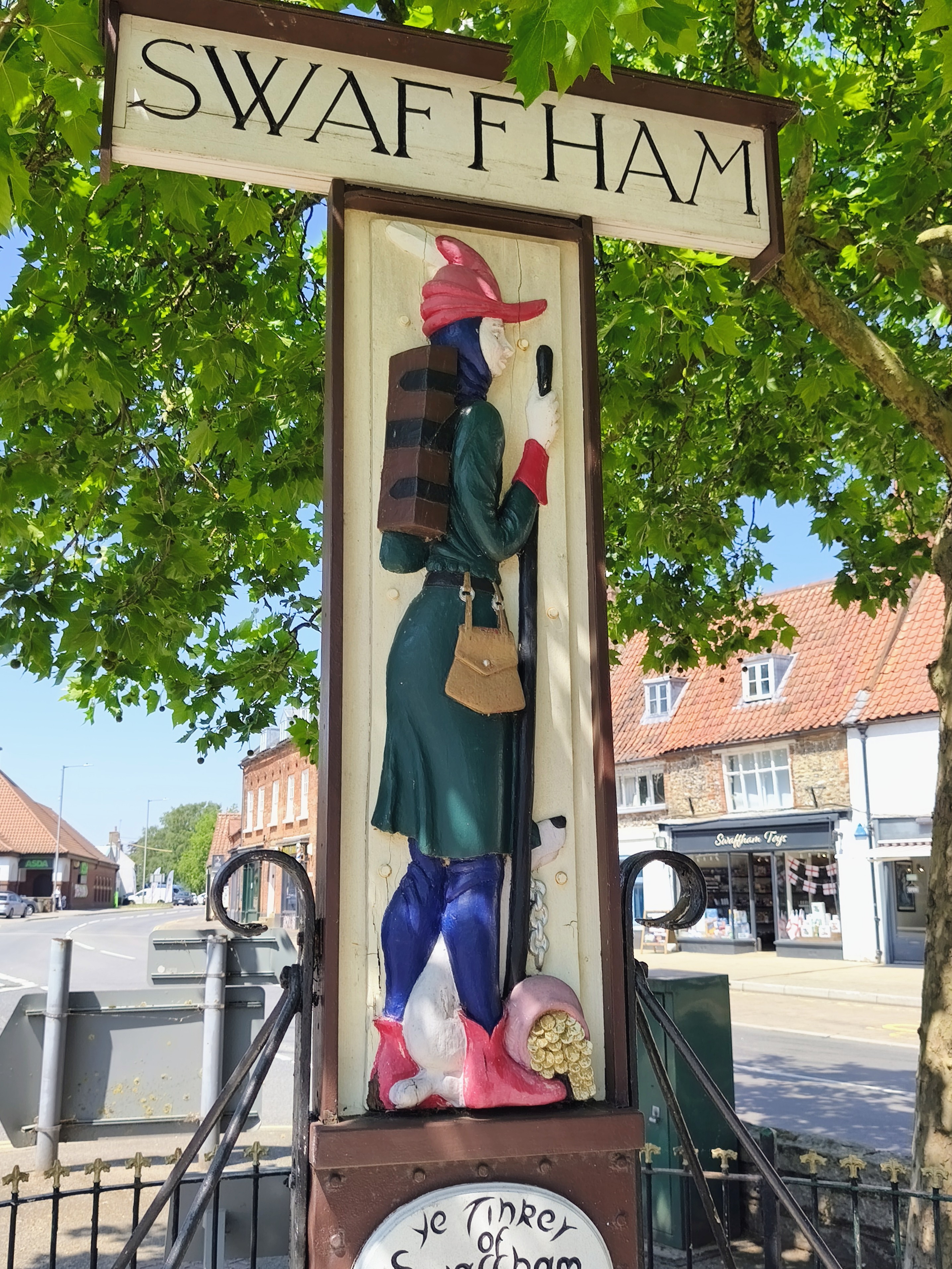
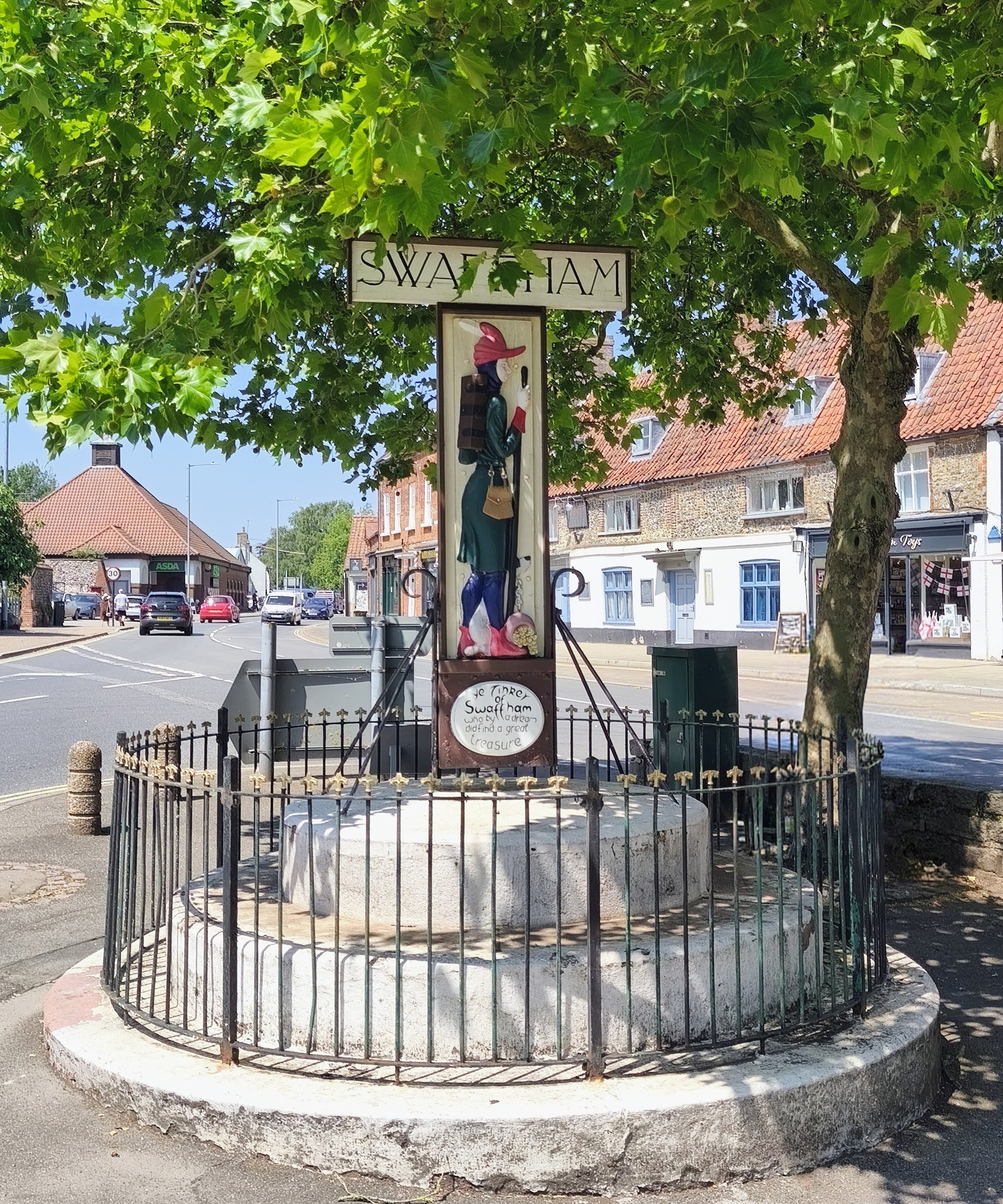
(Image: Swaffham Town Sign. Source: E.Holohan 2026)
A Story That Stayed With Me
When I was at primary school in rural Norfolk I remember hearing one of the first Norfolk folktales that ever captured my imagination: the Pedlar of Swaffham.
The story fascinated me. Over the years, I came to realise that although it felt so familiar to me, it was not nearly as well known elsewhere. Many people had heard of the famous tale of Dick Whittington and his cat, but very few people I met had ever heard of the Pedlar of Swaffham and his hound. Yet, as we shall discover, this story belongs to a much wider tradition of folklore and shares surprising similarities with legends from elsewhere.
I can still picture myself sitting cross legged on the classroom floor, listening intently as my teacher recounted the almost magical story of a poor pedlar whose life was transformed after following a dream. Then came the part that amazed me. My teacher told us that the story was based on a real person, and that the pedlar had paid for the rebuilding of the church in Swaffham. Better still, she said, you could still see him on the town sign.
To a child, that was extraordinary. How could someone who seemed to belong in a fairy tale have actually existed?
Stories like this have a way of staying with you, lodging themselves in your imagination. The Pedlar of Swaffham certainly did for me. Decades later while visiting Norfolk, I decided it was finally time to visit Swaffham itself to see whether I could still find traces of the legend and perhaps even of the man behind it.
Looking for the Pedlar
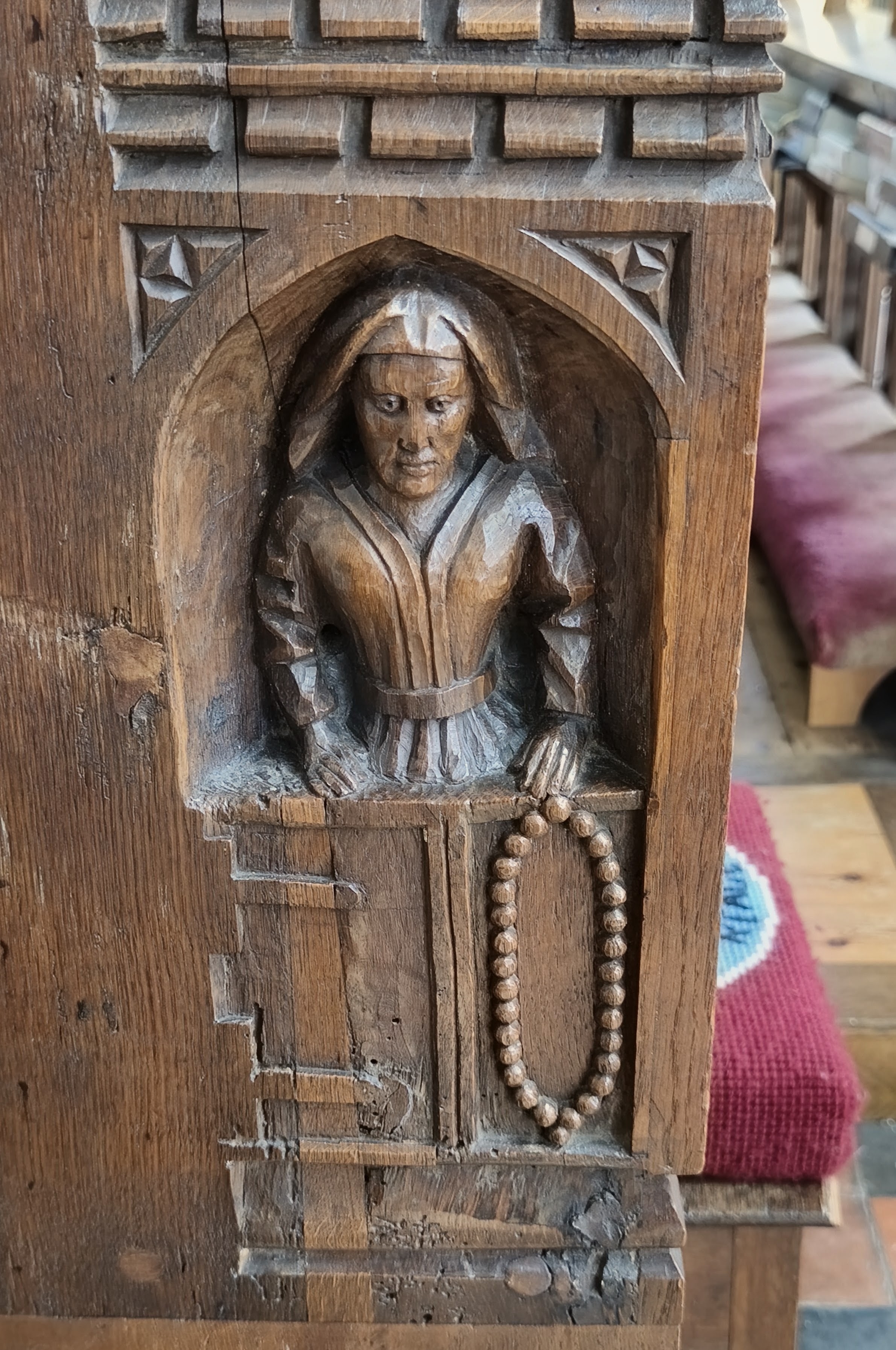
(Image: Carving believed to be John Chapman. Source: E.Holohan 2026)
While researching both the folklore and the historical origins of the Pedlar of Swaffham, I discovered that St Peter and St Paul’s Church contains carvings believed to depict the historical John Chapman, the man thought to have inspired the legend. That made the church my first destination.
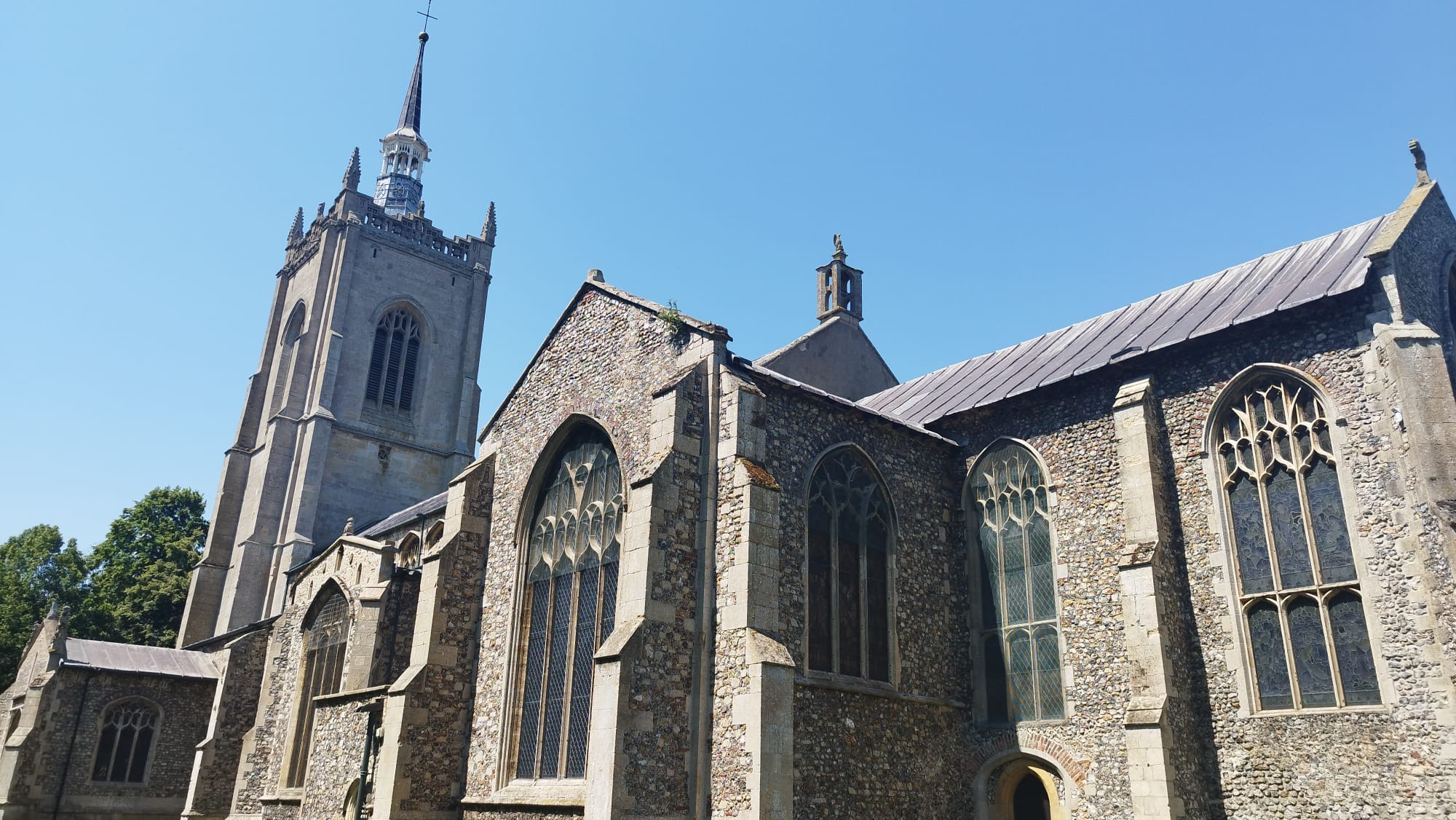
Walking from the marketplace down a wide lane, the great tower of St Peter and St Paul’s gradually came into view, rising above the surrounding buildings. Stepping inside, I was immediately struck by the magnificent hammerbeam roof stretching overhead. The church was quiet, filled with the sort of peaceful atmosphere that encourages you to slow down and take everything in with reverence.
I then began my search for the famous carvings.
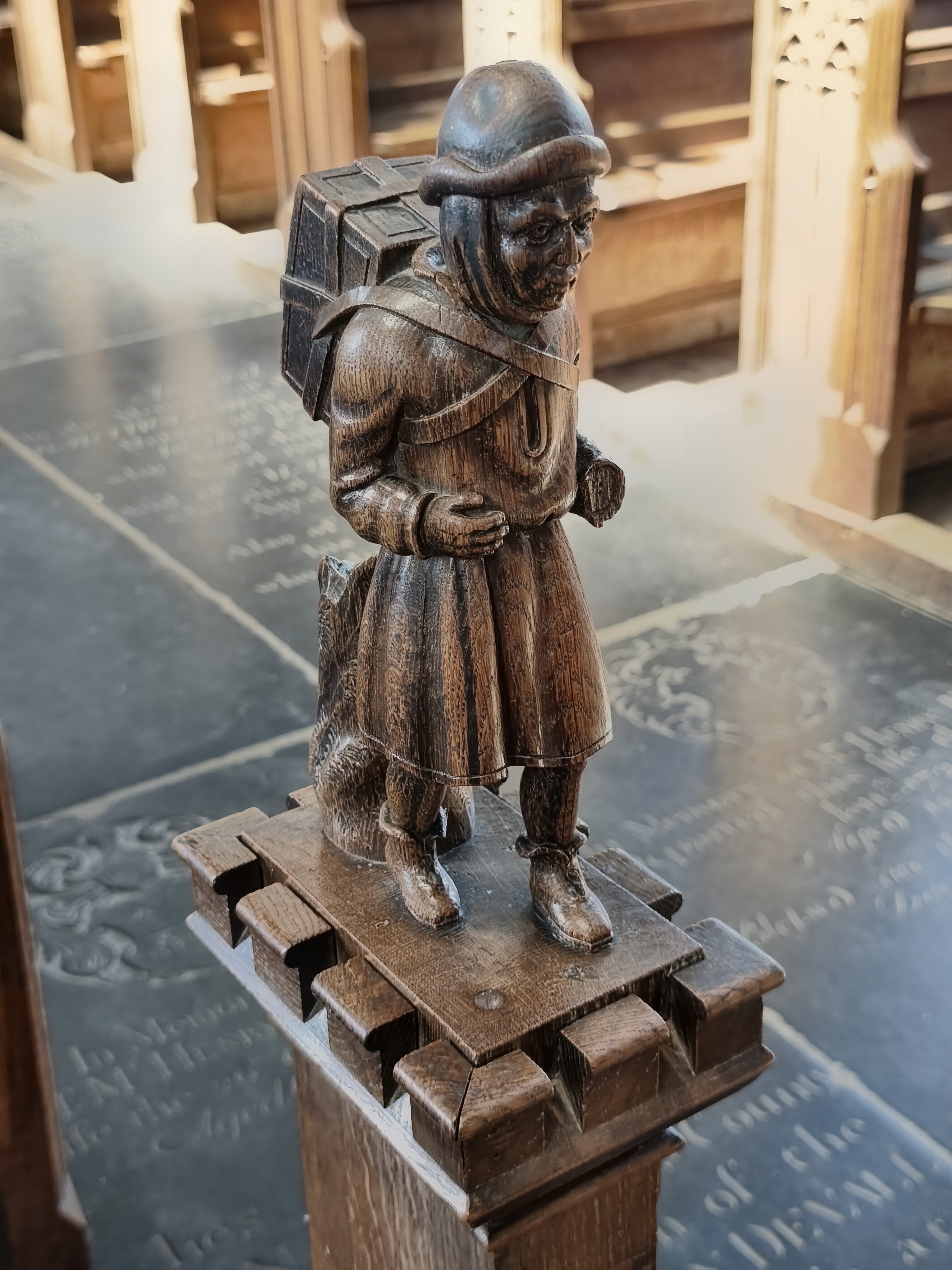
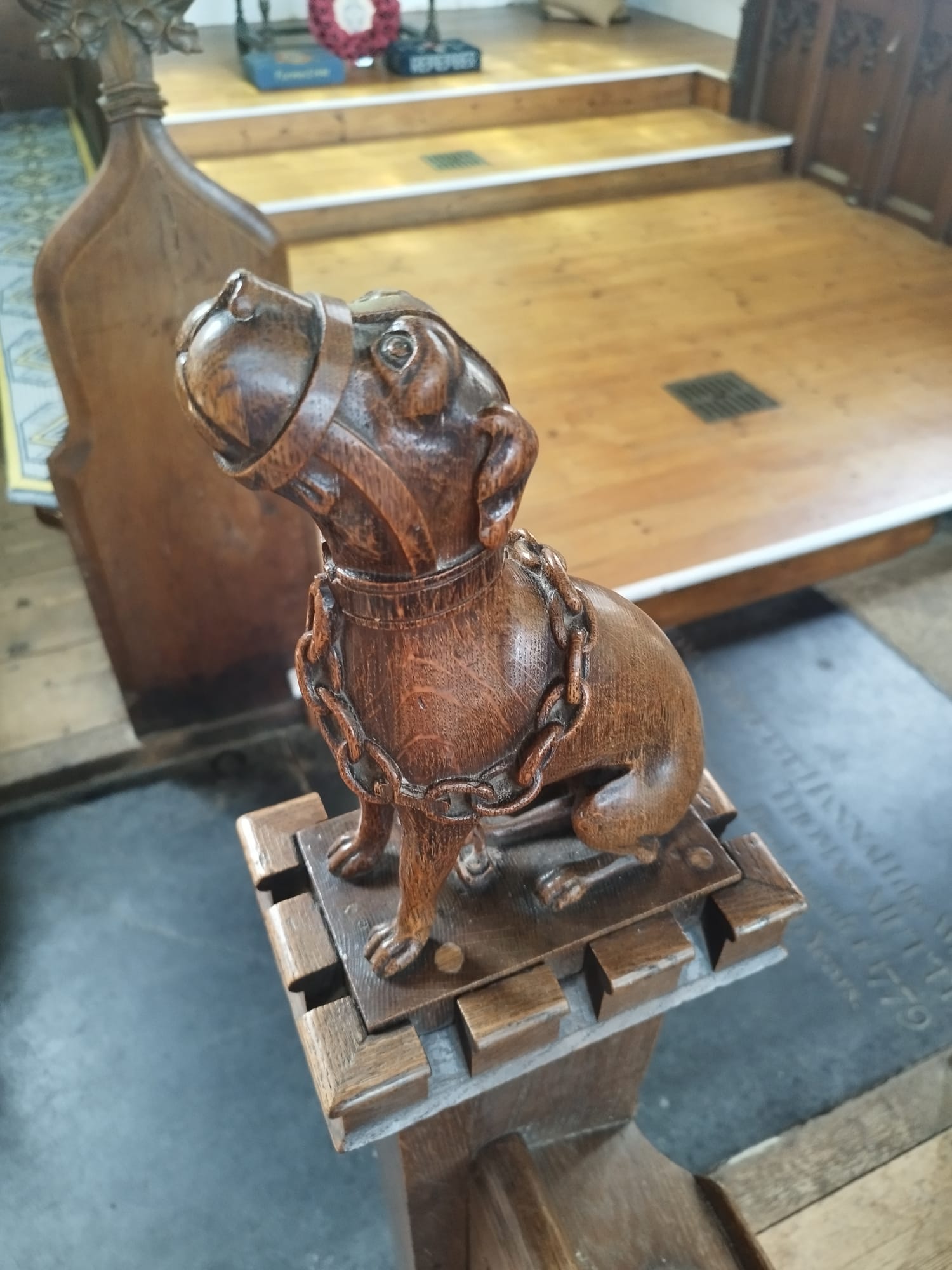
The first I found were on the bench ends. Some showed a folkloric depiction of the Pedlar of Swaffham wearing his close fitting rolled brim hat and carrying his pack. Nearby were carvings of his faithful dog. They were wonderful to see, but they were not the figures I had come looking for.
Further into the church, I finally found them. The carvings believed to represent the historical John Chapman show him peering from a window, while his wife looks out from a balcony above. It felt strangely moving to come face to face with someone who had lived in my imagination since childhood.
The Church Behind the Legend
The history of the man in the carving is closely linked to the history of the church itself.
(Image: St Peter and St Paul’s Church, Swaffham. Source: E.Blackshaw 2026)
St Peter and St Paul’s Church was rebuilt during the fifteenth century, funded by a number of wealthy local benefactors. Among them was John Chapman, whose generosity helped finance the work and whose likeness is thought to survive within the church.
It is here that history and folklore begin to merge. The documented life of John Chapman became entwined with the local legend until it became difficult to separate the historical benefactor from the legendary pedlar. Together, they created one of Norfolk’s most loved folk stories.
Who was John Chapman? Why did he become known as the Pedlar of Swaffham? How did the story of one Norfolk merchant become one of England’s most enduring folktales?
Settle in and let us follow the dream that turned an ordinary pedlar into a legend.
The Pedlar’s Dream
John Chapman was a pedlar, a travelling merchant, who wandered around Norfolk in the fifteenth century, taking his goods from one market to another. On market days he would join the other traders selling everything from brooches and combs to silver mirrors, eggs, spices, mustard and freshly baked bread. With his packhorse loaded with wares, John would leave Swaffham early in the morning and spend the day selling what he could. He’d then stay overnight in simple lodgings and return home the next day.
One day he came home tired and disappointed. Business had been very poor and he had not sold a single thing, not even one copper pan.
After his meal he complained to his wife that money was becoming short and trade was getting harder. The long journey had worn him out, so he went straight upstairs to bed.
That night he had the strangest dream.
(Image: Pedlar of Swaffham bench end. Source: E.Holohan 2026)
The dream was so vivid that it felt completely real. A man appeared to him over and over again, telling him that if he travelled to London Bridge and stood there, he would hear something that would lead him to his fortune.
When he woke the dream stayed with him. He tried to put it out of his mind, but it kept returning. The next day he thought about it again. Then the day after that. The more he tried to ignore it, the more it seemed to pop into his head.
Eventually he could stand it no longer.
“I have to go to London Bridge,” he told his wife.
She thought the whole idea sounded preposterous, but she could see he had made up his mind. If travelling all that way would finally put the dream to rest, then she was not going to stop him.
So John packed a few clothes and some food for the journey, called to his faithful dog, and set off on the long road to London.
After many days of walking he finally arrived in the hustle and bustle of the great city. Before long he found London Bridge, but it was nothing like the bridge we know today. In those days it was lined with houses and shops, with people living and working all along it. It was one of the busiest places in England.
John found a place to stand and waited.
He watched everyone who passed, listening carefully to every conversation. Surely someone would say the words he had travelled all this way to hear.
One day passed. Then another. Still nothing happened.
On the third day a shopkeeper noticed him and asked why he had been standing on the bridge for so long.
John admitted that he was there because of a dream. The shopkeeper just laughed.
“My friend,” he said, “if I believed dreams, I’d be as foolish as you. Only a few nights ago I dreamed I should travel to the home of a man called John Chapman in Swaffham and dig beneath the tree behind his house. According to my dream, I’d find a great treasure there. But you don’t see me rushing off to Norfolk, do you?”
(Image: Chapman’s dog. Source: E.Holohan 2026)
The shopkeeper laughed again and went back to his business.
John stood speechless, scarcely believing his own ears. Without wasting another moment, he turned around and began the journey home.
As soon as he reached Swaffham he grabbed a spade and hurried to the apple tree behind his house. He dug as quickly as he could, hardly expecting to find anything, yet still hoping.
Then his spade struck something hard.
He uncovered a chest buried beneath the earth, filled with gold coins. He and his wife were overjoyed. But carved into the lid was an inscription in Latin that neither he nor his wife could understand. He started to worry that this might not be his fortune, but perhaps a curse inscribed. Hoping someone might recognise the words, John placed the chest in his window.
It wasn’t long before some educated young men who knew the language happened to pass by. They read the inscription and translated it.
“Under me doth lie, another much richer than I.”
John didn’t need telling twice.
He returned to the tree and dug even deeper. Soon he pulled up another chest, this one far larger than the first. Inside were coins, jewels and riches beyond anything he had ever imagined.
The pedlar’s fortune had finally been found.
According to the legend, John Chapman became one of Swaffham’s wealthiest men. Grateful for his good fortune, he helped pay for the rebuilding of St Peter and St Paul’s Church.
Whether every detail really happened is impossible to know. Over the centuries, history and folklore have become intertwined. More than five hundred years later, the pedlar remains a symbol of Swaffham and is immortalised on the town sign. Visitors can still find the carvings said to represent the pedlar and his loyal dog, and his story continues to be told in Swaffham and far beyond.
As I walked from the church, I thought my journey with the Pedlar had come to an end. In reality, it was only just beginning. While researching the Swaffham legend I had come across another story of a prophetic dream and hidden treasure, but this time from a place with a very personal connection to my own life.
It made me wonder whether the Pedlar of Swaffham is just one version of a much older story, one that has travelled across countries and centuries.
That is a journey I’ll be exploring in the next part of this series.
(Image: Swaffham Town Sign. Source: E.Holohan 2026)
Sources
Dixon, Geoffrey M. Folk Tales and Legends of Norfolk. Minimax Books Ltd, 1 Dec. 1998.
Westwood, Jennifer, and Jacqueline Simpson. The Lore of the Land : A Guide to England’S Legends, from Spring-Heeled Jack to the Witches of Warboys. London, Penguin Books, 2006.
Great Yarmouth isn’t just a seaside town of sugar donuts and amusement arcades; it’s a place rich in weird tales, ghostly sightings, and strange histories. From pirates to witches, from mystics to mummies, the town bubbles with secrets that float through its streets and graveyards. Join me as we walk through Great Yarmouth’s darker side, exploring haunted corners, overlooked tragedies, and uncanny stories.
Our journey begins in the heart of Great Yarmouth, where the imposing St Nicholas’ Church stares out over the town like a sentinel. Its stones have witnessed hundreds of years of worship, but it has also seen scenes of witchcraft, piracy, and ghostly happenings.
Stop 1: St Nicholas Church, Great Yarmouth
(Image: St Nicholas Church, Gt Yarmouth. Source: E.Holohan 2023)
This church is said to be the biggest parish church in the United Kingdom. Once belonging to a Benedictine priory, its construction of was completed in 1119. Although very little of the original Benedictine church now stands, the base of the current tower is Norman. Expansions and changes were made during the Middle Ages. In the 13th century, the aisles were widened. In the 14th century, the south porch was constructed. In the 15th century, the north wall was equipped with additional windows.
In the 16th century, the church was split into three sections, each of which was used by a different denomination. When the church was renovated in the 19th century, these sections were once again connected. However, a large portion of this work is no longer visible because the majority was completely destroyed by bombing and fire in 1942. Reconstruction of the inside took place from 1957 to 1960.
In the graveyard: English Pirate Attack
(Image: Headstone of David Bartleman. Image: E.Holohan 2023)
In the graveyard here, we find a gravestone that has a rare inscription that refers to an English pirate attack:
“To the memory of David Bartleman, Master of the Brig Alexander and Margaret of North Shields, who on the 31st of Jan 1781 on the Norfolk Coast with only three 3 pounders and ten men and boys nobly defended himself against a cutter carrying eighteen 4 pounders and upwards of a hundred men commanded by the notorious English pirate Fall and fairly beat him off. Two hours after the enemy came down upon him again, when totally disabled, his mate Daniel MacAuley, expiring with the loss of blood and himself dangerously wounded, he was obliged to strike and ransome. He brought his shattered vessel into Yarmouth with more than the honour of a conqueror and died here in consequence of his wounds. On the 14th of February following in the 25th year of his age”.
This stone, dedicated to the remembrance of David Bartleman, Master of the brig Alexander & Margaret of North Shields, is tucked away in the old church graveyard. On 31st January, 1781, Bartleman bravely defended himself against a cutter with eighteen four-pounder cannons and a crew of up to 100 men while sailing the Norfolk coast with a crew of ten men and boys and only light armament of three-pounders. Fall, an infamous English pirate, commanded the Cutter attacking.
This triumph was fleeting, though, as two hours later Fall’s Cutter struck the unfortunate Brig once more. The battle raged on until the Alexander & Margaret was fully incapacitated. Captain Bartleman found himself in a desperate situation; he had no choice but to surrender and pay a ransom to ensure the safety of his ship and crew. His first mate, Daniel MacAulay, was seriously injured and rapidly losing blood, leaving the captain with little choice to make the difficult decision to pay to secure their release. Then, on 14th February 1781, at the age of 25, he brought his proud but broken vessel into Yarmouth, where he passed away from his wounds.
A stone was placed above the tomb by his father, Alexander Bartleman, to honour the bravery of his son’s death, the courage of his loyal mate, and the notoriety of Fall the Pirate.
Daniel Fall, also known as Fall the Pirate or John Fall, first gained fame in November 1780 when he captured two colliers from Lowestoft South Roads. At that time, he was known as “the noted Daniel Fall, a smuggler and captain of a large privateer.” The frigate Pegasus set sail from Yarmouth in pursuit but failed to locate him. An article in the Ipswich Journal reported that a 20-gun American cutter privateer had seized two large merchant ships off Pakefield, but the man-of-war ‘Fly’ from Hollesley Bay intercepted and took back the stolen goods.
Fall was known to sail under American colours, suggesting that the privateer mentioned might have been his ship. By February 1781, around the time of the attack on the brig Alexander & Margaret and death of David Bartleman, he was spotted on one of the Harwich packet ships, where he raised the American flag and displayed letters of marque from America, France, and Holland. Shortly after, it was reported that Fall, now known as the ‘rebel commodore’, was operating off Orford Ness with a squadron of Dunkirk-based privateers.
In early June 1781, Fall captured the Prince of Wales using two cutters: the Liberty, which he had recently stolen from a Scottish port, and the Fearnought, which he commanded.
By April 1782, Fall was reported to be heading into the Irish Sea, but after that, he seemed to disappear from the pages of history. No further sightings or reports of his activities surfaced along the East Coast. What happened to the notorious pirate Fall after his last raid: did he perish in battle like his poor opponent David Bartleman, or vanish into obscurity?
Witches Memorialised
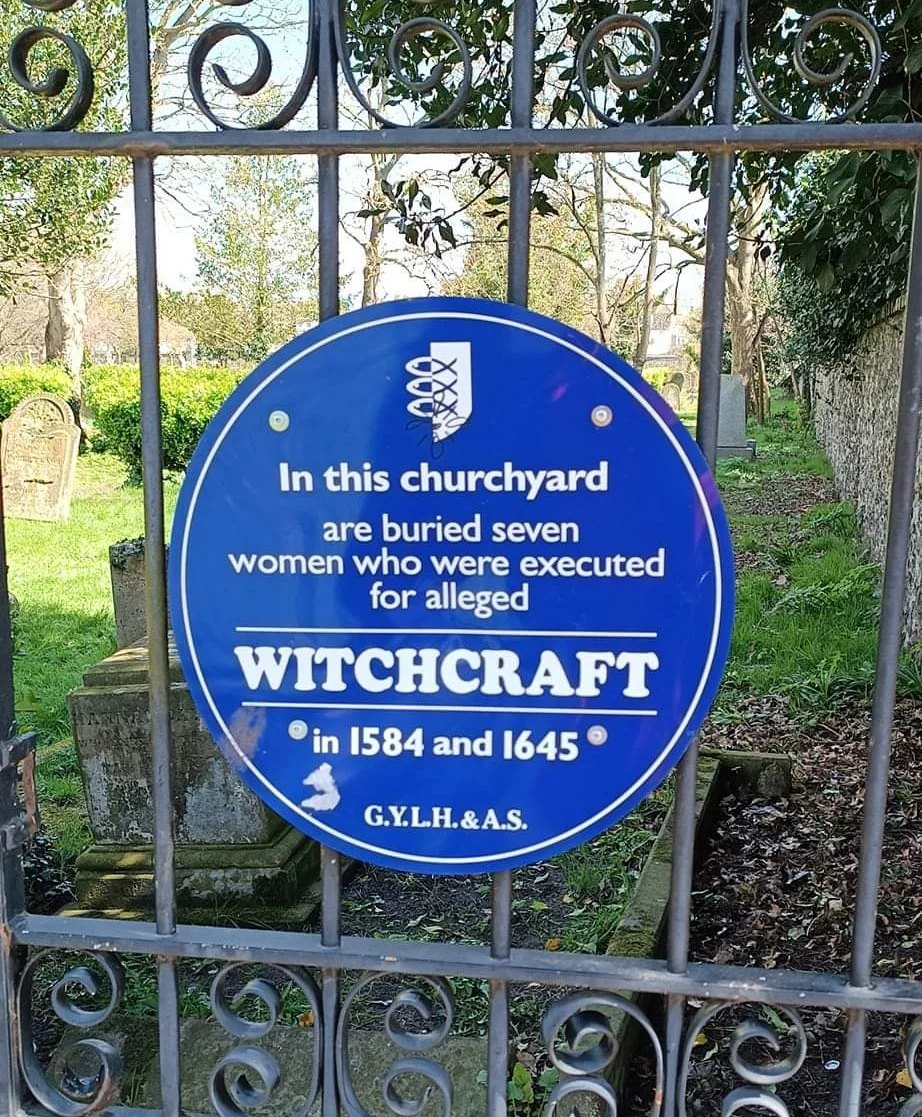
Also in the churchyard we find the memorial plaque commemorating the five women hanged at North Denes during the Matthew Hopkins Witch Trials who were buried here; Bridget Howard, Margaret Blackbourne, Alice Clisswell, Elizabeth Bradwell, and Elizabeth Dudgeon. They are located in the churchyard’s north side. Why were the supposed witches buried here, in consecrated ground, when most others accused of such crimes were cast out to the crossroads?
(Image: Witches Memorial plaque. Source: E.Holohan 2023)
The history of Great Yarmouth is associated with the 17th-century witch hunts, especially in 1645 when Matthew Hopkins, the so-called Witchfinder General, paid the town a visit. Many people, both men and women, were tried for witchcraft at this time, and some of them were found guilty and put to death. The five women were hanged at nearby North Denes during these Witch Trials. Many of the accused in Great Yarmouth, according to historians, were simply social misfits or victims of unrelated disputes, not actual practitioners of witchcraft.
It has never been explained why the supposed witches were buried in the churchyard. According to a long-standing custom, people who are found guilty of crimes, including witchcraft, are typically buried in unconsecrated ground or at a crossroads, where their spirits would be flummoxed and unable to return and cause trouble in a society that values godliness.
In reality, according to Christian tradition, outcasts and suicides were the only people buried on the north side of a churchyard. The unbaptised, excommunicated, strangers, vagrants, executed criminals, and people suspected of practicing witchcraft were all included in this proclamation. This was frequently called “lying out of the sanctuary” or “burial without the sanctuary.” The saying “the devil walks in dark places” stems from ancient times, and was initially used to describe the darker parts of a churchyard, particularly the north side of a building.
Thomas Vaughn: Body Snatcher
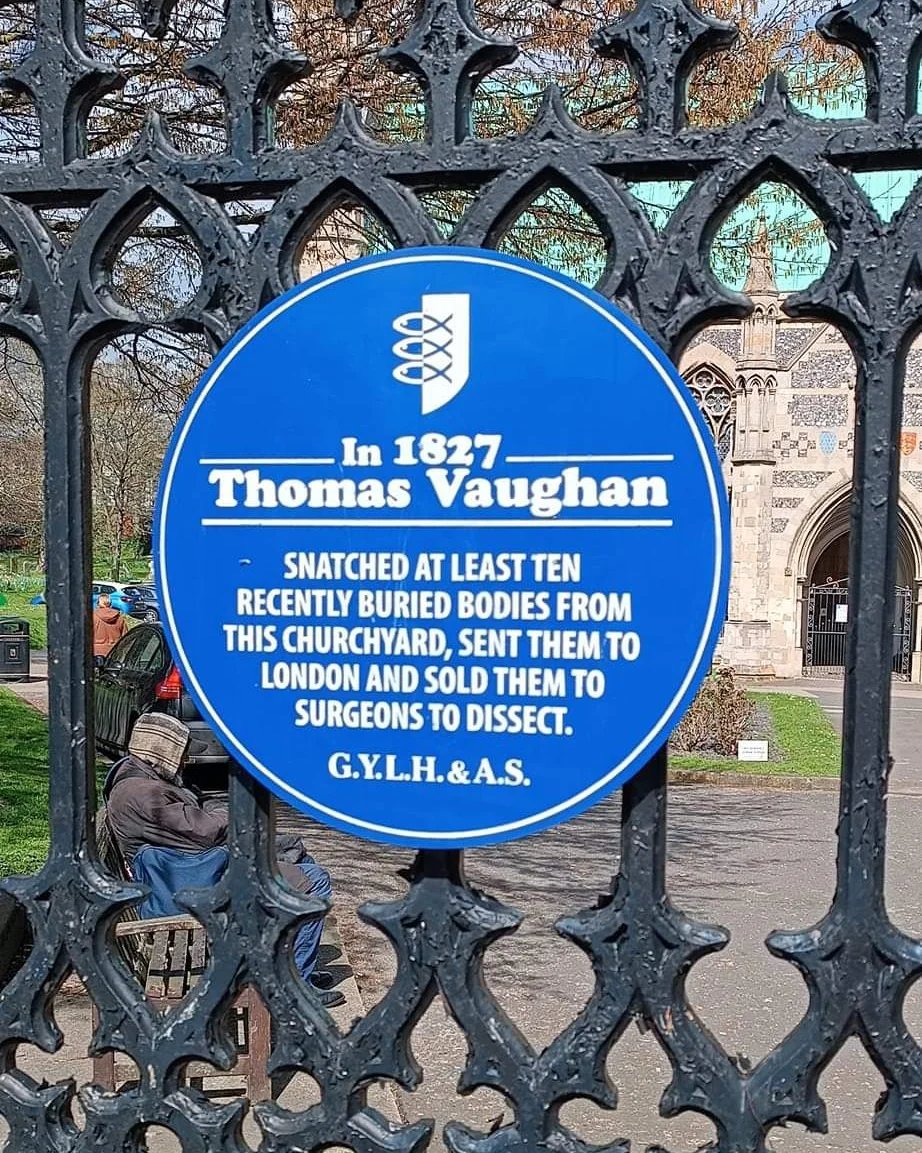
Also at the graveyard we can see the plaque remembering local body snatcher, Thomas Vaughn. Ten remains were taken from Great Yarmouth’s St. Nicholas Churchyard in 1827 by Thomas Vaughn and his two accomplices. In the end, he was imprisoned, but only for half a year! For more on this, read on for Body Snatchers Row 6.
(Image: Thomas Vaughn plaque. Source: E.Holohan 2023)
Oliver Tomkins: Cannibal Victim
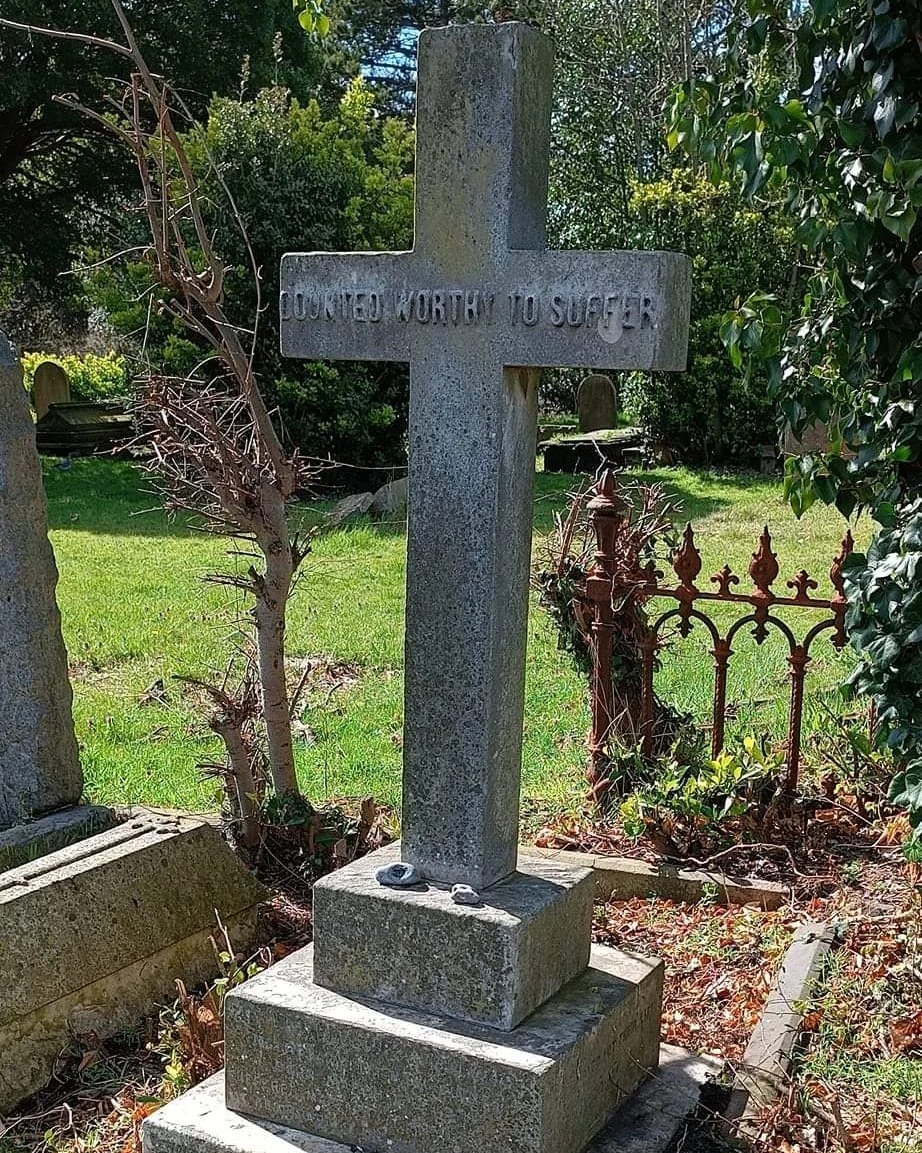
Situated in the graveyard you can see the grave marker of Oliver Tomkins. There is likely no body buried under the marker, as this Great Yarmouth citizen, about 120 years ago, was rewarded by cannibals for his attempts to spread the word of God by being killed, dismembered, cooked, and eaten. This was all within hours of Oliver Tomkins’ final diary entry following his arrival on a Papua New Guinean island inhabited by cannibals: “they tried hard to persuade us to come ashore…we promised we would visit their village in the morning.” The reward for his visit to the village was to be his host’s dinner!
(Image: grave marker of Oliver Tomkins. Source: E.Holohan 2023)
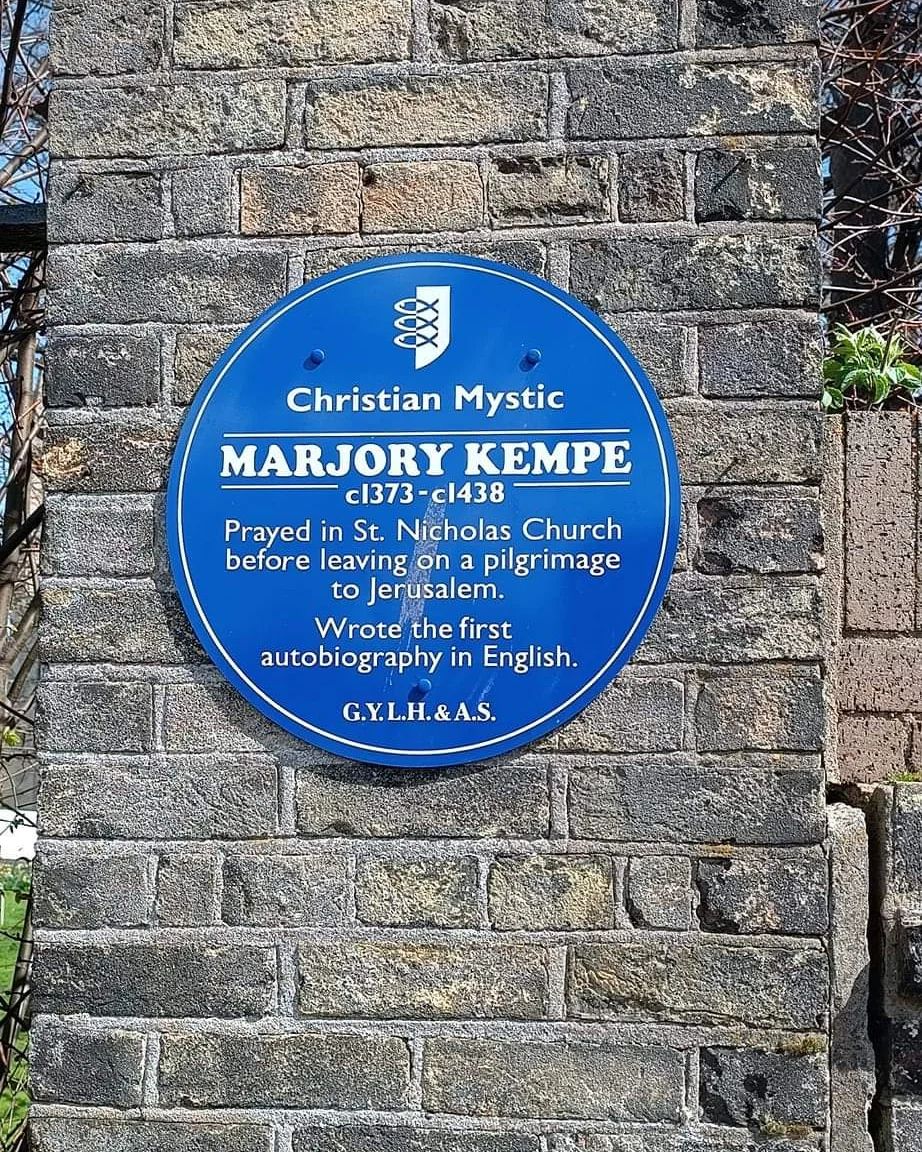
Next up at St Nicholas’ Churche we find Margery Kempe’s blue plaque.
Many believe that “The Book of Margery Kempe,” written by the English Christian mystic Margery Kempe (c. 1373–after 1438), is the first autobiography in the English language. Kempe’s domestic struggles, her extensive pilgrimages to holy sites in Europe and the Holy Land, and her mystical interactions with God are all chronicled in her book.
Margery Kempe was considered a mystic due to her profound and personal relationship with God. This was marked by visions, conversations with Jesus, Mary, and other religious figures, and via active participation in biblical events through these visions. She also embraced a highly devotional and pious lifestyle, which included prolonged weeping, fasting, and pilgrimages, which were all seen as evidence of her spiritual connection
Kempe prayed in St Nicholas church before leaving on a pilgrimage to Jerusalem and a blue plaque now commemorates this.
Churchyard Hauntings
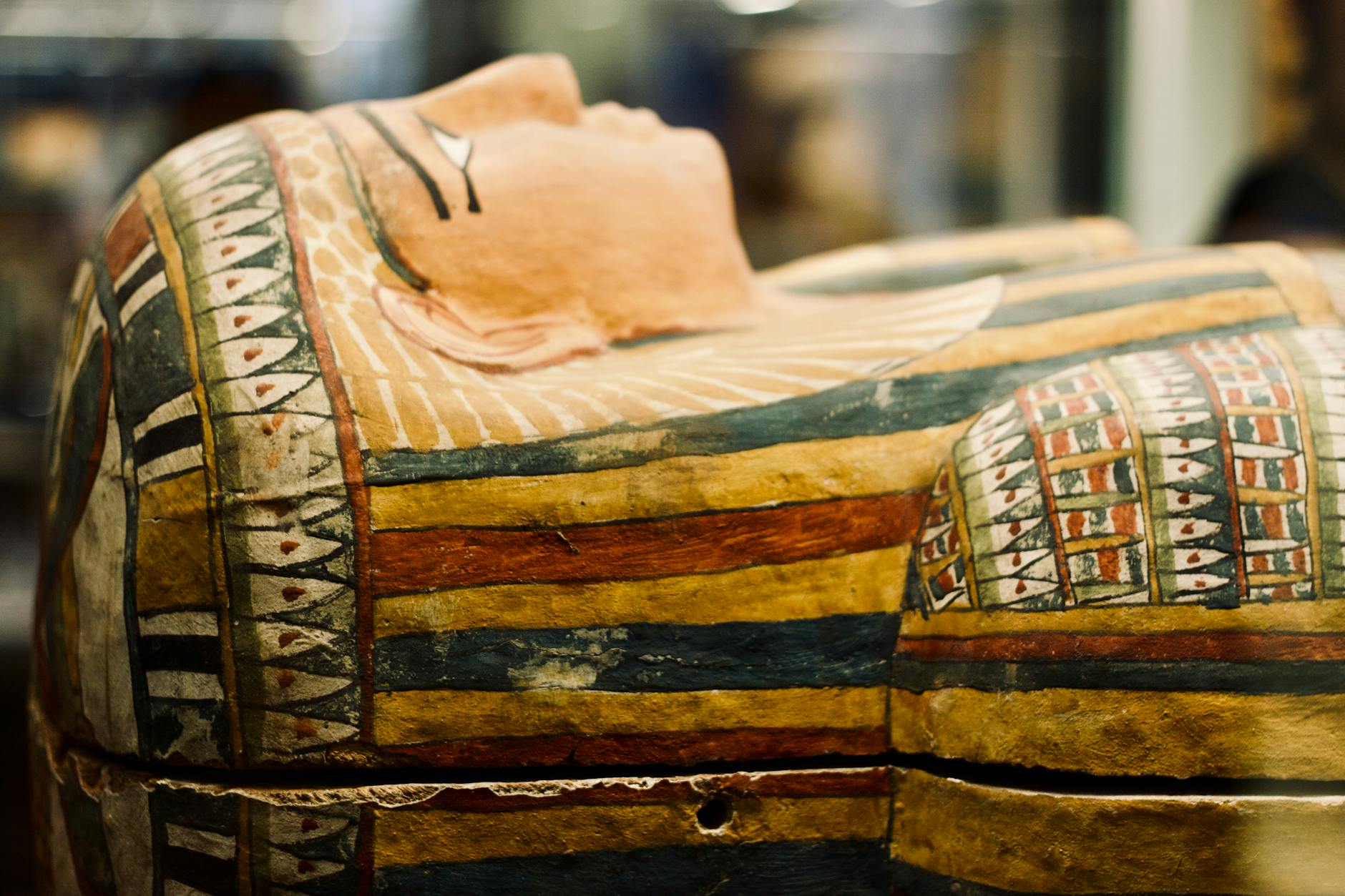
As well as being a place of rest, the church graveyard is also known for its unquiet residents. According to legend, at the height of “Egyptomania,” in the 1900s, a well-wisher donated the coffin of an ancient Egyptian princess to the Priory school next door to Great Yarmouth Minster. People were fascinated by mummies in this period because they believed that the ancient bodies had supernatural abilities. Some mummies were even ground into a dust for use as medicine or shown at gruesome “unwrapping parties.” Mummies were the height of fashion at this time!
Unfortunately, many mummies suffered in Europe’s humid environment after being removed from their natural hot, dry resting places. The princess mummy was kept in its case on display in a classroom, but it was eventually agreed that the only sensible thing to do when the mummy inside started to smell was to bury it in the church graveyard.
The Vicarage and St. Nicholas’ Church started to experience after dark knocking noises on their doors shortly after the burial; an investigation into the tapping noises revealed no reason.
The vicar was frequently confused and anxious when he answered the vicarage door to no one after hearing loud bangs. A decision was made to return the mummy to its casket since the noises were becoming unbearable and seemed to be coming from nowhere.
A mummified arm that had been mistakenly left behind when the body was hurriedly buried in the middle of the night was discovered when the box was opened. It seems, it had been begging to be freed and reunited with its body! The noises stopped and there was finally peace once the arm was interred with the rest of the body. The arm left behind; was it an accident, or something more sinister keeping the dead from their rest?
(Image: Ghostly knights. Source: WordPress 2025)
Along with tales of unquiet mummies, the churchyard also has takes of spectral horsemen. Ghostly apparitions were allegedly wreaking havoc in the graveyard in October 1922. A woman reported to the local police that she had witnessed three ghosts in shining armour riding horses across the churchyard.
As word spread, hundreds of people returned night after night to catch a glimpse through the railings, wanting to see these spirits for themselves. However, no further apparitions were seen. A bet was made to anyone who would camp out in the churchyard and to keep watch for the knights, but it was never taken up and the town’s citizens ultimately lost interest.
From the graveyard’s shadowy corners, we make our way down to Row Six. At first glance, it’s just another of Great Yarmouth’s narrow passageways, but this one earned a gruesome reputation as ‘Body Snatcher’s Row’.
Stop 2: Row Six- Body Snatcher’s Row
(Image: Body Snatchers Row sign. Source: E.Holohan 2023)
Row six, Body Snatchers’ Row, leads from St Nicholas’ churchyard to Northgate Street and is a reminder of when human bodies were stolen to order for anatomical dissection in London. In 1827, Thomas Vaughn, a resident of Row six, and his two henchmen, stole ten bodies from the churchyard. Vaughan was employed by Sir Astley Cooper, a surgeon to Queen Victoria. Vaughan used sawdust to conceal the bodies and transported them to London, where they were used for medical training purposes. Vaughan was tried at the Norwich assizes and received only 6 months imprisonment for this offence. He was later transported to Australia having been caught in possession of clothing he had taken from a corpse. In those days, sadly, theft of property was seen as a far more serious offence than stealing dead bodies.
Leaving behind the grisly world of stolen corpses, we come to a calmer, more literary stop. At 37–39 King Street, we arrive the birthplace of Anna Sewell, the author of Black Beauty. This is a house where tales of compassion for animals meet stories of ghostly presences
Stop 3: Anna Sewell House and The Man in the Window
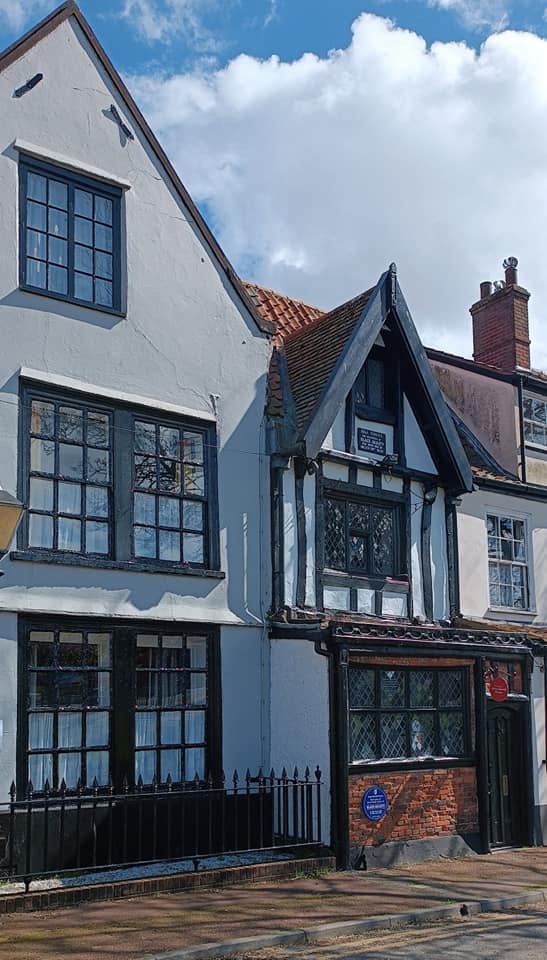
The author of Black Beauty was born at Anna Sewell House on Church Plain, in Great Yarmouth. In 2021, Redwings Horse Sanctuary purchased the house, which dates to the 16th or 17th century. The property is now used by Redwings to highlight Anna Sewell’s renowned novel and her influence in animal protection.
(Image: Anna Sewell’s birthplace in Church Plain. Source: E.Holohan 2023)
On 24 November 1877, for just £40 and without a royalty condition, Anna Sewell sold Jarrold & Sons the entire rights to her book “Black Beauty”. “Black Beauty: his grooms and Companions, the autobiography of a horse” was the title under which the book was published. Since then, the book has sold about 30 million copies worldwide, making it the sixth best-selling book in the English language.
The adventures and misfortunes of a horse named Beauty are the subject of Anna’s tale, which was penned at the White House on Spixworth Road in Old Catton. The story was written in the first person from Beauty’s point of view. Anna survived long enough to learn of its success, but she was never able to witness the book’s eventual bestseller status. In April 1878, she passed away in Old Catton, Norwich, and was buried at the Quaker Chapel in nearby Buxton Lamas, where Anna had family.
In Great Yarmouth, a woman once reported that she saw a strange apparition in the window of the birthplace of the Black Beauty author. According to the eyewitness, Professional psychic medium Freda Joy, a man with “period features” who may have been the sibling of author Anna Sewell can be seen in photos shot seconds apart. Joy stated: “I couldn’t believe what I saw. I took the pictures within seconds apart and saw what looked like an image of man in the window.”
From this modest town house to a building spectacle, our path now takes us to the Hippodrome, Britain’s only surviving purpose-built circus, where sounds of joyful laughter mingle with shadows of the ghost of its flamboyant creator
Stop 4: The Hippodrome Circus, Where the Showman Goes On
The Great Yarmouth area has a long history of circuses, with travelling circuses appearing as early as 1815 and resident circuses from 1845.
(Image: Hippodrome Circus, Great Yarmouth. Souce: E.Holohan 2023)
The Great Yarmouth Hippodrome, built in 1903, is a landmark and Britain’s only surviving purpose-built circus building that still regularly hosts circus performances. Designed by Ralph Scott Cockrill, it features a unique, sinking ring that can be transformed into a pool for water spectacles. The Hippodrome was the inspiration of George Gilbert, a former circus performer who became a successful showman. The building’s facade features Art Nouveau details, including terracotta and brickwork.
The Hippodrome has hosted a variety of entertainment, including water shows, stage plays, cinema, and cine variety. During wartime, the Hippodrome was even used as a military practice shooting range. The ghost of showman George Gilbert is also said to walk the upper balcony of the Hippodrome.
Peter Jay bought the building in 1979, restoring the circus floor that sinks into a water feature in 1981 when he presented his first show. The Jay family continue to produce Circus Spectaculars four times a year, with Jack Jay as ringmaster and producer and Ben Jay as manager. The Hippodrome houses a collection of historical artifacts, props, and other circus memorabilia, curated by Peter Jay.
From the Hippodrome Circus, we make our way walking south on St George’s Road, turn left onto South Quay. Here we enjoy the scenic views along the quay.
Stop 5: A Stroll Along the South Quay
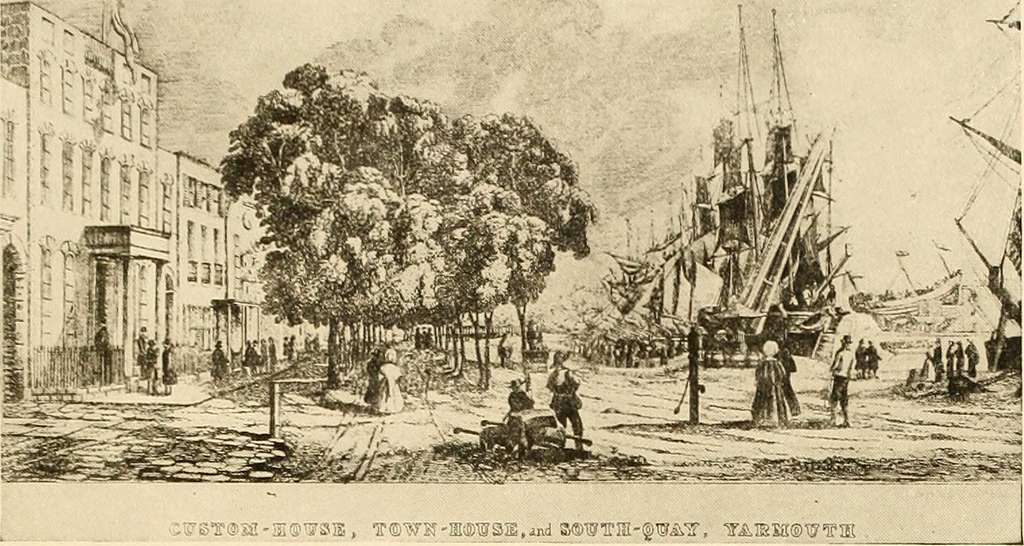
Take a stroll down the historic South Quay. It has been said that there were so many boats leaving Yarmouth in 1913 that you could cross the river from by leaping from one boat to another. The magnificent buildings along the river are a reminder of this port’s history. The Old Merchant’s House and the Great Yarmouth Row Houses are located just off South Quay.
The Rows were a network of winding alleyways where port workers lived.
(Image: The South Quay, circa 18th or 19th Century. Source: getarchive.net 2025)
The South Quay Elizabethan House has a reputation for being haunted. Some have called it a “hotbed of paranormal activity”. The Elizabethan House Museum is a historic 16th-century house, which showcases Elizabethan domestic life. It was constructed by affluent trader Benjamin Cowper in 1596, and when Cowper’s fortune grew, it was expanded in the early 1600s. In 1635, the mansion was bought by the town bailiff and local businessman, John Carter. Shortly before the Civil War, it developed as a meeting spot for Parliamentarians, most famously hosting a meeting in 1648 to discuss the future of King Charles I. John Carter’s sons, John and Nathaniel, inherited the house after his death in 1667 and remained there until their deaths in the early 1700s.
The house is said to have a history of paranormal events, including sightings of a ghostly woman, and reports of disembodied voices and unexplained noises The Elizabethan House is a popular location for ghost hunts and paranormal investigations due to its reputation as a haunted location.
As we continue west along the South Quay and head a little deeper through the side streets, we now encounter the Time and Tide Museum, located at 5 South Quay.
The Time and Tide Museum is housed in one of the best-preserved Victorian herring curing facilities in the United Kingdom.
The Tower Fish Curing Works, which was first constructed in the mid 1800s and expanded in 1880, is now home to the Time and Tide Museum. The works finally closed their doors in 1988 and The Tower Fish Curing Works was acquired in 1998 with the goal of turning it into a museum. This museum now showcases the history of Great Yarmouth, its herring business and social history.
At this museum you can discover Great Yarmouth’s varied history, its rich maritime and fishing heritage and some of the fascinating characters who made their living from the sea. You can even wander through a reconstructed Victorian ‘Row’ and see inside a fisherman’s home. You can soak in the atmosphere of the 1950s quayside, and hear exciting tales of shipwrecks and gripping rescues. The museum also contains some items of Fortean interest, such as the walking cane of Robert Hales, the East Somerton Giant.
Finally, we retrace our steps by walking north along South Quay, turning right onto St Nicholas Road and then heading back to the church.
And so, our walk comes full circle, to St Nicholas’ Church. In just a short wander through Great Yarmouth’s streets, we’ve uncovered tales of pirates and body snatchers, witches and mystics, circus ghosts and cannibal victims. This is a town where history and folklore blur, where the past is never quite at rest. Next time you stroll along these cobbles or pause by the quay, perhaps you’ll sense it too: the unseen layers of Great Yarmouth’s darker side.
(Image: The Spook Express, Joyland. Source: E.Holohan 2023)
Time and Tide – Norfolk Museums Service. (2024). Time and Tide – Time and Tide – Norfolk Museums Service. [online] Available at: https://www.timeandtide.norfolk.gov.uk/.
(Time Between Times. Image Credit: O.Staton and Spotify)
I’m thrilled to share that I recently had the incredible opportunity to join the captivating storyteller Owen Staton on his podcast, The Time Between Times. It was my first podcast interview, and we had a wonderful conversation about my writing, my obsession with the paranormal, and, of course, my all-time favourite Norfolk ghost story; the eerie tale of the Phantom Drummer Boy of Hickling Broad. Owen asked me why I chose this particular tale to be retold by the firepit. It’s more than just a ghost story to me; listen to the episode to find out why this eerie legend resonates so deeply.
Owen Staton is a master storyteller, so I couldn’t have asked for a better host to guide me through this fascinating chat. We covered everything from the origins of my interest in all things spooky and Fortean to my adventures around the UK and the Republic of Ireland in search of haunted places. I even had the chance to discuss my blog, Ghost Catcher Isles, which has been steadily growing in 2024, and my exciting plans for its future. I even shared a personal story about an unforgettable encounter that still gives me chills. You won’t want to miss this!
It was such a fun and thought-provoking conversation, and if you’re into ghost stories, the paranormal, or just love a good tale, this episode is one you won’t want to miss.
You can catch the full interview on Spotify or wherever you prefer to get your podcasts. Come listen, and let me know what you think—maybe we’ll share our own ghostly experiences together next time!
I’m proud to see my debut article in Haunted Magazine, sharing the front cover with stars of Uncanny, Danny Robins and Chris French too. Exciting!
This article is also very special to me as it recounts one of my final excursions with my late mother Susan. My mum was very creative and loved to write fantasy fiction, but was still building up her confidence around her craft. She loved all things spooky, was a ‘believer’ and had had many an unexplained creepy encounter. I get my love of the paranormal from her. Sadly she passed away far too soon and unexpectedly last year. I wish she were here to read my debut article and I hope I’ve done her proud.
Please pick up a copy soon to read all about my adventures in search of witches and giants.
My step-uncle Gerald lived in the village of Hickling, nestled in the heart of the Norfolk Broadlands. He was one of the few remaining reed cutters, a job with a long, proud tradition in the area but sadly dying out as fewer people needed thatch for their homes.
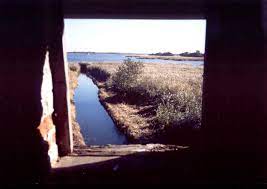
It was back in the mid-1990s that my step-uncle spent his day on Hickling Broad, the local body of water, slicing through reeds as the sun dipped below the horizon. One evening, the air grew cold and he witnessed a spectral figure gliding across the Broad.
(Hicking Broad, Norfolk. Image Source: John Fielding)
Now, being Hickling born and bred and from a family whose ancestry here stretched back as far as the Norse settlers, Gerald realised in horror that he was witnessing a local legend recreating its ethereal journey across the Broad.
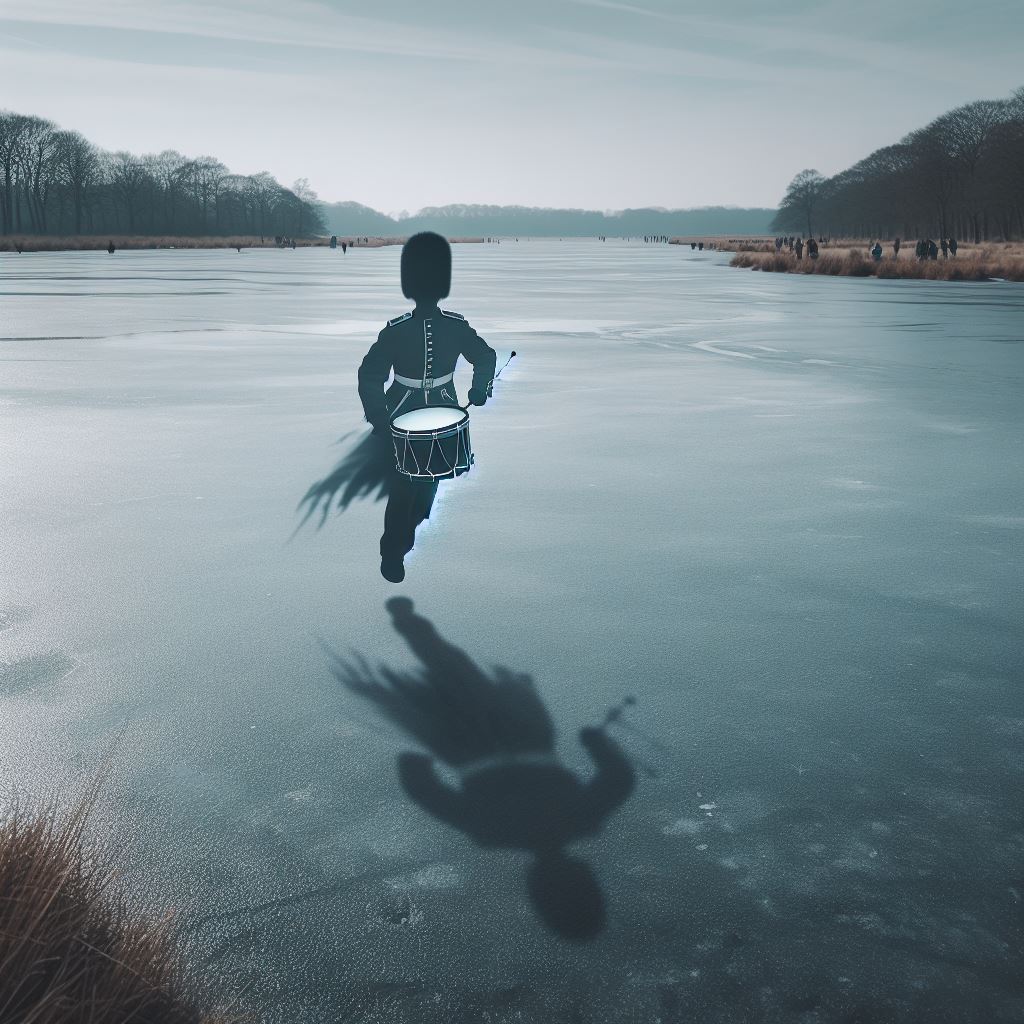
Local folklore has it that during the winter of 1815, shortly before the battle of Waterloo, a local drummer boy from Potter Heigham returned home on leave. While back he fell passionately in love with a local girl from a wealthy and influential family. The girl’s father, knowing the drummer boy was poor, refused to allow the relationship and any thought of marriage.
Undeterred by this, the star-crossed lovers continued to meet in secret every night in a little hut at Swim Coots on the edge of Hickling Broad. When the winter turned icy and the Broad froze over, the drummer boy skated over the ice, wearing his bright yellow scarlet trimmed coat, and would beat his kettle drum to signal his approach.
One frozen February evening the girl waited at Swim Coots as usual and listened out for the drum beat of her paramour. But this time the drum beat suddenly stopped and there was an eerie silence. The ice had cracked and the drummer boy had plunged through and drowned in the freezing waters of the Broad.
It is said that the girl rushed to the edge of the frozen Broad to find her lover and was relieved to see the shivering boy skating towards her. As she held out her hands to help him ashore, she felt his icy touch and the drummer boy disappeared.
The unfortunate drummer boy was not found for several days when a lifeless body was pulled from the Broad clad in a yellow coat with scarlet trim.
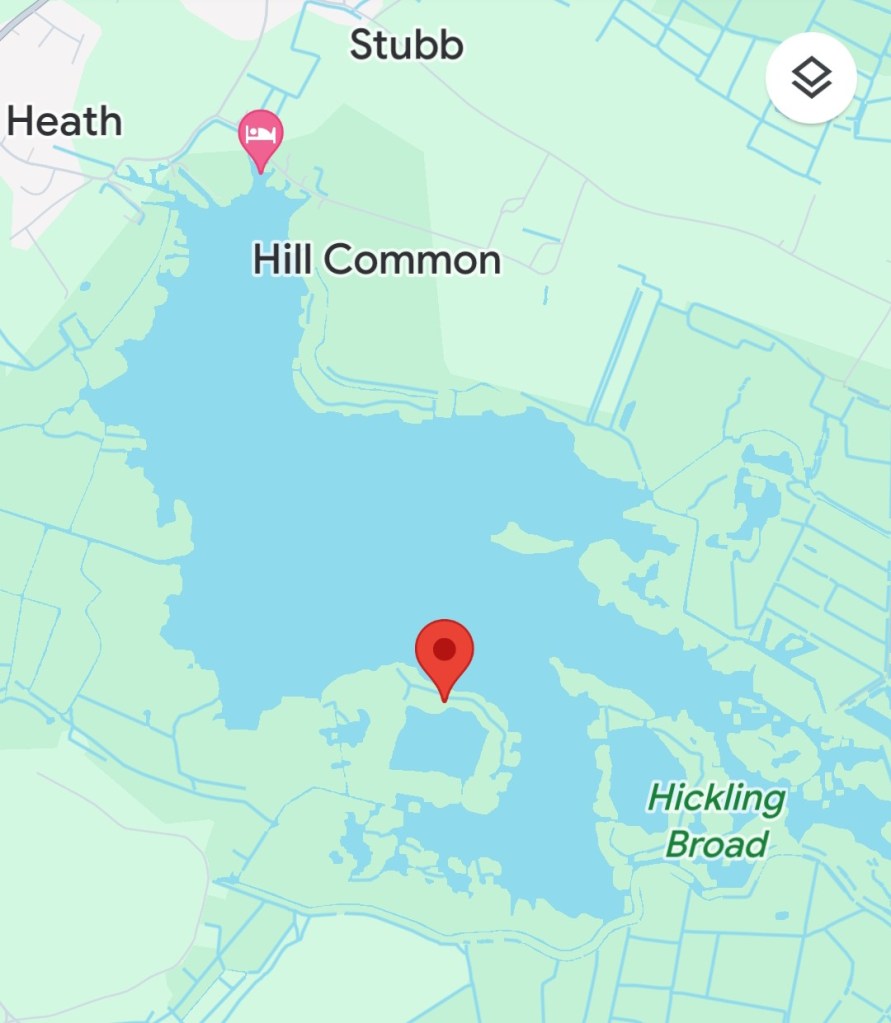
(Hickling Broad with Swim Coots marked. Image Source: Google Maps 2023)
Since then, it is said that on some cold winter nights in February, the eerie sound of a rhythmic drum tattoo and the swishing of skates can be heard, as the ghostly drummer boy tries to keep his date with his sweetheart.
After observing in shock the gliding figure, Gerald quickly downed his tools and fled back to the village where he decided to visit the Greyhound Inn for a stiff, nerve-settling drink. As Gerald recounted the haunting sight of the ghostly drummer boy to the sceptical pub patrons, the line between reality and spirits blurred. Was it the ethereal presence of the supernatural he witnessed, or a distorted vision fuelled by the spirits from his glass?
The locals in the pub dismissed his tale, attributing it to his well-known predilection for whisky. However, Gerald couldn’t shake the chilling memory, leaving him wondering if the haunting beats of the drummer boy would forever echo in his consciousness or fade away like the dissipating spirits in his empty whisky glass.
I’ve been interested in the paranormal since I was a child, even joining an amateur paranormal investigation team in Ireland for a year when I lived in Dublin, though remaining firmly in the ‘sceptic’ camp. The experiences I want to describe to you happened to my mother when I was around 13 years old and it is where my interest in the paranormal began.
My mum has worked as a care assistant and later in managerial roles in elderly people’s residential care homes in Norfolk for most of her adult life. She has had several unusual, creepy and unexplained experiences in several places, but the one that left its mark on her and me the most was in a care home in a busy touristic town on the Norfolk Broads. This care home was in a very old building that had once been part of a landed estate, and it comprised of gardens, a large house with multiple rooms and converted stables/sheds.
My mum worked as a relief assistant manager there for a period and part of the job required that she sleep over night. She had slept in different rooms in the main building before and had odd experiences; she had had her things moved and nightclothes folded and put on the bed on occasion and upon asking no staff had admitted to moving them. She said this room felt safe and friendly, like there was a friendly poltergeist there who wanted to be helpful. In one certain room, she had woken in the night to hear crying from the room above. Upon investigation, she was told that there was nobody in the room above. Although creepy, her experiences in these rooms did not leave her shaken and she was generally happy to sleep in them.
It was however, when my mum was required to sleep in the rooms in the converted stables/sheds that she had the experiences that left her shaken and scared. I remember seeing my mum when she returned from work the afternoon after her first night in that room and she looked awful. She looked exhausted and shaken up but would not tell me what had happened to her. It took her around 3 days for her to finally gain the strength to speak about it as she felt she would not be believed. I believe she experienced something in that room that she could not explain.
My mum told me that she had felt uncomfortable in that room from the first time she went in. She said it felt cold and unfriendly. On that first night she had finished up her tasks for the night and had gone to her room to settle in for the night. She said she had the bedside lamp on and was propped up in bed reading, which is her custom to help her relax before sleep. She said it felt cold in the room and she noticed something odd from over the top of her book. She said she saw a grey mist coalescing near the window and between the end of the bed. She felt frozen with fear and watched the mist grow until around 5ft in height, like figure. The mist seemed to shuffle towards her and this was more than enough for my mum and she told me she shot out of the bed and out of the room. She refused to return that night and slept as best she could in a chair in one of the lounges. She spoke to the night staff and they disclosed that other people had had strange experiences in that room.
Sadly, my mum had to return to that room as part of her job, so she decided she had to live with whatever was in the room. She said following that first incident she experienced knocking and banging on the door, but nobody there and staff confirming nobody had been to her room. She heard knocking and banging inside the room too, sometimes waking her up. She was so frightened she spoke to a local vicar about what to do and began sleeping with a Bible next to the bed and a glass of water to represent life.
Other relief assistant managers also had to slept in that room and at least 2 others disclosed that they had had experiences in there. One lady had felt what felt like someone get in bed beside her and somehow pass through her. Another had felt something pulling the duvet from the end of the bed.
My mum spoke to some locals who said that they believed an Italian prisoner of war had worked on the estate and had died in the stables. Could he still be there trying to get attention?
My mum said throughout the time she worked there she continued to experience things in that room, but they did calm after she spoke to it. She became so fed up with her sleep being disturbed and feeling afraid that she literally spoke to it, or at least to the room, telling it that she wasn’t there to harm it, she had to stay there for her job and if it ceased bothering her, she would not bother it. This seemed to calm things in there somewhat from then on and she was able to sleep with less disturbance.
The building there is no longer a care home for the elderly, but has a similar use, so she prefers to keep the place anonymous as she doesn’t want to cause alarm to anyone who stays there now. I wonder if the entity in that room and the spirits in the other rooms are still active?











 Ghost Catcher Isles
Leave a comment