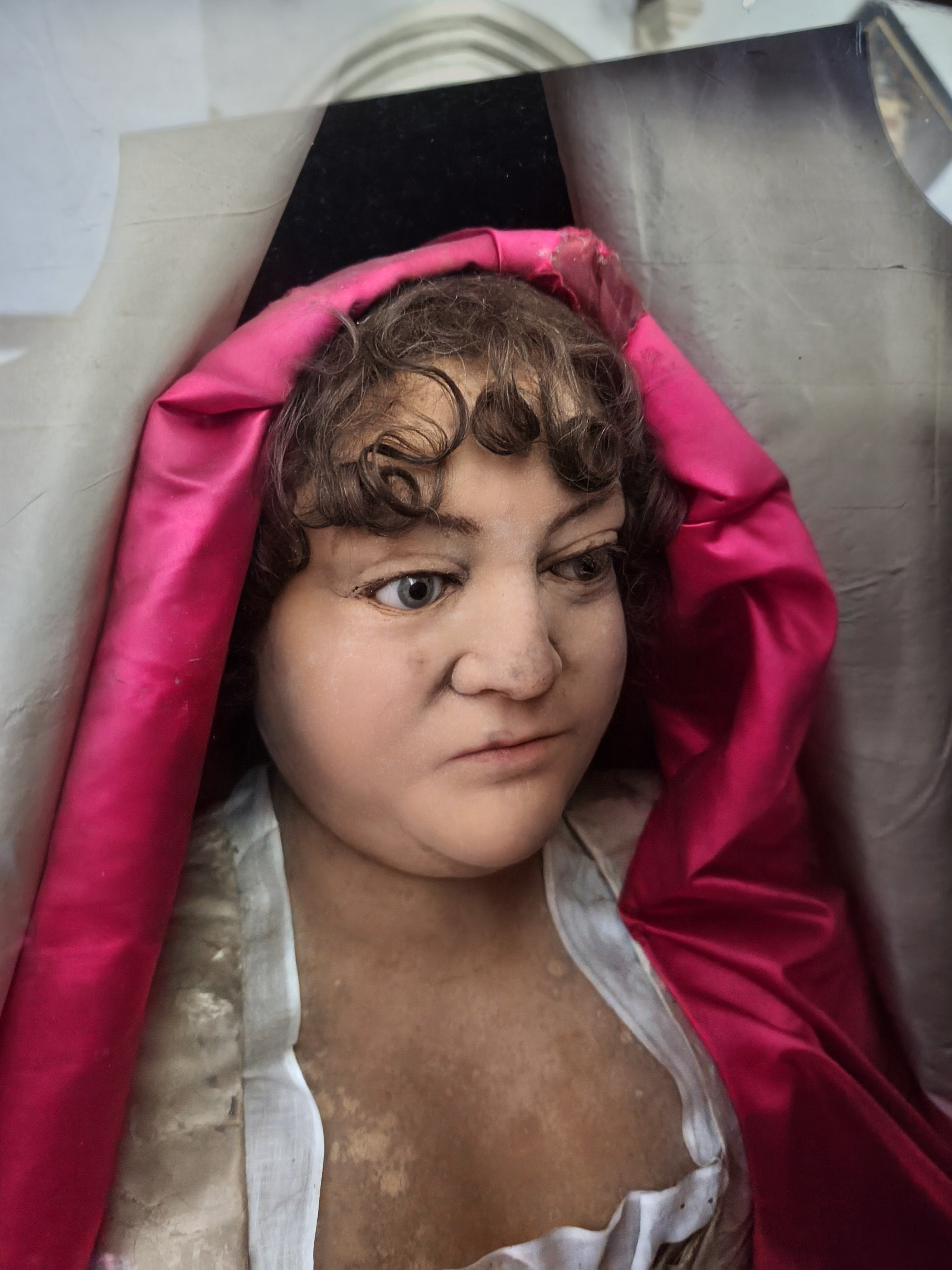
Face to Face with the Uncanny Wax Lady of Stow Bardolph

(Image: Effigy of Sarah Hare. Source: E.Holohan 2026)

When I was a child, I had a fascination with the strange corners of history, and this, of course, has continued on into adulthood. The books I borrowed from the library were full of ghosts, folklore, unexplained mysteries and curious historical oddities. Among all the photographs that lodged themselves in my imagination, save for the spontaneous human combustion foot photo, one stood out above the rest. It was the wax effigy of Sarah Hare.

I remember being quite unsettled by it. In a time before I’d ever heard the phrase “uncanny valley,” I already knew exactly how it felt. She looked too real to be a statue yet far too lifeless to be a person. I found her slightly repulsive, but I could never quite look away.

So, when I recently found myself in Norfolk, visiting Holy Trinity Church at Stow Bardolph was top of my list. I wanted to see whether the real thing would have the same effect as those childhood photographs. And it absolutely did.
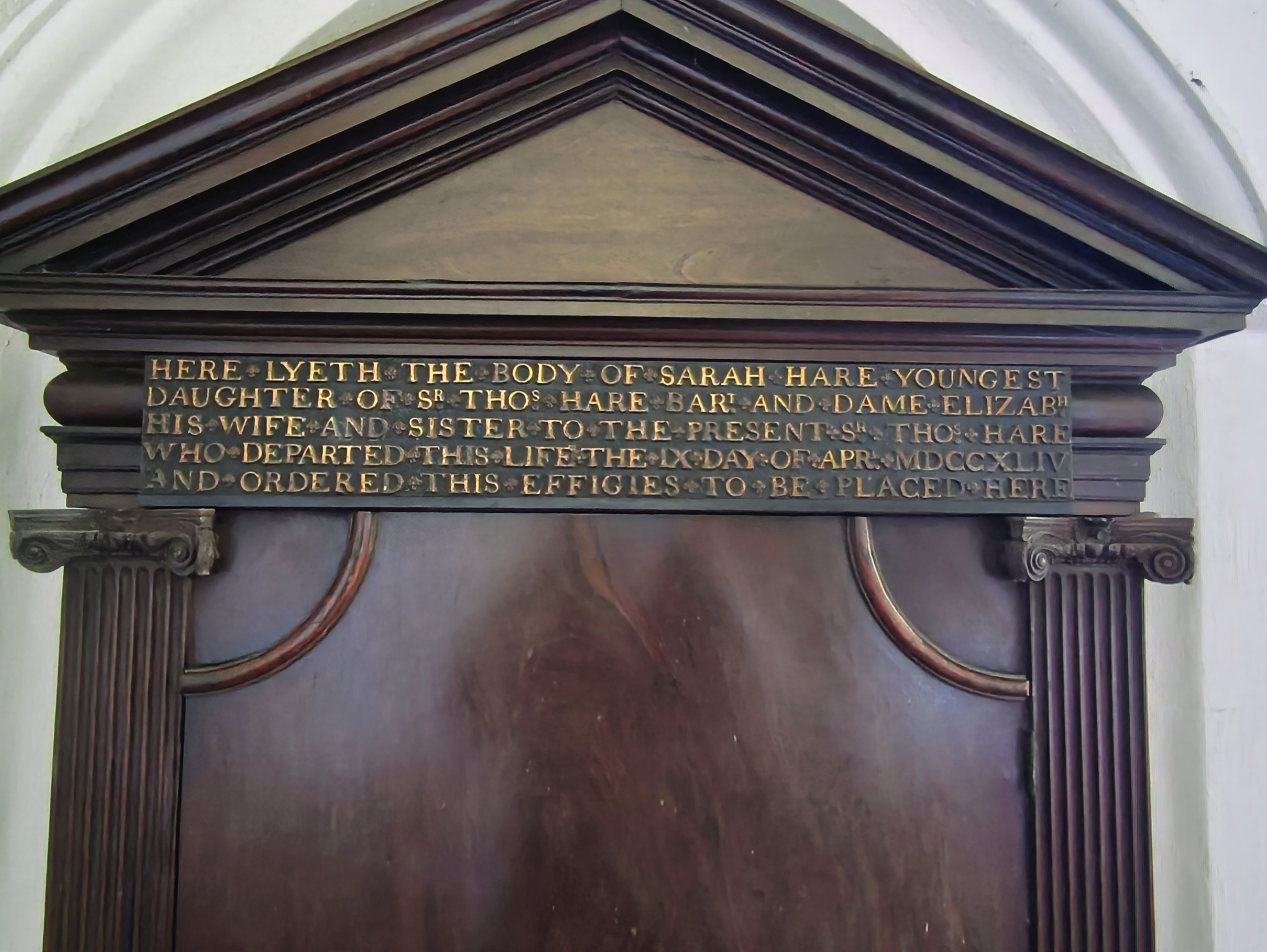
(Image: Inscription on Cabinet. Source: E.Holohan 2026)

Sarah Hare was the youngest daughter of Sir Thomas Hare of Stow Hall. She never married, so was what was once called a “spinster”, and lived a fairly ordinary life. In 1744, aged 55, she died from blood poisoning after pricking her finger while sewing. Later, locals claimed it was divine punishment for the crime of sewing on a Sunday, although the far more likely explanation is that the wound simply became infected.

The year before her death she wrote a remarkably detailed will. Alongside gifts to the poor of the parish, she made one very unusual request. She wanted her face and hands reproduced in wax, her own hair placed upon her head, and the finished effigy displayed in a mahogany cabinet with a glass front close to where she was buried.

She wrote: “I desire to have my face and hands made in wax with a piece of crimson satin thrown like a garment in a picture, hair upon my head and put in a case of Mahogany with a glass before and fix’d up so near the place were my corps lyes as it can be with my name and time of death put upon the case in any manner most desirable…

If she did not arrange it during her lifetime, she instructed that it should be done after her death. Her family honoured those wishes. If you don’t ask, you don’t get, I suppose. And oh boy, did she get.

Today visitors to the Hare family mausoleum find a plain mahogany cabinet tucked into one corner. Nothing about it hints at what lies inside. Then the doors are opened, and there she is…

No photograph quite prepares you for seeing Sarah face to face. Her blue eyes seem fixed upon you. Her skin shows every wart and blemish. Her double chin has not been smoothed away. She wears one of her own silk gowns along with the crimson satin she specifically requested, and what is thought to be her own hair frames her face beneath an old fashioned wig.
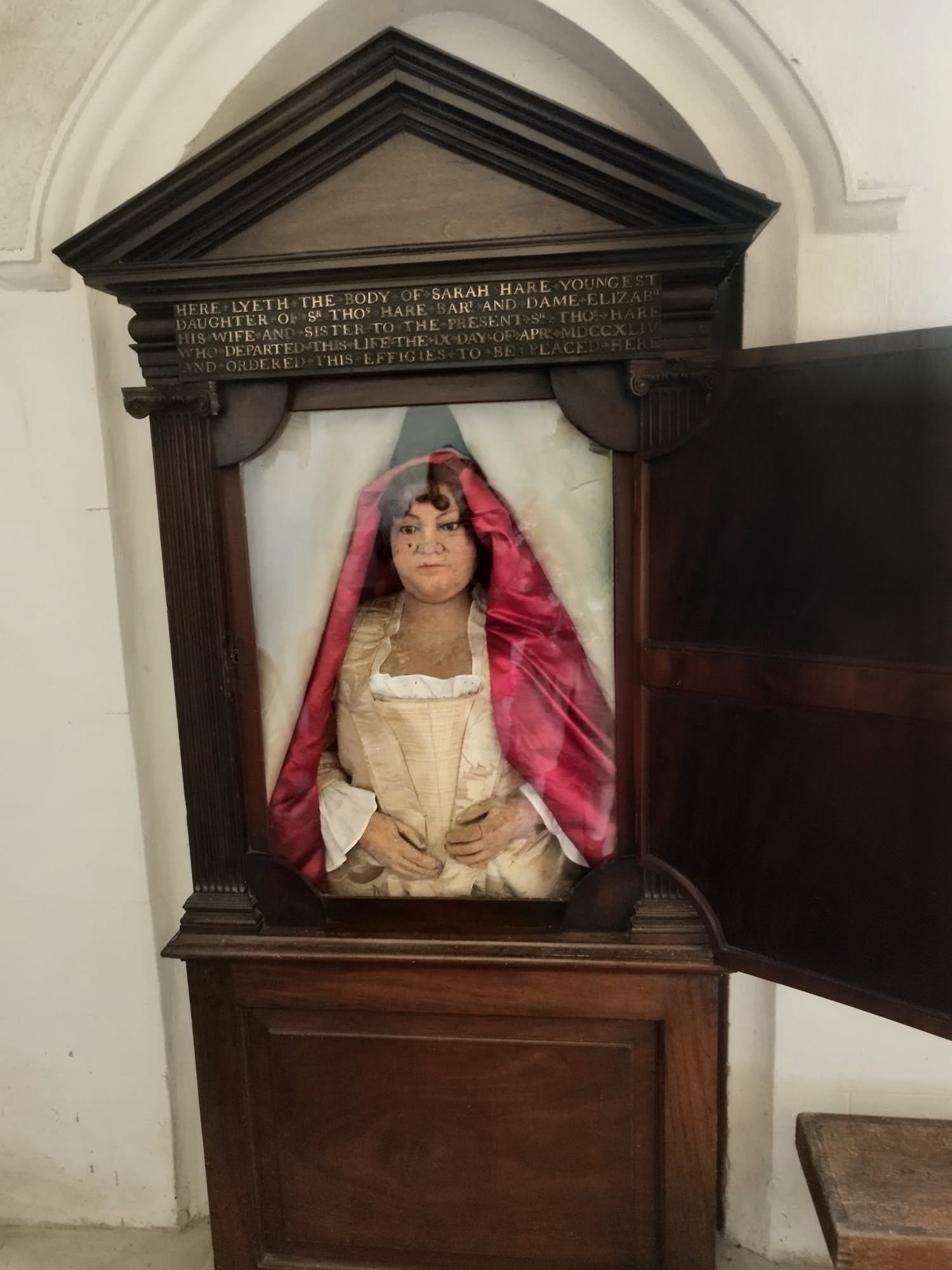
(Image: Effigy of Sarah Hare. Source: E.Blackshaw 2026)

It is an astonishingly honest portrait, unadulterated by an idealising sculptor. In a time when many memorials celebrated wealth, beauty or achievement, Sarah chose something altogether different by asking to be remembered exactly as she was.

I wondered what her motives were. Was it vanity? I doubt it. If anything, the effigy avoids vanity completely. Nothing has been softened or flattered. Every blemish and imperfection remains. Perhaps it was simply a desire not to disappear entirely. After all, most of us hope to leave some trace that we were here, whether through family, creative work or acts of kindness. In Sarah’s case, she chose wax.

The effect is incredibly eerie. There is something deeply unsettling about meeting the gaze of someone who died almost three centuries ago, particularly when they appear so strikingly human.

There is also something strangely moving about it. Sarah has spent nearly 300 years silently watching visitors come and go. Seasons have changed and decades have flashed by. Yet Sarah still waits behind those cabinet doors. Time has not been entirely kind. The wax has required careful conservation and rodents once damaged her clothing before restoration work in the 1980s. Even so, she survives as the only funerary wax effigy in England outside Westminster Abbey.

Sarah Hare achieved the immortality she wanted, although probably in a way she could not have ever imagined. Thousands of curious visitors now make the journey to Stow Bardolph simply to meet her and look into her eyes.

As I left the Hare Chapel, I thought back to the child who had first stared uneasily at her photograph all those years ago. The real Sarah Hare was every bit as uncanny as I’d hoped she would be. Sometimes the strangest places really do live up to their reputation.

And occasionally, they exceed it.


Sources

Dreams of Treasure

Part 1: The Pedlar of Swaffham 

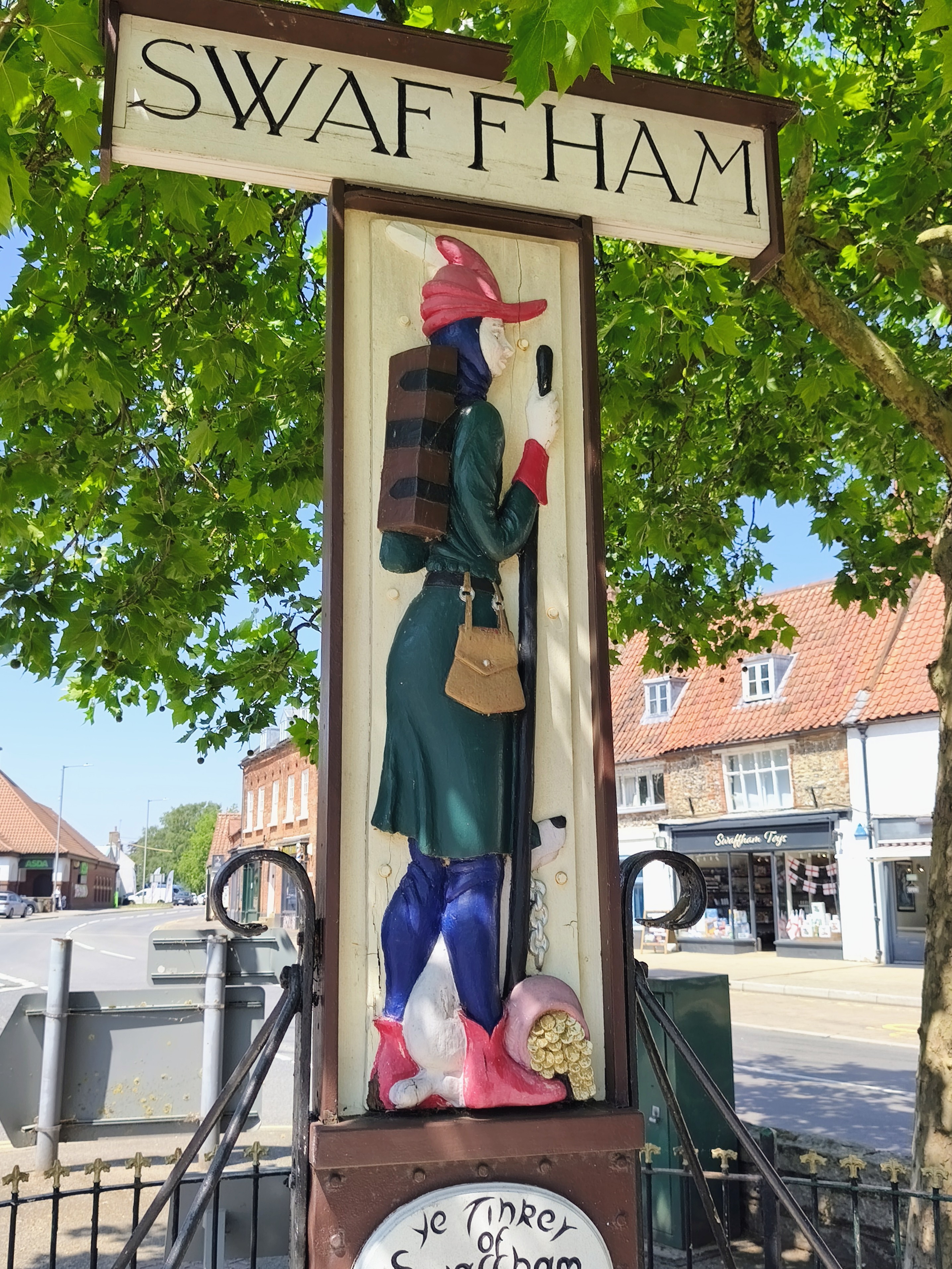
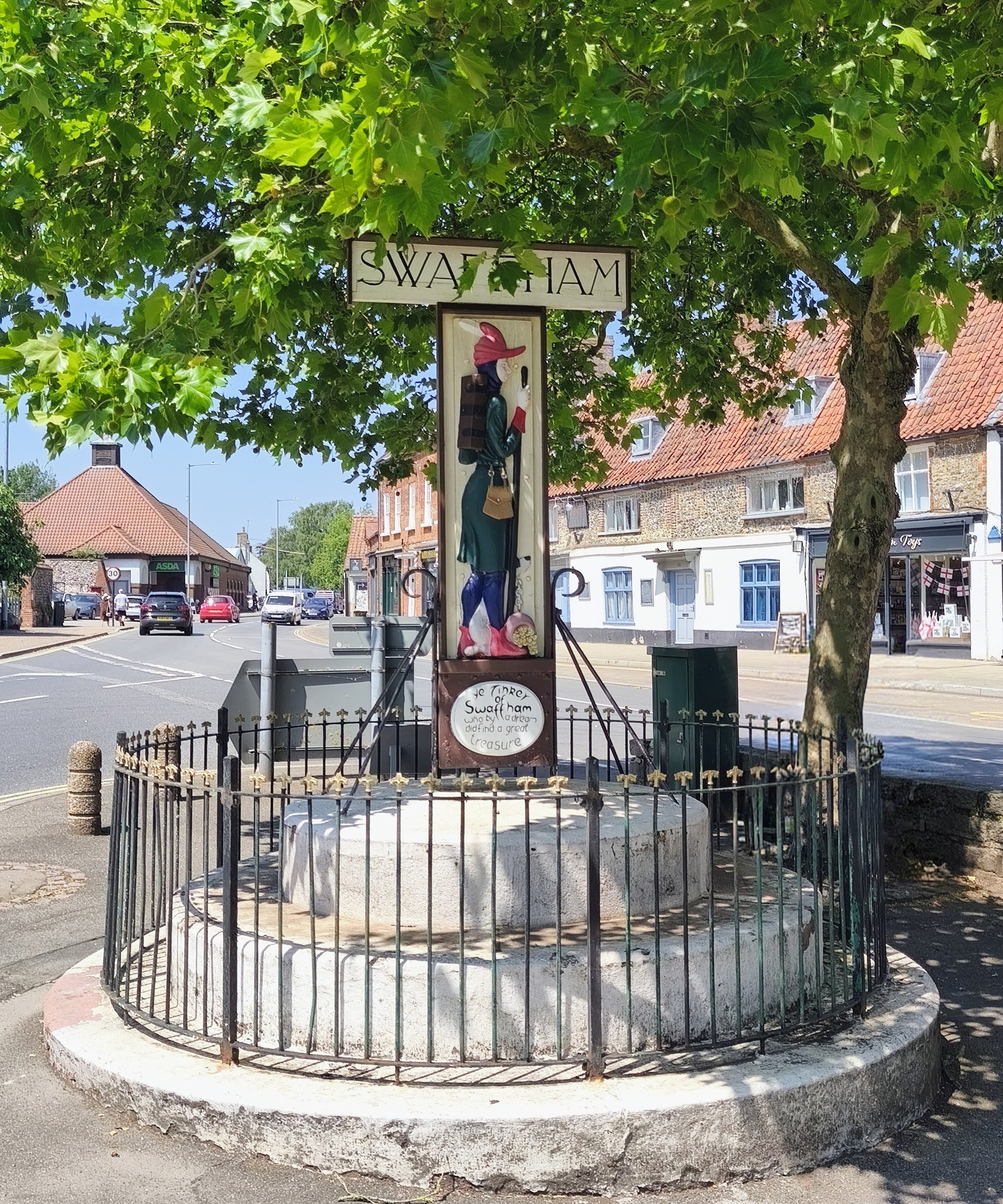
(Image: Swaffham Town Sign. Source: E.Holohan 2026)

A Story That Stayed With Me

When I was at primary school in rural Norfolk I remember hearing one of the first Norfolk folktales that ever captured my imagination: the Pedlar of Swaffham.

The story fascinated me. Over the years, I came to realise that although it felt so familiar to me, it was not nearly as well known elsewhere. Many people had heard of the famous tale of Dick Whittington and his cat, but very few people I met had ever heard of the Pedlar of Swaffham and his hound. Yet, as we shall discover, this story belongs to a much wider tradition of folklore and shares surprising similarities with legends from elsewhere.

I can still picture myself sitting cross legged on the classroom floor, listening intently as my teacher recounted the almost magical story of a poor pedlar whose life was transformed after following a dream. Then came the part that amazed me. My teacher told us that the story was based on a real person, and that the pedlar had paid for the rebuilding of the church in Swaffham. Better still, she said, you could still see him on the town sign.

To a child, that was extraordinary. How could someone who seemed to belong in a fairy tale have actually existed?

Stories like this have a way of staying with you, lodging themselves in your imagination. The Pedlar of Swaffham certainly did for me. Decades later while visiting Norfolk, I decided it was finally time to visit Swaffham itself to see whether I could still find traces of the legend and perhaps even of the man behind it.

Looking for the Pedlar

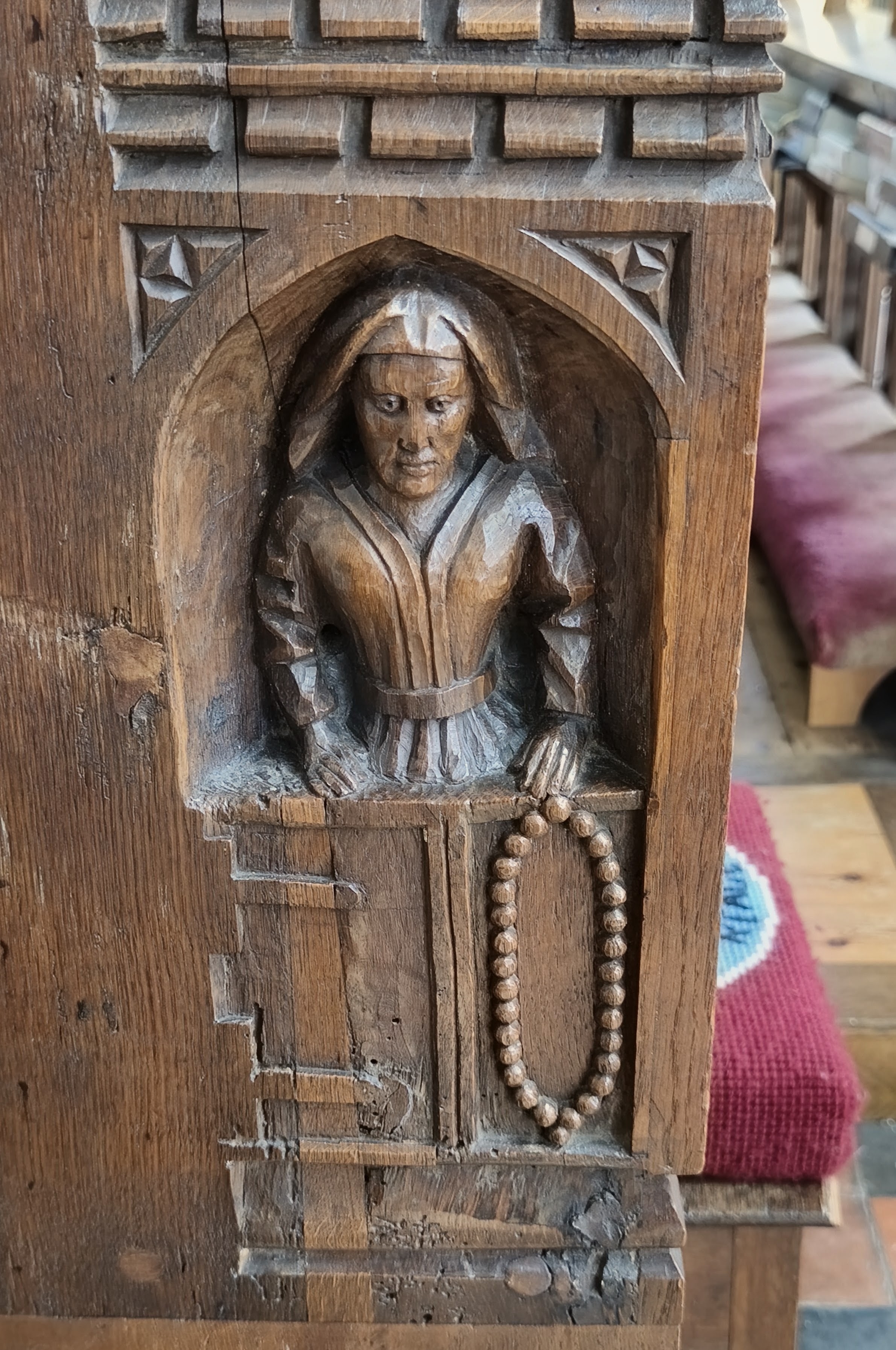
(Image: Carving believed to be John Chapman. Source: E.Holohan 2026)

While researching both the folklore and the historical origins of the Pedlar of Swaffham, I discovered that St Peter and St Paul’s Church contains carvings believed to depict the historical John Chapman, the man thought to have inspired the legend. That made the church my first destination.

Walking from the marketplace down a wide lane, the great tower of St Peter and St Paul’s gradually came into view, rising above the surrounding buildings. Stepping inside, I was immediately struck by the magnificent hammerbeam roof stretching overhead. The church was quiet, filled with the sort of peaceful atmosphere that encourages you to slow down and take everything in with reverence.

I then began my search for the famous carvings.

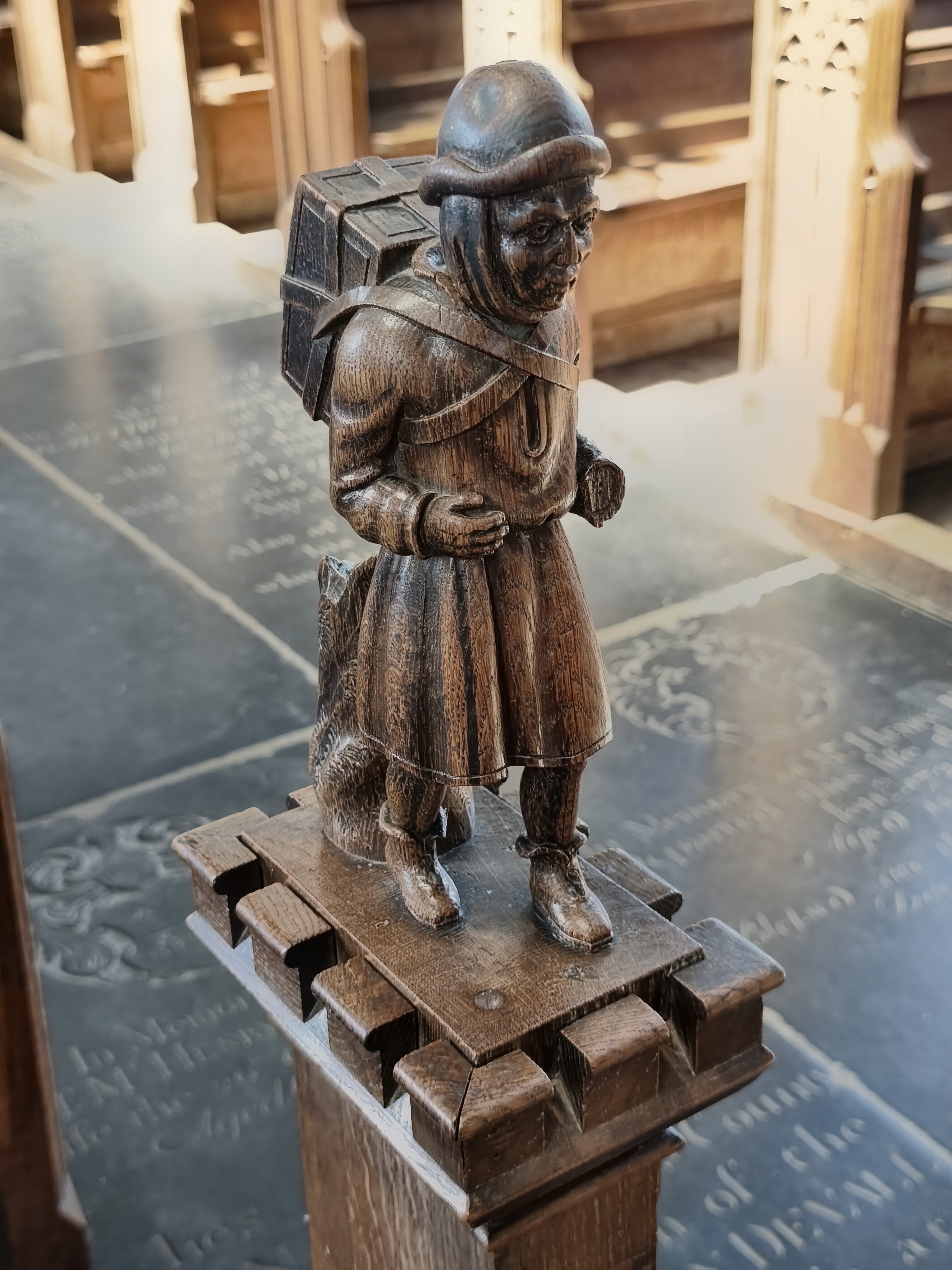
The first I found were on the bench ends. Some showed a folkloric depiction of the Pedlar of Swaffham wearing his close fitting rolled brim hat and carrying his pack. Nearby were carvings of his faithful dog. They were wonderful to see, but they were not the figures I had come looking for.

Further into the church, I finally found them. The carvings believed to represent the historical John Chapman show him peering from a window, while his wife looks out from a balcony above. It felt strangely moving to come face to face with someone who had lived in my imagination since childhood.

The Church Behind the Legend

The history of the man in the carving is closely linked to the history of the church itself.

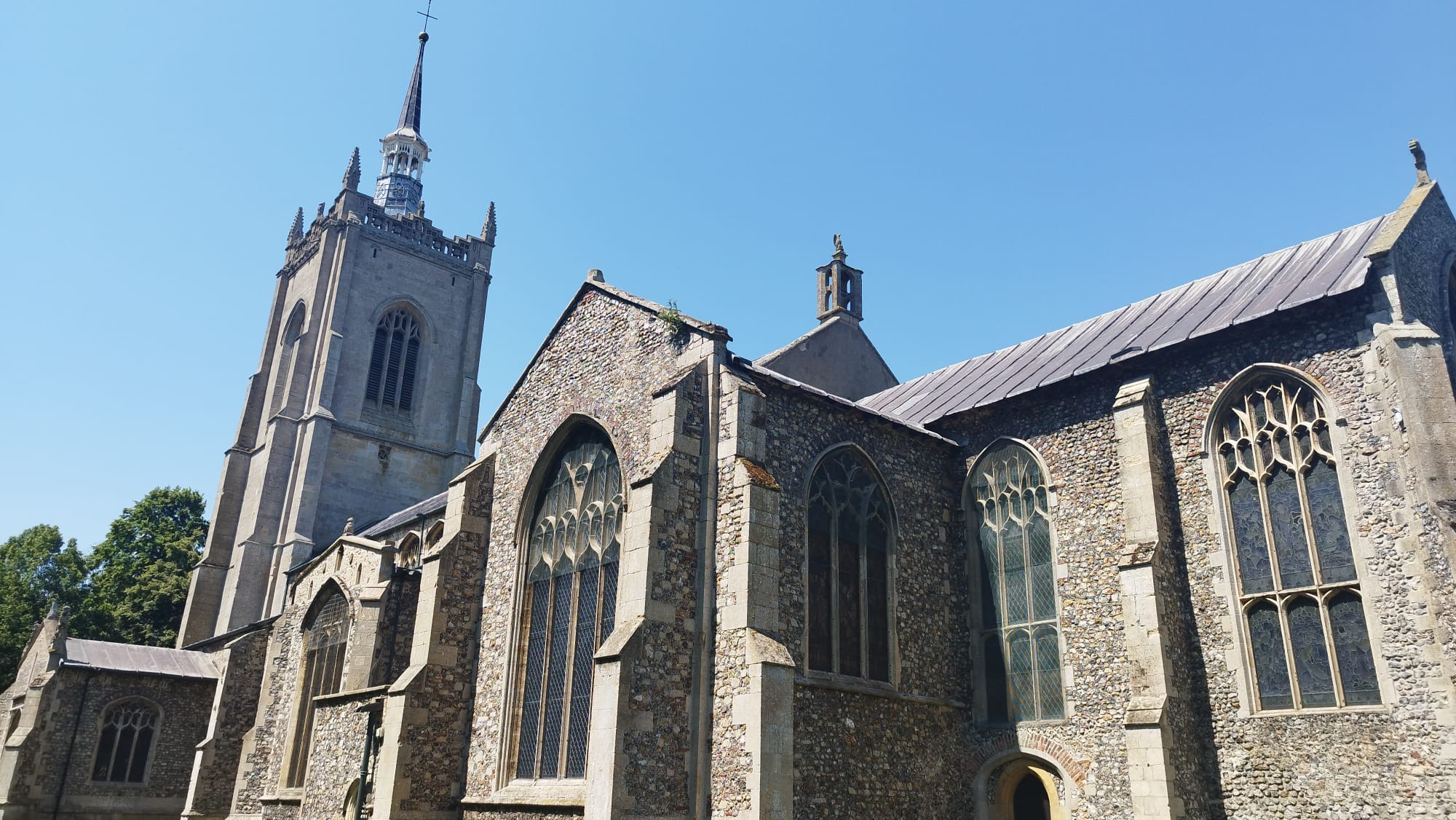
(Image: St Peter and St Paul’s Church, Swaffham. Source: E.Blackshaw 2026)

St Peter and St Paul’s Church was rebuilt during the fifteenth century, funded by a number of wealthy local benefactors. Among them was John Chapman, whose generosity helped finance the work and whose likeness is thought to survive within the church.

It is here that history and folklore begin to merge. The documented life of John Chapman became entwined with the local legend until it became difficult to separate the historical benefactor from the legendary pedlar. Together, they created one of Norfolk’s most loved folk stories.

Who was John Chapman? Why did he become known as the Pedlar of Swaffham? How did the story of one Norfolk merchant become one of England’s most enduring folktales?

Settle in and let us follow the dream that turned an ordinary pedlar into a legend.

The Pedlar’s Dream

John Chapman was a pedlar, a travelling merchant, who wandered around Norfolk in the fifteenth century, taking his goods from one market to another. On market days he would join the other traders selling everything from brooches and combs to silver mirrors, eggs, spices, mustard and freshly baked bread. With his packhorse loaded with wares, John would leave Swaffham early in the morning and spend the day selling what he could. He’d then stay overnight in simple lodgings and return home the next day.

One day he came home tired and disappointed. Business had been very poor and he had not sold a single thing, not even one copper pan.

After his meal he complained to his wife that money was becoming short and trade was getting harder. The long journey had worn him out, so he went straight upstairs to bed.

That night he had the strangest dream.

(Image: Pedlar of Swaffham bench end. Source: E.Holohan 2026)

The dream was so vivid that it felt completely real. A man appeared to him over and over again, telling him that if he travelled to London Bridge and stood there, he would hear something that would lead him to his fortune.

When he woke the dream stayed with him. He tried to put it out of his mind, but it kept returning. The next day he thought about it again. Then the day after that. The more he tried to ignore it, the more it seemed to pop into his head.

Eventually he could stand it no longer.

“I have to go to London Bridge,” he told his wife.

She thought the whole idea sounded preposterous, but she could see he had made up his mind. If travelling all that way would finally put the dream to rest, then she was not going to stop him.

So John packed a few clothes and some food for the journey, called to his faithful dog, and set off on the long road to London.

After many days of walking he finally arrived in the hustle and bustle of the great city. Before long he found London Bridge, but it was nothing like the bridge we know today. In those days it was lined with houses and shops, with people living and working all along it. It was one of the busiest places in England.

John found a place to stand and waited.

He watched everyone who passed, listening carefully to every conversation. Surely someone would say the words he had travelled all this way to hear.

One day passed. Then another. Still nothing happened.

On the third day a shopkeeper noticed him and asked why he had been standing on the bridge for so long.

John admitted that he was there because of a dream. The shopkeeper just laughed.

“My friend,” he said, “if I believed dreams, I’d be as foolish as you. Only a few nights ago I dreamed I should travel to the home of a man called John Chapman in Swaffham and dig beneath the tree behind his house. According to my dream, I’d find a great treasure there. But you don’t see me rushing off to Norfolk, do you?”

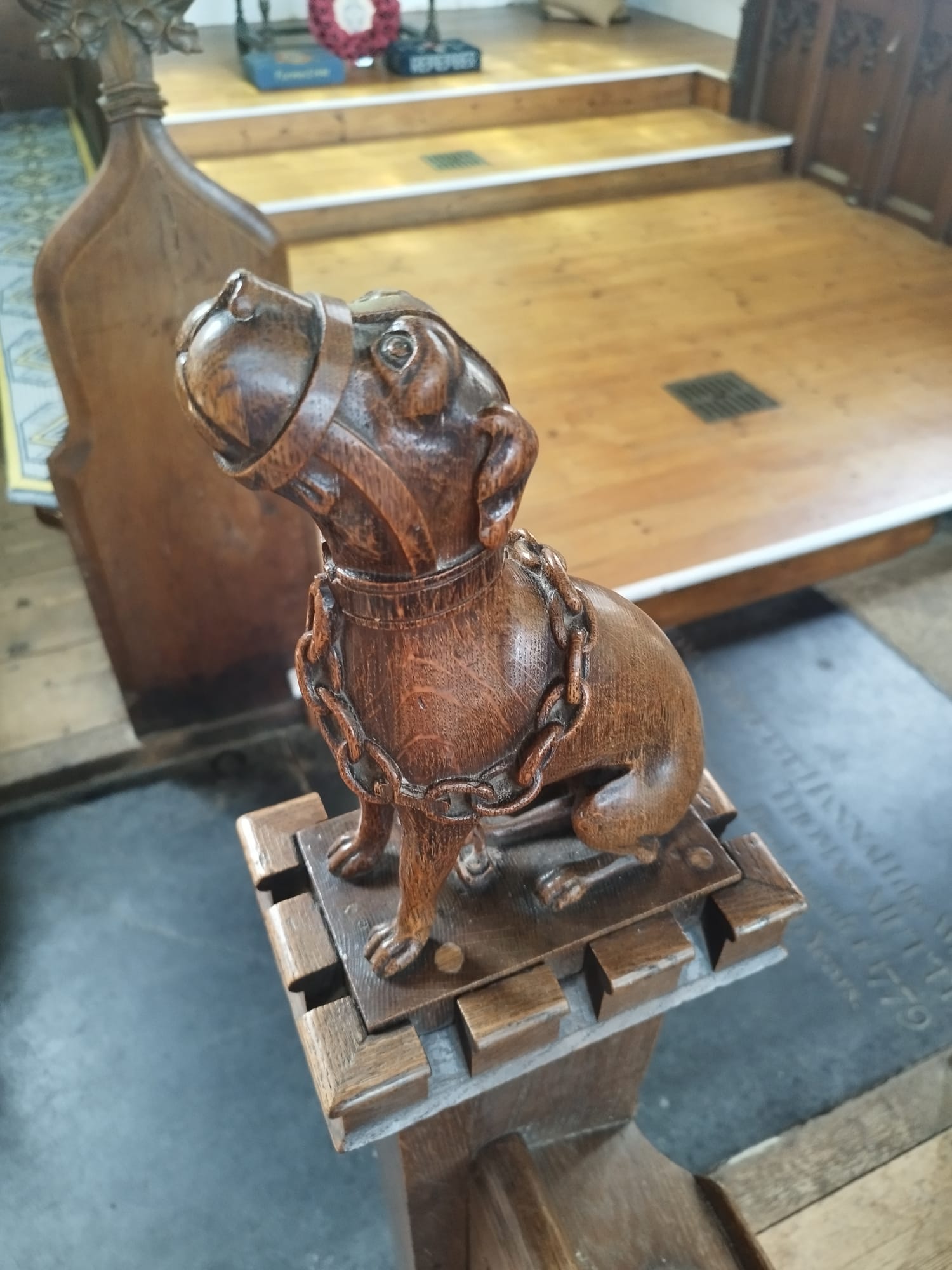
(Image: Chapman’s dog. Source: E.Holohan 2026)

The shopkeeper laughed again and went back to his business.

John stood speechless, scarcely believing his own ears. Without wasting another moment, he turned around and began the journey home.

As soon as he reached Swaffham he grabbed a spade and hurried to the apple tree behind his house. He dug as quickly as he could, hardly expecting to find anything, yet still hoping.

Then his spade struck something hard.

He uncovered a chest buried beneath the earth, filled with gold coins. He and his wife were overjoyed. But carved into the lid was an inscription in Latin that neither he nor his wife could understand. He started to worry that this might not be his fortune, but perhaps a curse inscribed. Hoping someone might recognise the words, John placed the chest in his window.

It wasn’t long before some educated young men who knew the language happened to pass by. They read the inscription and translated it.

“Under me doth lie, another much richer than I.”

John didn’t need telling twice.

He returned to the tree and dug even deeper. Soon he pulled up another chest, this one far larger than the first. Inside were coins, jewels and riches beyond anything he had ever imagined.

The pedlar’s fortune had finally been found.

According to the legend, John Chapman became one of Swaffham’s wealthiest men. Grateful for his good fortune, he helped pay for the rebuilding of St Peter and St Paul’s Church.

Whether every detail really happened is impossible to know. Over the centuries, history and folklore have become intertwined.  More than five hundred years later, the pedlar remains a symbol of Swaffham and is immortalised on the town sign. Visitors can still find the carvings said to represent the pedlar and his loyal dog, and his story continues to be told in Swaffham and far beyond.

As I walked from the church, I thought my journey with the Pedlar had come to an end. In reality, it was only just beginning. While researching the Swaffham legend I had come across another story of a prophetic dream and hidden treasure, but this time from a place with a very personal connection to my own life.

It made me wonder whether the Pedlar of Swaffham is just one version of a much older story, one that has travelled across countries and centuries.

That is a journey I’ll be exploring in the next part of this series. 

(Image: Swaffham Town Sign. Source: E.Holohan 2026)

Sources

‘First Irish case’ of death by spontaneous combustion

Photo by Du01b0u01a1ng Nhu00e2n on Pexels.com

A man who burned to death in his home died as a result of spontaneous combustion, an Irish coroner has ruled.

Michael Faherty, 76, died at his home in Galway on 22 December 2010.

Deaths attributed by some to “spontaneous combustion” occur when a living human body is burned without an apparent external source of ignition.

See here for the full story:  http://www.bbc.co.uk/news/world-europe-15032614

333 Phenomena

Photo by Ivan Oboleninov on Pexels.com

Over the years there have been frequent reports of a variety of unusual phenomena experienced between 3-4am, particularly heightened at 3:33am. Such phenomena as individuals waking up at this time for no logical reason, reported experiences of ‘sleep paralysis’ and more frequent reports of paranormal activity are associated with this time frame.

3am is often referred to as “Dead Time” or the “Devil’s Hour” as it is the time when paranormal activity is at its peak. Demons are said to be more active at this time rather than spirits. The popular Christian theory is that Jesus Christ died at 3pm, the opposite of 3am, and so 3am is the most active time for demons who wish to defy Christ and mock the Holy Trinity.

3:33am is thought to be the time for the ultimate mockery of the Holy Trinity with it also being half of 666; the number of the Beast. It is said at this time the veil between the world of the living and the world of the dead is at its thinnest, allowing demons and spirits to communicate or cross over more easily than at other times.

Those who research the field of the paranormal state that spirits can be active 24/7 and that there is no concrete evidence to indicate that 3am is more active than any other time.  However, paranormal activity may appear to occur more often at night as conditions of darkness are more suitable for conducting paranormal research. It is easier to see light anomalies or apparitions in the darkness and many items of paranormal research equipment are better able to pick up on activity in dark conditions.  The senses are also intensified at night, which may give the impression that there is more paranormal activity occurring at that time due to everyday noises and tricks of the light creating mistaken paranormal experiences.

It has also been noted that many deaths occur between 3-5am as it is at this time that the body’s immune system is more vulnerable. Those who are terminally ill or very elderly are more likely to pass away at this time due to the body being weakened. Some researchers cite this as a theory as to why more spirits are active at this time, correlating with their times of death.

333 phenomena has also been reported by individuals who recognise repeated patterns of these numbers in their daily life such as waking up at 3:33am or seeing these numbers everywhere. Due to the theory that these numbers are a mockery of the Holy Trinity, individuals may have assigned religious meaning to these numbers causing psychological suggestion and leading the subconscious to pick out these patterns. This can go as far as subconsciously programming the body to wake up at this time.

It does seem naive for anyone to be able to claim that 3pm was the exact time of the death of Jesus, as at present religious scholars still disagree on what date this even took place. Therefore it seems imprudent for the number 3 to be ascribed mystical and religious meaning. Historically many people believed that midnight, the ‘witching hour’, was a period of greater activity for witches, demons and ghosts, with people avoiding going out at night due to this.  It seems likely that our primeval fear of the dark, when early humans were more vulnerable to predators, has been retained and as a consequence superstition and religion has been used to apply meaning to our fear of the dark and the unknown.

2009-2014 Ghost Catcher UK & Ireland© All rights reserved. All my posts are copyright and if you do wish to refer to them or use anything from them on your site, please ask permission first

Religion vs the Paranormal


Paranormal beliefs are often portrayed as less rational and credible than religious beliefs. Even worse are conservative and fundamentalist believers who often regard paranormal claims as having to do with the forces of evil.

Religious and paranormal beliefs do share a number of important things in common, both have the view that the world is not just matter and energy, but presume the added presence of immaterial forces that influence or control the course of our lives. There seems to be a desire to provide meaning and coherence to otherwise random and chaotic events. If we suddenly are aware of a distant event that we should not know about we might attribute that to clairvoyance or psychic powers. How is this so different to believing it could be angels or God?

Paranormal belief systems are very similar to religion; they can provide meaning to our lives as well as the events in our lives. They can provide a social structure and comfort at different times. Paranormal belief systems do however lack some of the critical characteristics of religions. We do not necessarily base moral codes upon paranormal beliefs.

Religious beliefs are often based on cultural conditioning; most beliefs are inherited from the family unit and taught in institutional settings or absorbed through contact with society at large. Spiritual and paranormal beliefs on the other hand are most often based on personal experience; they can go hand in hand as they sometimes serve the same purpose. They both provide a moral foundation upon which to base behavior.

The paranormal community has exploded maybe due to the lack of faith in religion. And with all the controversy with abuse allegations that has come to light it is no wonder people are looking for alternative means of belief and faith.

West Cork Angel?

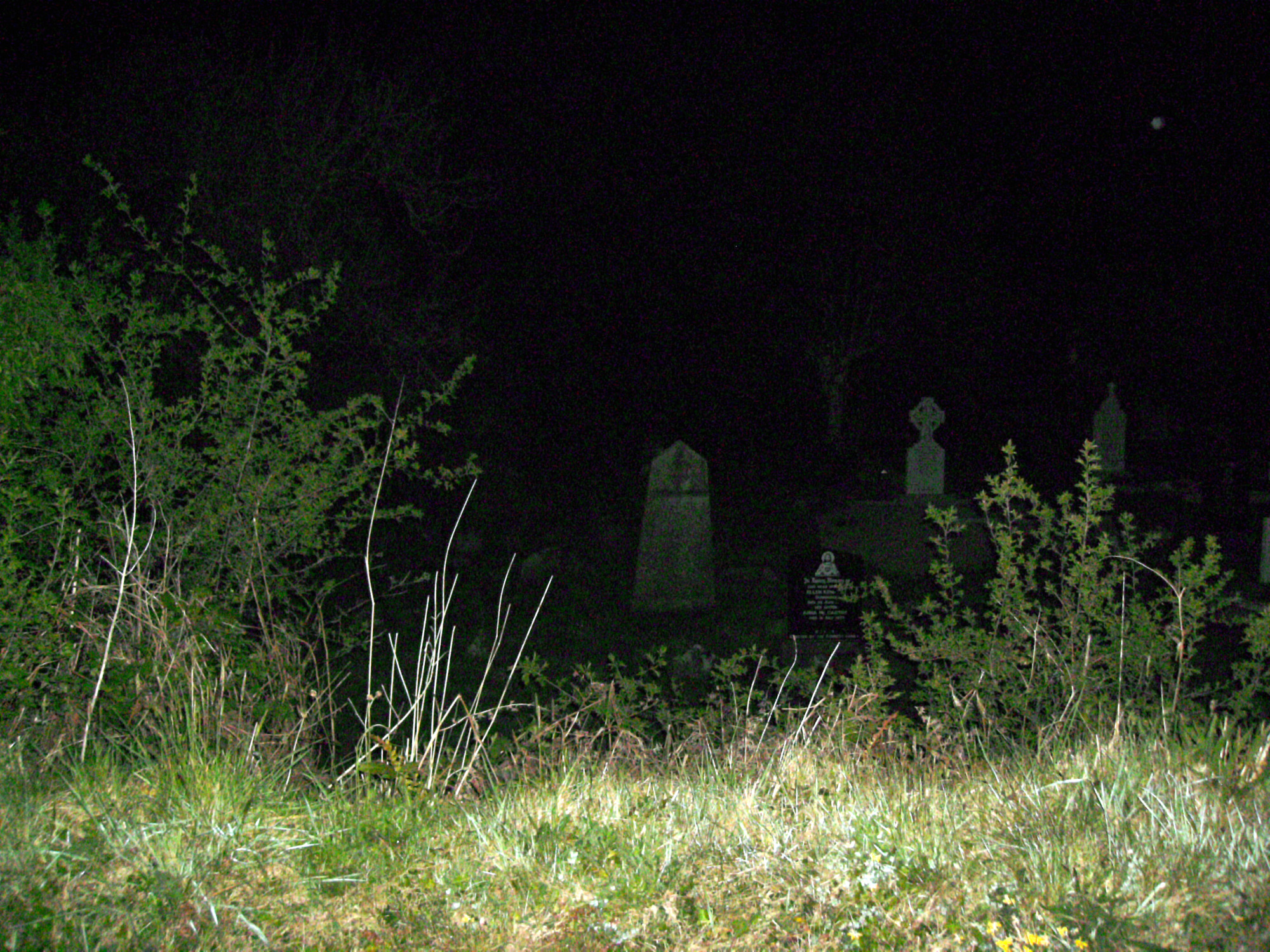
On 1st May 2010 Steve was driving towards Goleen from Bantry with Susan and another passenger. It was around 5am in the morning and the road was clear. Steve was driving past Kilheangul Burial Ground at around 40 miles per hour and noticed in his peripheral vision that the gravestones appeared to be ‘glowing’. He saw a large looming, glowing white shape that he took to be a very tall Celtic cross, also glowing. Steve felt eerie and the hairs on the back of his neck stood up, although the other passengers did not notice the cemetery. The moon was almost full so Steve puts this experience perhaps down to the moon reflecting off the gravestones.

On 6th May 2010 Susan drove me to Kilheangul Burial Ground at around 11pm to take photos of the location in order to find a possible explanation for the ‘glowing gravestones’. Susan stayed in the car while I got out to take photos. While Susan was backing up the car into a nearby lay-by she turned her head towards the cemetery and saw what she believed to be a very tall glowing white statue of a man or angel. She thought nothing of it at the time, as this is the kind of sight expected in a cemetery. Susan describes the figure as that of a tall, solid looking man with curly hair. The figure was glowing white, which she took to be moonlight reflecting off granite. However it was a cloudy night with no moonlight. The figure appeared to be turned towards the direction of myself taking photos.  Meanwhile I took several photos and saw no such figure amongst the stones. I did however notice a quick flash of light amongst the gravestones which I put down to being a reflection from the car headlights.

Upon returning home Susan asked me if I had taken a picture of the ‘statue’. When I reviewed the photos taken there was no such figure and I had not seen any figure with my naked eye. Susan felt rather emotional following the experience. The next day they returned to the burial ground in the hours of daylight in order to find the ‘statue’ that Susan had seen. However there was no such statue. Susan does not believe it was the nearby tree or the white Celtic cross. She believes it was taller and in a different position to these. Upon reviewing the photos Steve also believes the thing he saw was much taller than the Celtic crosses present and in the same area as Susan’s sighting.

Both Steve and Susan would like to pass off what they saw as having natural origins such as tricks of the light. However, it is unusual that what they saw seems to be similar: a large figure of some kind glowing white. Steve, Susan and I also do not have any knowledge of Gaelic, but upon researching the name of the Gaelic name of the cemetery found that ‘Aingeal’ means ‘angel’. Could this have been an angel or guardian spirit watching over the burial ground?

Ouija Boards

ouija

Ouija boards as we know them came into existence as a game in the mid-1800’s, when spiritualism and channeling were fashionable. Previous to this the first historical mention of something similar to a Ouija board is found in China at around 1100 B.C.[The word “Ouija” is a mix of the French and German words for “yes.” Adolphus Theodore Wagner first patented Ouija boards, or “talking boards,” in England in1854. In the patent, Wagner called his invention a “psychograph” and it was supposed to read people’s minds. By 1861, Frenchman, Allan Kardac, was describing the Ouija board as a tool with which to open communications with the spirit world.

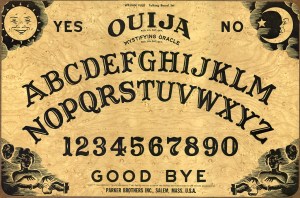
Modern Ouija boards were then developed by inventor William Fuld, who sold his patent to Parker Brothers in 1966.  The Ouija boards sold by Parker Brothers consist of a rectangular game board that is covered with a woodcut-style alphabet, the words yes, no, and good-bye, and the numbers 0-9. Also included is a heart-shaped plastic planchette. The planchette is the ‘pointer’ that glides over the board under the direction of supernatural forces and form comments and questions by pointing them out.

Although marketted as a toy, there are people who believe they can be harmful. Some people believe that “evil demons” pretend to be cooperative ghosts in order to trick players into becoming spiritually possessed. Some Ouija board users claim to have had bad experiences related to their by being haunted by “demons,” seeing apparitions of spirits or hearing voices after using them. Some paranormal researchers claim that the majority of the worst cases of demon  harassment and possession are caused by the use of Ouija boards.

How does a Ouija Board work? Believers claim that humans are a channel through which the spirit can alter the world. Sceptics believe that it is all down to small and subconscious movements of the hand. This is known as the ‘ideomotor effect’. Some would also argue that mediums communicate on a deep near unconscious level so it is also likely that a spirit could direct the users of a Ouija Board in a similar manner.

Although I have never used a Ouija Board myself, my mother dabbled with them as a teenager. I would probably try using one once, but having been strongly warned off them by my mother, I would not want to make a habit of it. Here is an experience my mother once had with a Ouija Board:

“Many years ago when I was about 13, I used to go out with a lad from a local town. One evening we were in his bedroom with four other friends, and we decided to play with the Ouija Board. One of the other lads was against it and refused to take part, so he sat on a chair by the wardrobe and as we asked the spirits questions he took the mickey, saying we were pushing the glass etc.
We contacted a spirit whose name was Jack and he had been a sailor. The lad by the wardobe laughed and took the mickey again, saying he knew what sailors were like and making bad comments. My boyfriend and I were amazed by the contact and asked lots of questions of this Jack, but it became difficult because of my boyfriend’s mate taking the mickey. We began to lose track of what we had said and started to ask silly things. I think the spirit became annoyed because a moment later there was a loud bang and the lad by the wardrobe had blood trickling from the side of his mouth. Well, we got out of the room and ran downstairs like hell. Once we had calmed down in the kitchen the lad told us what had happened: the bang we had heard was his head going back and hitting the wardrobe. He said that something or someone had hit him in the face, hence the blood and the cut lip. Well it was not any of us that did it! To this day I will never forget it and the look on the lad’s face. We never played with the Ouija Board again in that house and my boyfriend burnt all the letters and the board. Very strange indeed.”

Ouija – By Sylvia Plath
It is a chilly god, a god of shades,
Rises to the glass from his black fathoms.
At the window, those unborn, those undone
Assemble with the frail paleness of moths,
An envious phosphorescence in their wings.
Vermillions, bronzes, colors of the sun
In the coal fire will not wholly console them.
Imagine their deep hunger, deep as the dark
For the blood-heat that would ruddlr or reclaim.
The glass mouth sucks blooh-heat from my forefinger.
The old god dribbles, in return, his words.

The old god, too, write aureate poetry
In tarnished modes, maundering among the wastes,
Fair chronicler of every foul declension.
Age, and ages of prose, have uncoiled
His talking whirlwind, abated his excessive temper
When words, like locusts, drummed the darkening air
And left the cobs to rattle, bitten clean.
Skies once wearing a blue, divine hauteur
Ravel above us, mistily descend,
Thickening with motes, to a marriage with the mire.

He hymns the rotten queen with saffron hair
Who has saltier aphrodisiacs
Than virgins’ tears. That bawdy queen of death,
Her wormy couriers aer at his bones.
Still he hymns juice of her, hot nectarine.
I see him, horny-skinned and tough, construe
What flinty pebbles and ploughable upturns
As ponderable tokens of her love.
He, godly, doddering, spells
No succinct Gabriel from the letters here
But floridly, his amorous nostalgias.