An Unexpected Discovery
I was recently in Bungay in Suffolk for the Black Shuck Festival. Bungay is famous for its supernatural history, so this was naturally the attraction for me; however, while there, I also chanced upon another story which was completely unexpected.
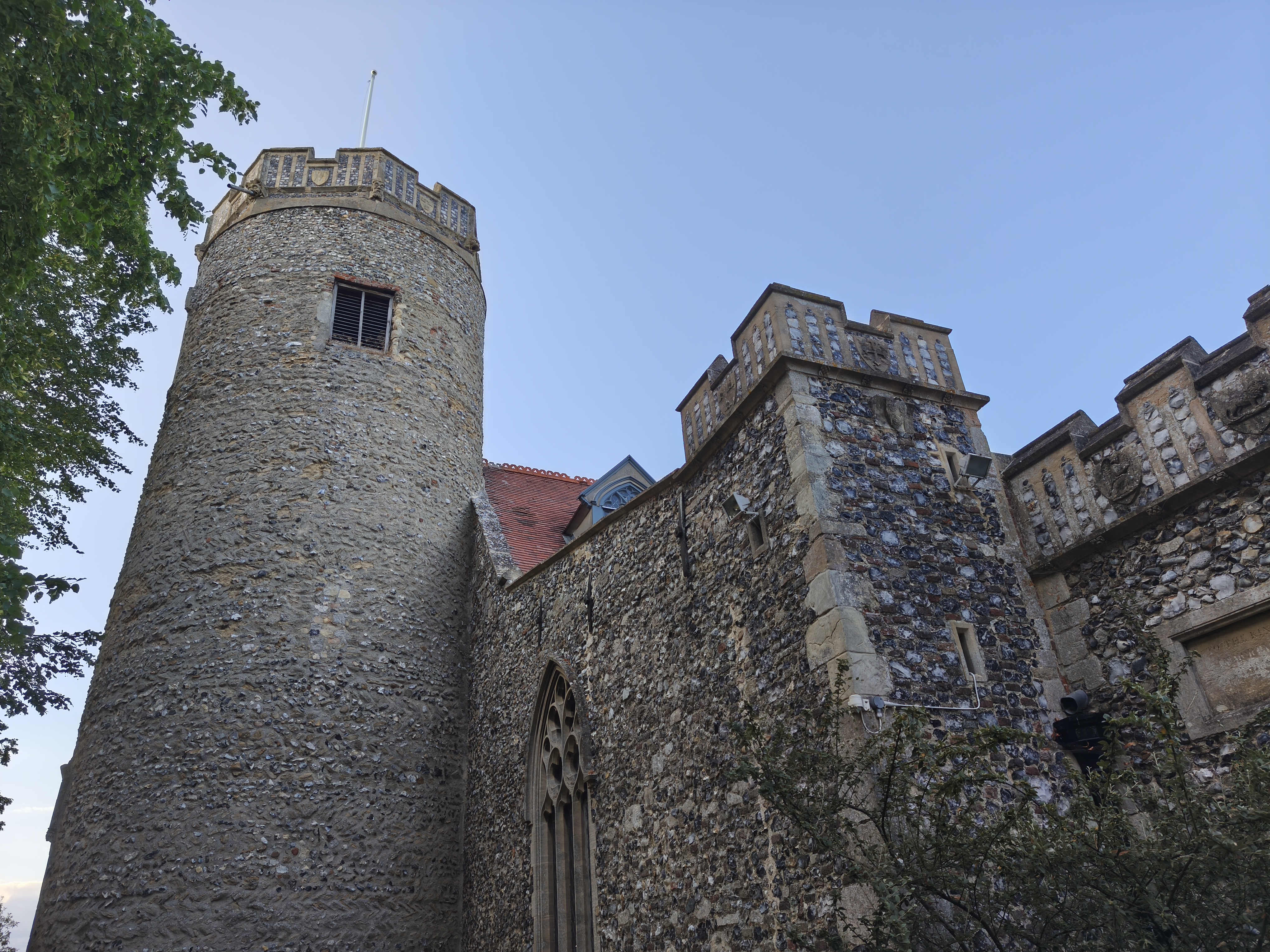
While in town, I walked past another church, one that isn’t so much in the limelight as the one just up the road, St Mary’s, with its demon dog association. This church is Holy Trinity Church, an ancient building with parts of it dating to late Saxon times but with considerable restoration over the years. Its 11th-century round tower is considered to be the oldest complete structure in Bungay. The tower is eye-catching with its flintwork and traces of herringbone masonry.
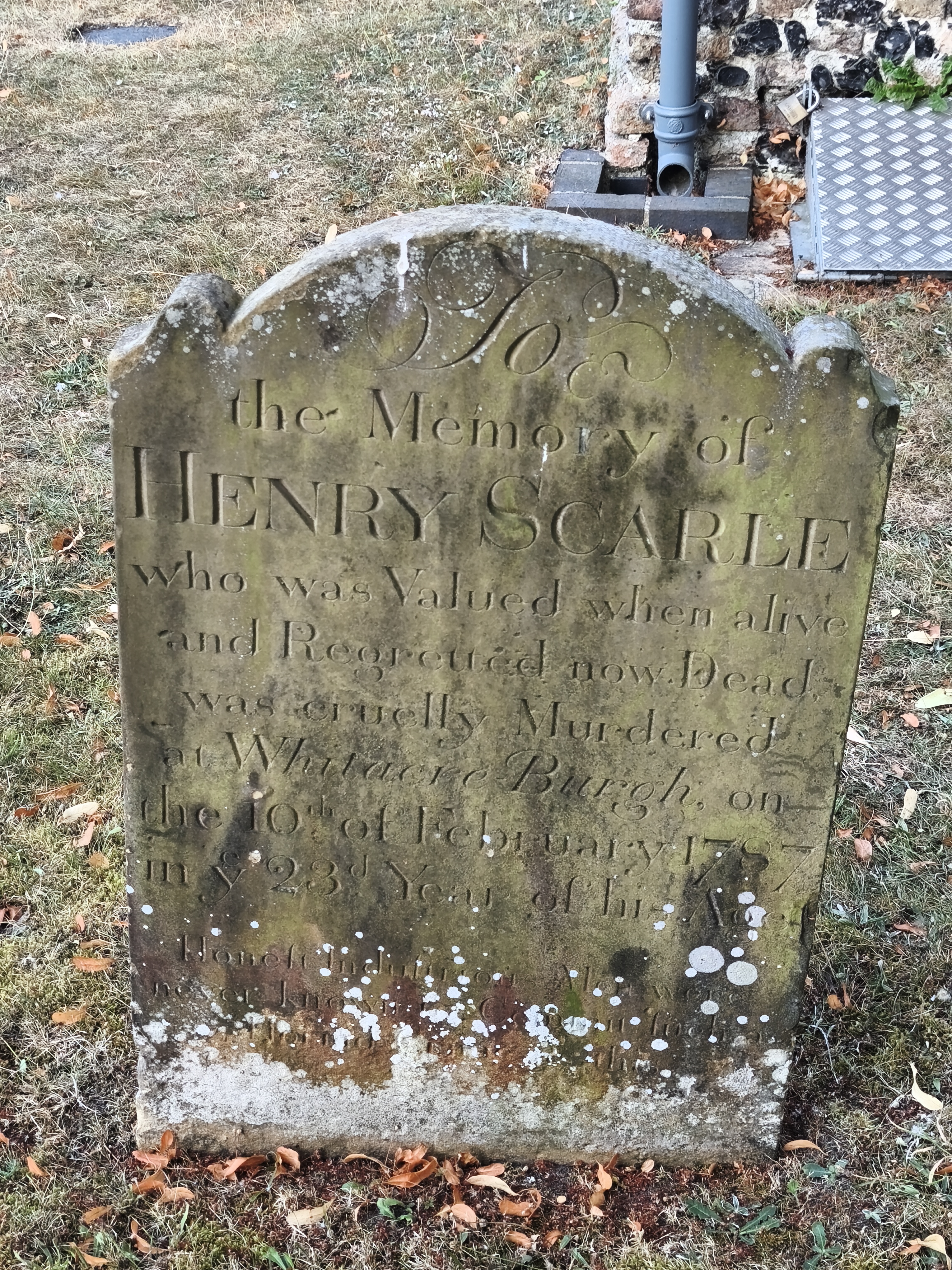
I love to poke around an old church and graveyard, so I decided to have a look around. Sadly, the church was closed up for refurbishment, so I couldn’t see inside. I did, however, decide to explore the exterior and graveyard. It was here among the gravestones that one inscription immediately caught my attention. The stone didn’t simply record a name and date; it said the man buried beneath had been murdered.
The Grave of Henry Scarle.
The headstone is unassuming and weathered, yet remarkably well preserved considering its age. Lichen obscures some of the inscription but the name Henry Scarle stands out in large letters. It was the words beneath his name that really caught my attention: cruelly murdered.
The full inscription is as follows:
“To the memory of Henry Scarle, who was valued when alive, and regretted now dead, cruelly murdered at Wheatacre Burgh, on the 10th February, 1787, in the 23rd year of his age: honest and industrious men were never known to commit such a horrid crime as this.”
My interest was piqued. Who was Henry Scarle? How was he murdered? And why had his violent death been recorded on his gravestone?
Henry Scarle was a 23 year old man employed as a waterman by the owner of the Bungay Staithe Navigation, a man called Matthias Kerrison. Scarle’s job was to handle the boats that transported corn, wood and other goods along the River Waveney and the surrounding waterways between the many towns and villages.
The Murder
In 1787, Scarle was with one of the wherries he’d moored in Wheatacre Burgh Staithe (now known as Burgh St Peter), when he discovered two men planning to rob the cargo. According to later accounts of the murder, that night he watched and waited for the robbers, but sadly they spotted him first, grabbed him violently, and bludgeoned him to death before hurling his lifeless body into the river.
His assailants fled, while Scarle’s body was later found floating in the river. They were eventually apprehended at Botesdale, a Suffolk village south-west of Diss, reportedly fleeing towards London. They were then taken to Norwich Castle Gaol.
The murderers were identified as William Hawk and Thomas Mayhew. Hawk was a Beccles man and a miller by trade, while Mayhew was a local man from Bungay and a waterman like his victim Scarle. Mayhew had previously robbed Mr Kerrison, Scarle’s employer, of some corn. Both were tried at Norwich and found guilty of the murder of young Henry Scarle on the 29th of March that year. Simon Stannard was also accused as an accomplice, but was later acquitted and therefore dodged the noose. Hawk and Mayhew were hanged the following day, on 30th March 1787.
The Strange Fate of Henry Scarle’s Body
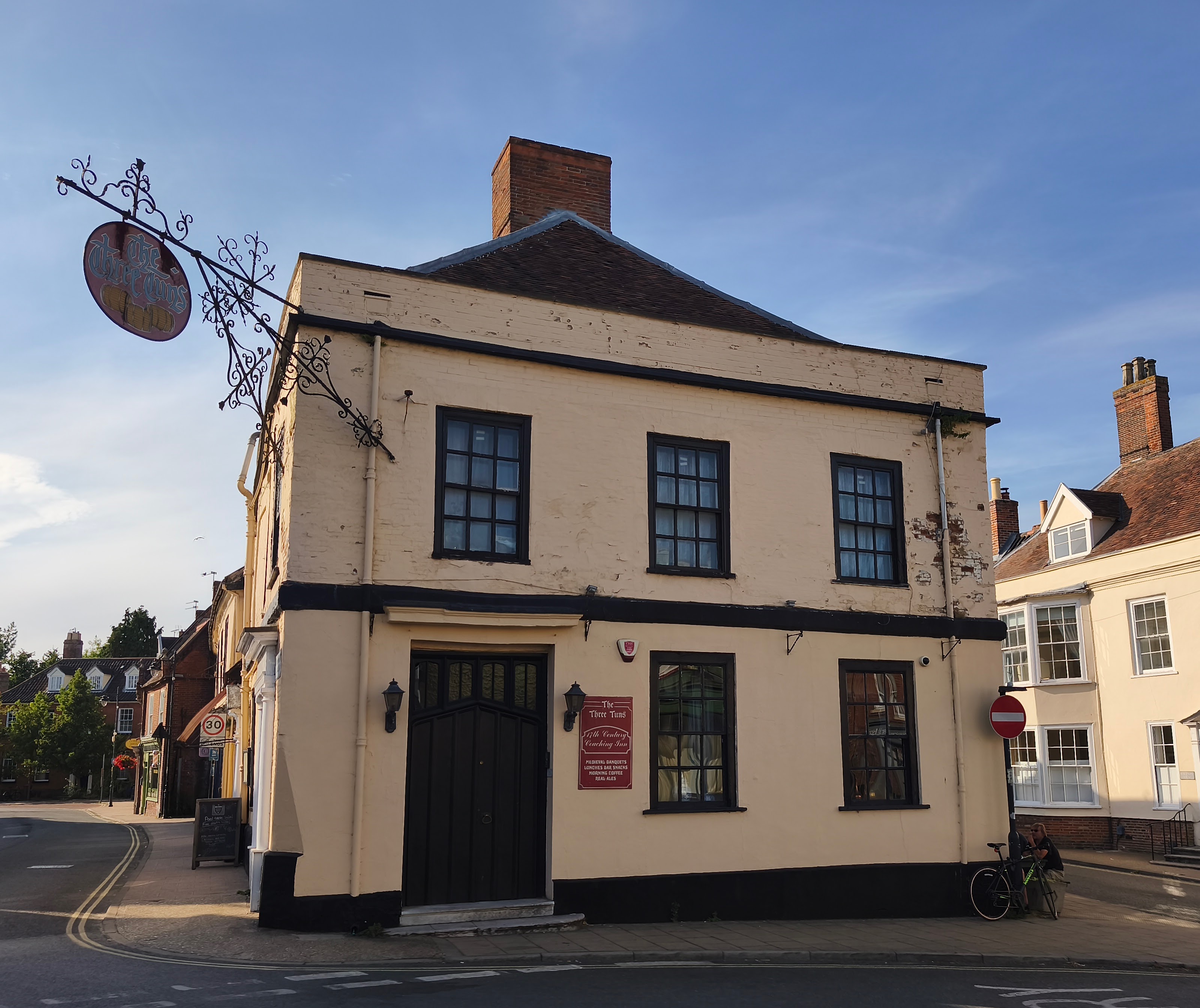
Henry Scarle’s employer, Matthias Kerrison, was said to be an enterprising man when it came to making money. According to later accounts, after his employee’s death, he realised he could profit from this situation and had his body exhibited on a bier in the Assembly Rooms at one of the local Bungay pubs, the Three Tuns. It is said he advertised this event as “a penny a peep” and many people from far and wide queued up to view the victim’s corpse. This must have been a horrendous and gruesome sight, as poor Henry Scarle had been beaten to death before his body was thrown into the river, where it remained for some time before being found. According to the story, the money raised from the viewings was used by Kerrison to respectfully bury the young man and to erect the gravestone that still stands in Holy Trinity churchyard to this day.
From Murder Victim to Ghost?
The Three Tuns pub, where Scarle’s body is said to have been exhibited, still stands in the centre of Bungay. The pub has since acquired quite a reputation for being haunted. In 1969, one paranormal investigator reportedly claimed that they had identified 24 different ghosts there, including highwayman Tom Hardy and Rex Bacon, who is said to have hanged himself at the top of the stairs there in 1682. I am sure you won’t be surprised to hear that another troubled spirit that is said to haunt the Three Tuns is that of our very own sad Henry Scarle.
A Story Hidden in a Churchyard
I had gone to Bungay for the Black Shuck Festival and certainly hadn’t expected to come away researching the murder of a young waterman who died more than 200 years ago.
What started with an interesting inscription on an old gravestone led me to a brutal murder, the rather macabre tale of Henry’s body being put on public display, and finally the suggestion that he may still haunt the very pub where his body was exhibited.
Whether Henry Scarle really does haunt the Three Tuns is another matter, but his story is certainly a fascinating and rather sad piece of Bungay’s history. It also shows exactly why I can never resist having a poke around an old churchyard. You really don’t know what stories you might stumble across.
Sources
- “6-Apr-1787 – Page 3 in News – US, London Times, 1785-1919.” Fold3, 2026, http://www.fold3.com/document/28088642/. Accessed 30 Aug. 2026.
- Ancestry. “Henry Scarle (1764-1787) – Find a Grave Memorial.” Findagrave.Com, 2020, https://www.findagrave.com/memorial/211595510/henry-scarle. Accessed 30 Aug. 2026.
- CPUK. “Executions in Norfolk 1735-1799 – Capital Punishment UK.” Capital Punishment UK, 24 June 2025, http://www.capitalpunishmentuk.org/norfolk.html. Accessed 30 Aug. 2026.
- Jennings, Pete. Haunted Suffolk. Tempus Publishing Limited, 2006.
- Knott, Simon. “Suffolk Churches.” Suffolkchurches.Co.Uk, 2016, http://www.suffolkchurches.co.uk/bungayht.htm#. Accessed 30 Aug. 2026.
- “Until Death.” Until Death, 6 Aug. 2023, https://untildeathmagazine.wordpress.com/. Accessed 30 Aug. 2026.
 Ghost Catcher Isles
Leave a comment