Cruelly Murdered: The Strange Fate of Henry Scarle

An Unexpected Discovery
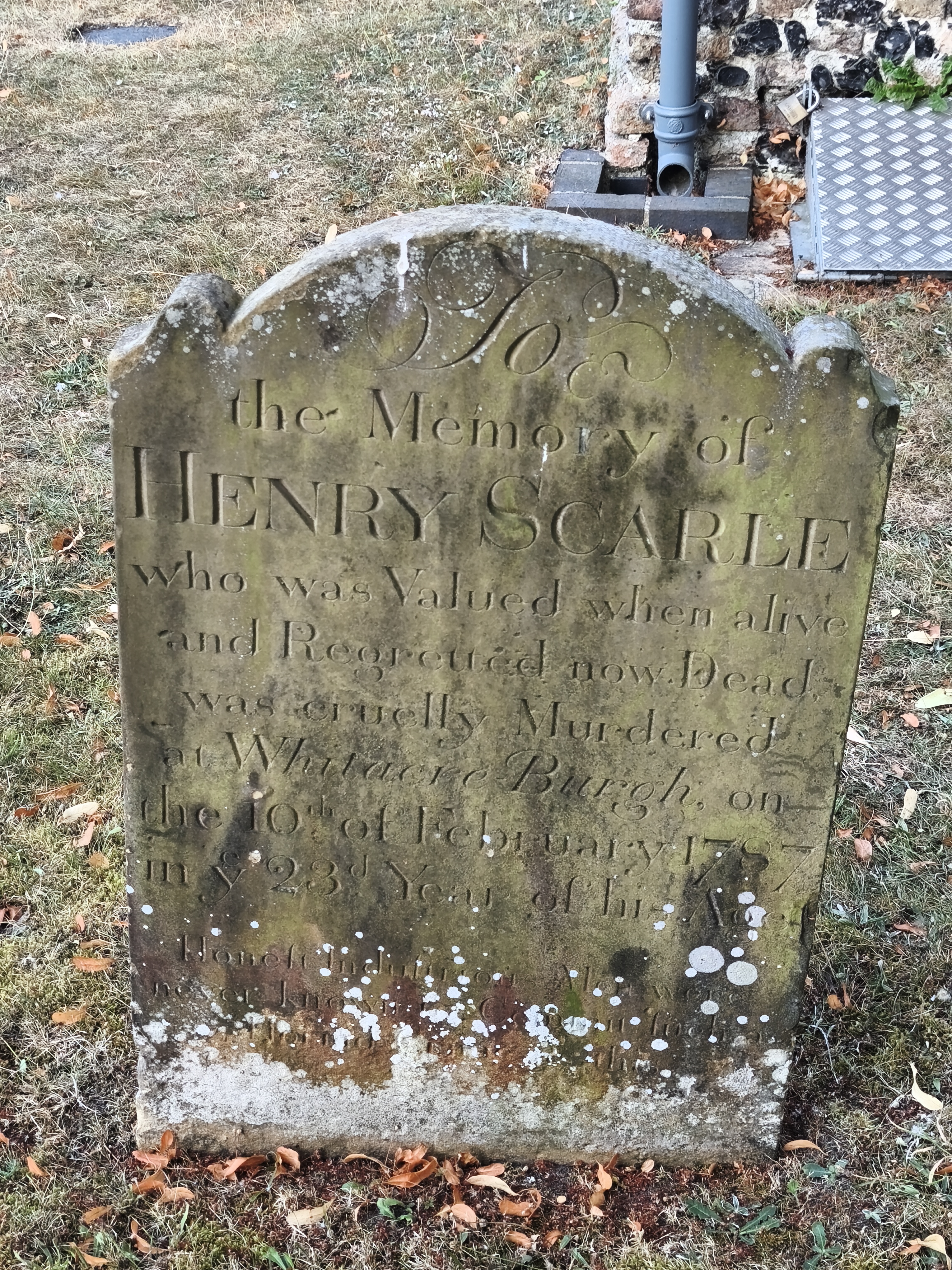
(Image: The grave of Henry Scarle. Source: E.Holohan 2026)

I was recently in Bungay in Suffolk for the Black Shuck Festival. Bungay is famous for its supernatural history, so this was naturally the attraction for me; however, while there, I also chanced upon another story which was completely unexpected.

While in town, I walked past another church, one that isn’t so much in the limelight as the one just up the road, St Mary’s, with its demon dog association. This church is Holy Trinity Church, an ancient building with parts of it dating to late Saxon times but with considerable restoration over the years. Its 11th-century round tower is considered to be the oldest complete structure in Bungay. The tower is eye-catching with its flintwork and traces of herringbone masonry.

I love to poke around an old church and graveyard, so I decided to have a look around. Sadly, the church was closed up for refurbishment, so I couldn’t see inside. I did, however, decide to explore the exterior and graveyard. It was here among the gravestones that one inscription immediately caught my attention. The stone didn’t simply record a name and date; it said the man buried beneath had been murdered.

The Grave of Henry Scarle.

The headstone is unassuming and weathered, yet remarkably well preserved considering its age. Lichen obscures some of the inscription but the name Henry Scarle stands out in large letters. It was the words beneath his name that really caught my attention: cruelly murdered.

The full inscription is as follows:

My interest was piqued. Who was Henry Scarle? How was he murdered? And why had his violent death been recorded on his gravestone?

Henry Scarle was a 23 year old man employed as a waterman by the owner of the Bungay Staithe Navigation, a man called Matthias Kerrison. Scarle’s job was to handle the boats that transported corn, wood and other goods along the River Waveney and the surrounding waterways between the many towns and villages.

The Murder

In 1787, Scarle was with one of the wherries he’d moored in Wheatacre Burgh Staithe (now known as Burgh St Peter), when he discovered two men planning to rob the cargo. According to later accounts of the murder, that night he watched and waited for the robbers, but sadly they spotted him first, grabbed him violently, and bludgeoned him to death before hurling his lifeless body into the river.

His assailants fled, while Scarle’s body was later found floating in the river. They were eventually apprehended at Botesdale, a Suffolk village south-west of Diss, reportedly fleeing towards London. They were then taken to Norwich Castle Gaol.

The murderers were identified as William Hawk and Thomas Mayhew. Hawk was a Beccles man and a miller by trade, while Mayhew was a local man from Bungay and a waterman like his victim Scarle. Mayhew had previously robbed Mr Kerrison, Scarle’s employer, of some corn. Both were tried at Norwich and found guilty of the murder of young Henry Scarle on the 29th of March that year. Simon Stannard was also accused as an accomplice, but was later acquitted and therefore dodged the noose. Hawk and Mayhew were hanged the following day, on 30th March 1787.

The Strange Fate of Henry Scarle’s Body
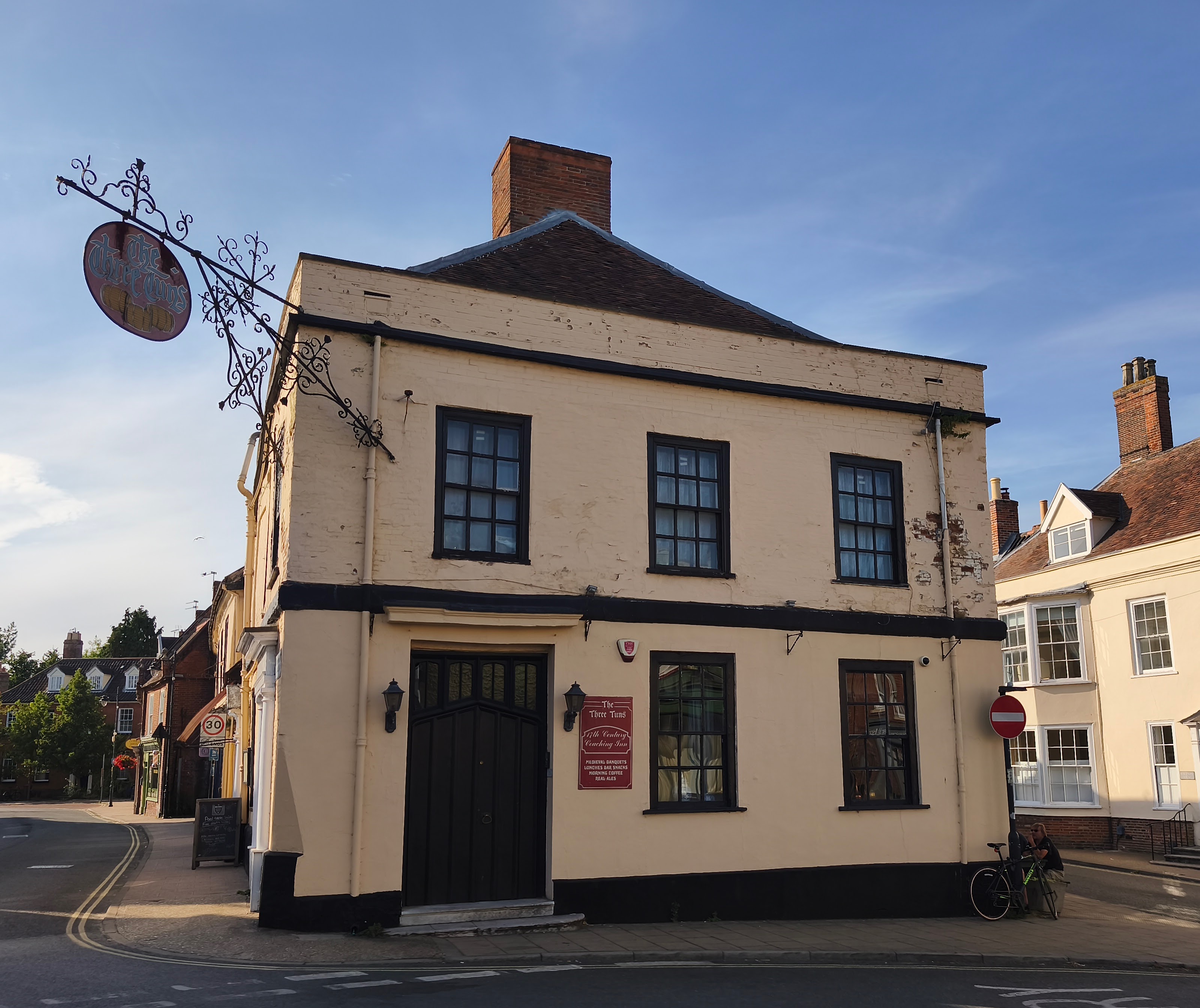
(Image: Three Tuns Pub. Source: E.Holohan 2026)

Henry Scarle’s employer, Matthias Kerrison, was said to be an enterprising man when it came to making money. According to later accounts, after his employee’s death, he realised he could profit from this situation and had his body exhibited on a bier in the Assembly Rooms at one of the local Bungay pubs, the Three Tuns. It is said he advertised this event as “a penny a peep” and many people from far and wide queued up to view the victim’s corpse. This must have been a horrendous and gruesome sight, as poor Henry Scarle had been beaten to death before his body was thrown into the river, where it remained for some time before being found. According to the story, the money raised from the viewings was used by Kerrison to respectfully bury the young man and to erect the gravestone that still stands in Holy Trinity churchyard to this day.

From Murder Victim to Ghost?

The Three Tuns pub, where Scarle’s body is said to have been exhibited, still stands in the centre of Bungay. The pub has since acquired quite a reputation for being haunted.  In 1969, one paranormal investigator reportedly claimed that they had identified 24 different ghosts there,  including highwayman Tom Hardy and Rex Bacon, who is said to have hanged himself at the top of the stairs there in 1682. I am sure you won’t be surprised to hear that another troubled spirit that is said to haunt the Three Tuns is that of our very own sad Henry Scarle.

A Story Hidden in a Churchyard
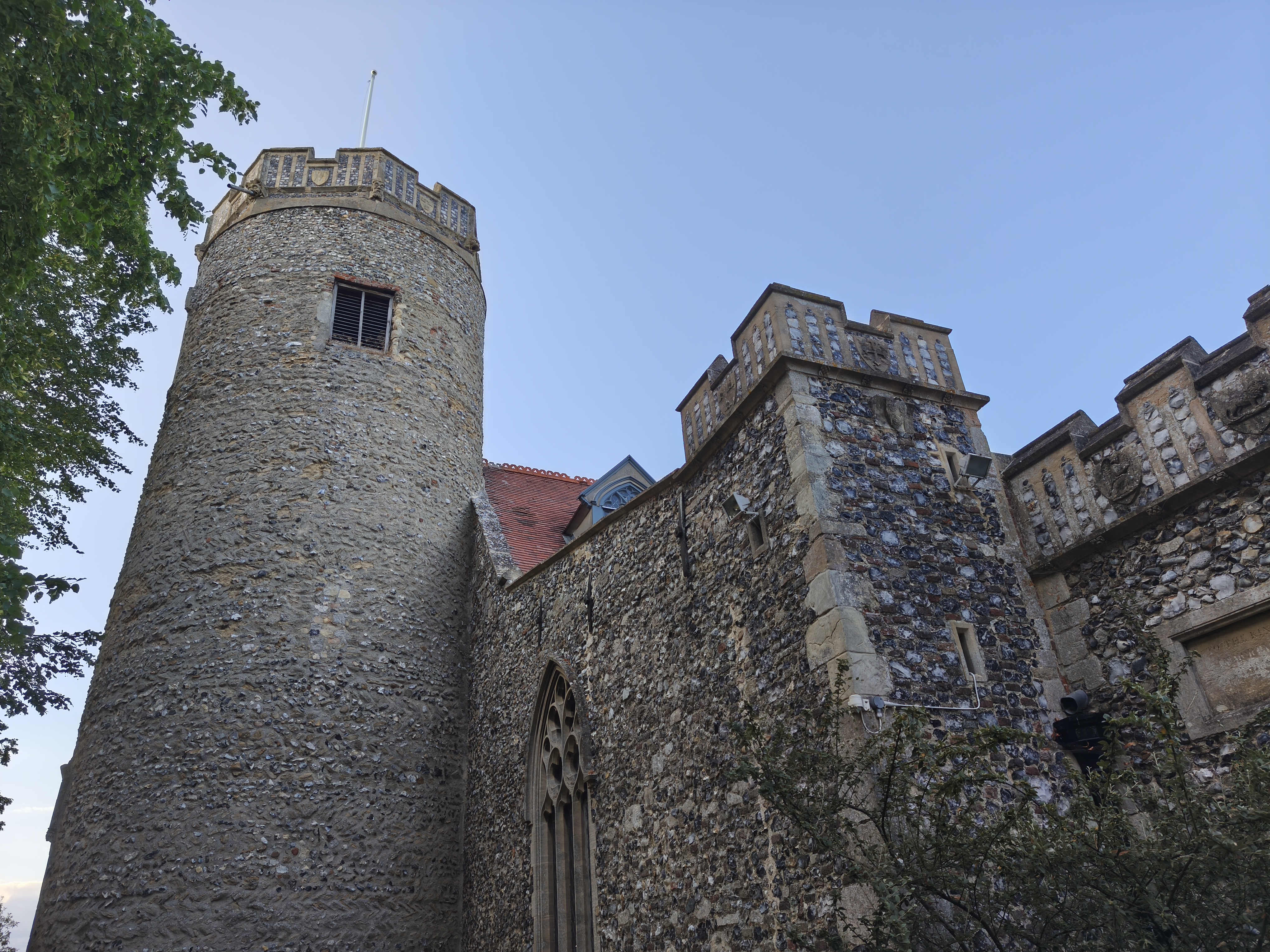
(Image: Holy Trinity Church, Bungay. Source: E.Holohan)

I had gone to Bungay for the Black Shuck Festival and certainly hadn’t expected to come away researching the murder of a young waterman who died more than 200 years ago.

What started with an interesting inscription on an old gravestone led me to a brutal murder, the rather macabre tale of Henry’s body being put on public display, and finally the suggestion that he may still haunt the very pub where his body was exhibited.

Whether Henry Scarle really does haunt the Three Tuns is another matter, but his story is certainly a fascinating and rather sad piece of Bungay’s history. It also shows exactly why I can never resist having a poke around an old churchyard. You really don’t know what stories you might stumble across.


Sources

    Leave a comment

    Face to Face with the Uncanny Wax Lady of Stow Bardolph

    (Image: Effigy of Sarah Hare. Source: E.Holohan 2026)

    When I was a child, I had a fascination with the strange corners of history, and this, of course, has continued on into adulthood. The books I borrowed from the library were full of ghosts, folklore, unexplained mysteries and curious historical oddities. Among all the photographs that lodged themselves in my imagination, save for the spontaneous human combustion foot photo, one stood out above the rest. It was the wax effigy of Sarah Hare.

    I remember being quite unsettled by it. In a time before I’d ever heard the phrase “uncanny valley,” I already knew exactly how it felt. She looked too real to be a statue yet far too lifeless to be a person. I found her slightly repulsive, but I could never quite look away.

    So, when I recently found myself in Norfolk, visiting Holy Trinity Church at Stow Bardolph was top of my list. I wanted to see whether the real thing would have the same effect as those childhood photographs. And it absolutely did.

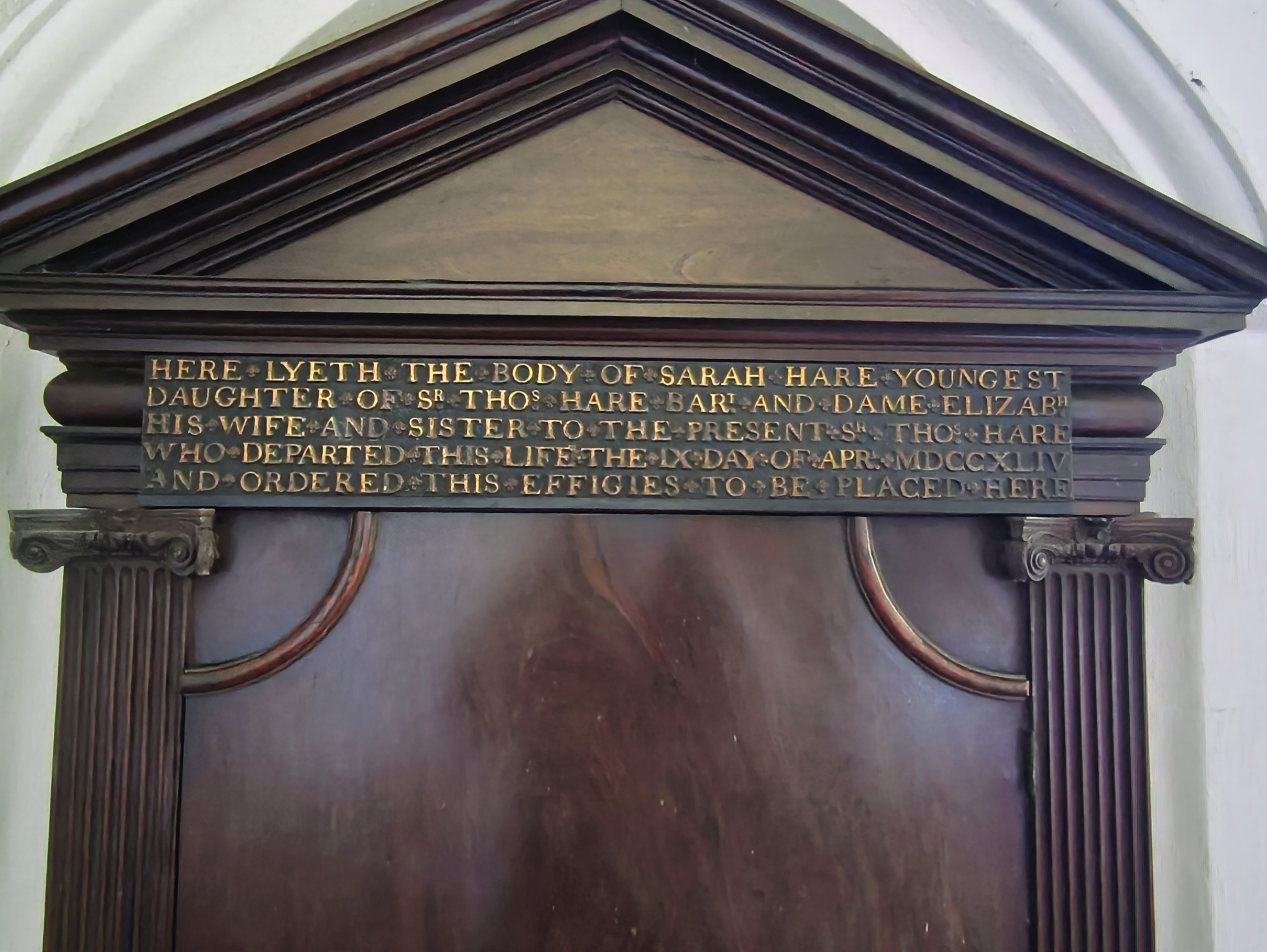
    (Image: Inscription on Cabinet. Source: E.Holohan 2026)

    Sarah Hare was the youngest daughter of Sir Thomas Hare of Stow Hall. She never married, so was what was once called a “spinster”, and lived a fairly ordinary life. In 1744, aged 55, she died from blood poisoning after pricking her finger while sewing. Later, locals claimed it was divine punishment for the crime of sewing on a Sunday, although the far more likely explanation is that the wound simply became infected.

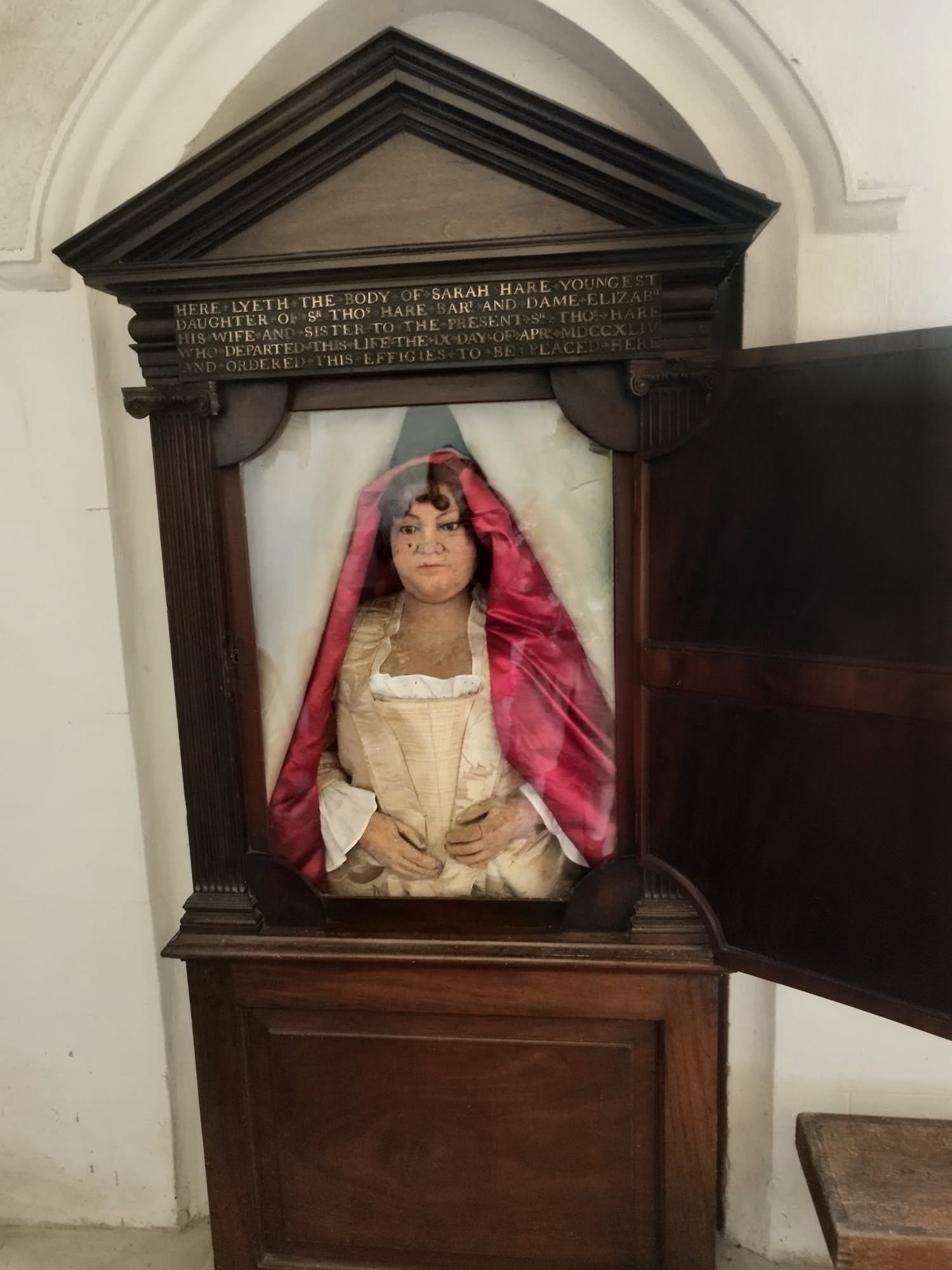
    The year before her death she wrote a remarkably detailed will. Alongside gifts to the poor of the parish, she made one very unusual request. She wanted her face and hands reproduced in wax, her own hair placed upon her head, and the finished effigy displayed in a mahogany cabinet with a glass front close to where she was buried.

    She wrote: “I desire to have my face and hands made in wax with a piece of crimson satin thrown like a garment in a picture, hair upon my head and put in a case of Mahogany with a glass before and fix’d up so near the place were my corps lyes as it can be with my name and time of death put upon the case in any manner most desirable…

    If she did not arrange it during her lifetime, she instructed that it should be done after her death. Her family honoured those wishes. If you don’t ask, you don’t get, I suppose. And oh boy, did she get.

    Today visitors to the Hare family mausoleum find a plain mahogany cabinet tucked into one corner. Nothing about it hints at what lies inside. Then the doors are opened, and there she is…

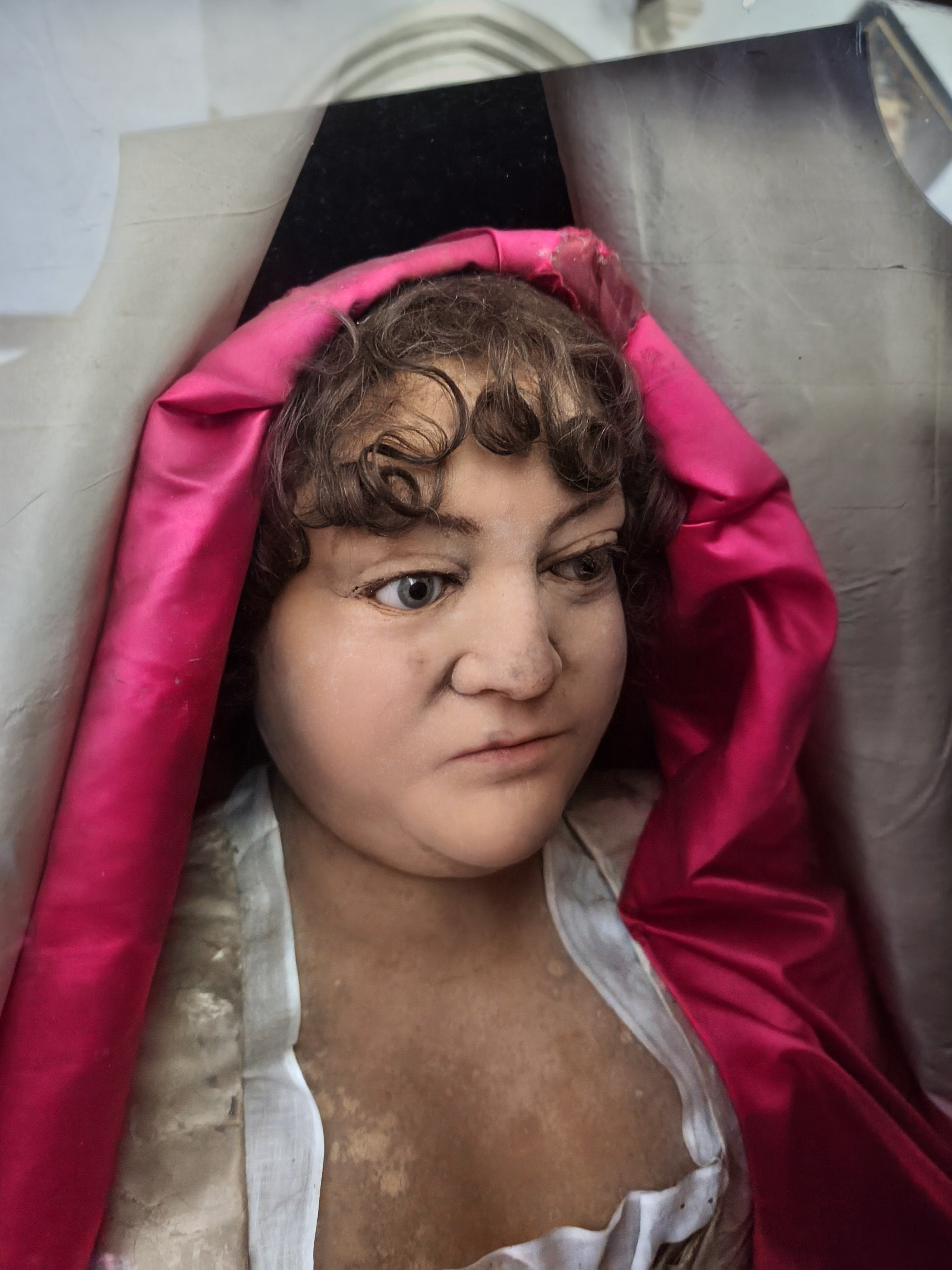
    No photograph quite prepares you for seeing Sarah face to face. Her blue eyes seem fixed upon you. Her skin shows every wart and blemish. Her double chin has not been smoothed away. She wears one of her own silk gowns along with the crimson satin she specifically requested, and what is thought to be her own hair frames her face beneath an old fashioned wig.

    (Image: Effigy of Sarah Hare. Source: E.Blackshaw 2026)

    It is an astonishingly honest portrait, unadulterated by an idealising sculptor. In a time when many memorials celebrated wealth, beauty or achievement, Sarah chose something altogether different by asking to be remembered exactly as she was.

    I wondered what her motives were. Was it vanity? I doubt it. If anything, the effigy avoids vanity completely. Nothing has been softened or flattered. Every blemish and imperfection remains. Perhaps it was simply a desire not to disappear entirely. After all, most of us hope to leave some trace that we were here, whether through family, creative work or acts of kindness. In Sarah’s case, she chose wax.

    The effect is incredibly eerie. There is something deeply unsettling about meeting the gaze of someone who died almost three centuries ago, particularly when they appear so strikingly human.

    There is also something strangely moving about it. Sarah has spent nearly 300 years silently watching visitors come and go. Seasons have changed and decades have flashed by. Yet Sarah still waits behind those cabinet doors. Time has not been entirely kind. The wax has required careful conservation and rodents once damaged her clothing before restoration work in the 1980s. Even so, she survives as the only funerary wax effigy in England outside Westminster Abbey.

    Sarah Hare achieved the immortality she wanted, although probably in a way she could not have ever imagined. Thousands of curious visitors now make the journey to Stow Bardolph simply to meet her and look into her eyes.

    As I left the Hare Chapel, I thought back to the child who had first stared uneasily at her photograph all those years ago. The real Sarah Hare was every bit as uncanny as I’d hoped she would be. Sometimes the strangest places really do live up to their reputation.

    And occasionally, they exceed it.


    Sources

    Dreams of Treasure

    Part 1: The Pedlar of Swaffham 

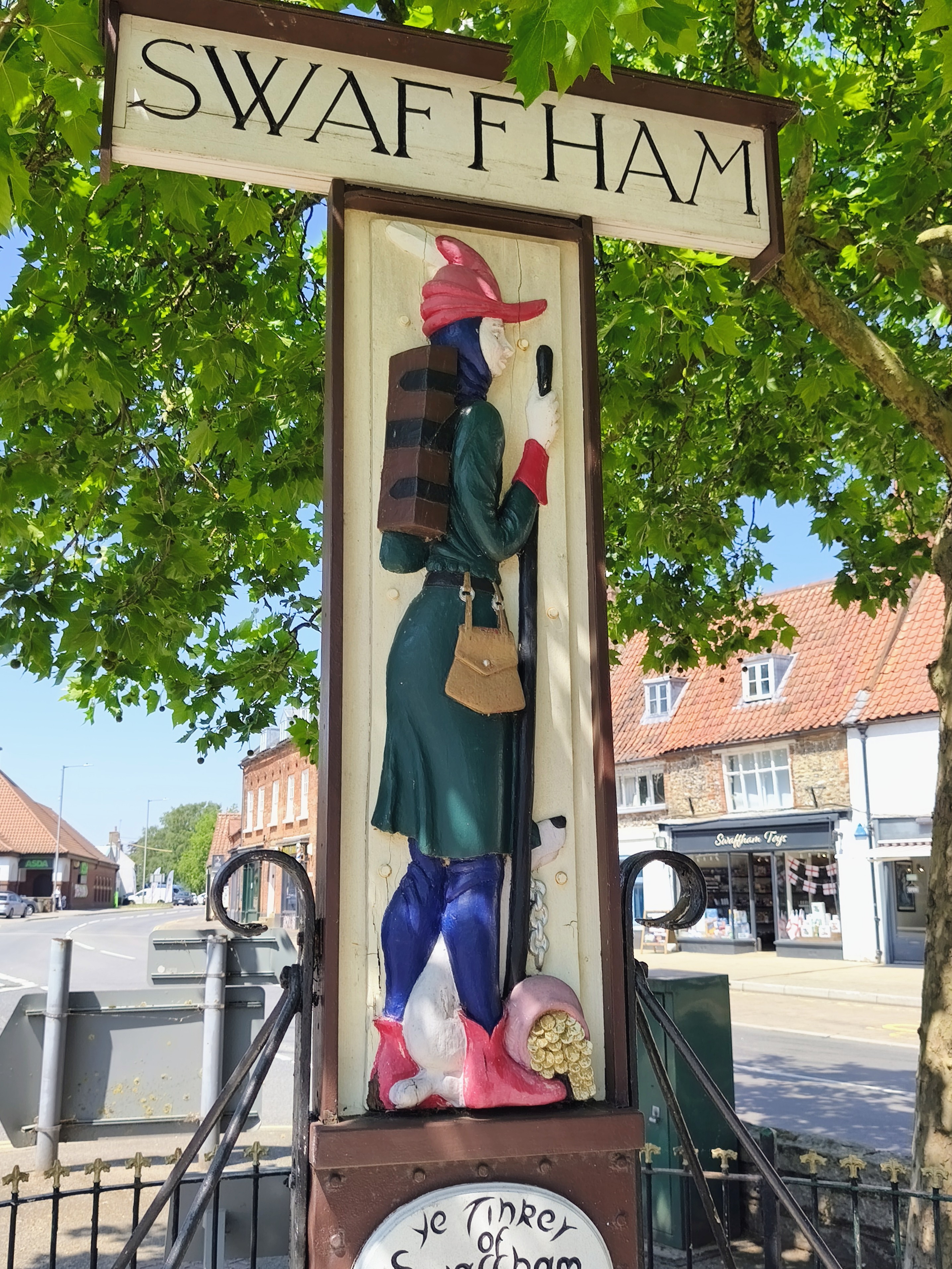
    (Image: Swaffham Town Sign. Source: E.Holohan 2026)

    A Story That Stayed With Me

    When I was at primary school in rural Norfolk I remember hearing one of the first Norfolk folktales that ever captured my imagination: the Pedlar of Swaffham.

    The story fascinated me. Over the years, I came to realise that although it felt so familiar to me, it was not nearly as well known elsewhere. Many people had heard of the famous tale of Dick Whittington and his cat, but very few people I met had ever heard of the Pedlar of Swaffham and his hound. Yet, as we shall discover, this story belongs to a much wider tradition of folklore and shares surprising similarities with legends from elsewhere.

    I can still picture myself sitting cross legged on the classroom floor, listening intently as my teacher recounted the almost magical story of a poor pedlar whose life was transformed after following a dream. Then came the part that amazed me. My teacher told us that the story was based on a real person, and that the pedlar had paid for the rebuilding of the church in Swaffham. Better still, she said, you could still see him on the town sign.

    To a child, that was extraordinary. How could someone who seemed to belong in a fairy tale have actually existed?

    Stories like this have a way of staying with you, lodging themselves in your imagination. The Pedlar of Swaffham certainly did for me. Decades later while visiting Norfolk, I decided it was finally time to visit Swaffham itself to see whether I could still find traces of the legend and perhaps even of the man behind it.

    Looking for the Pedlar

    (Image: Carving believed to be John Chapman. Source: E.Holohan 2026)

    While researching both the folklore and the historical origins of the Pedlar of Swaffham, I discovered that St Peter and St Paul’s Church contains carvings believed to depict the historical John Chapman, the man thought to have inspired the legend. That made the church my first destination.

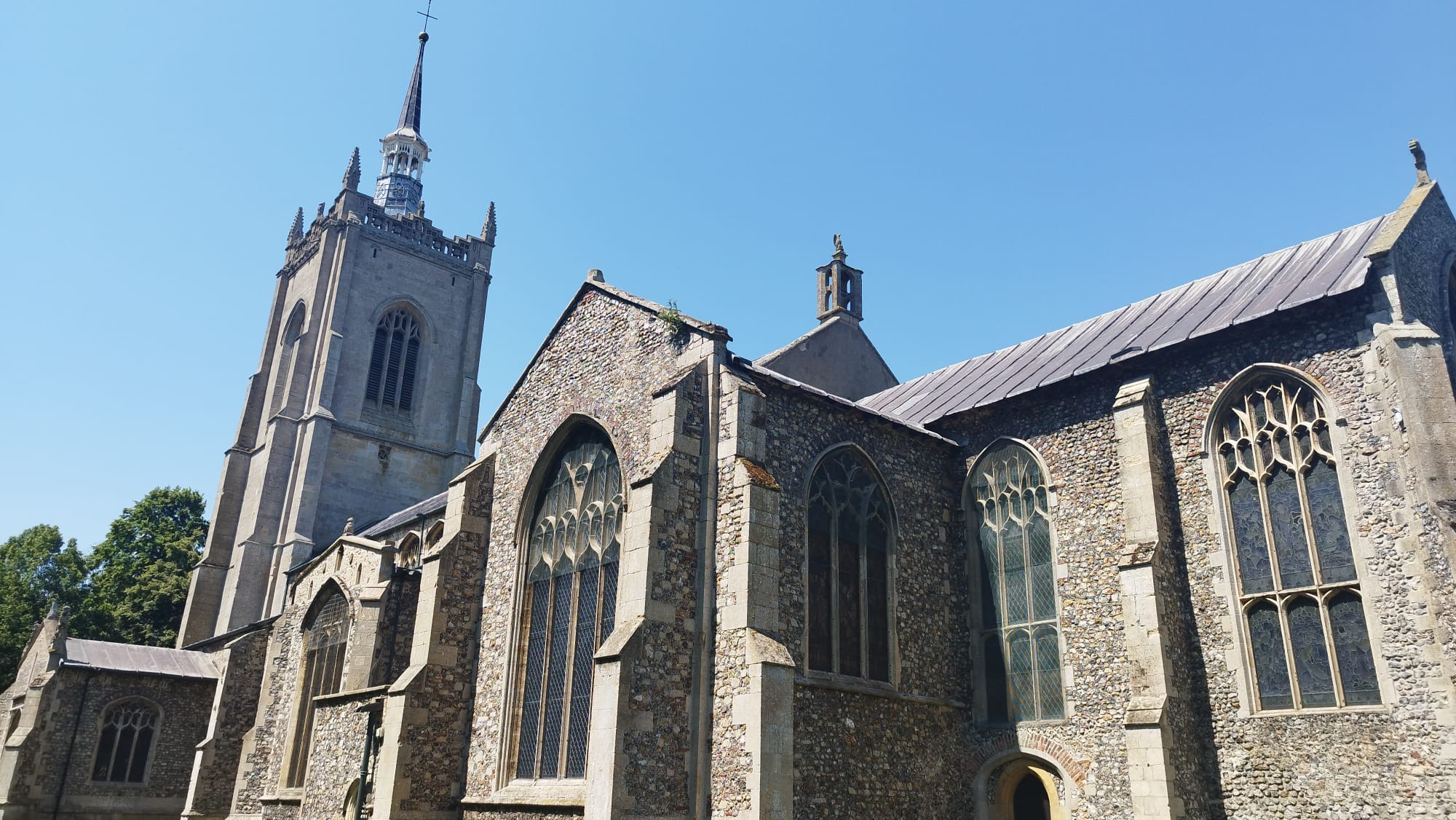
    Walking from the marketplace down a wide lane, the great tower of St Peter and St Paul’s gradually came into view, rising above the surrounding buildings. Stepping inside, I was immediately struck by the magnificent hammerbeam roof stretching overhead. The church was quiet, filled with the sort of peaceful atmosphere that encourages you to slow down and take everything in with reverence.

    I then began my search for the famous carvings.

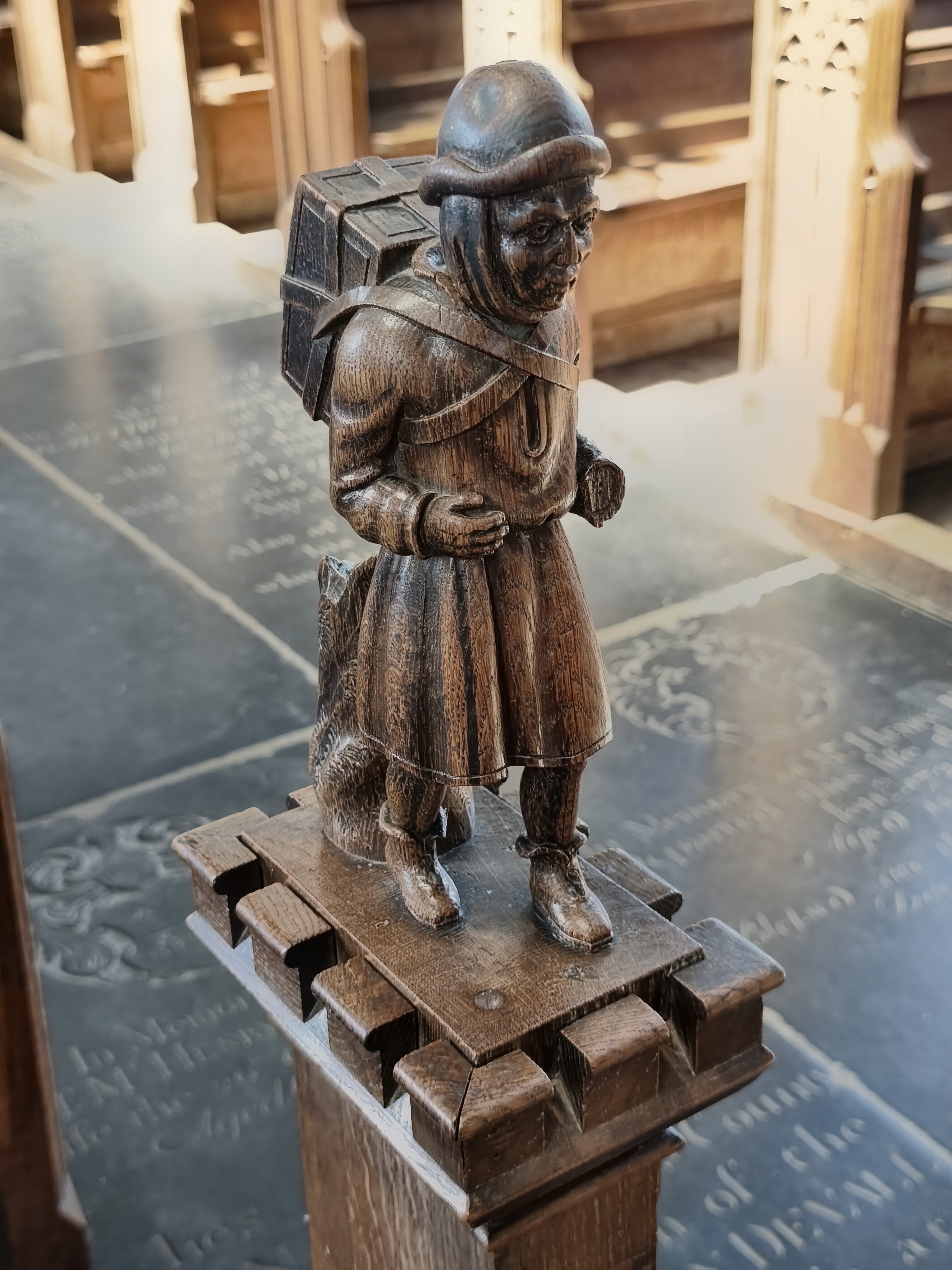
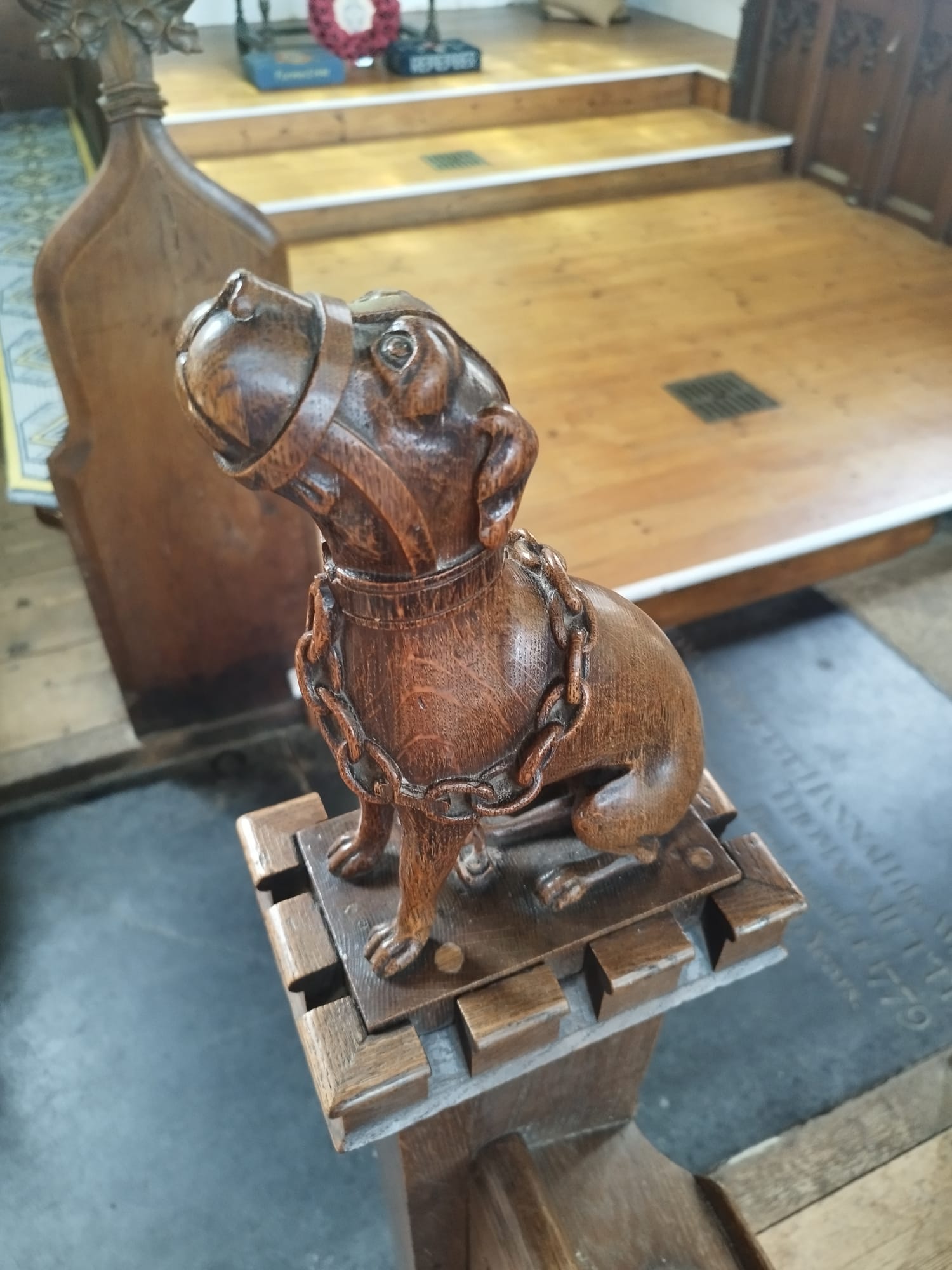
    The first I found were on the bench ends. Some showed a folkloric depiction of the Pedlar of Swaffham wearing his close fitting rolled brim hat and carrying his pack. Nearby were carvings of his faithful dog. They were wonderful to see, but they were not the figures I had come looking for.

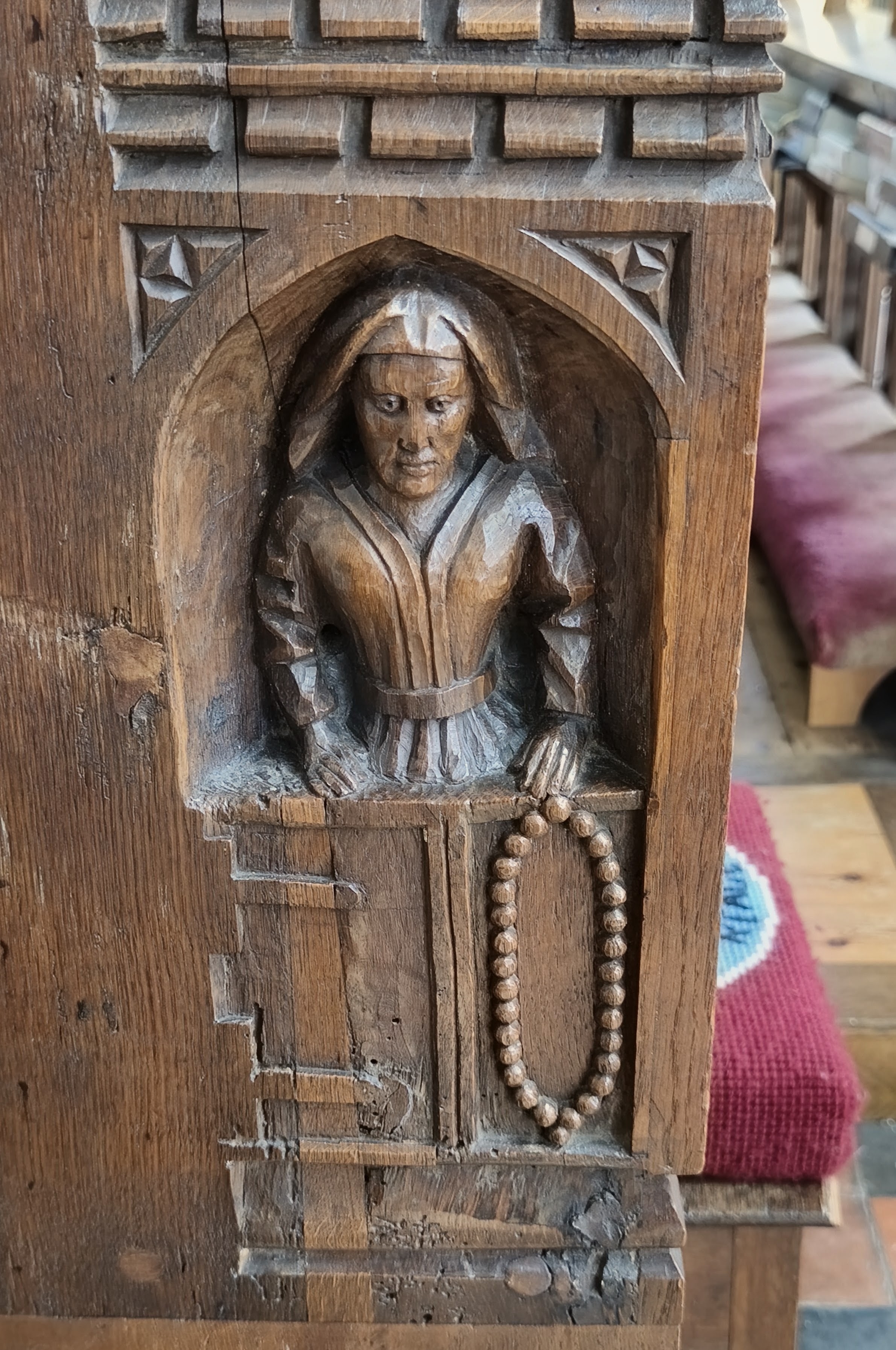
    Further into the church, I finally found them. The carvings believed to represent the historical John Chapman show him peering from a window, while his wife looks out from a balcony above. It felt strangely moving to come face to face with someone who had lived in my imagination since childhood.

    The Church Behind the Legend

    The history of the man in the carving is closely linked to the history of the church itself.

    (Image: St Peter and St Paul’s Church, Swaffham. Source: E.Blackshaw 2026)

    St Peter and St Paul’s Church was rebuilt during the fifteenth century, funded by a number of wealthy local benefactors. Among them was John Chapman, whose generosity helped finance the work and whose likeness is thought to survive within the church.

    It is here that history and folklore begin to merge. The documented life of John Chapman became entwined with the local legend until it became difficult to separate the historical benefactor from the legendary pedlar. Together, they created one of Norfolk’s most loved folk stories.

    Who was John Chapman? Why did he become known as the Pedlar of Swaffham? How did the story of one Norfolk merchant become one of England’s most enduring folktales?

    Settle in and let us follow the dream that turned an ordinary pedlar into a legend.

    The Pedlar’s Dream

    John Chapman was a pedlar, a travelling merchant, who wandered around Norfolk in the fifteenth century, taking his goods from one market to another. On market days he would join the other traders selling everything from brooches and combs to silver mirrors, eggs, spices, mustard and freshly baked bread. With his packhorse loaded with wares, John would leave Swaffham early in the morning and spend the day selling what he could. He’d then stay overnight in simple lodgings and return home the next day.

    One day he came home tired and disappointed. Business had been very poor and he had not sold a single thing, not even one copper pan.

    After his meal he complained to his wife that money was becoming short and trade was getting harder. The long journey had worn him out, so he went straight upstairs to bed.

    That night he had the strangest dream.

    (Image: Pedlar of Swaffham bench end. Source: E.Holohan 2026)

    The dream was so vivid that it felt completely real. A man appeared to him over and over again, telling him that if he travelled to London Bridge and stood there, he would hear something that would lead him to his fortune.

    When he woke the dream stayed with him. He tried to put it out of his mind, but it kept returning. The next day he thought about it again. Then the day after that. The more he tried to ignore it, the more it seemed to pop into his head.

    Eventually he could stand it no longer.

    “I have to go to London Bridge,” he told his wife.

    She thought the whole idea sounded preposterous, but she could see he had made up his mind. If travelling all that way would finally put the dream to rest, then she was not going to stop him.

    So John packed a few clothes and some food for the journey, called to his faithful dog, and set off on the long road to London.

    After many days of walking he finally arrived in the hustle and bustle of the great city. Before long he found London Bridge, but it was nothing like the bridge we know today. In those days it was lined with houses and shops, with people living and working all along it. It was one of the busiest places in England.

    John found a place to stand and waited.

    He watched everyone who passed, listening carefully to every conversation. Surely someone would say the words he had travelled all this way to hear.

    One day passed. Then another. Still nothing happened.

    On the third day a shopkeeper noticed him and asked why he had been standing on the bridge for so long.

    John admitted that he was there because of a dream. The shopkeeper just laughed.

    “My friend,” he said, “if I believed dreams, I’d be as foolish as you. Only a few nights ago I dreamed I should travel to the home of a man called John Chapman in Swaffham and dig beneath the tree behind his house. According to my dream, I’d find a great treasure there. But you don’t see me rushing off to Norfolk, do you?”

    (Image: Chapman’s dog. Source: E.Holohan 2026)

    The shopkeeper laughed again and went back to his business.

    John stood speechless, scarcely believing his own ears. Without wasting another moment, he turned around and began the journey home.

    As soon as he reached Swaffham he grabbed a spade and hurried to the apple tree behind his house. He dug as quickly as he could, hardly expecting to find anything, yet still hoping.

    Then his spade struck something hard.

    He uncovered a chest buried beneath the earth, filled with gold coins. He and his wife were overjoyed. But carved into the lid was an inscription in Latin that neither he nor his wife could understand. He started to worry that this might not be his fortune, but perhaps a curse inscribed. Hoping someone might recognise the words, John placed the chest in his window.

    It wasn’t long before some educated young men who knew the language happened to pass by. They read the inscription and translated it.

    “Under me doth lie, another much richer than I.”

    John didn’t need telling twice.

    He returned to the tree and dug even deeper. Soon he pulled up another chest, this one far larger than the first. Inside were coins, jewels and riches beyond anything he had ever imagined.

    The pedlar’s fortune had finally been found.

    According to the legend, John Chapman became one of Swaffham’s wealthiest men. Grateful for his good fortune, he helped pay for the rebuilding of St Peter and St Paul’s Church.

    Whether every detail really happened is impossible to know. Over the centuries, history and folklore have become intertwined.  More than five hundred years later, the pedlar remains a symbol of Swaffham and is immortalised on the town sign. Visitors can still find the carvings said to represent the pedlar and his loyal dog, and his story continues to be told in Swaffham and far beyond.

    As I walked from the church, I thought my journey with the Pedlar had come to an end. In reality, it was only just beginning. While researching the Swaffham legend I had come across another story of a prophetic dream and hidden treasure, but this time from a place with a very personal connection to my own life.

    It made me wonder whether the Pedlar of Swaffham is just one version of a much older story, one that has travelled across countries and centuries.

    That is a journey I’ll be exploring in the next part of this series. 

    (Image: Swaffham Town Sign. Source: E.Holohan 2026)

    Sources