Before the Tide Takes Them: A Story Close to Home

Cover art for 'Places Remember' from the Happisburgh Trilogy, featuring a coastal scene with cliffs and a distant building, set in a vintage style.
(Image: Before the Tide Takes Them. Source: Places Remember, N.Higgins, 2026)

I recently had the chance to take a small part in a new audio drama podcast called Places Remember. The first episode, “Before the Tide Takes Them”, takes us to Happisburgh on the Norfolk coast and into the rather dark story of Jonathan Balls, better known as the Happisburgh Poisoner.

Happisburgh has always had a special place in my heart. My mum Sue was born there and spent her early years living in a little cottage in the village with my grandma Jean and my Irish grandad Terry. My great grandma, Nanny Winnie, also lived in Happisburgh and once worked as a barmaid at the Hill House pub. I grew up in a nearby village and have lots of childhood memories of visiting relatives in Happisburgh and playing at Nanny Winnie’s house. She now rests with her second husband Bob in St Mary’s churchyard.

When I think of Happisburgh I think most of all of the beach. It was one of my mum’s favourite places, her “happy place”, and I have many memories of walking there with her. Then there is the wonderful candy-cane red and white lighthouse, standing like a lone sentinel over the village and coastline.
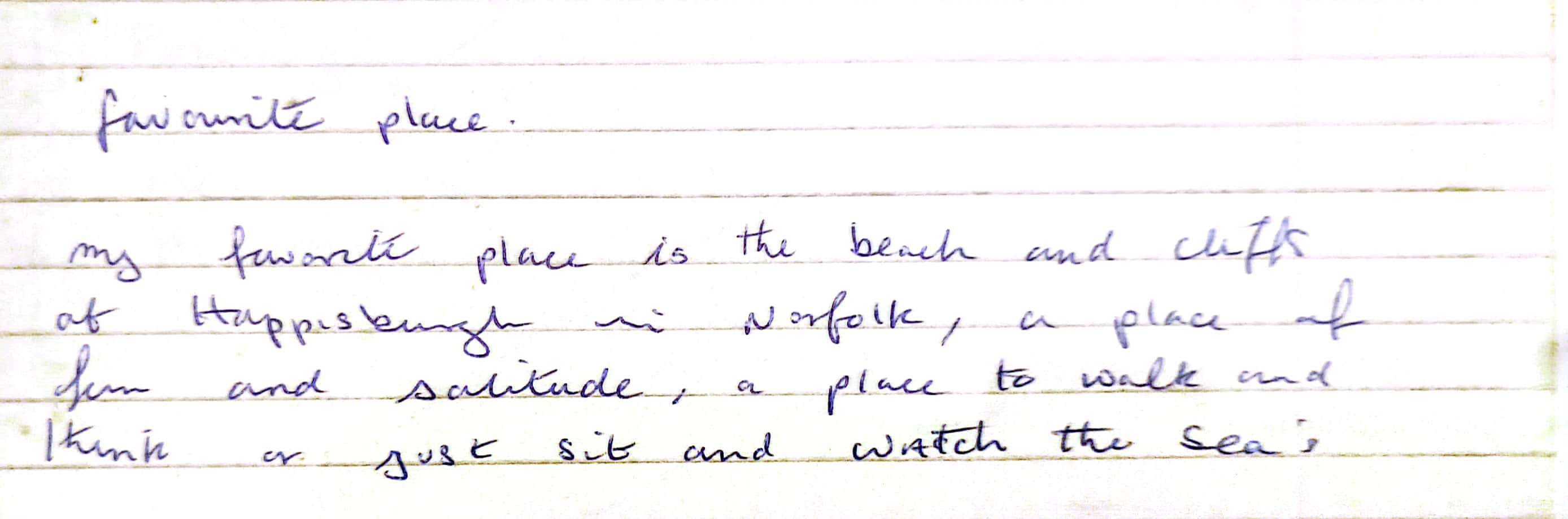
A handwritten note describing a favourite place, highlighting the beach and cliffs of Happisburgh in Norfolk as a location for fun and solitude.
(Image: Handwritten extract from Susan M. Gayfer’s personal notebooks. Source: E.Holohan personal collection 2026)

Sadly it is also a coastline that is gradually disappearing. Coastal erosion has long been part of Happisburgh’s story, which makes the title “Before the Tide Takes Them” feel particularly appropriate. There is something quite poignant about preserving the stories of a place where the landscape itself is being slowly and steadily lost.

My mum loved the paranormal, Forteana, true crime and dark history, and she was fascinated by Happisburgh’s many strange stories. Jonathan Balls was a particular favourite of hers.

The story takes us back to the 1840s, when a disturbing series of deaths among Balls’ family and others in the village eventually raised suspicions of poisoning. Arsenic was discovered, questions began to be asked, and the story became considerably darker.

And then there is Jonathan Balls’ burial. Why, according to local tradition, did he want to be buried with a Bible, a plum cake, a fire iron, coal tongs and handkerchiefs?

I’m not going to tell you. You’ll have to listen!
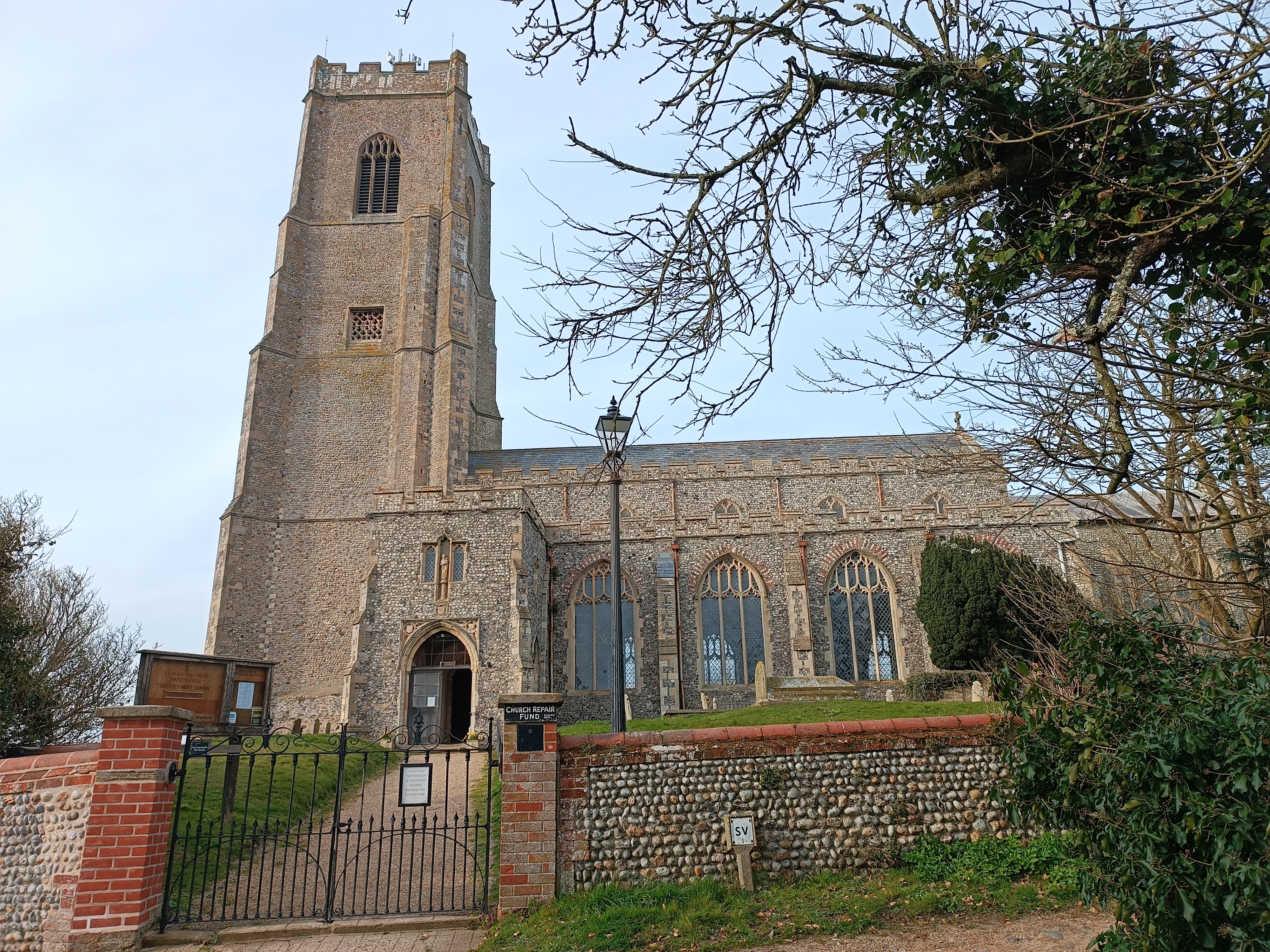
A medieval church with a tall stone tower, surrounded by trees and a stone wall, featuring a pathway leading to the entrance.
(Image: St Mary’s, Happisburgh. Source: E.Holohan 2025)

My mum always wanted to know more about the case and, for reasons probably best described as dark tourism, was particularly keen to discover exactly where Balls was buried in Happisburgh churchyard. I think she would have been rather excited that I ended up taking part in an audio drama about him. She’d certainly have been grilling me for more information and poring over all the research on the website. And I strongly suspect she’d still be asking me where his grave was so we could go and find it.

So when Nigel told me he was thinking about a new project based around Happisburgh, I really wanted to be involved. I asked for a small role and ended up playing Maria Lambert, one of the gossiping villagers. It seems quite appropriate that my first venture into voice acting involved gossiping about suspicious happenings in a Norfolk village!

Some of the scenes were recorded online with other members of the cast, while for others I recorded my lines separately and sent them in. My husband Ed also got involved by playing Reverend Birch, so it was a first venture into voice acting for both of us. I was slightly nervous about hearing myself in the finished episode, but I was actually quite pleased with how I sounded. Even a little of my original Norfolk accent crept back in. I’m Norfolk Broads born and bred, although these days my accent is fairly neutral most of the time.

The whole cast did a great job, particularly considering that many of us hadn’t done voice acting before. The music and sound effects really bring it together, and I loved hearing the story gradually unfold. Nigel and Allison rounded it all off perfectly with their narration and deeper discussion at the end.

And this is only the beginning. Before the Tide Takes Them is the first part of a Happisburgh trilogy, combining original audio drama with discussion of the real history and research behind the story. The drama is based on historical events and contemporary newspaper reports, although characters, dialogue and some events have been imagined or adapted.

For me, being involved means a little more than simply having a small part in a podcast. Happisburgh is part of my family history and part of my childhood. It is the beach with memories of my mum, Nanny Winnie resting in the churchyard and that familiar lighthouse watching over a coastline that is slowly changing.

Being able to play even a tiny part in keeping one of its stranger stories alive feels rather special.

You can listen to “Places Remember: Before the Tide Takes Them” here:

It is also available through Spotify and Apple Podcasts.

There is also a new accompanying Places Remember website. This is still being populated, but Nigel and Allison are gradually adding historical sources, research and further information uncovered during their investigations, so it is well worth keeping an eye on as it develops:

https://www.placesremember.com
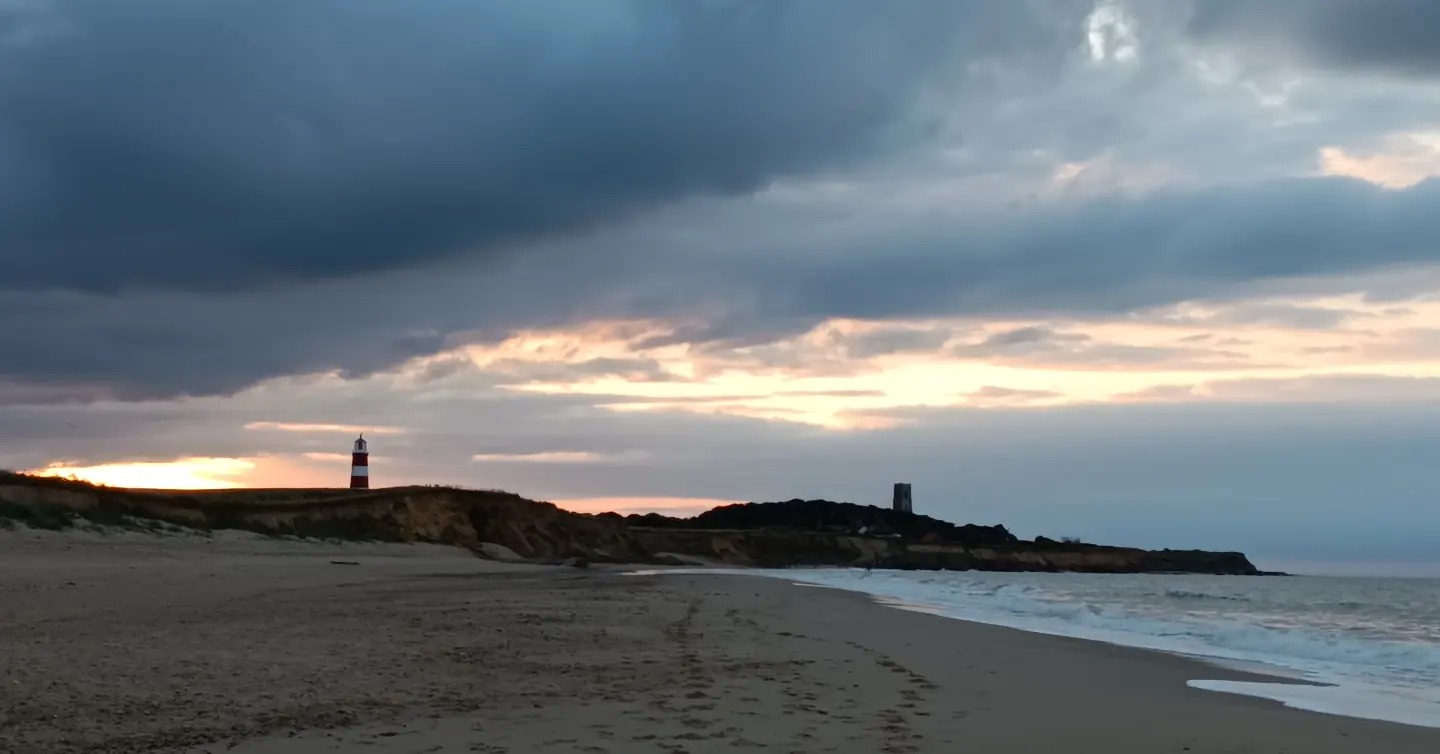
A scenic beach at sunset, featuring a striped lighthouse in the distance and dramatic clouds in the sky.
(Image: Happisburgh beach with lighthouse and church in view. Source: E.Holohan 2025)

Leave a Reply

Face to Face with the Uncanny Wax Lady of Stow Bardolph

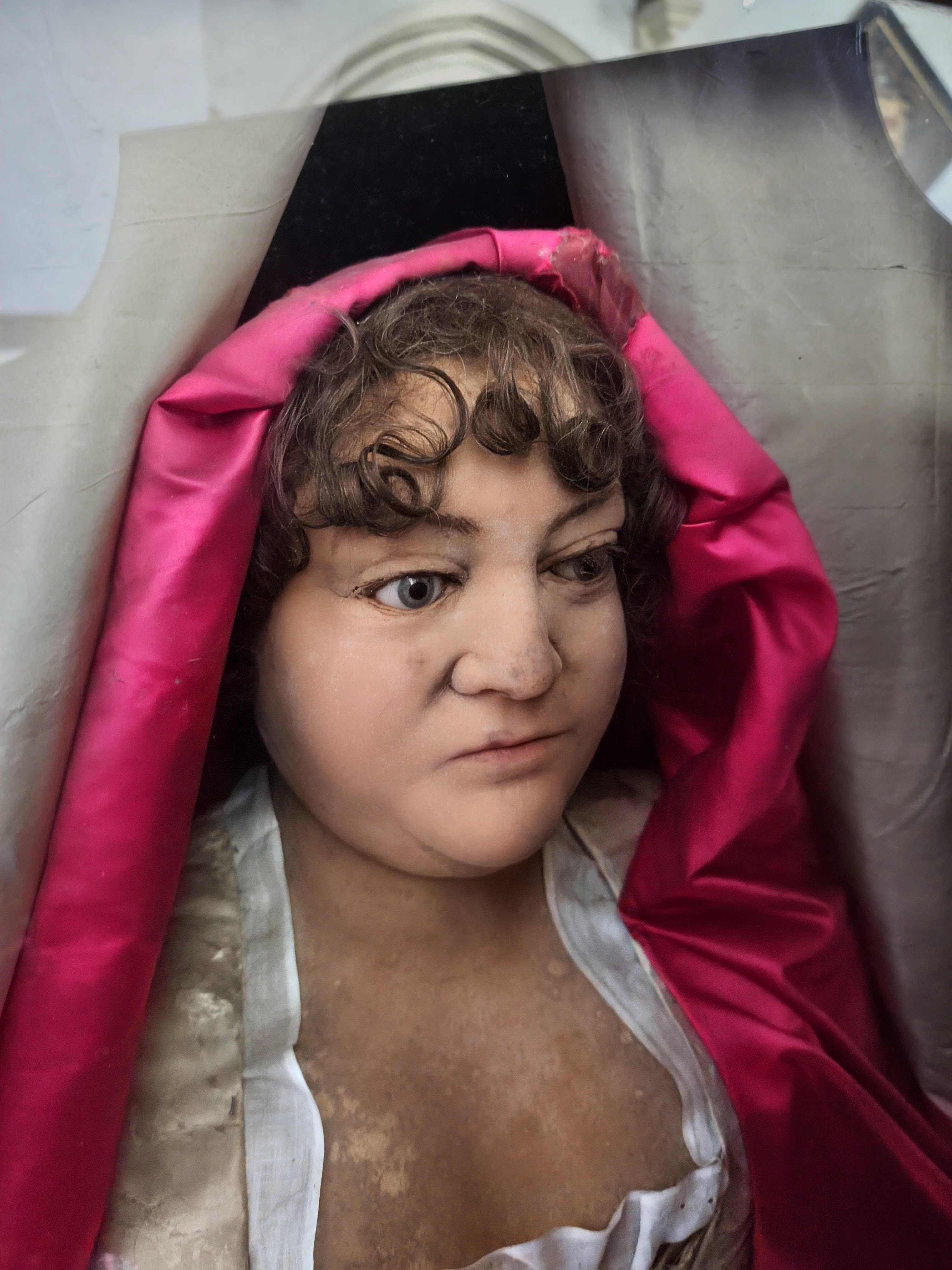
(Image: Effigy of Sarah Hare. Source: E.Holohan 2026)

When I was a child, I had a fascination with the strange corners of history, and this, of course, has continued on into adulthood. The books I borrowed from the library were full of ghosts, folklore, unexplained mysteries and curious historical oddities. Among all the photographs that lodged themselves in my imagination, save for the spontaneous human combustion foot photo, one stood out above the rest. It was the wax effigy of Sarah Hare.

I remember being quite unsettled by it. In a time before I’d ever heard the phrase “uncanny valley,” I already knew exactly how it felt. She looked too real to be a statue yet far too lifeless to be a person. I found her slightly repulsive, but I could never quite look away.

So, when I recently found myself in Norfolk, visiting Holy Trinity Church at Stow Bardolph was top of my list. I wanted to see whether the real thing would have the same effect as those childhood photographs. And it absolutely did.

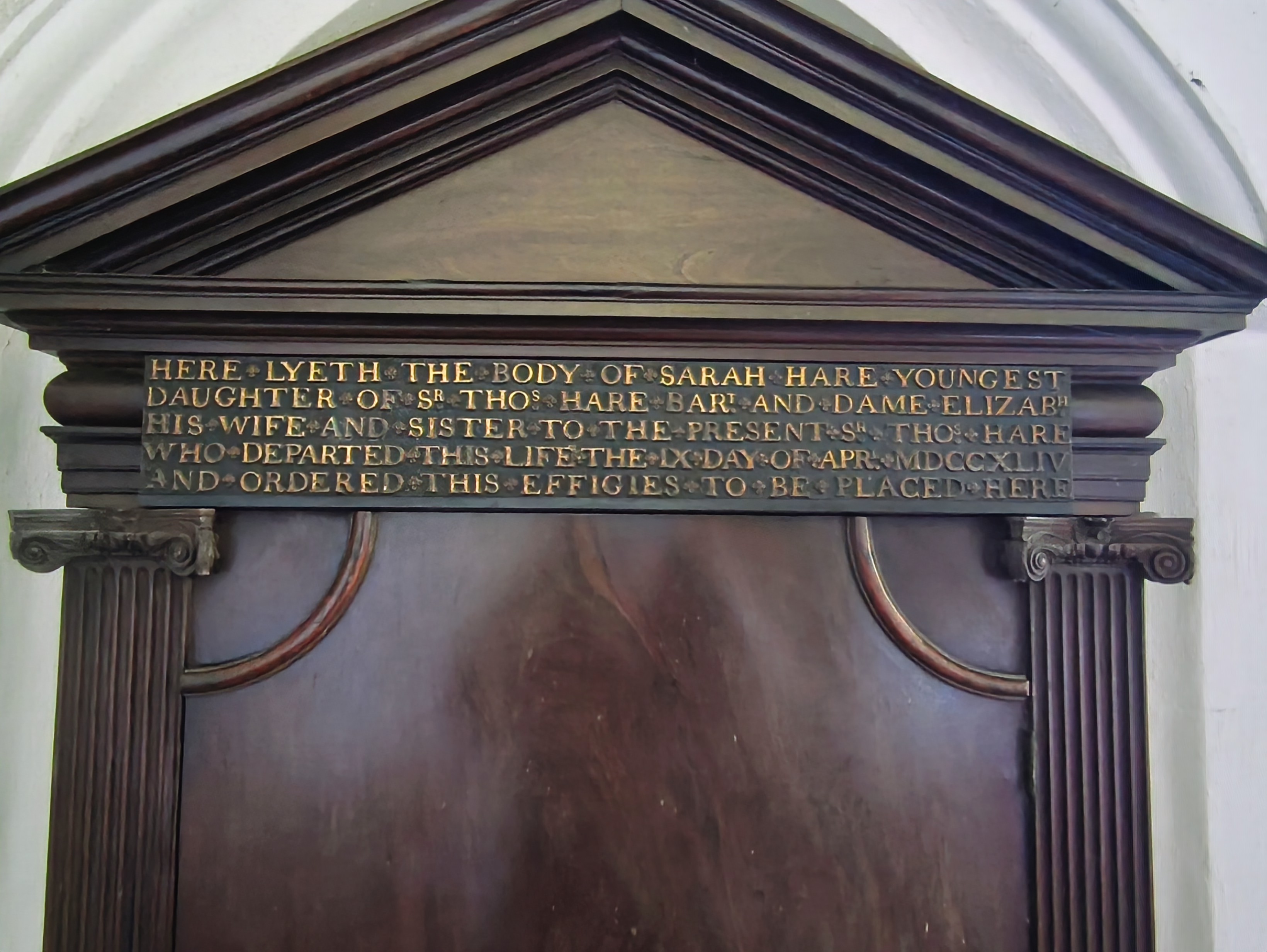
(Image: Inscription on Cabinet. Source: E.Holohan 2026)

Sarah Hare was the youngest daughter of Sir Thomas Hare of Stow Hall. She never married, so was what was once called a “spinster”, and lived a fairly ordinary life. In 1744, aged 55, she died from blood poisoning after pricking her finger while sewing. Later, locals claimed it was divine punishment for the crime of sewing on a Sunday, although the far more likely explanation is that the wound simply became infected.

The year before her death she wrote a remarkably detailed will. Alongside gifts to the poor of the parish, she made one very unusual request. She wanted her face and hands reproduced in wax, her own hair placed upon her head, and the finished effigy displayed in a mahogany cabinet with a glass front close to where she was buried.

She wrote: “I desire to have my face and hands made in wax with a piece of crimson satin thrown like a garment in a picture, hair upon my head and put in a case of Mahogany with a glass before and fix’d up so near the place were my corps lyes as it can be with my name and time of death put upon the case in any manner most desirable…“

If she did not arrange it during her lifetime, she instructed that it should be done after her death. Her family honoured those wishes. If you don’t ask, you don’t get, I suppose. And oh boy, did she get.

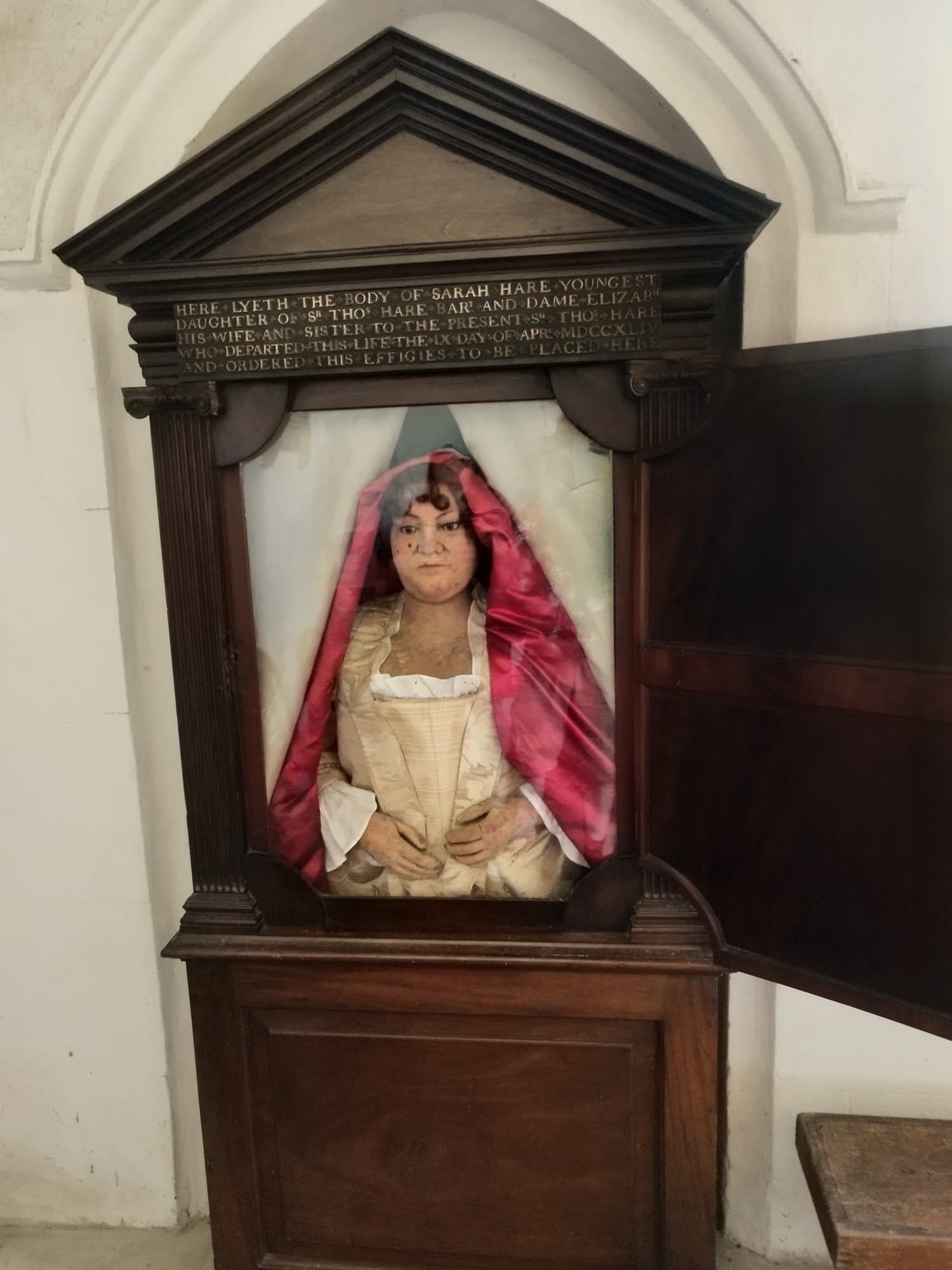
Today visitors to the Hare family mausoleum find a plain mahogany cabinet tucked into one corner. Nothing about it hints at what lies inside. Then the doors are opened, and there she is…

No photograph quite prepares you for seeing Sarah face to face. Her blue eyes seem fixed upon you. Her skin shows every wart and blemish. Her double chin has not been smoothed away. She wears one of her own silk gowns along with the crimson satin she specifically requested, and what is thought to be her own hair frames her face beneath an old fashioned wig.

(Image: Effigy of Sarah Hare. Source: E.Blackshaw 2026)

It is an astonishingly honest portrait, unadulterated by an idealising sculptor. In a time when many memorials celebrated wealth, beauty or achievement, Sarah chose something altogether different by asking to be remembered exactly as she was.

I wondered what her motives were. Was it vanity? I doubt it. If anything, the effigy avoids vanity completely. Nothing has been softened or flattered. Every blemish and imperfection remains. Perhaps it was simply a desire not to disappear entirely. After all, most of us hope to leave some trace that we were here, whether through family, creative work or acts of kindness. In Sarah’s case, she chose wax.

The effect is incredibly eerie. There is something deeply unsettling about meeting the gaze of someone who died almost three centuries ago, particularly when they appear so strikingly human.

There is also something strangely moving about it. Sarah has spent nearly 300 years silently watching visitors come and go. Seasons have changed and decades have flashed by. Yet Sarah still waits behind those cabinet doors. Time has not been entirely kind. The wax has required careful conservation and rodents once damaged her clothing before restoration work in the 1980s. Even so, she survives as the only funerary wax effigy in England outside Westminster Abbey.

Sarah Hare achieved the immortality she wanted, although probably in a way she could not have ever imagined. Thousands of curious visitors now make the journey to Stow Bardolph simply to meet her and look into her eyes.

As I left the Hare Chapel, I thought back to the child who had first stared uneasily at her photograph all those years ago. The real Sarah Hare was every bit as uncanny as I’d hoped she would be. Sometimes the strangest places really do live up to their reputation.

And occasionally, they exceed it.


Sources