A tale of jealousy, violence, and a spectral hound.

Some place names are scenic. Others are puzzling. And then there are those that stop you mid-journey.
“Dead Maids.”
I first noticed the name while travelling through the quiet Wiltshire countryside near Salisbury, at a crossroads on the A36. Surrounded by rolling fields and woodland, nothing about the landscape seems sinister at first glance. Yet names like Dead Maids Crossroads, Black Dog Woods, and Black Dog Hill suggest something darker beneath the surface: a story rooted in violence, grief, and restless spirits.
In this stretch of countryside between Warminster and Bath, folklore seems to cling to the hedgerows, and the veil between history and haunting feels unnervingly thin.
A Duel at Dawn
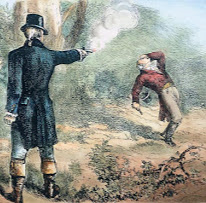
The most widespread legend of the area at Chapmanslade and Dilton Marsh is linked to the crossroads, known as “Dead Maids”. Local folklore tells of a farmer’s daughter, perhaps from what is now called “Dead Maids Farm”, who found herself in a love triangle, pursued by two eligible suitors between the late eighteenth and early nineteenth centuries. Initially, neither man knew of the other, and the farmer’s daughter enjoyed the affections of both for a time. Inevitably, this deception was unmasked, and the men quarrelled over who should win the hand of the girl in marriage. The girl could not choose between them, and it was agreed that a duel would decide the issue once and for all.
At dawn, the two suitors faced one another on a windswept hill while the faithful black dog of one of the men quietly watched on. The pistols were fired, and one of the men fell, shot through and killed instantly. As he fell, his trusty dog, driven by despair, exacted immediate justice on the apparent victor of the duel. The beast, desperate to avenge his master, savaged the victor and tore out his throat before vanishing into the dense, shadowed woods: never to be seen alive again.
Buried at the Crossroads
After the duel, the farmer’s daughter, grief-stricken and distraught at the violence she had incited, tragically took her own life. In those days, people who had ended their own lives were denied burial in consecrated ground, sometimes being interred at parish boundaries or crossroads. The multiple directions of crossroads were believed to confuse any troubled spirit, preventing it from rising and finding its way back to haunt the living.
It is from this tragedy that the crossroads got its name, and it is said that the unfortunate dog later died of grief in those same woods, now named “Black Dog Woods”, and haunts them even to this day.
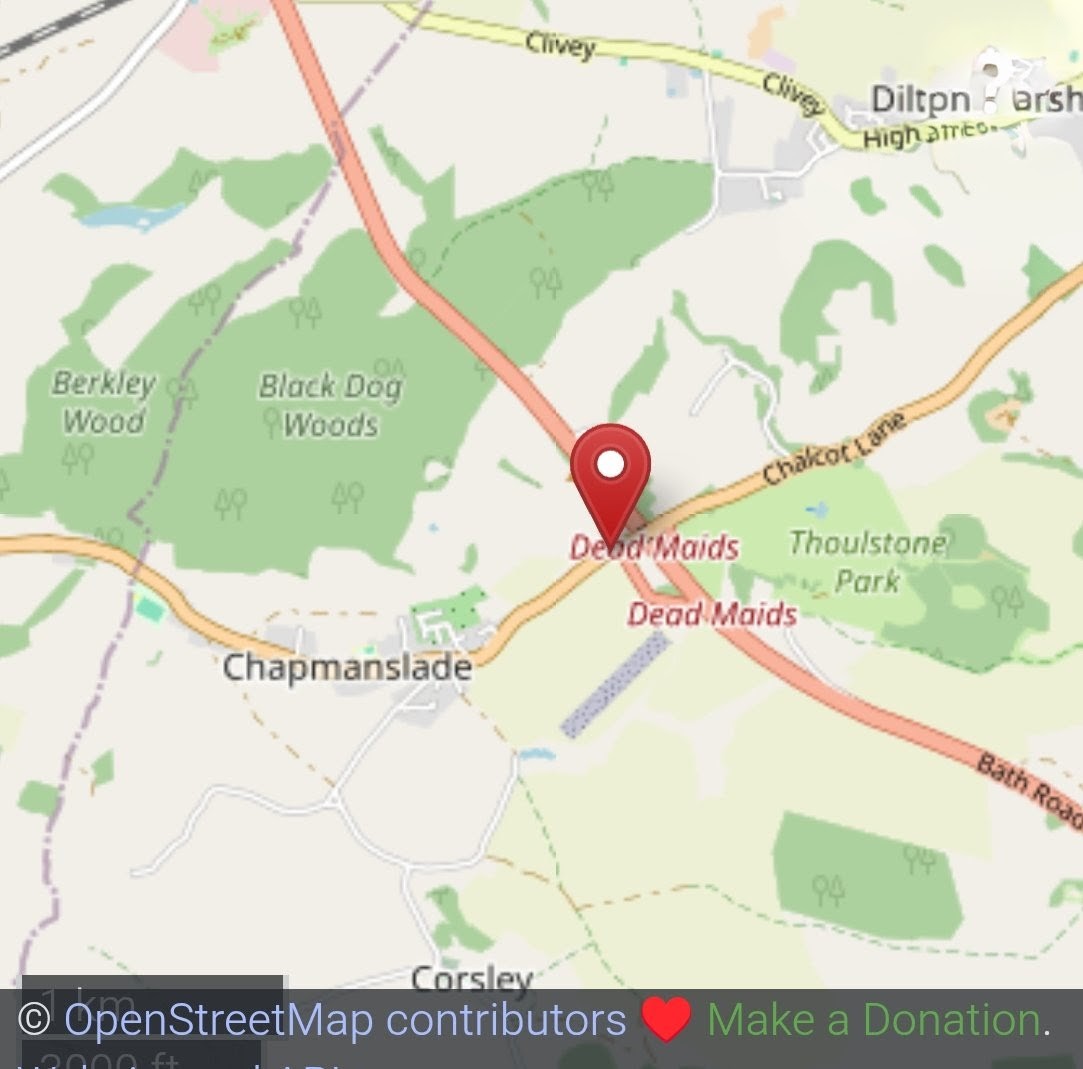
The Black Dog of the Hill
Yet the tale of the duel and the grieving dog is not the only explanation for the name “Black Dog Hill”. Some claim it was the very hill where the sad duel was fought, but others tell the tale of a dastardly highwayman who hid in the shadows here. Before the A36 was straightened in the 1970s, the road here used to twist and turn up the hill. These sharp bends provided ideal cover for highwaymen.
One particular rogue would lie in wait in the darkness with his companion, a large, highly trained black dog. As a stagecoach slowed down to navigate the bend, the beast would leap onto the vehicle and sink its teeth into the driver’s neck, bringing the coach to a halt. While the carriage was at a standstill, the highwayman would rob the passengers with little resistance.
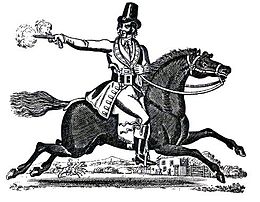
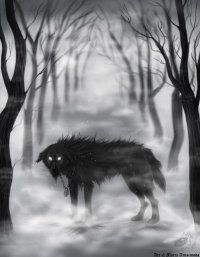
One day, however, the highwayman’s reign of fear was cut short when he was eventually shot dead. The fate of his trusty canine accomplice remains a mystery, but there are those who say Black Dog Hill is now haunted by a spectral black hound.
Whether born from tragedy at dawn or the violence of highway robbery, the black dog lingers here in local memory. Perhaps it is merely the human need to impose meaning on cruel twists of fate such as these. Or perhaps something older moves through these woods after dark.
Today, traffic passes quickly over Dead Maids Crossroads. Drivers rarely slow, and few know the stories attached to the name on the signpost. But folklore has a way of outlasting roads, maps, and modern scepticism.
And if you find yourself travelling that stretch at dusk, you might glance towards the treeline.
Just in case something dark and doglike is watching from the shadows.
Sources
- Dilton-marsh.org.uk. (2026). Dead Maids. [online] Available at: http://www.dilton-marsh.org.uk/people/deadmaids.php [Accessed 21 Feb. 2026].
- Jefferson , P. (2026). BBC – Wiltshire – Moonraking – Wiltshire’s Black dogs. [online] Bbc.co.uk. Available at: https://www.bbc.co.uk/wiltshire/content/articles/2005/10/27/black_dogs_feature.shtml [Accessed 21 Feb. 2026].
- Mysticaltimesblog.com. (2026). Dead Maids Crossroads, Black Dog Woods & Black Dog Hill , Wiltshire. [online] Available at: https://mysticaltimesblog.com/dead-maids-crossroads-black-dog-woods-black-dog-hill-wiltshire/ [Accessed 21 Feb. 2026].
- Sabre-roads.org.uk. (2026). Dead Maids. [online] Available at: https://www.sabre-roads.org.uk/w/index.php?title=Dead_Maids [Accessed 21 Feb. 2026].
- Whitlock, R. (1976). The Folklore of Wiltshire. B. T. Batsford Limited.
 Ghost Catcher Isles
