Punkie Night: Somerset’s Lantern Festival and Its Connection to Halloween, Samhain & Púca Night

Light flickering in the Autumn Dark

When the October sky over Somerset turns a bruised purple and the moon hangs low, the village streets spring to life with a glow that feels both ancient and mischievous. Children clutch glowing carved lanterns, their faces lit by flickering candles, while the air fills with a chant that has echoed through the countryside for generations:

“It’s Punkie Night tonight… Give us a candle, give us a light…”

(Image: Punkie Lanterns. Source: Punkie Night/Facebook)

This eerie procession, known as Punkie Night, is more than a quirky local festival; it is a living link to centuries-old customs that once guided lost souls, kept wandering malevolent spirits at bay, and turned the darkness of early winter into a community celebration. Here we’ll uncover the origins of the “punkie” lantern, trace the folklore from 19th‑century Somerset to the Celtic “Púca Night,” and explore how this regional tradition mirrors the modern Halloween rituals we know today.

What Exactly is Punkie Night?

Punkie Night is a lantern festival peculiar to Somerset, celebrated in villages such as Hinton St George. It takes place on the last Thursday of October every year.

The word “punkie” in Punkie Night originates from a local name for a lantern, with possible connections to “pumpkin,” “punky” (a term for a young child’s ghost), or the Old English word “punk” (timber or tinder).

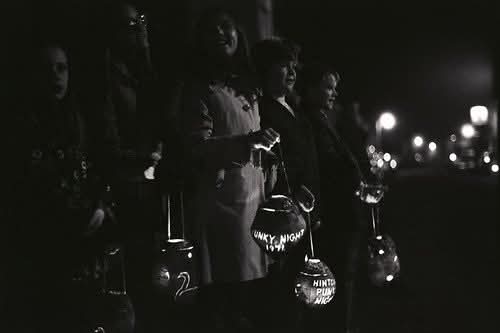
On Punkie Night, local people carve glowing lanterns from ‘mangelwurzels’, a type of large beetroot grown for cattle feed. Once carved and lit from within by candles, these ‘punkies’ are carried through the street by children and adults alike, often wearing costumes. Traditionally, the punkies are borne through the streets or door to door in a noisy parade, where those carrying them call for treats or candles to light their lanterns, singing:

(Image: Magelwurzels. Source: Punkie Night/Facebook)

“It’s Punkie Night tonight,
It’s Punkie Night tonight,
Give us a candle, give us a light,
If you don’t, you’ll get a fright.

It’s Punkie Night tonight,
Adam and Eve wouldn’t believe,
It’s Punkie Night tonight.”

Iona Opie and Peter Opie described this Somerset custom beautifully in The Lore and Language of Schoolchildren (Oxford University Press, 1987):

“To children in south Somerset a punkie is a home-made mangel-wurzel lantern of more artistic manufacture than those commonly made elsewhere for Hallowe’en. Laboriously executed designs, or floral patterns, or even scenes with houses, horses, dogs, or ships, are cut on the surface of the mangels, so that when the flesh has been carefully scooped out—leaving just a quarter of an inch to support the skin—and the stump of a candle has been lighted within, the designs become transparencies, and the lanterns ‘glow in the dark with a warm golden light’. These lanterns (reported from Long Sutton and Hinton St. George) are carried by a loop of string secured through two holes near the top just beneath the lid of the lantern. At Hinton St. George, where Punkie Night is the fourth Thursday in October, some sixty children come out into the street with their lanterns, and parade through the village in rival bands, calling at houses and singing.”

A Tale of Lost Men and Heroic Wives

According to local lore, Punkie Night can be traced back to when a group of Hinton St George men ventured to the nearby Chiselborough Fair in the early 1800s. The men spent their time at the fair drinking and carousing, and when they tried to return home after night fell, they soon lost their way. Although their village was only a few miles away, they became lost in the darkness without lanterns to light their path and were unable to find their way home.
(Image: Punkie Parade. Source: Punkie Night/Facebook)

Their wives back in Hinton St George were distraught with worry and carved makeshift lanterns from mangelwurzels and took to the streets in search of their wayward husbands. Some say that when the men first spotted the light from the women’s lanterns glowing in the darkness, they mistook them for will o’ the wisps, or even restless spirits, and ran away in terror. Once they realised the flickering punkies were held by their heroic wives, they were soon guided home to safety.

Older Roots of Punkie Night and Shared Traditions

Punkie Night was first recorded in the 19th Century but may have much older roots. In Ireland, there is a Celtic celebration called “Púca Night” which has Otherworldly connections. Here, Púca refers to fairies and sprites, which were not necessarily clearly delineated ideas from ghosts and spirits in Irish folklore. Similar to Samhain, Halloween, and Punkie Night, the veil between the world of the living and the dead is believed to thin at this time. Lanterns were said to guide lost souls back to their homes and also ward off the spirits of the dead who would roam the land of the living during this liminal period.

In these traditions, there is also the shared custom of children and adults going door to door ‘souling’ to ask for something. In Púca Night and Halloween, children ask for sweets and candy, and on Punkie Night, a candle for their punkie was requested.

Both Punkie Night and Halloween also feature chanting or singing to request these gifts. In Punkie Night, children sing their traditional Punkie Night song, while modern trick or treaters might chant the popular naughty rhyme:

“Trick or treat,
Smell my feet,
Give me something good to eat!
If you don’t, I don’t care –
I’ll pull down your underwear!”
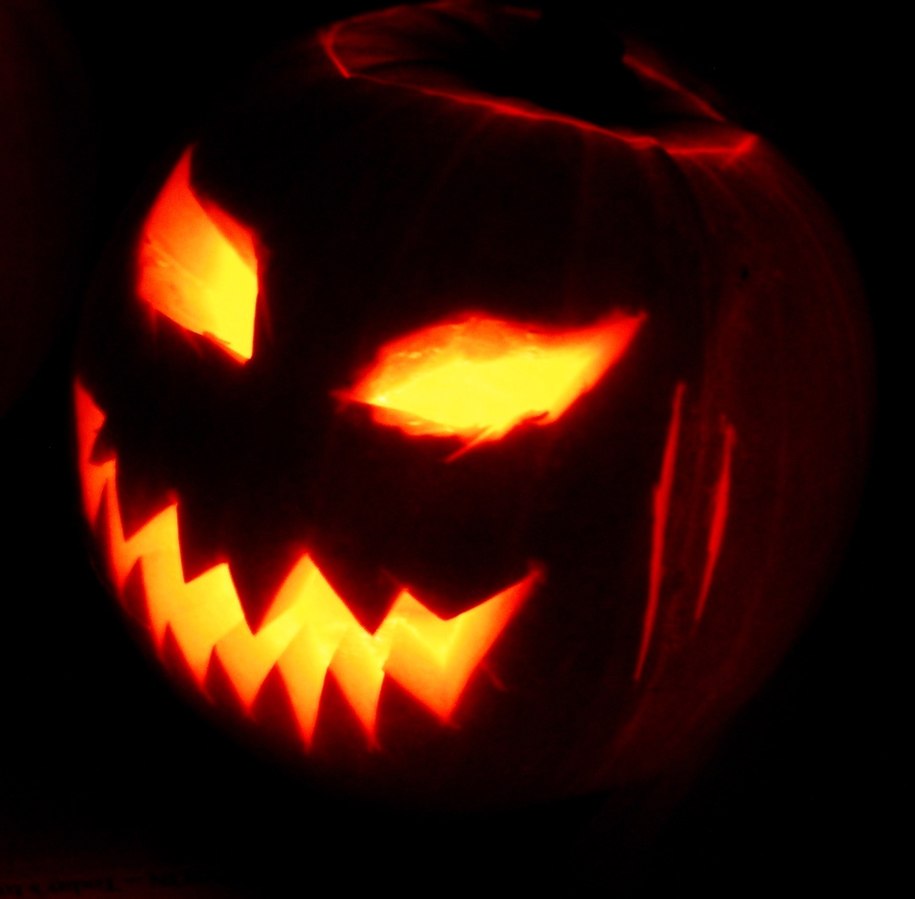
(Image: Jack-O-Latern. Source: Toby Ord, CC BY-SA 2.5, via Wikimedia Commons)

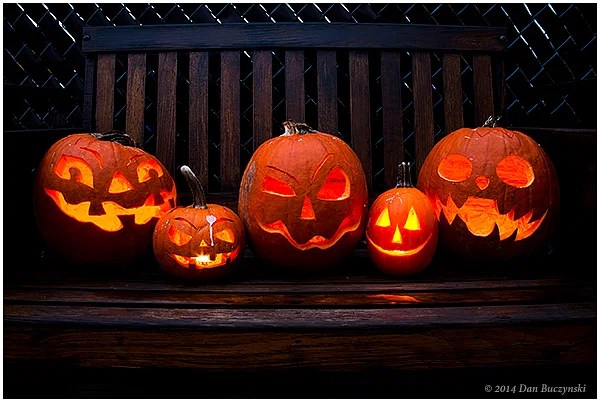
The carving of faces in punkies also has similarities to the customs of Samhain and modern Halloween. Scary faces were carved into turnip lanterns on Samhain and were placed in windows or carried outside to deter evil spirits. This has been adopted into modern Halloween traditions with carved pumpkin jack-o-lanterns being placed on window sills and on doorsteps.

These celebrations all incorporated themes of darkness, spirits of the dead, and the turning of the year. They belong to the season when the nights draw in, the harvest has ended, and people once believed that the dead and otherworldly spirits walked the earth. In this respect, Punkie Night can be seen as a regional English counterpart to Púca Night, Samhain, and Halloween. It is a survival of the same autumnal fears, folklore, and festivities that people experience at this time of year, but shaped by Somerset’s rhythms and spirit.

Why Punkie Night Endures

Punkie Night endures, weaving together folklore, community, and the timeless human fascination with light in the dark. From the crude lanterns carved by anxious wives in the 1800s to the elaborate mangelwurzel “punkies” paraded by today’s children, the festival captures a uniquely Somerset spirit while reflecting broader autumnal rites such as Samhain, Púca Night, and contemporary trick‑or‑treating. By preserving this tradition, the village of Hinton St George keep alive a story that celebrates resilience, imagination, and the comforting glow of shared history, proving that even as the nights grow longer, the light of community burns ever brighter.


Reference list

Oweynagat Cave and the Irish Origins of Samhain and Halloween

(Neopagans in Ireland celebrating Samhain. Image Credit: Unknown author, CC BY-SA 4.0, via Wikimedia Commons)

Tucked away in the beautiful scenic landscape of County Roscommon, Ireland, lies a mysterious and legendary cave known as “Oweynagat” (pronounced “Oen-na-gat”), also known as ‘Cave of the Cats’. This ancient cave is believed to be the mythical entrance to the Otherworld, Ireland’s Gate to Hell, a supernatural realm in Irish mythology. Oweynagat is one of the most important places linked to the ancient Celtic festival of “Samhain”, the forerunner to the modern Halloween. Steeped in lore and shrouded in mystery, Oweynagat is a powerful symbol of Ireland’s ancient spiritual heritage and the very origins of Halloween.

The Mythology of Oweynagat

Oweynagat is part of Rathcroghan, a major archaeological complex that served as a royal site for the ancient Irish kingdom of Connacht. This area comprises over 250 archaeological features; it is an area surrounded by many ancient sites, monuments, holy wells and standing stones. Rathcroghan is deeply linked to Queen Medb, a famous warrior queen in Irish mythology, and features heavily in stories of the “Ulster Cycle”, one of the four great story cycles of Irish mythology.

(An ogham stone which forms the lintel of Oweynagat Cave. Image Credit: Cathalpeelo, CC BY-SA 4.0, via Wikimed)

Oweynagat is often described in these tales as the “gateway to the Otherworld.” Irish mythology describes the cave as a place where powerful forces of the supernatural were said to reside. During Samhain, it was believed that the veil between the human world and the Otherworld was at its thinnest, allowing spirits, fairies, and other entities to pass through more easily. The cave itself was seen as a physical gateway through which supernatural beings could enter the mortal realm, making it a focal point for rituals and lore featuring Samhain.

One of the most famous legends associated with Oweynagat in relation to Samhain is known as ‘The Adventures of Nera”. One Samhain night, Ailill and Medb, ancient rulers of Rathcroghan, dared anyone to tie a rope around the foot of a captive hanging on a nearby gallows. They promised a reward to anyone who succeeded. Nera, a brave warrior, accepted this challenge. Decked out in his armour, he approached the captive and managed to tie the rope, only for the captive to come to life, asking Nera for a drink as a last request.

Nera agreed and carried the captive on his back to find water. As they passed three houses, each were marked by strange omens such as a lake of fire surrounding one, the captive finally drank from a slop bucket in one of the homes. In a final act of revenge, he spat his last sip on the faces of the house’s occupants, who died instantly. Returning the captive to his execution site, Nera then witnessed a horrifying vision of his home in flames and his people slain by an otherworldly army. When he followed this mysterious army into the underworld of Oweynagat, he found himself before a faery king.

(Underworld Army. Image Credit: Bing AI)

The faery king ordered Nera to bring wood daily to a house within the faery mound, where Nera met and married a faery woman. She shared many of the secrets of the faery world, warning him that his vision of his people’s demise could come true if he didn’t alert them. When Nera finally returned, only moments had passed in the human world despite his long stay in the faery mound.

Ailill and Medb, taking Nera’s warning seriously, prepared to attack the faery mound the next Samhain. Nera returned to his faery wife, who revealed she was pregnant with his child and encouraged him to escape with his family from the faery realm before the attack. He agreed and watched as the men of Connacht destroyed the faery mound, retrieving the powerful Crown of Briun, one of Ireland’s three great treasures.

Nera, however, remained forever tied to the faery world, never to be seen again in the mortal realm. The tale ends with his fate sealed, waiting in the faery mound until the end of time. The cave has since been claimed to be the birthplace of Halloween due to this story being set at Samhain.

(The Morrigan. Image Credit: Nabilsai, 2024)

Another legend relating to the cave at Oweynagat is that it is the home of the Morrígan, a Celtic war goddess who, according to tradition, emerges from the cave each Samhain to bring chaos to the land.  Ailill and Medb’s cats, who were supposed to roam out of Oweynagat on Samhain, are among the other mythological animals connected to the cave. They represent the chaos and the forces of nature that were thought to be let loose on this night.

Samhain: The Roots of Halloween

Samhain celebrations have a long history that predates written records. Samhain heralded the start of the dark of winter and the conclusion of the harvest season for the Celts. It was thought to be observed between October 31st and November 1st, sunset to sunset. Due to it being a transitional period, there was thought to be little separation between this world and the Otherworld. The veil thinned, enabling communication between living people and supernatural entities.

According to legend, Oweynagat cave is thought to become a portal to the otherworld at this time of year, where faeries and mortals may enter each other’s respective worlds. According to folklorist and professor, Dorothy Bray, “Samhain was a time charged with great supernatural energy and ordinary natural laws were suspended. The idea of the otherworld developed into the idea of the afterlife, so Samhain became a time when the worlds of life and death meet, when the souls of the dead return and can be seen.”  


(Offerings to the spirits of the ancestors. Image Credit: ©E.Holohan 2024)

According to local archaeologist and historian, Daniel
Curley, “Monsters and manifestations would emerge, led by the goddess Morríghan,
to create a world ready for winter, including birds with foul breath that would
strip leaves from trees. Locals would stay indoors in fear of being dragged
into the other world when the ghouls had finished ravaging the land. If you had
to go outside you wore a costume and mask to look hideous. That way you would
be left alone and not dragged into the otherworld.”

Feasting, bonfires, and rituals honouring the ancestors were all part of Samhain. People made food and drink offerings outside their homes to calm any wandering spirits who were thought to be free to roam on this night. People sometimes wore frightening masks or costumes to either ward off or blend in with any supernatural creatures that had passed over into our world, and bonfires were lit to guide the way to lost spirits.

From Samhain to Halloween

Many ancient traditions were adapted and reinterpreted to conform to Christianity as it expanded over Ireland. On November 1st, the Church created All Saints’ Day, which is a day to commemorate saints and martyrs. The night before was called All Hallows’ Eve, which later transformed to “Halloween.”

Samhain rituals gave rise to modern Halloween traditions including trick-or-treating, pumpkin carving, and the wearing of spooky costumes. Wearing costumes to ward off any lost spirits gave rise to the Halloween custom of dressing up as monsters, ghosts, or other terrifying creatures. The modern custom of “trick-or-treating,” in which youngsters knock on doors looking for sweet treats, evolved from the habit of leaving out food offerings.

(Jack-O-Latern. Image Credit: Toby Ord, CC BY-SA 2.5, via Wikimedia Commons)

The jack-o’-lantern, another popular Halloween custom, has Irish origins too. In order to ward off evil spirits, people in Ireland used to carve swedes and place candles inside to make glowing lanterns. This custom was carried to America by Irish immigrants in the 19th century, and it eventually developed into the pumpkin lanterns we are accustomed to today

Oweynagat Cave Today

A trip to Oweynagat Cave provides a window into the past for those who are interested in learning more about the Irish origins of Halloween. Although the cave appears to be damp, murky and unassuming, it is simple to see why ancient humans sensed a power in its presence. Visitors may feel the weight of centuries’ worth of history, rituals and legend hanging in the air when they first enter Oweynagat cave.

Today, Halloween is mainly about entertaining costumes, sweets and light-hearted frights. However, Halloween’s origins lie much deeper; it has to do with ancestors, the cycles of nature, and myths surrounding the invisible realm. Oweynagat Cave is a mysterious reminder of the mythical beginnings of this well-known festival, as well as Ireland’s contributions to a festival now observed world over.

It is easy to imagine the ghosts of Rathcroghan’s ancient lands and possibly the cave’s mythical cats emerging from the depths of Oweynagat cave as Samhain draws near, serving as a powerful reminder that the real spirit of Halloween continues to reverberate throughout Ireland’s ancient landscapes.


Reference list

Step Into the Paranormal: Highlights from the Live Vlog on the GhostÉire Channel

(GhostÉire interview with Ghost Catcher Isles. Image Credit: GhostÉire Channel)

If you’re someone who feels the tantalising pull toward the strange and supernatural, then this one’s for you. Picture this: a quiet Saturday night, lights dimmed, a flickering candle perhaps—and there I was, live on the GhostÉire Channel, diving headfirst into the world of the paranormal. Together with my incredible host Anthony Kerrigan, we opened the door to stories, historic sites, and legendary mysteries. Members of the “Uncanny Community” and paranormal enthusiasts tuned in, sharing in the experience as we wandered through tales of ancient landscapes and whispered legends. But if you missed it, don’t worry: the full recording is waiting for you, ready to be explored at your own pace.

A Bond Forged Through an Uncanny Curiosity

We kicked off the night by discussing my passion for the podcast Uncanny and the amazing ‘Uncanny Community’ it has fostered. There’s something powerful about this community: a place where like-minded individuals gather to share their strange encounters, eerie experiences, and shared fascination with the unknown. The support, curiosity, and friendship are inspiring, making it the perfect place for those drawn to the mysterious to connect.

Mysteries Carved into the Earth: The Uffington White Horse and Wayland’s Smithy

Our next stop on this haunted journey took us to one of Britain’s most iconic sites: the Uffington White Horse, a massive chalk figure etched into an Oxfordshire hillside that has withstood nearly 3,000 years of history. There’s a sacred stillness to it, a feeling that resonates with something far older than we’ll ever know. Is it a mark of ancient ritual, a tribute to old gods, or simply a beacon carved to guide travellers of the past? Each theory adds a layer of wonder to this timeless mystery.

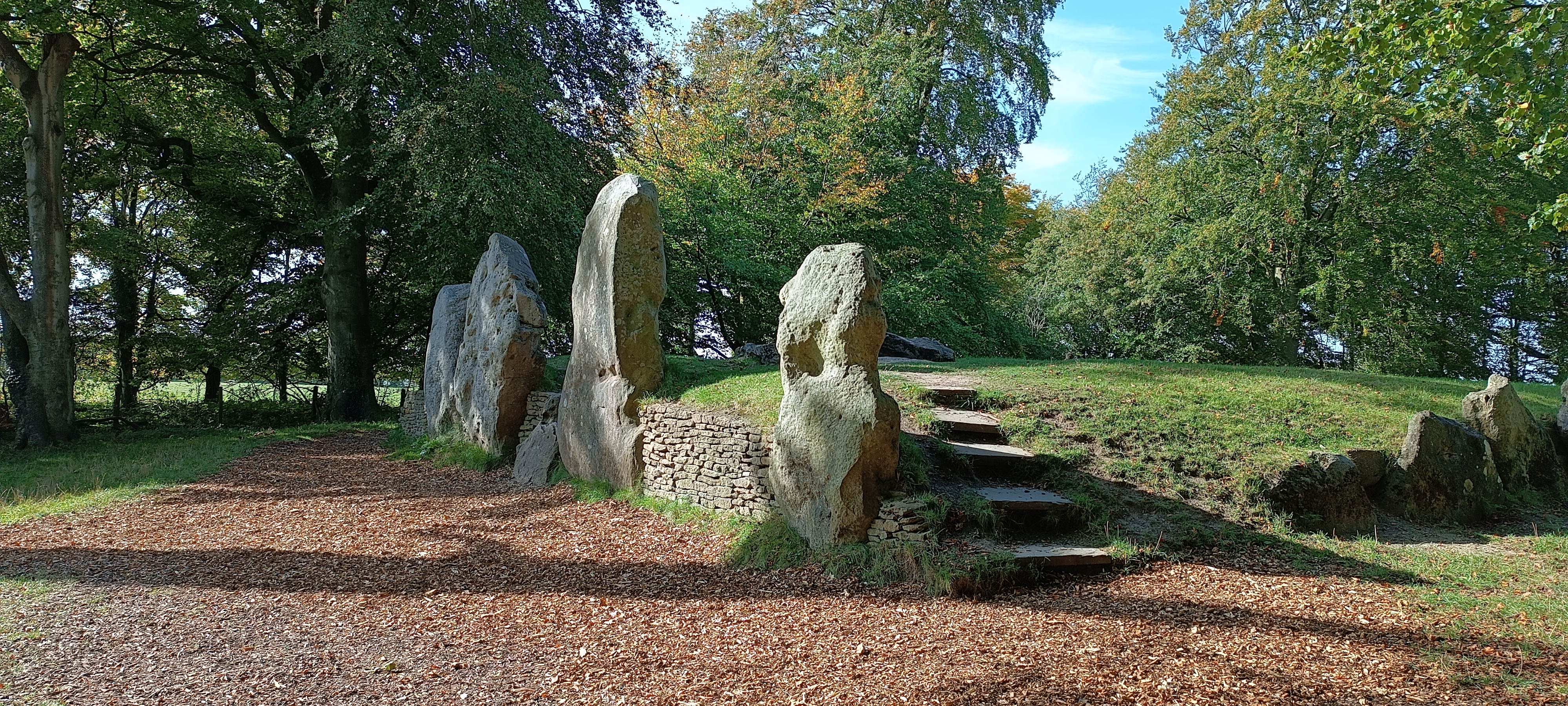
(Wayland’s Smithy. Image Credit: E.Holohan)

And just a stone’s throw away lies Wayland’s Smithy, an ancient burial site nestled within this mysterious landscape. It’s a place that buzzes with mystery. Standing there, surrounded by earth that’s seen so much, you can’t help but wonder what these ancient builders believed and what secrets they took with them.

The Haunting Sounds of the Whispering Mummies

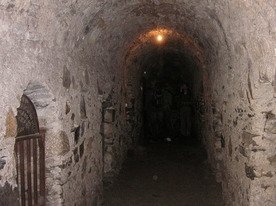
(The Crypt under St Michan’s. Image Credit: E.Holohan)

Our final topic was one that feels both spine-tingling and sombre: the Whispering Mummies of St. Michan’s Church in Dublin. Interred in crypts beneath this centuries-old church, the mummified remains have become legend, and some say that if you listen closely, the mummies themselves seem to whisper secrets of a bygone time. There’s a strange, haunting beauty here, where history and the supernatural meet in the stillness. The whispers, or maybe just the echoes of centuries, remind us that death is a mystery we all ponder, and yet, here we are, side-by-side with those who came long before us.

Join Us on a Journey Into the Unknown

If you have a passion for the paranormal or a love for history that holds shadows and secrets, this conversation is an invitation to journey with me and my host Anthony. Each story shared brought its own sense of wonder, its own question that lingered in the air. So, wrap up in a blanket, dim the lights, and join us in exploring these mysteries. Watch the full recording on the GhostÉire Channel and step with us into a world where every answer brings another question; and where the unknown is always just a little closer than we think.

Watch via links below:

GhostÉire Channel:  https://www.ghosteire.net/ghosteire-channel-seasoniv

On Youtube: https://youtu.be/73ksjMGSInc

(Interview poster. Image Credit: GhostÉire Channel)

Join Ghost Catcher Isles Live for a Paranormal Deep Dive on GhostÉire!

(Live Vlog. Image Credit: GhostÉire)

Are you fascinated by the paranormal? Intrigued by folklore and eerie legends? Then you won’t want to miss my exclusive live vlog interview on the GhostÉire Channel, where we explore the unknown and the mysterious. It’s time to sit back, relax, and join me and my host Anthony Kerrigan as we delve into the world of the paranormal.

On this episode, Anthony will be speaking to me about my passion for all things paranormal. This includes ghostly tales, mystical sites, and everything in between. We’ll discuss my blog, Ghost Catcher Isles, where I explore strange and eerie stories from across the UK and also the Republic of Ireland.

Here’s a sneak peek of what we’ll cover:

Uncanny Podcast and the ‘Uncanny’ Community

We’ll kick things off by talking about the hit paranormal podcast and documentary series, Uncanny. It first aired on BBC Radio 4 in 2021, it’s now a cult favourite. The podcast was created by Danny Robins and it dives deep into real-life supernatural encounters. It features key witness interviews and expert analysis from experts in the field such as Dr. Ciaran O’Keeffe, Professor Chris French, and Dr. Evelyn Hollow. Uncanny recently had a TV adaptation and also experienced a successful live tour across the UK and Ireland. Consequently, the Uncanny phenomenon continues to grow. But where do I stand—Team Believer or Team Sceptic? Or somewhere in between? Tune in to find out!

The Mystery of the Uffington White Horse

Next, we’ll journey to Oxfordshire, England, to explore the ancient chalk hill figure known as the Uffington White Horse. Dating back to the late Bronze Age, this enigmatic figure has sparked centuries of fascination. Is it a tribute to Epona, the Celtic goddess of horses, or linked to Rhiannon of Welsh myth? I’ll share my experience of visiting this iconic site and reveal whether the surrounding landscape holds any paranormal secrets.

The Whispering Mummies of St Michan’s

Our final topic takes us to the eerie vaults beneath St Michan’s Church in Dublin, home to mummified remains preserved for centuries. From the mysterious ‘nun’ to the six-foot-five ‘crusader,’ these mummies have their own strange stories to tell. We’ll dive into the chilling reports of ghostly whispers and invisible hands that haunt this crypt. And yes, we’ll also discuss the tragic fire of June 2024 that destroyed several of these ancient remains.

Want to ask a question? Feel free to send in your questions live about any of the topics we’ll cover—or anything related to the paranormal!

How to Watch Live: Catch the interview LIVE through the GhostÉire website at www.ghosteire.net—just press the RED button on the homepage. You can also watch via the GhostÉire Channel Facebook page: https://www.facebook.com/events/503154179156001

The live interview will last approximately 90 mins. Feel free to join for the full interview. You can join and leave as you wish. You have the flexibility to dip in and out at any time during the live broadcast.

Don’t miss out on this spine-tingling discussion! This show is open to over 18’s only

My First Podcast Experience: Ghosts & Stories

(Time Between Times. Image Credit: O.Staton and Spotify)

I’m thrilled to share that I recently had the incredible opportunity to join the captivating storyteller Owen Staton on his podcast, The Time Between Times. It was my first podcast interview, and we had a wonderful conversation about my writing, my obsession with the paranormal, and, of course, my all-time favourite Norfolk ghost story; the eerie tale of the Phantom Drummer Boy of Hickling Broad. Owen asked me why I chose this particular tale to be retold by the firepit. It’s more than just a ghost story to me; listen to the episode to find out why this eerie legend resonates so deeply.

Owen Staton is a master storyteller, so I couldn’t have asked for a better host to guide me through this fascinating chat. We covered everything from the origins of my interest in all things spooky and Fortean to my adventures around the UK and the Republic of Ireland in search of haunted places. I even had the chance to discuss my blog, Ghost Catcher Isles, which has been steadily growing in 2024, and my exciting plans for its future. I even shared a personal story about an unforgettable encounter that still gives me chills. You won’t want to miss this!

It was such a fun and thought-provoking conversation, and if you’re into ghost stories, the paranormal, or just love a good tale, this episode is one you won’t want to miss.

You can catch the full interview on Spotify or wherever you prefer to get your podcasts. Come listen, and let me know what you think—maybe we’ll share our own ghostly experiences together next time!


Links

The Legend of Stingy Jack: The Haunting Legend Behind the Halloween Jack-o’-Lantern

(Image Source: A traditional Irish turnip Jack-o’-lantern from the early 20th century. Photographed at the Museum of Country Life, Ireland. © Rannṗáirtí Anaiṫnid 2009)

Halloween, a time of ghosts, ghouls, and goblins, is a time when the veil between this world and the next is at its weakest and spirits roam the earth.  One legend looms large in the heart of Halloween itself – the macabre tale of Stingy Jack. This eerie figure from Irish folklore was the origin of the popular Halloween tradition of carving jack-o’-lanterns. Join me as I explore the dark legend of Stingy Jack and his connection to Halloween.

Who was Stingy Jack?

The legend of Stingy Jack originated from the depths of Irish folklore. Stingy Jack was a notorious trickster known for his deceit and cunning. Jack’s reputation for manipulation and shrewdness was so notorious that he even caught the eye of the devil himself.

The Legend and Faustian Bargain

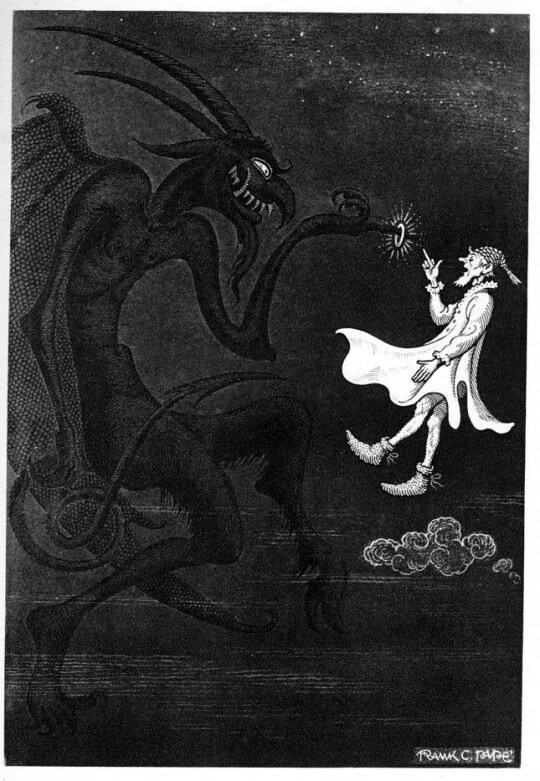
The legend has it that Jack was out one night after having a tipple in his local tavern when he stumbled upon Satan on a country road. The devil demanded his soul, but Jack pleaded to have a last drink of ale with him in the local pub.  After their drinking session, Jack used his cunning to trick the devil into transforming himself into a coin to pay for their drinks. Jack placed the devilish coin in his pocket where he kept a crucifix, thereby stopping the devil from returning to his true form.

(Image Source: PAPÉ, Frank C. “The Devil…Did for His Comfort Give Him a Ring”, illustration from Rabelais’ Gargantua and Pantagruel, 1927. © Halloween HJB 2020)

Jack was very pleased with himself and his wheeze, but eventually freed Satan. However, not one for missing a trick, Jack only agreed to free the devil after he had struck a Faustian bargain. Jack made a deal that the devil should spare his soul for ten years.

Ten years passed and Jack encountered Satan once again while he was stumbling home from the pub. Using his cunning once again, he asked to have a last snack of an apple from a nearby tree. The devil foolishly climbed the apple tree to fetch him an apple. Once up the tree, Jack surrounded its trunk with crucifixes, trapping the devil in its branches. Realising he’d been had, the devil pleaded to be let down, but not before agreeing never to take Jack’s soul. However, this bargain came with a haunting clause, one that would forever alter Jack’s fate.

Jack’s Just Desserts

Eventually, Jack’s drink-fuelled life came to an end and he died. His soul prepared to ascend to Heaven, however as he tried to enter the pearly gates he was stopped by St Peter. Jack, demanding to know why he could not enter Heaven, was taken to see God, who told him that due to his sinful lifestyle, trickery, and deceitful ways, he was not eligible for Heaven.

Jack then descended to the Gates of Hell and begged Satan for admission into the underworld. However, the devil, fulfilling his obligation to Jack, could not take his soul.  Jack was instead condemned to roam the earth in perpetual darkness. The devil, however, felt sorry for Jack and gave him an ember to light his way, which he placed inside a carved turnip to create a makeshift lantern. This eerie lantern forever guides his eternal search for a final resting place as he wanders the world between the planes of good and evil.

(Image Source: Carved Turnips, © opacity 2019)

The Birth of the Jack-o’-Lantern and Stingy Jack’s Influence on Halloween

Over time Stingy Jack’s turnip lantern became synonymous with Celtic Samhain and Halloween. Irish immigrants brought their traditions to America and soon discovered that the local pumpkins, larger and easier to carve, made ideal lanterns. This transformation from turnips to pumpkins gave birth to the iconic ‘Jack-O’-Lantern’ we know today.

As you prepare for Halloween and carve your pumpkin jack-o’-lanterns, remember the eerie folkloric origin of this beloved tradition.  Stingy Jack, with his cunning trickery and Faustian bargain, has left an enduring spark of folklore as his cursed spirit lights our way through the mysterious and magical night of Halloween. So, when you see those flickering jack-o’-lanterns, spare a thought for Stingy Jack forever condemned to wander the earth with only a lantern to light his way.

(Image Source: Jack-O’-Lanterns, ©macwagen – CC BY-NC-ND -2019)

References

An Eerie Encounter with the Dullahan’s Death Coach

Lawrence Holohan and unknown young lady, possibly a granddaughter

When I was a teenager, still in high school, I became very interested in my Irish heritage and began tentatively researching my family tree. My grandfather was from Thomastown in County Kilkenny and married my grandmother after he met her in Norfolk while stationed there with the RAF. Sadly, he died quite young, only a few months before my mother was born. I think not knowing my grandfather was what made me even more determined to look into my Irish roots and the first port of call was talking to my grandaunt Phila, my grandfather’s younger sister. Phila was a fountain of family history knowledge, providing me with a family tree drawn from memory and writing down a few memories and stories about the relatives she remembered. One such story has intrigued me since and has led me to further research and create this blog post.

Lawrence Holohan was Phila’s grandpa, my 2nd great-grandfather. He was born in 1870 in Thomastown in the county of Kilkenny in Ireland. He lived in an area near Bennetsbridge, not far from Thomastown, called Newhouse. Records trace his ancestors back to this area at least until the turn of the 19th century.

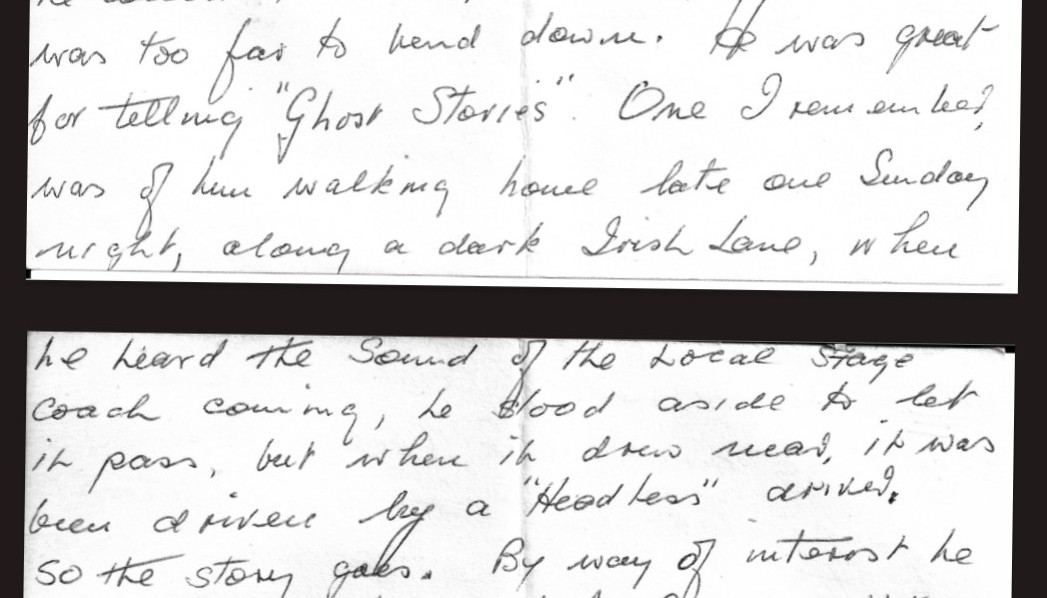
My grandaunt wrote down quite a few of her memories about him, but the one that captivated me the most was this story, as follows:

“He was great for telling ‘ghost stories’. One I remember was of him walking home late one night, along a dark Irish lane, when he heard the sound of the local stagecoach coming. He stood aside to let it pass, but when it drew near, it was being driven by a ‘headless’ driver, so the story goes.”

Aunty Phila’s handwritten notes

Lawrence died in 1956 and Phila has also now sadly passed away, so I cannot find out any more information on this wonderful ghost story from them, however, I have been able to look into some of the folklore of Ireland concerning headless coach drivers and headless horsemen.

It seems that stories of the headless coach have some history in the Bennettsbridge area, as I found a story originating from there in the National Folklore Collection, UCD. This was located in their Schools’ Collection and was written by 13-year-old Mary Nolan of nearby Danesfort in 1938:

“Headless Coach

In ancient times the old Irish people believed in many mythical things. They believed in Fairies and the “Headless Coach” and many things like that.

It is said that people in those days saw the ‘Headless Coach’ and this is the description they have of it. The Coach was very big and there was supposed to be dead people on it. The horses that were drawing it had no heads and that is why it was called the ‘Headless Coach’.

In the middle of the night some people heard it and they said it came up the Bennetts – Bridge road and it went down the Stoneyford road and it stopped at the Protestant Church. The people did not know where it came from.

The Coach made great noise as it travelled. Old people say it has to pass along the same way every four years.

People long ago told many stories about the ‘Headless Coach’ and they were kept by tradition.”

Was this the same apparition that Lawrence saw on that lonely lane, making its way to take a soul? It sounds as if the Headless Coach was a regular visitor along the roads he would have walked as a young man and he would have grown up hearing stories of its deathly journeys.

Ireland is a land shrouded in rich folklore, where tales of otherworldly beings and ghostly spectres abound. Among the many fascinating and eerie stories, two figures stand out for their chilling presence and association with death: the Dullahan and the Cóiste Bodhar Death Coach.

The Dullahan: The Headless Horseman

Dullahan, the headless horseman via Wikipedia (Croker, Thomas Crofton (1834) “XXIX. The Headless Horseman” in Fairy legends and traditions of the south of Ireland, John Murray, p. 239)

In Irish legend, the Dúlachán or Dullahan is a terrifying figure, often referred to as the “Gan Ceann” or “Headless One.” This malevolent being is said to roam the countryside, heralding imminent death with his appearance. The Dullahan was thought to be a sign of death, similar to the folklore of the banshee. Unlike the Banshee, which is known to warn of a coming death in certain families, the Dullahan does not come just to warn; he is the harbinger of someone’s certain death.  The Dullahan is depicted as a headless horseman, carrying his detached head under his arm or holding it high up in the air. The head’s eyes are said to be constantly moving, peering into the distance and revealing the fate of those whose demise is drawing near.

The first mention of the Dullahan appears in Thomas Crofton Croker’s book Fairy Legends and Traditions of the South of Ireland in 1828 and he is described as follows in the tale “The Headless Horseman”:

   ” ..such a head no mortal ever saw before. It looked like a large cream cheese hung round with black puddings: no speck of colour enlivened the ashy paleness of the depressed features; the skin lay stretched over the unearthly surface almost like the parchment head of a drum. Two fiery eyes of prodigious circumference, with a strange and irregular motion, flashed like meteors.”

Clothed in a tattered, black cloak, the Dullahan wielded a whip made from a human spine, which he used to strike fear into anyone who crossed his path. His horse’s hooves were said to spark flames as they gallop, leaving a sinister trail of fire in their wake. When the Dullahan stopped riding, it was believed that a soul was about to pass into the afterlife. It is claimed that witnesses would hear their name being called out, and if they looked back, they were destined to die.

Despite his forbidding demeanour, the Dullahan was said to be fearful of gold and would avoid areas where these precious metals are present. As a result, people would sometimes leave offerings of gold to protect themselves from the dreaded fate he carried.

Croker’s tale “The Headless Horseman” provides the best depiction of the Dullahan, presented with good humour. The protagonist of the story is Charley Culnane, who while out riding at night witnessed the apparition of a disembodied head of a horse ridden by the figure of a headless spectral rider:

“A figure, whose height (judging as well as the obscurity of the night would permit him) he computed to be at least eight feet, was seated on the body and legs of a white horse full eighteen hands and a half high … his vision failed in carrying him further than the top of the collar of the figure’s coat, which was a scarlet single-breasted hunting frock …]see further he could not, and after straining his eyes for a considerable time to no purpose, he exclaimed, with pure vexation, “By the big bridge of Mallow, it is no head at all he has!

“Look again, Charley Culnane, said a hoarse voice, that seemed to proceed from under the right arm of the figure.

Charley did look again, and now in the proper place, for he clearly saw, under the aforesaid right arm, that head from which the voice had proceeded, and such a head no mortal ever saw before.”

Surprisingly Charley then decided to challenge the headless horseman to a race, much to the delight of the ghostly rider:

“A hundred years it is since my horse and I broke our necks at the bottom of Kilcummer Hill, and ever since I have been trying to get a man that dared to ride with me, and never found one before.”

The horseman disappeared without taking Charley’s life and rewarded him with the promise of supernatural assistance in any future races in which Charley would take part.

There are also legends and tales concerning the “Headless Coach”, or in Irish Cóiste Bodhar, with its driver being the Dullahan.

The Cóiste Bodhar Death Coach: Harbinger of Doom

The Cóiste Bodhar, also known as the “Silent Coach” or “Death Coach”, is by legend a ghostly coach drawn by a team of headless, skeletal horses, and it travels silently through the night to collect the souls of the departed. Like the Dullahan, the Cóiste Bodhar is a harbinger of death and signals the end of a person’s life.

The sight of the Cóiste Bodhar is said to bring an eerie stillness to the surroundings as if nature itself is holding its breath. The coach is often described as being adorned with funereal symbols, and its windows are said to be draped in mournful black. Those who witness the spectral procession may be overcome with a sense of foreboding, as they know that someone’s demise is imminent.

In some versions of the tale, the Cóiste Bodhar is driven by a Dullahan, further intertwining the stories of these two chilling entities. According to WB Yeats in his book  Irish Fairy and Folk Tales (1893), the Dullahan drives the coach:

“This is a most gruesome thing. He has no head, or carries it under his arm. Often he is seen driving a black coach called coach-a-bower (Ir. Coite-bodhar), drawn by headless horses. It rumbles to your door, and if you open it a basin of blood is thrown in your face. It is an omen of death to the houses where it pauses. Such a coach not very long ago went through Sligo in the gray of the morning, as was told me by a sailor who believed he saw it. In one village I know its rumbling is said to be heard many times in the year.”

According to Croker, the Dullahan could be heard driving the Death Coach particularly hard on some nights when there were souls to be collected:

“The following account of the Dullahans and their coach was communicated to the writer by a lady resident in the neighbourhood of Cork:–

“They drive particularly hard wherever a death is going to take place. The people about here thought that the road would be completely worn out with their galloping before Mrs. Spiers died. On the night the poor lady departed they brought an immense procession with them, and instead of going up the road, as usual, they turned into Tivoli: the lodge-people, according to their own account, ‘were kilt from them that night.’ The coachman has a most marvellously long whip, with which he can whip the eyes out of anyone, at any distance, that dares to look at him. I suppose the reason he is so incensed at being looked at, is because he cannot return the compliment, ‘pon the ‘count of having no head. What a pity it is none but the Dullahans can go without their heads! Some people’s heads would be no loss to them, or anyone else.”

One compelling story by Croker concerning the Death Coach is that of “Hanlon’s Mill”. The protagonist Michael Noonan was walking back from Ballyduff, Co Cork from his trip to a shoemaker and passed the ruined mill of “Old Hanlon”. The ruin surprisingly seemed to be issuing clacking noises as if it were working away. Mick then met his neighbour Darby who asked him to take the horse and cart back. Mick passed by the River Awbeg and here noticed that the moon reflected on a pool of water had disappeared.  When he turned, he then saw, following beside his cart, a black coach drawn by six headless black horses, driven by a headless coachman clothed in black:

“How was Mick astonished at finding, close along-side of the car, a great high black coach drawn by six black horses, with long black tails reaching almost down to the ground, and a coachman dressed all in black sitting up on the box. But what surprised Mick the most was, that he could see no sign of a head either upon coachman or horses.”

The next morning, Mick received news from a local huntsman that Master Wrixon of Ballygibblin had died suddenly after a fit. So, according to legend, the appearance of the “Headless Coach” foreshadowed an imminent death once again.

Photo by u0410u043du0442u043eu043d u0425u0430u0442u043au0435u0432u0438u0447 on Pexels.com

Another interesting story occurred in 1876 in county Clare, collected by Thomas Johnson Westropp, in his 1910 “A Folklore Survey of County Clare”.  Here a servant for the MacNamara family of Ennistymon House was taking a stroll late at night when he heard the rumbling of wheels along the lane. Confused as to what vehicle would be out at such a late time of night, he then realised it must be the Cóiste Bodhar.

The servant then quickly ran and opened the three gates leading to Ennistymon House and threw himself face down on the ground as the death coach hurtled past him. Without stopping at Ennistymon House, it drove into the distance until it was out of sight and no longer heard. A day later news arrived that Sir Admiral Burton MacNamara had died in London.

Despite their fearsome reputation, the Dullahan and Cóiste Bodhar serve as a reminder of the ancient beliefs and superstitions that have shaped Irish culture. Did Lawrence Holohan really witness the Death Coach passing by on its solemn journey? Did it come to take the soul of a family member or friend of his? The answers are now lost in time. However, what we do know is that legend of the Dullahan and the Death Coach continues to captivate and frighten those who hear their eerie hoofbeats or the rumbling of wheels echoing in the darkness, making them two of the most enduring and haunting figures in Irish folklore.

Photo by Hakan Erenler on Pexels.com

I dedicate this post to my mother Susan Gayfer (01/06/1956-24/07/2023) who passed away suddenly and unexpectedly the on the day I finished writing the first draft and had been excited to read the finished product. She sadly did not live to read it.

References