Oweynagat Cave and the Irish Origins of Samhain and Halloween

(Neopagans in Ireland celebrating Samhain. Image Credit: Unknown author, CC BY-SA 4.0, via Wikimedia Commons)

Tucked away in the beautiful scenic landscape of County Roscommon, Ireland, lies a mysterious and legendary cave known as “Oweynagat” (pronounced “Oen-na-gat”), also known as ‘Cave of the Cats’. This ancient cave is believed to be the mythical entrance to the Otherworld, Ireland’s Gate to Hell, a supernatural realm in Irish mythology. Oweynagat is one of the most important places linked to the ancient Celtic festival of “Samhain”, the forerunner to the modern Halloween. Steeped in lore and shrouded in mystery, Oweynagat is a powerful symbol of Ireland’s ancient spiritual heritage and the very origins of Halloween.

The Mythology of Oweynagat

Oweynagat is part of Rathcroghan, a major archaeological complex that served as a royal site for the ancient Irish kingdom of Connacht. This area comprises over 250 archaeological features; it is an area surrounded by many ancient sites, monuments, holy wells and standing stones. Rathcroghan is deeply linked to Queen Medb, a famous warrior queen in Irish mythology, and features heavily in stories of the “Ulster Cycle”, one of the four great story cycles of Irish mythology.

(An ogham stone which forms the lintel of Oweynagat Cave. Image Credit: Cathalpeelo, CC BY-SA 4.0, via Wikimed)

Oweynagat is often described in these tales as the “gateway to the Otherworld.” Irish mythology describes the cave as a place where powerful forces of the supernatural were said to reside. During Samhain, it was believed that the veil between the human world and the Otherworld was at its thinnest, allowing spirits, fairies, and other entities to pass through more easily. The cave itself was seen as a physical gateway through which supernatural beings could enter the mortal realm, making it a focal point for rituals and lore featuring Samhain.

One of the most famous legends associated with Oweynagat in relation to Samhain is known as ‘The Adventures of Nera”. One Samhain night, Ailill and Medb, ancient rulers of Rathcroghan, dared anyone to tie a rope around the foot of a captive hanging on a nearby gallows. They promised a reward to anyone who succeeded. Nera, a brave warrior, accepted this challenge. Decked out in his armour, he approached the captive and managed to tie the rope, only for the captive to come to life, asking Nera for a drink as a last request.

Nera agreed and carried the captive on his back to find water. As they passed three houses, each were marked by strange omens such as a lake of fire surrounding one, the captive finally drank from a slop bucket in one of the homes. In a final act of revenge, he spat his last sip on the faces of the house’s occupants, who died instantly. Returning the captive to his execution site, Nera then witnessed a horrifying vision of his home in flames and his people slain by an otherworldly army. When he followed this mysterious army into the underworld of Oweynagat, he found himself before a faery king.

(Underworld Army. Image Credit: Bing AI)

The faery king ordered Nera to bring wood daily to a house within the faery mound, where Nera met and married a faery woman. She shared many of the secrets of the faery world, warning him that his vision of his people’s demise could come true if he didn’t alert them. When Nera finally returned, only moments had passed in the human world despite his long stay in the faery mound.

Ailill and Medb, taking Nera’s warning seriously, prepared to attack the faery mound the next Samhain. Nera returned to his faery wife, who revealed she was pregnant with his child and encouraged him to escape with his family from the faery realm before the attack. He agreed and watched as the men of Connacht destroyed the faery mound, retrieving the powerful Crown of Briun, one of Ireland’s three great treasures.

Nera, however, remained forever tied to the faery world, never to be seen again in the mortal realm. The tale ends with his fate sealed, waiting in the faery mound until the end of time. The cave has since been claimed to be the birthplace of Halloween due to this story being set at Samhain.
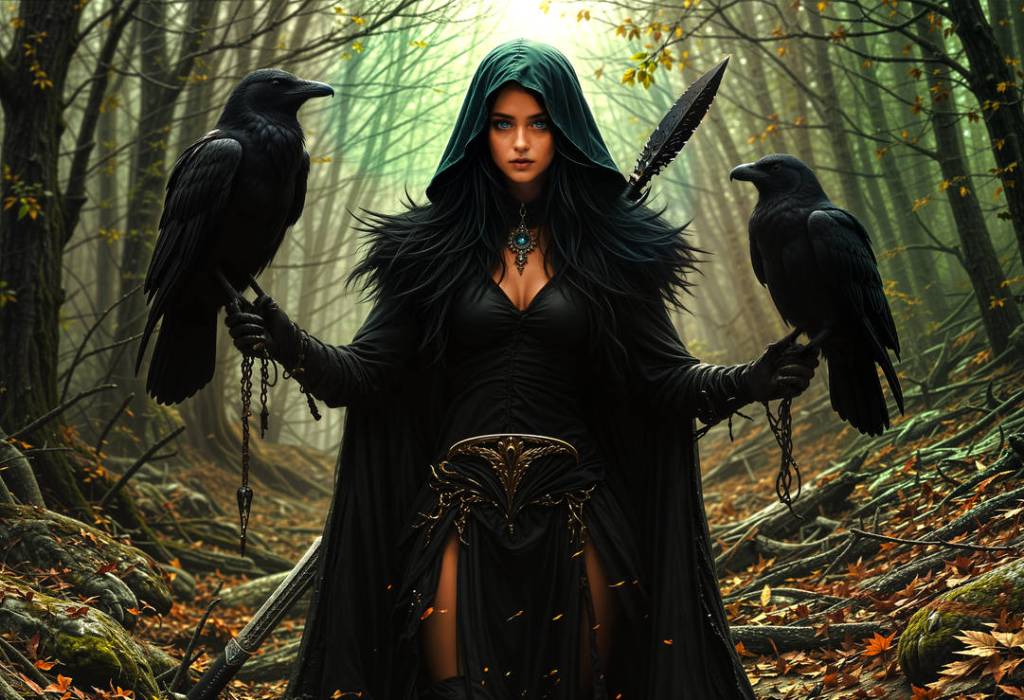
(The Morrigan. Image Credit: Nabilsai, 2024)

Another legend relating to the cave at Oweynagat is that it is the home of the Morrígan, a Celtic war goddess who, according to tradition, emerges from the cave each Samhain to bring chaos to the land.  Ailill and Medb’s cats, who were supposed to roam out of Oweynagat on Samhain, are among the other mythological animals connected to the cave. They represent the chaos and the forces of nature that were thought to be let loose on this night.

Samhain: The Roots of Halloween

Samhain celebrations have a long history that predates written records. Samhain heralded the start of the dark of winter and the conclusion of the harvest season for the Celts. It was thought to be observed between October 31st and November 1st, sunset to sunset. Due to it being a transitional period, there was thought to be little separation between this world and the Otherworld. The veil thinned, enabling communication between living people and supernatural entities.

According to legend, Oweynagat cave is thought to become a portal to the otherworld at this time of year, where faeries and mortals may enter each other’s respective worlds. According to folklorist and professor, Dorothy Bray, “Samhain was a time charged with great supernatural energy and ordinary natural laws were suspended. The idea of the otherworld developed into the idea of the afterlife, so Samhain became a time when the worlds of life and death meet, when the souls of the dead return and can be seen.”  


(Offerings to the spirits of the ancestors. Image Credit: ©E.Holohan 2024)

According to local archaeologist and historian, Daniel
Curley, “Monsters and manifestations would emerge, led by the goddess Morríghan,
to create a world ready for winter, including birds with foul breath that would
strip leaves from trees. Locals would stay indoors in fear of being dragged
into the other world when the ghouls had finished ravaging the land. If you had
to go outside you wore a costume and mask to look hideous. That way you would
be left alone and not dragged into the otherworld.”

Feasting, bonfires, and rituals honouring the ancestors were all part of Samhain. People made food and drink offerings outside their homes to calm any wandering spirits who were thought to be free to roam on this night. People sometimes wore frightening masks or costumes to either ward off or blend in with any supernatural creatures that had passed over into our world, and bonfires were lit to guide the way to lost spirits.

From Samhain to Halloween

Many ancient traditions were adapted and reinterpreted to conform to Christianity as it expanded over Ireland. On November 1st, the Church created All Saints’ Day, which is a day to commemorate saints and martyrs. The night before was called All Hallows’ Eve, which later transformed to “Halloween.”

Samhain rituals gave rise to modern Halloween traditions including trick-or-treating, pumpkin carving, and the wearing of spooky costumes. Wearing costumes to ward off any lost spirits gave rise to the Halloween custom of dressing up as monsters, ghosts, or other terrifying creatures. The modern custom of “trick-or-treating,” in which youngsters knock on doors looking for sweet treats, evolved from the habit of leaving out food offerings.

(Jack-O-Latern. Image Credit: Toby Ord, CC BY-SA 2.5, via Wikimedia Commons)

The jack-o’-lantern, another popular Halloween custom, has Irish origins too. In order to ward off evil spirits, people in Ireland used to carve swedes and place candles inside to make glowing lanterns. This custom was carried to America by Irish immigrants in the 19th century, and it eventually developed into the pumpkin lanterns we are accustomed to today

Oweynagat Cave Today

A trip to Oweynagat Cave provides a window into the past for those who are interested in learning more about the Irish origins of Halloween. Although the cave appears to be damp, murky and unassuming, it is simple to see why ancient humans sensed a power in its presence. Visitors may feel the weight of centuries’ worth of history, rituals and legend hanging in the air when they first enter Oweynagat cave.

Today, Halloween is mainly about entertaining costumes, sweets and light-hearted frights. However, Halloween’s origins lie much deeper; it has to do with ancestors, the cycles of nature, and myths surrounding the invisible realm. Oweynagat Cave is a mysterious reminder of the mythical beginnings of this well-known festival, as well as Ireland’s contributions to a festival now observed world over.

It is easy to imagine the ghosts of Rathcroghan’s ancient lands and possibly the cave’s mythical cats emerging from the depths of Oweynagat cave as Samhain draws near, serving as a powerful reminder that the real spirit of Halloween continues to reverberate throughout Ireland’s ancient landscapes.


Reference list

Uncovering Glastonbury’s Supernatural Secrets – An Uncanny Journey into Paranormal, Mythical, and Folkloric Wonder

Glastonbury, a town steeped in mysticism and ancient folklore, served as the backdrop for a recent winter expedition that united bloggers, podcasters, and fans of the paranormal. Our journey began at the venerable George and Pilgrim pub, an atmospheric establishment echoing with centuries of history.

George and Pilgrim Pub: An Eerie Prelude

Nestled in the heart of Glastonbury, the George and Pilgrim pub proved to be the ideal starting point for our supernatural escapade.

(George & Pilgrim Pub Image Source: ©E.Blackshaw)

The George and Pilgrim pub is one of the best surviving pre-reformation inns in England, one that has provided food, drink, and accommodation to pilgrims and visitors to Glastonbury for centuries. Its exact age is unknown, but it is known to have been rebuilt by Abbot Selwood in around 1455 when he oversaw an expansion of the abbey. The building itself comprises three stone storeys with a façade that resembles a small castle with battlements.  There are three panels over the front entrance. Two of these contain the coat of arms of the abbey and King Edward IV while the third is blank. This possibly contained the white rose of York and was tactfully removed when King Henry VII came to the throne. The inn was built to accommodate wealthy pilgrims visiting the nearby abbey.  The pub is also linked to the abbey by an underground tunnel that begins in the cellar and leads to a point within the abbey walls. It is thought that pilgrims could have used the tunnel to gain secret access to the abbey. Parts of the interior still have the original oak beam ceiling and stone slab flooring. Early carvings, figurines, and statues are still in place in the bar area. The interior is full of historical character, from its beamed ceilings, dark oak furniture, and huge fireplace.

As we convened, exchanging greetings, the air buzzed with anticipation. The pub, with its creaking floorboards and shadowy corners, set the stage for a day filled with eerie adventures.

St Margaret’s Chapel: A Sanctuary of Secrets

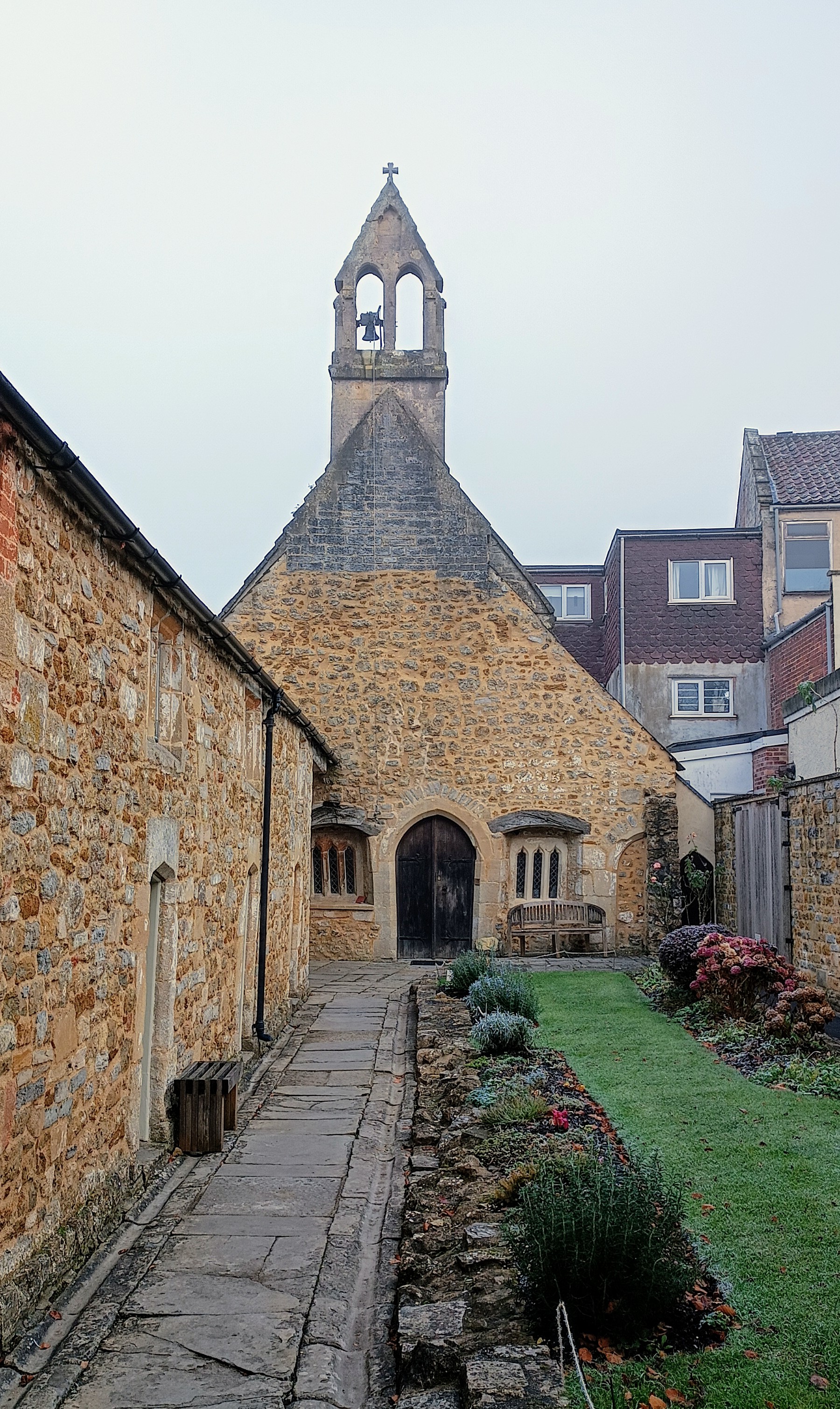
(St Margaret’s Chapel. Image Source: ©E.Holohan)

Our first destination to beckon us was St Margaret’s Chapel, a hidden gem of Glastonbury, a retreat away from the bustle of Magdalene Street. This sacred space exuded an otherworldly energy of peace and tranquillity. Built around 1250-70 and founded by Abbot Michael, it was first established as a pilgrim hospital with a chapel at the east end.  At this time, it was known as the Hospital of St Mary Magdalene. Tired and hungry pilgrims were fed, washed, and accommodated here while visiting the abbey to view its shrines and relics. It was originally a long infirmary hall with cubicles on either side. The chapel was dedicated to St Margaret who was a Scottish Queen and Saxon princess. The chapel itself has a barrel roof and a now fully restored bell-cote.

By the early 15th Century, the large hall was replaced with two rows of alms-houses used for accommodating aging, poor parishioners. These were in use until the 1950s when one row was finally demolished. The site was rescued by the Quest Community and the Mary and Margaret Charity, who restored it and now care for it.

Here we explored the chapel with its glittering icons and spent some time in quiet contemplation in the gardens before moving on to the next destination on our journey.

Chalice Well: Nourishing the Spirit

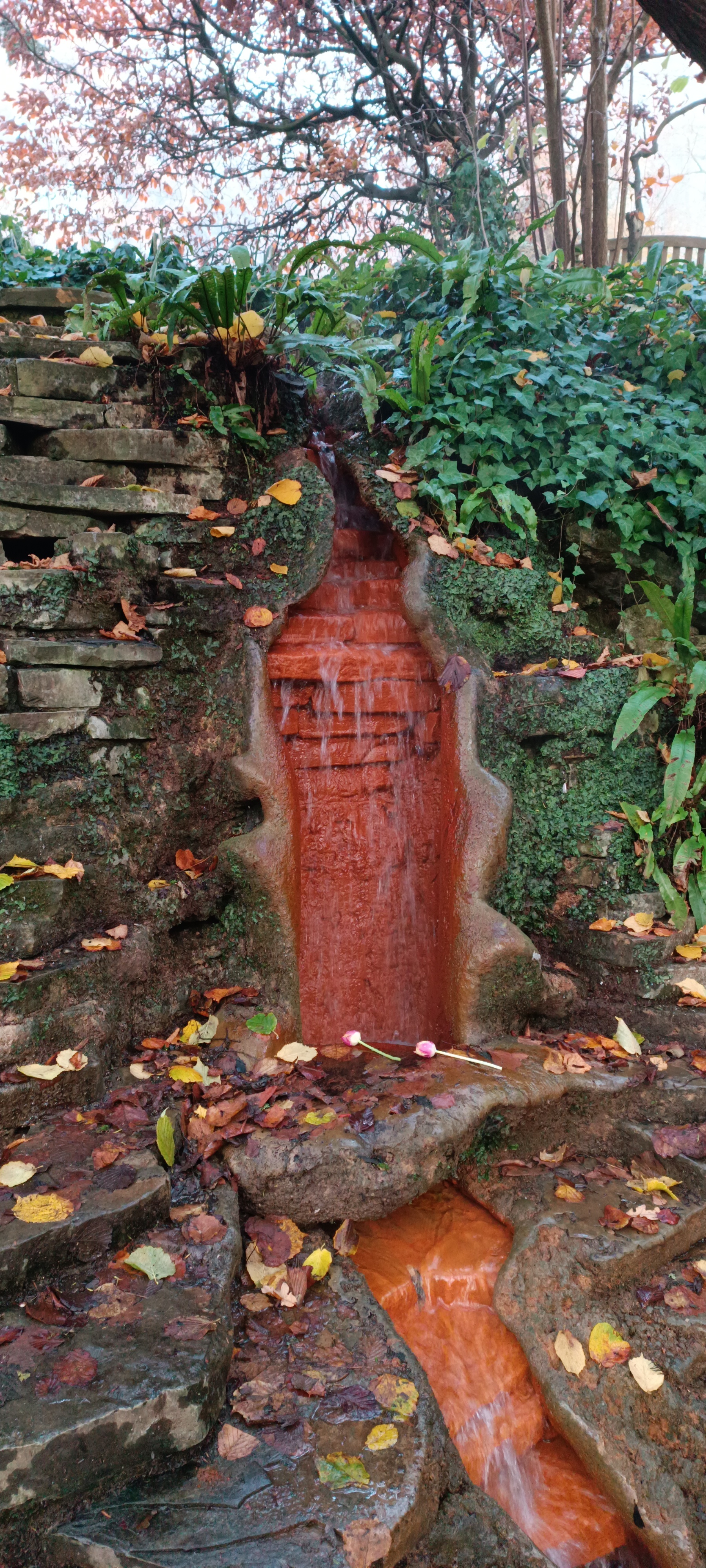
(Chalice Well. Image Source: ©E.Holohan)

A pilgrimage to Glastonbury wouldn’t be complete without a visit to the Chalice Well, a site brimming with symbolism and ancient charm.

The Chalice Well, lying sheltered between Chalice Hill and the Tor, is an area of gardens arranged around a series of fountains and water features. It was the main supply of fresh water in Glastonbury until the 19th Century and 25,000 gallons of water flow there every day. This holy well is also known as the “Red Spring” or “Blood Spring” due to the red iron deposits the water leaves on everything it touches.

The site is ancient, with a 1961 excavation bringing up Roman pottery and flint. The stump of a yew tree dated to the Roman period was even found in the deep excavation. Yews still grow at the Chalice Well today and have a strong association with the ancient Druids and also Christian churchyard.

Legend has it that Joseph of Arimathea and his followers settled nearby and built the first Christian shrine in Britain and that the earliest baptisms were conducted in the spring. It is said that Joseph brought the chalice or cup used by Jesus in the Last Supper and either buried or washed the cup at the site, causing the water representing the blood of Christ to spring forth from the ground. Due to this, the Chalice Well is linked to the quest for the Holy Grail.

The Chalice Well has also been associated with healing waters for several centuries. In 1582 Dr John Dee declared he had discovered the ‘Elixir Vitae’ at the well and declared the water had healing properties. By the 18th Century, it became fashionable for people to visit the take the waters, with visitors flocking to the well to be healed. In 1750 a man from North Wootton claimed he had had a dream which told him to drink the water on seven consecutive Sundays to cure his asthma. He did this and proclaimed that he had “recovered of his disorder”. By 1751 tens of thousands of visitors came to take the waters, many of whom made sworn testimonies stating they had been cured of all manner of things, including blindness, ulcers, deafness, and scrofula.

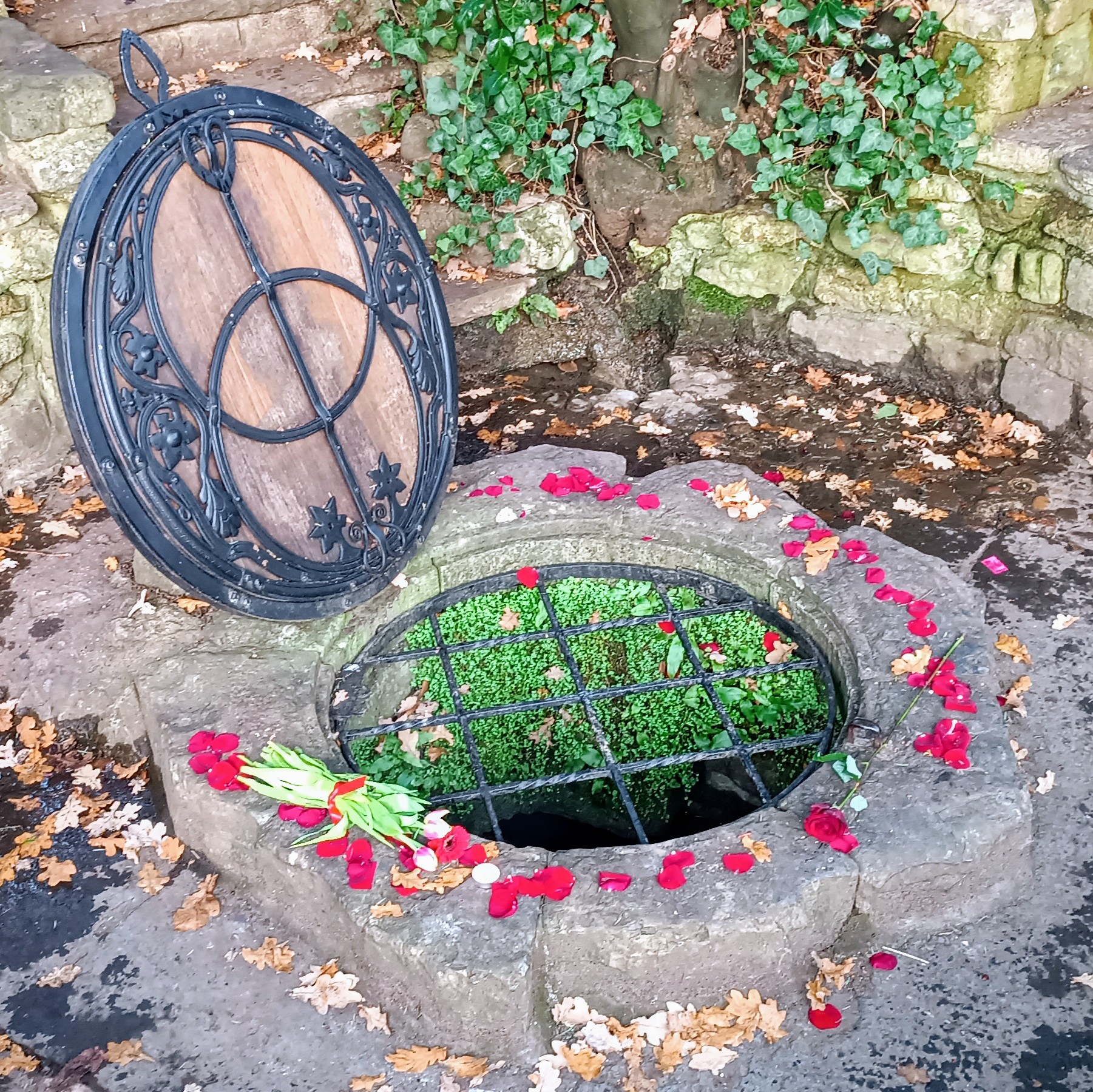
(Chalice Well. Image Source: ©E.Holohan)

Today the Lion’s Head drinking fountain is the only place in the gardens where the iron-rich water is safe to drink. The Chalice Well is now a place of quiet contemplation, peace, and calm, where visitors can revive their spirits and be soothed by nature. My husband and I filled our water bottle here, so we could drink the healing, iron-rich water later.

On Wellhouse Lane outside Chalice Well, leading up to the Tor, there is also a tap where travellers can fill their bottles when the gardens are closed. Directly opposite this lies the White Spring, from which calcium-rich waters flow, which we didn’t visit on this occasion.

The healing waters and vibrant gardens provided a tranquil respite, allowing our group to reflect on the mystical threads connecting Glastonbury’s past and present.

Glastonbury Tor: A Beacon of Mystery

Due to the inclement icy weather, myself and a number of our group decided to forgo climbing up the iconic Glastonbury Tor, preferring to view from a distance from the Chalice Well below. However, two brave members of our group continued their exploration, climbing through the mist and ice to the summit.

The Tor is a towering hill with panoramic views, it is shrouded in legend, rumoured to be the mythical Avalon. The mists rolling off the Levels left only the tower visible, pointing like a beacon towards the heavens; imposing and darkly powerful. The climb to the summit is approximately 158m above sea level, the sides are precipitous, and on a clear day, climbers can see for miles.

In early times the whole area here used to be a wetland and archaeology shows that the early inhabitants of the area built communities on hills or manmade structures, such as at the Lake Villages of Godney and Mere. Therefore, before the Levels were drained, Glastonbury Tor would have been a wetland island, perhaps leading to the myth of the Isle of Avalon. In prehistoric times it certainly would have been a landmark for local inhabitants and travellers.

(The Tor seen from Chalice Well below. Image Source: ©E.Blackshaw)

Archaeological excavation indicates that the site has been inhabited since at least the 6th Century. Pottery and metalwork have been found there indicating the presence of a people of possible importance such as a monastic community. This may have been a sacred place long before Christianity, used by Bronze Age people and perhaps the Celts. The positioning of the Chalice Well and the Tor fits with a Celtic format, perhaps a place of pagan religious importance, later taken over by Christians.

A Norman chapel was built to St Michael on the summit, but destroyed by an earthquake in 1275. It was rebuilt 50 years later and in the 15th Century a tower was added, which remains today as a romantic, lonely ruin.

The Tor is associated with several myths and legends. There is thought to be a cave deep within the Tor, which is said to be a portal into the Otherworld which the Welsh mythological Lord of the Otherworld (Annwn) uses to transport spirits. It is said that on All Hallows Eve, the Lord of the Otherworld rides out from the cave on dark steeds for the Wild Hunt; collecting souls. He is followed by the hounds of hell, Cwn Annwn. The myth remains strong as in 2005 in the early hours of the morning, locals said that a charge of demonic horses could be heard galloping through the town. Four locals stated that they saw riderless black horses thundering up Bere Lane, along Chilkwell Street, and then disappearing in the direction of the Tor. They were lucky to keep their souls, in that case!

There is also a story relating to St Collen and his experience of the Tor. The saint visited Glastonbury but shortly after had a falling out with the local monks. He left for the Tor and made a cell in a quiet spot near the spring at the bottom. Here he is said to have had a vision of the Lord of the Otherworld, also believed to be King of the Fair Folk (fairies), Gwyn ap Nudd. His vision included scenes of revelry at the fairy castle, a fine feast, and music. St Collen sprinkled holy water and the vision vanished, leaving him alone on the Tor summit. Locals say that if the summit of the Tor is covered in mist, Gwyn ap Nudd is holding high revelry there. The members of our group climbed the misty Tor, but as far as I know, were not transported to the Fairy Realm on this occasion.

Return to the Haunted Haven: the George and Pilgrim Pub

After our day of exploring some of the sights of Glastonbury, we reconvened back at the George and Pilgrim pub for dinner and drinks in its atmospheric setting. We spent the evening sharing stories and bonding over our shared interests.

(Evening shenanigans. Image Source: ©J.Hickey-Hall)

As night fell, many of us chose to brave the haunted rooms of the George and Pilgrim, welcoming the prospect of nighttime encounters with the unknown.

The George and Pilgrim pub has a reputation as one of the most haunted hotels in England. A man in 17th-century clothing is said to walk through the bar, to then disappear. In the Small Bar guests have heard a violent argument in process, only to discover on investigation that there is nobody there.

The bedrooms on the upper floors are said to be haunted by a variety of spirits. Footsteps have been heard moving along the empty corridors and cigar smoke has been smelled by occupants in certain rooms in the early hours. Chambermaids have reported that taps have been turned on, bed covers disordered, and furniture moved by unseen hands.

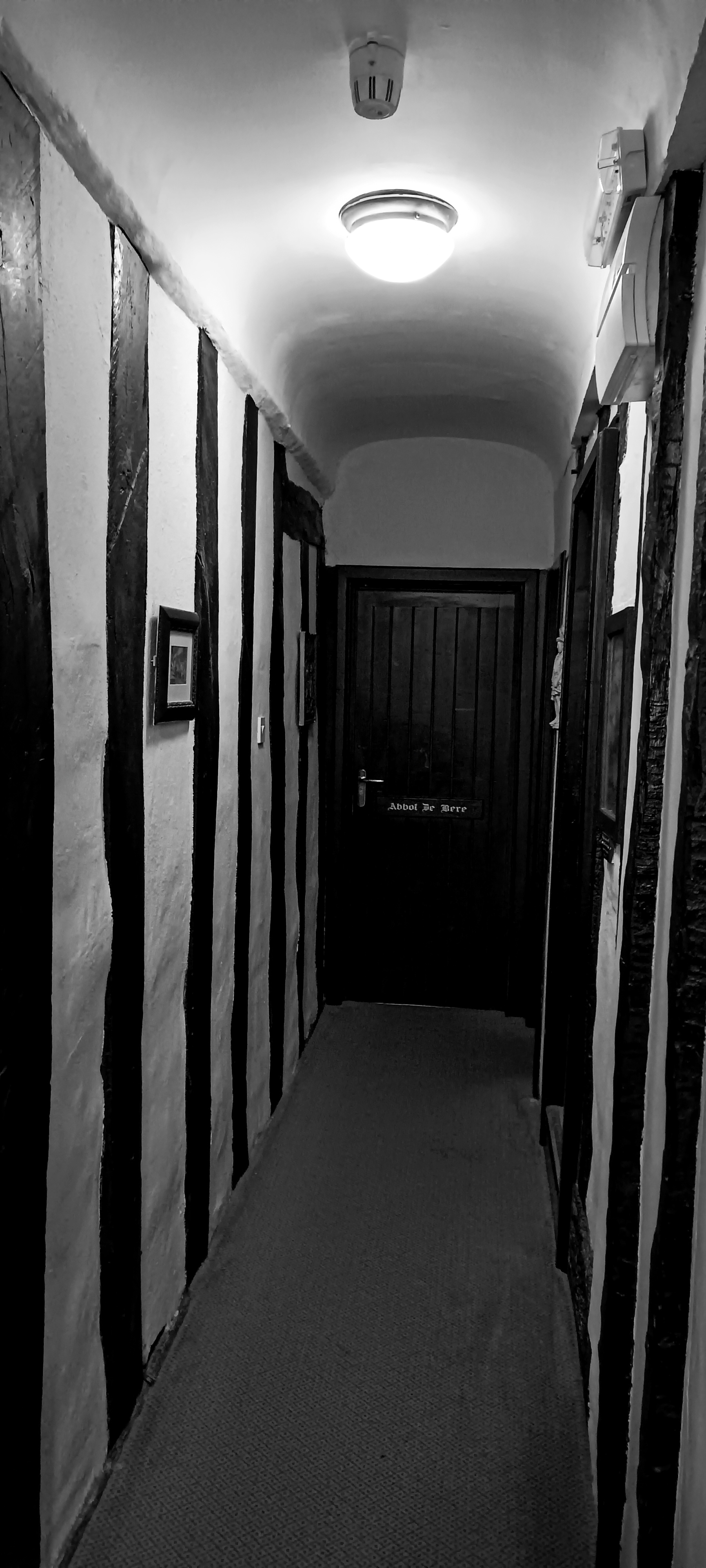
(The corridor to the Abbot Bere Room. Image Source: ©E.Blackshaw)

In one room the spirit of a monk was seen by a lady who awoke in the night. She felt the bed sink as the monk sat on the bed, where he stayed for several minutes talking about the time of Queen Elizabeth I, before fading away. Local legend has it that a monk once completed suicide in that very room.

A married couple once stayed in another room and reported that the wife was woken in the night by footsteps approaching the bedroom door. She looked to see a glimmering light with a tall, thin man in a sports jacket standing at the door. As she went to leap out of bed in fright, he smiled and disappeared.

The group decided to meet up in one of the rooms, ‘Abbot Richard Bere’ room, to see if anything spooky could be felt. Abbot Bere was Abbot of Glastonbury between 1493-1524. He began much building on Glastonbury Abbey, from the chapels to the crypts, and also rebuilt the tribunal in around 1500. Although the room was very atmospheric, with its old-fashioned four-poster bed, we did not feel anything unusual in this room.

Several of us retired to bed, but a small group of us including myself peeled off and spent some time in another of the bedrooms. Here we turned out the lights and called out for any spirits to show themselves. We heard some small tapping sounds, but on investigation, these sounds were found to be the radiators heating up.

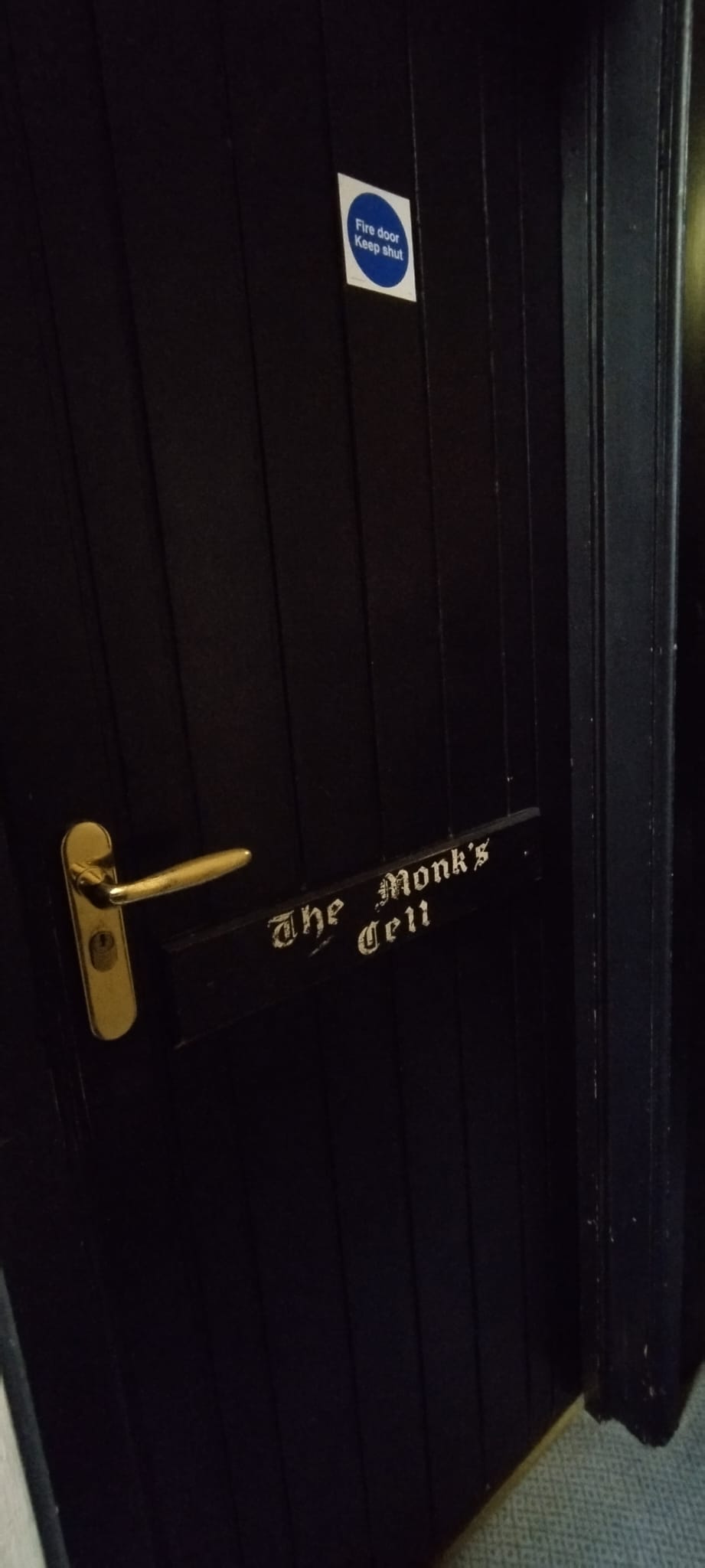
Finally, we called it a night and my husband and I retired to our room, ‘The Monk’s Cell’. This room is believed to be where the Abbot Whiting and his two monks were held on the morning of their execution. Abbot Whiting had been charged by King Henry VIII with robbery at the Bishop’s Palace in Wells after the dissolution of the monasteries. He was found guilty and attached to a hurdle, dragged through town, and eventually was hanged up on Glastonbury Tor alongside two of his monks John Thorne and Roger Wilfred. Whiting was then drawn and quartered and his head hung over the Abbey gateway.

(The Mon’s Cell. Image Source: ©E.Blackshaw)

The room had an eerie feel to it, this may just have been due to suggestion because of its old-fashioned style and slightly off-kilter proportions. I slept quite poorly that night, having weird dreams, but this once again may be due to the priming of being in a ‘possibly haunted’ room. My husband slept quite well though.

The next morning, however, provided some spooky hijinks. In the breakfast room, we were entertained by the light-hearted staff as we ate our breakfasts. Several times we noted that breakfast menus fell off the tables, perhaps pushed by spectral hands. Or, just as likely, gravity, of course. The staff claimed that this was the hotel poltergeist, ‘Arkwright’, who caused all kinds of mischief in the kitchen and breakfast room.

A Parting of Ways

Our sojourn through Glastonbury transcended the ordinary, weaving together a collective tale of mystery, and folklore, and shared fascination with the paranormal. As we departed, the ancient energy of Glastonbury lingered, leaving an indelible mark on each of us and a treasury of memories and stories to share with kindred spirits.

Please check out some of my fellow Glastonbury explorers’ podcasts and writing:

Peter Laws (https://www.peterlaws.co.uk/), Owen Staton (Time Between Times: https://www.youtube.com/@TimebetweenTimes), Dr Delyth Badder ( The Folklore of Wales: Ghosts https://www.amazon.co.uk/Folklore-Wales-Ghosts-Delyth-Badder/dp/191527950X), Jo Hickey-Hall (The Modern Fairy Sightings Podcast https://www.scarlettofthefae.com/category/the-modern-fairy-sightings-podcast/)

References