Victim Support Sponsored Ghost Hunt, January 2014- The Ancient Ram Inn, Gloucestershire

On 11th January 2014 members of Victim Support’s South West Victim Care Unit held a sponsored ‘ghost hunt’ at the Ancient Ram Inn in Wotton-Under-Edge, Gloucestershire.

The Ancient Ram Inn is considered one of Britain’s most haunted B&Bs and is reputedly haunted by at least twenty ghosts. It is claimed that it is so haunted it can no longer be used as a functioning B&B and instead opens its doors to budding ghost hunters.

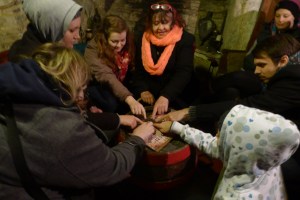
Members of the South West Victim Care Unit challenged themselves to see how long they could last out in this creepy building. A Ouija Board was used in “the bar” and several vigils were conducted in “the bishop’s room”. There were a few strange occurrences in the bishop’s room, such as a candle stick falling over, tapping noises coming from the fireplace, a brass bed warmer swinging and banging over the fireplace, a door knob rattling when nobody was at the door and long scratching noises coming from the door.

Were these down to a pranksters or spirits of the dead? You can find out for yourself if you spend a night at the Ancient Ram Inn.

Despite finding no concrete evidence of the afterlife, all members of the South West Victim Care Unit enjoyed their spooky experience, which raised £775 for Victim Support.

An more detailed write up of this investigation with additional photos will follow shortly.


Using the Ouija Board at the Ram Inn

Using the Ouija Board at the Ram Inn

2009-2014 Ghost Catcher UK & Ireland© All rights reserved. All my posts are copyright and if you do wish to refer to them or use anything from them on your site, please ask permission first
Ross Castle Investigation November 2010

This investigation followed the regular format of walk arounds and vigils in individual rooms. However, this investigation was different in that the focus was on experimenting on a séance in the lower tower room.  The purpose was to communicate with spirits and a planchette and alphabet cards laid out on the table were used.

One concern of individuals taking part in this séance was that of safety. Therefore the member of the team; who had tried some controlled experiences or instructions in what it feels for spirits to come close; was chosen to lead the proceedings. The member of the team who has had experience of working in spiritual development circles explained that, just as with living people, not all spirits are friendly. Also, if the spirit in contact was murdered this may create strong unpleasant feelings among those who have not had such experiences with communicating with in the past. Therefore, those who were prepared to be ‘touched by spirit’ were chosen to take part in the séance.

Here it was attempted to make direct communication with spirit through the participants’ psyches or ‘higher selves’. Instead of deciphering feelings from spirit, questions were asked.  A protection ritual was led by the team leader, which sought to protect the participants with a white light. This meditation was used more to get the participants into the correct mindset for connecting with spirit, though it also sought to create a psychic protection barrier.

The participants were asked to keep an open stance, with legs uncrossed, feet on the floor and a finger always on the planchette. This was done in order to keep spirit energy flowing and to align chakras. Crossing legs or arms would create interference and disrupt energy flow.

According to the leader of the séance, spirit does not move the planchette, but communicates with the participants’ psyche or energy field to make them move the planchette where it wants it to go. Here spirit works with the participants’ spirits in order to physically move the planchette, as the spirit communicating has no physicality in order to do this itself.

The séance leader called for any spirit to come to the table. This could have been any spirit whatsoever, not necessarily a spirit attached to the location. It could have been a spirit connected to an individual in the room or any spirit that wished to communicate. Those spirits who did not wish to communicate were not forced to.

The details of the séance will be kept confidential at this time in order to allow further unbiased investigation. However, one event of interest occurred while speaking to a mischievous spirit. Here one member of the group had chosen to remain in the living room below. However, the mischievous spirit announced that it wished to play a game with this member of the group. A loud bang was heard from downstairs and upon checking it was found that a change in air pressure in the living room, due to the heat from the log fire, had caused a door to slam loudly on its own. Could this have been due to a mischievous spirit playing a prank on the individual in the room, or merely natural causes?

Those individuals who participated in the séance had minimal experience of using a planchette and were sceptical of such methods. It was clear that quietly all individuals at the table had been conducting their own experiments to catch out fakery. However, all individuals came away from the séance saying that if someone was controlling the planchette it was very cleverly done as it was almost impossible to push the planchette in a controlled way. Seemingly the planchette moved where the spirit in communication desired it. All in all it was a very interesting experience, worthy of further experimentation and research.


2009-2014 Ghost Catcher UK & Ireland© All rights reserved. All my posts are copyright and if you do wish to refer to them or use anything from them on your site, please ask permission first
What are Ghosts?

“To himself everyone is an immortal. He may know that he is going to die, but he can never know that he is dead.” Samuel Butler, Immortality.

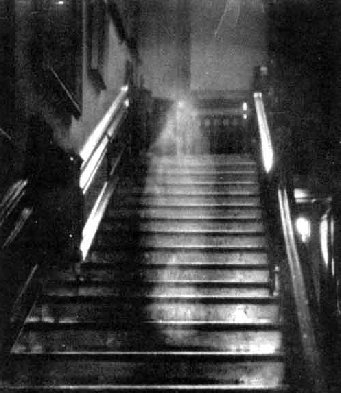
The label ‘ghost’ is a broad term which means different things to different people and in popular usage it is used to describe the disembodied soul or spirit of the dead in connection with a haunting. Another similar term is an ‘apparition’.  A ghost can be the non-conscious apparition of a past living person, an imprint or ‘recording’, unable to interact. A ghost may also be a disembodied personality, able to interact with the living. Ghosts may be visible or they may make their presence known to the living by making noises, causing cold breezes and cold spots, by creating smells and through moving objects. Ghost may not always be human; some may be phantom animals, spectral inanimate objects such as ships or even non-human energies such as angels or demons.

According to a Harris Poll conducted into religion and other beliefs in 2003 51% of the public of America, including, 58% of women, and 65% of those aged 25 to 29 believe in ghosts. Belief in ghosts may be a culturally influenced superstition reflecting our own fears of mortality as a belief in ghosts gives hope that the human personality survives death and is therefore immortal. A belief in ghosts may also reinforce our belief in the mysteries of the universe.

Many cultures and religions believe that in an afterlife or underworld where souls go after death. Some believe that souls travel to a place in the sky; some believe they rest at the bottom of a lake or even on the moon. Almost all cultures in history have believed at some point in the ability of spirits of the dead to return to the land of the living. These spirits may be malevolent or benevolent. Cultures that believe or believed in ancestor worship take spirits as fact. The spirits of their ancestors survive after death and interact with the living. Reverence is shown to the ancestors to keep in good favour and wise men and women communicate with them. The belief in ghosts has a long tradition and the first ghost stories can be found in ancient Greek literature. Pliny the Younger (c.61-c113) believed in ghosts due to his interest in two authentic cases concerning haunted houses in Athens.

According to Christian theology the soul joins God in heaven or Satan in hell. The soul can also end up in between in purgatory. Catholicism accepts that souls in purgatory may return to the realm of the living as apparitions to ask for prayers from the living. Protestants however do not believe that the dead can return. They see ghosts as being demons and evil entities pretending to be the spirits of the dead.

Spiritualists believe that ghosts are the souls of the dead trapped on the earth plane. These souls are confused or do not realise that they are in fact dead. It is the role of Mediums to communicate with these lost souls and help them move on. This can be done during seances, through channelling or via use of a spirit board (ouija board.)

According to tradition ghosts remain in the land of the living for a variety of reasons. They may return to give a warning or perhaps to advise and comfort humans. They may be vengeful and seek to right a wrong or obtain justice. They may need to return to request a proper burial or to confess some guilt so that they may rest in peace. Some ghosts may remain to guard or protect property which belonged to them in life or they may even return to inform heirs of the location property or treasure due to them. They may also guard over or protect a person who was dear to them in life. Other ghosts return or remain in a place that they loved or hated in life or they may even remain due to being unaware that they are dead.

It is a common misconception that ghosts only appear at night. Many appear in daylight; however visual apparitions are more often seen at night. It is believed that the greatest number of people die between the hours of 2-6am, which is one theory as to why more ghosts manifest during these hours. Ghosts are also more visible in the dark as they are thought to consist of energy, often manifesting in the form of light anomalies. In daylight these anomalies are more difficult to see with the naked eye.  Individuals may be more sensitive and receptive to clairvoyance when in a relaxed state or while asleep at night and so may have an increased likelihood of seeing an apparition. However, some experts believe these states may also create hallucinations of ghosts.

Another popular misconception is that ghosts are frequently to be found haunting graveyards. The majority of ghosts are not seen in graveyards, but are more often to be found in houses and buildings.

The majority of ghost reports have natural explanations such as tricks of the light created by foggy conditions or excessive electrical charges in the atmosphere during thunderstorms among many other explanations. However a small percentage of cases baffle experts and remain unexplained at present. There is also still no consensus amongst paranormal researchers as to whether ghosts are real or fantasies created by the human mind or if they are psychic remnants of past events playing over like a psychic recording or if they have personality and intelligence. However, it is hoped that further research over time will yield evidence and explanations to one day prove or disprove the existence of ghosts.

References:

  • Keene, P, Bradley-Stevenson, G and Saunders, B, 2006, The Ghost Hunter Chronicles. New Holland, London.
  • Underwood, P, 1999, Peter Underwood’s Guide to Ghosts & Haunted Places. Piatkus, London.
  • O’Keefe, C, and Fielding, Y, 2007, Ghost Hunters: A Guide to Investigating the Paranormal. Hodder, London
  • Danelek, J, 2006, The Case For Ghost: An Objective Look at the Paranormal. Llewellyn Publications, Minnesota
  • Guiley, R, 1997, The Guinness Encyclopedia of Ghosts and Spirits. Guinness Publishing, London
  • Harris Interactive, 2009, The Harris Poll® #11, February 26, 2003: The Religious and Other Beliefs of Americans 2003, http://www.harrisinteractive.com/harris_poll/index.asp?PID=359, [Accessed 15th February 2010]