
Earlier this year I was lucky enough to secure tickets to a paranormal night of discovery event being held in the atmospheric venue that is ‘The Mount Without’. This was a two-part event hosted by the marvellous Dr Kate Cherrell. The first part of the event was an introduction to Victorian Spiritualism introduced by Kate and the second part of the event was a paranormal investigation, co-hosted by Kate and Jamaica Inn paranormal investigator Karin Beasant, giving attendees the chance to try their hand at experiments and contacting spirits from beyond the veil.

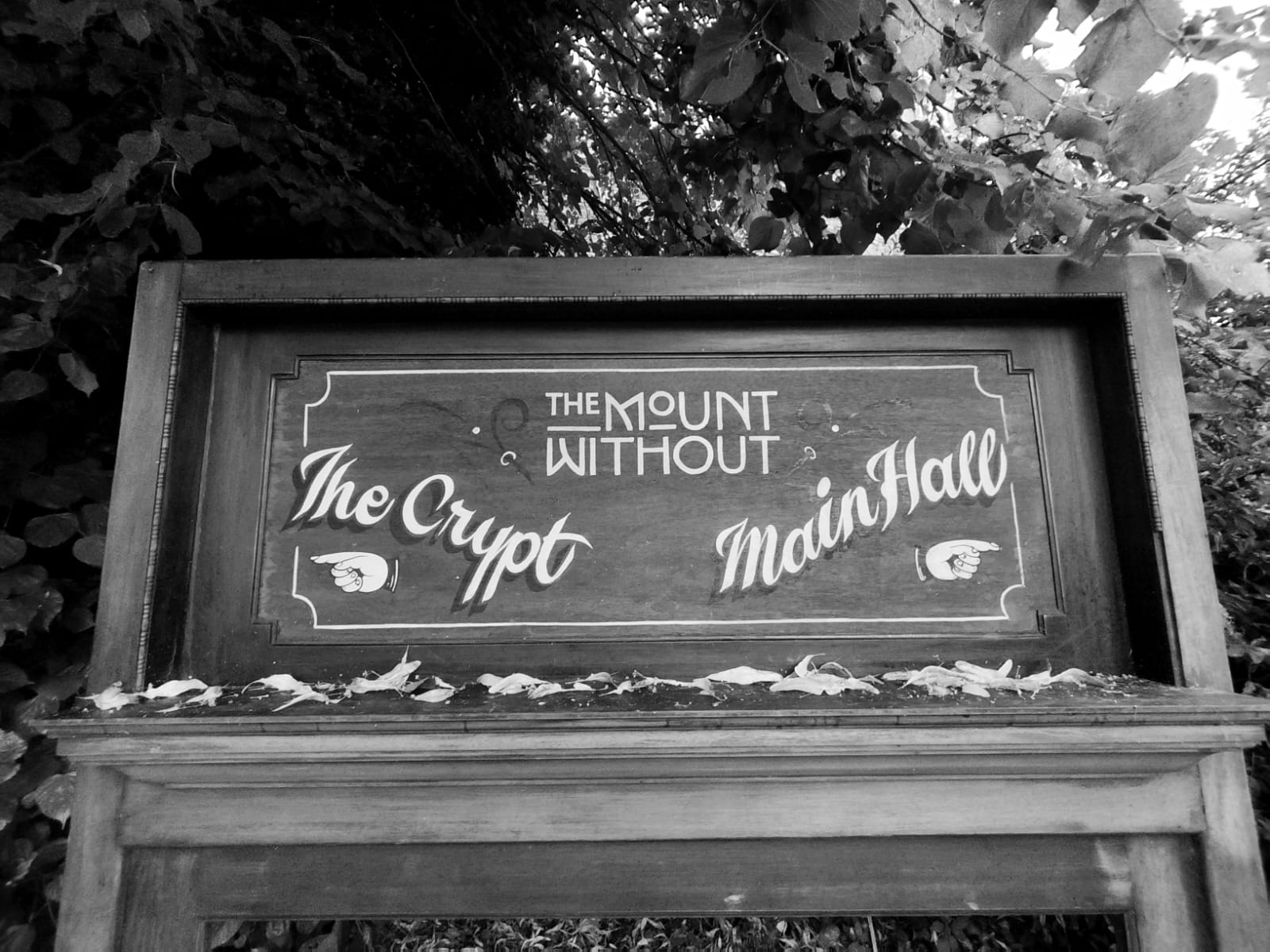
The Mount Without
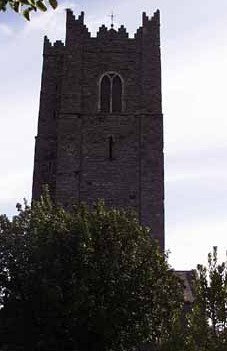
Saint Michael the Archangel on the Mount Without is an impressive church standing proud on St Michael’s Hill, looking over the city of Bristol. The first church on this site was likely Norman and built in 1147 by Robert Fitzhamon, who is famed for also building Tewksbury Abbey. The church was originally built outside the city walls and was therefore known as “The Mount Without”. The original church was then rebuilt in 1460 and the clock tower you see now is from that period.

Over the years the city of Bristol slowly grew up and around the church, as St Michael’s Hill became more populated with merchants and other residents. By 1775-1777 the church became too small to take the growing congregation and so the main body of the church was demolished and rebuilt by local builder, Thomas Paty. Around this time new graves were also created in the crypt and tombstones reused as ‘under slabs’ for the new graves. As the living population of Bristol grew, so did the population of the dead interred at the Church.
During the second world war, the church was damaged twice during the Bristol Blitz. In 1940 a 1000lbs bomb fell within feet of the Church and in 1941 an incendiary device set the roof alight destroying it. The church was repaired and in use until 1999 but the congregation dwindled over the years and was finally closed by the diocese.
The church lay empty, until squatters moved in and set it ablaze in October 2016. The dramatic blaze took at least 15 fire engines and many firefighters to extinguish. I could see the smoke from the blaze billowing in the sky near my home not too far away.
In 2017 the diocese wanted to find a new use for the building and asked for design bids from businesses, philanthropists and entrepreneurs. The church was finally reclaimed as the creative venue and events space that we see now, where it hosts artists, music and holistic events. This wonderful gothic revival church has been a gathering place for the people of Bristol for over 900 years and looks set to continue with that legacy.
An Introduction to Victorian Spiritualism
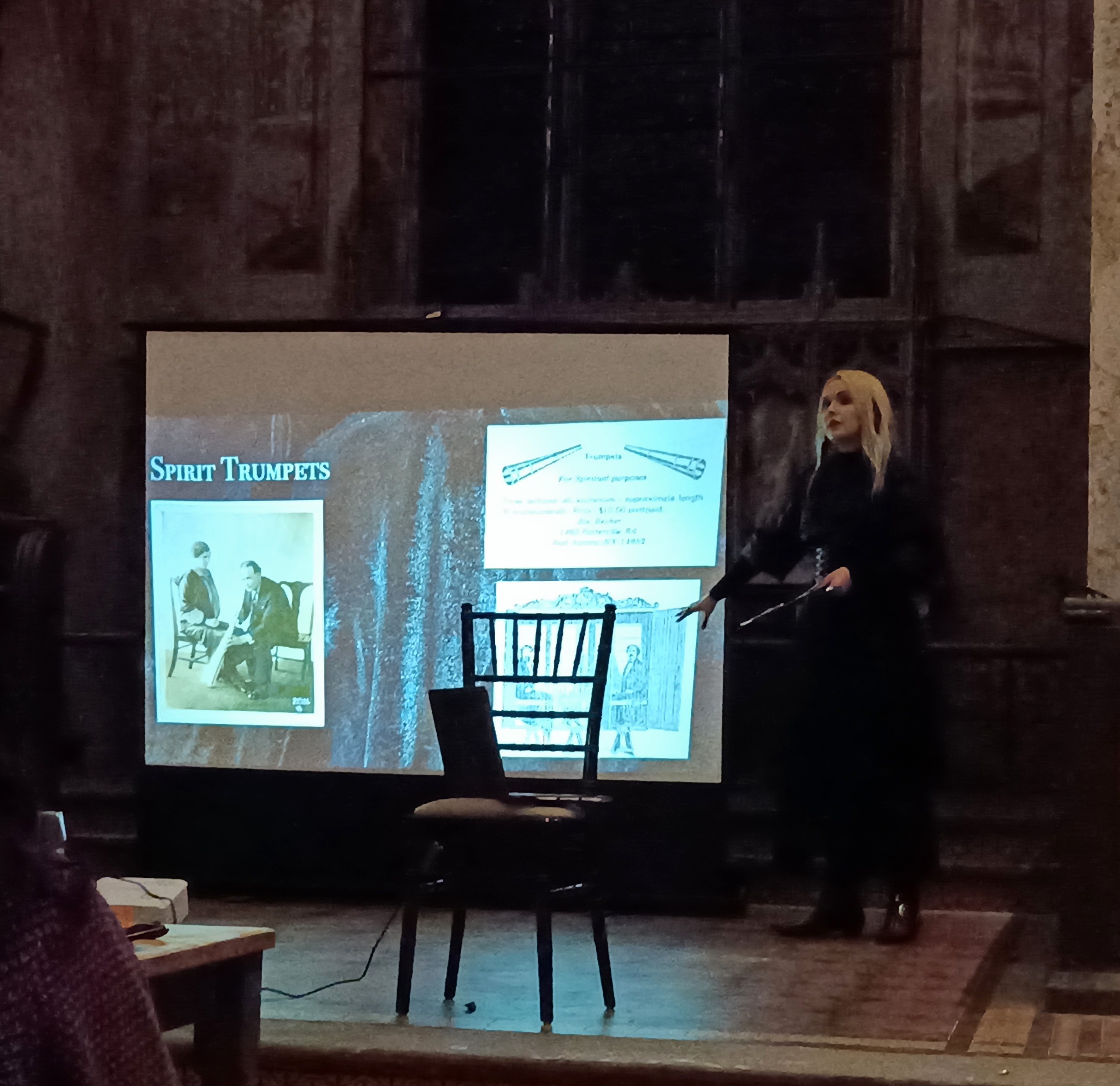
The evening kicked off with the introduction to Victorian spiritualism talk by Dr Kate Cherrell. This was a fascinating, informative and entertaining talk introducing us to the strange world of Victorian spiritualism including its history and types of spirit contact made in the 19th century. This was brought to life with a slide show, props and Kate’s sharp humour. I personally enjoyed hearing about spirit trumpets, the Fox sisters of Hydesville and witnessing Kate’s ectoplasm demonstration.
Spirit trumpets for example, or ‘séance trumpets’, were metal cones placed in the centre of a table during a séance to amplify any sounds issuing forth from the spirit realm. Sometimes a spirit would speak through a medium, who would bring the trumpet to their mouth to speak through. What larks!
The Paranormal Investigation
The second half of the night was the paranormal investigation; a chance to have hands on experience of communing with the spirit world. This started off with investigator Karin explaining the various gadgets, devises and paraphernalia used in investigation; from EMF readers, spirit boxes and motion sensors to planchettes and Ouija boards.
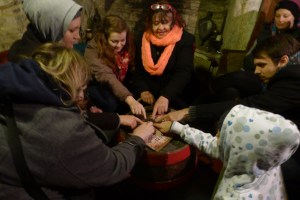
We split up into two groups and my group started off in the crypt with some table tipping. I’d never tried table tipping before, so this was all new to me. Table tipping is a form of psychic phenomenon in which a table can tilt, rise, wobble or rotate by the contact of the fingertips of individuals. It is a form of séance where sitters place their fingertips on the table and the table move without conscious muscular force. By relating the tilts to the alphabet or yes/no directions it is said to become possible to receive messages from beyond the veil.
We stood around a tall thin table with our finger tips gently rested on the top while Kate called out questions. It appeared that a religious man took a particular interest in talking to me and Kate asked him questions about his life before death. The table tilted and wobbled in answer to her queries, indicating he was originally from the north, had come to Bristol and stayed her while his family went to the New World. It was unclear if he had worked at the church or had just been a member of the congregation.
After the table tipping, we moved on to conduct a séance. For this we sat around a table with a spirit box and EMF readers on top, with shadow sensors dotted around the room near us. A bible was placed on the table also and we linked hands as a member of the group read a passage out from Corinthians. The hope was that we could invoke the spirits of this holy building by reading passages from the bible, triggering one of the various sensors. There were some beeps and possible triggering of sensors, but nothing too striking for me to note during this séance.
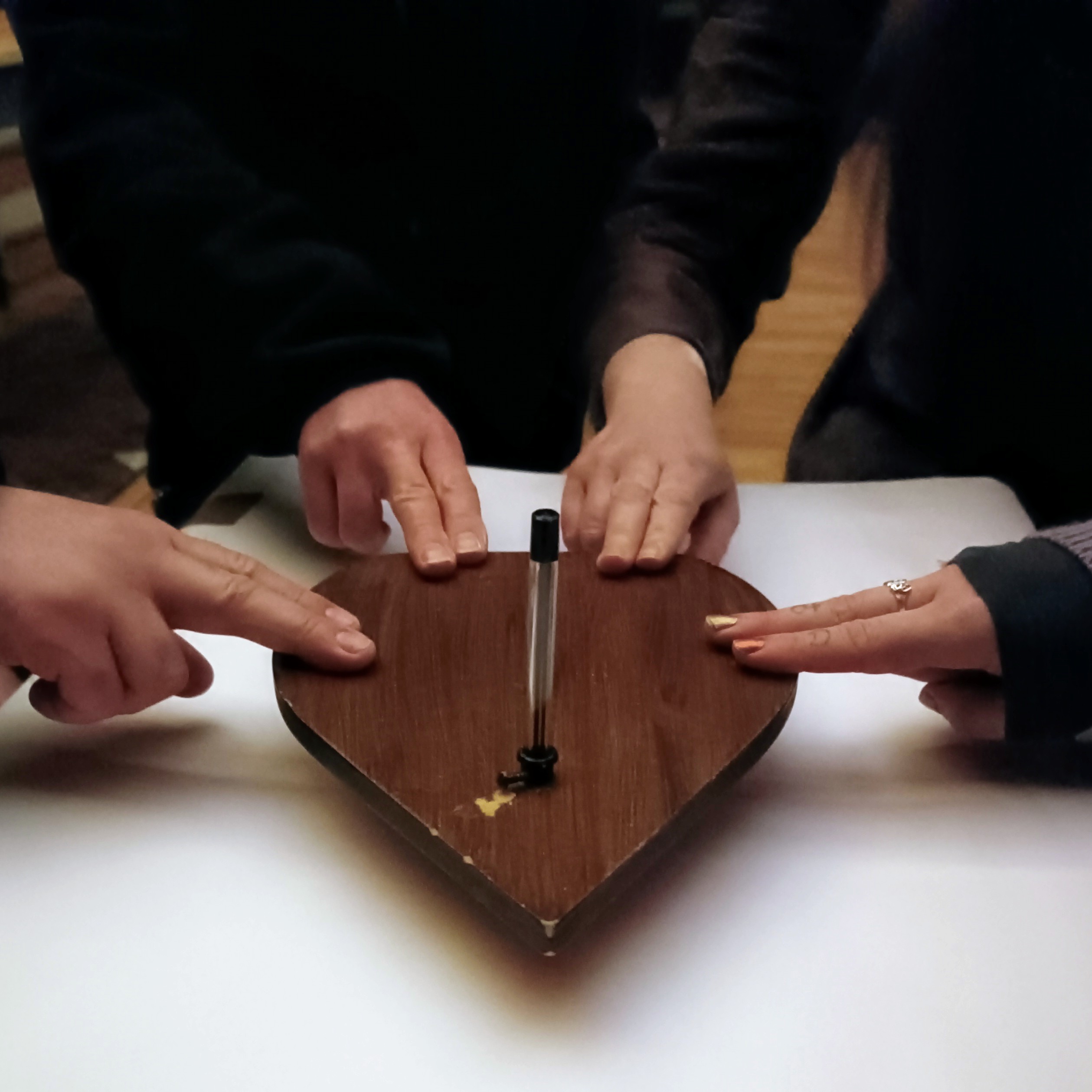
Next up, we headed upstairs in to the Nave of the church where we tried the planchette without much activity. The hope was that we would see some automatic writing. We all placed our fingers on the planchette and asked the spirits to move the planchette across the board, bringing messages from the other side. There was a small amount of movement, but not much unfortunately.
Following this we tried the “Estes Method”. The Estes method is where an investigator wears a blind fold to limit visual stimulation and also wears noise cancelling headphones connected to a sprit box; a device that is used to scan through radio frequencies and it is believed to be a communication tool between the spirit realm and the world of the living. While the investigator is listening to the spirit box, other members of the group call out to the spirits with questions. The blindfolded investigator will call out any ‘answers’ coming through the headphones from the spirit box. The idea is that the sensory deprivation eliminates any stimuli that could influence the blindfolded investigator.
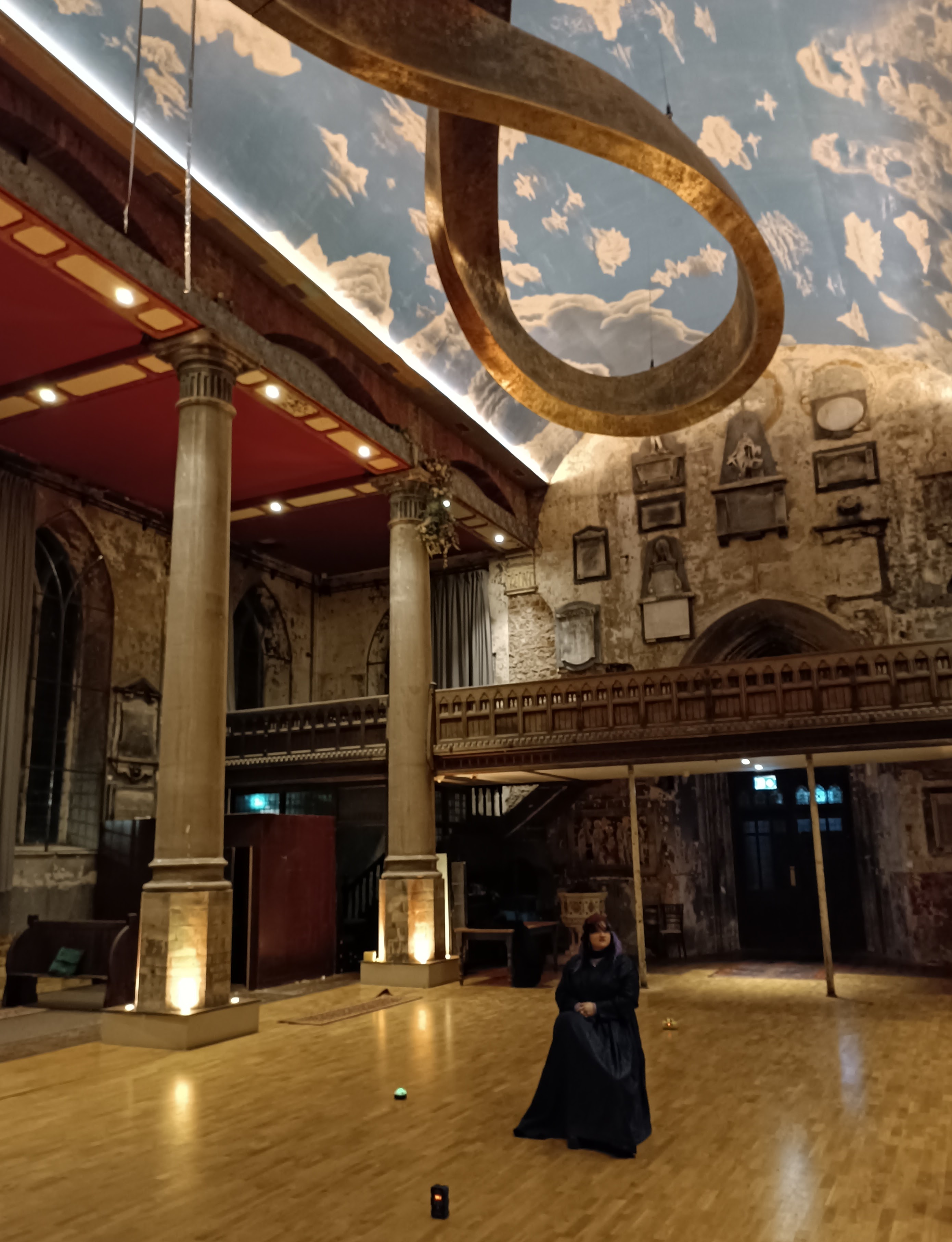
In our experiment we sat in a circle near the alter, all wearing blind folds. One person had the spirit box and headphones. One person sat in the centre of the room dressed in an old-fashioned dress near the shadow sensors. We called out questions and for the spirts to touch someone. After this some other ladies took it in turns to wear the old-fashioned dresses and sit in the centre of the room with the spirit box and a pal of mine in vintage style clothes also took his turn. We called out questions and even religious phrases in Latin to try to call for messages from the spirits. A few words were called out by the person with the spirit box including “like music” and other refences to music a few times.
To finish off we all sat in a circle where the chairs were positioned with one seat inside the circle and the next out. One person sat at the altar, while other members called out to the spirits to approach and communicate. The lady at the alter felt a cold spot next to her and a shadow sensor went off ahead of it. She said she felt like a hand was resting on her head at one point. Was this the spirits coming close to her or psychological suggestion?
I noted that the questions asked to the spirits often led to the Reverend William Knight. The Reverend Knight was a long serving rector of the parish, serving for almost sixty years before retiring in 1875. He died 3 years later and was buried in the church crypt. Could this have been him placing reassuring hand on the young lady’s head? There is also the story that a male figure has been seen looking out of the door near nave in past. Could this be the Reverend keeping a watchful eye over his beloved church even after death?
All in all, this was a fascinating and enjoyable night; from the whistle stop introductory talk based around Victorian spiritualism, to the hands-on experience of trying out paranormal investigation techniques. For me there was not enough activity to indicate that the spirits of the dead lurk in ‘The Mount’, waiting to communicate with the living. However, this location is steeped in history and atmosphere, so no doubt further investigation could prove me wrong. Perhaps on a late-night walk home past the Mount, I too one day will spot a dark figure looking out from the nave as I pass by.
With thanks to The Mount, Dr Kate Cherrell and Karin Beasant.
References:
- http://www.about-bristol.co.uk. (n.d.). St Michael the Archangel on the Mount Without, St Michael’s Hill, Bristol. [online] Available at: https://www.about-bristol.co.uk/chu-17.php [Accessed 8 Jul. 2023].
- The Mount Without. (n.d.). About – OUR STORY. [online] Available at: https://www.themountwithout.co.uk/about [Accessed 8 Jul. 2023].
- Wikipedia. (2023). St Michael on the Mount Without. [online] Available at: https://en.wikipedia.org/wiki/St_Michael_on_the_Mount_Without [Accessed 8 Jul. 2023].
- Arthur, A. (2021). Former Bristol church set to reopen as events and wedding venue. [online] Business Live. Available at: https://www.business-live.co.uk/commercial-property/bristol-church-st-michael-mount-20785472 [Accessed 8 Jul. 2023].
- News, I. (2016). Emergency services tackle large fire at Bristol church. [online] ITV News. Available at: https://www.itv.com/news/westcountry/2016-10-16/emergency-services-tackle-large-fire-at-bristol-church [Accessed 8 Jul. 2023].
- The College of Psychic Studies. (2021). The College of Psychic Studies : Enlighten : Spirit trumpets victorian seance. [online] Available at: https://www.collegeofpsychicstudies.co.uk/enlighten/spirit-trumpets-victorian-seance/ [Accessed 8 Jul. 2023].
- www.youtube.com. (n.d.). Mount Without Vlog. [online] Available at: https://www.youtube.com/ (redacted as private Patreon vlog link) [Accessed 8 Jul. 2023].
- Higgypop (n.d.). Former Bristol Church Hosted Kate Cherrell For A Night Of Ghostly Discoveries. [online] Higgypop Paranormal. Available at: https://www.higgypop.com/news/a-night-of-victorian-discoveries/ [Accessed 8 Jul. 2023].
- http://www.encyclopedia.com. (n.d.). Table-turning (or Table-tipping) | Encyclopedia.com. [online] Available at: https://www.encyclopedia.com/science/encyclopedias-almanacs-transcripts-and-maps/table-turning-or-table-tipping [Accessed 8 Jul. 2023].
- Hallozween. (n.d.). The Estes Method. [online] Available at: https://www.hallozween.com.au/the-estes-method/.
2009-present Ghost Catcher Isles© All rights reserved. All my posts are copyright and if you do wish to refer to them or use anything from them on your site, please credit and link this site



 Ghost Catcher Isles