Welcome to Ghost Catcher Isles, chronicling the weird, wonderful and eerie of the isles of Great Britain and the Republic of Ireland. Come with me on my adventures into the strange and paranormal
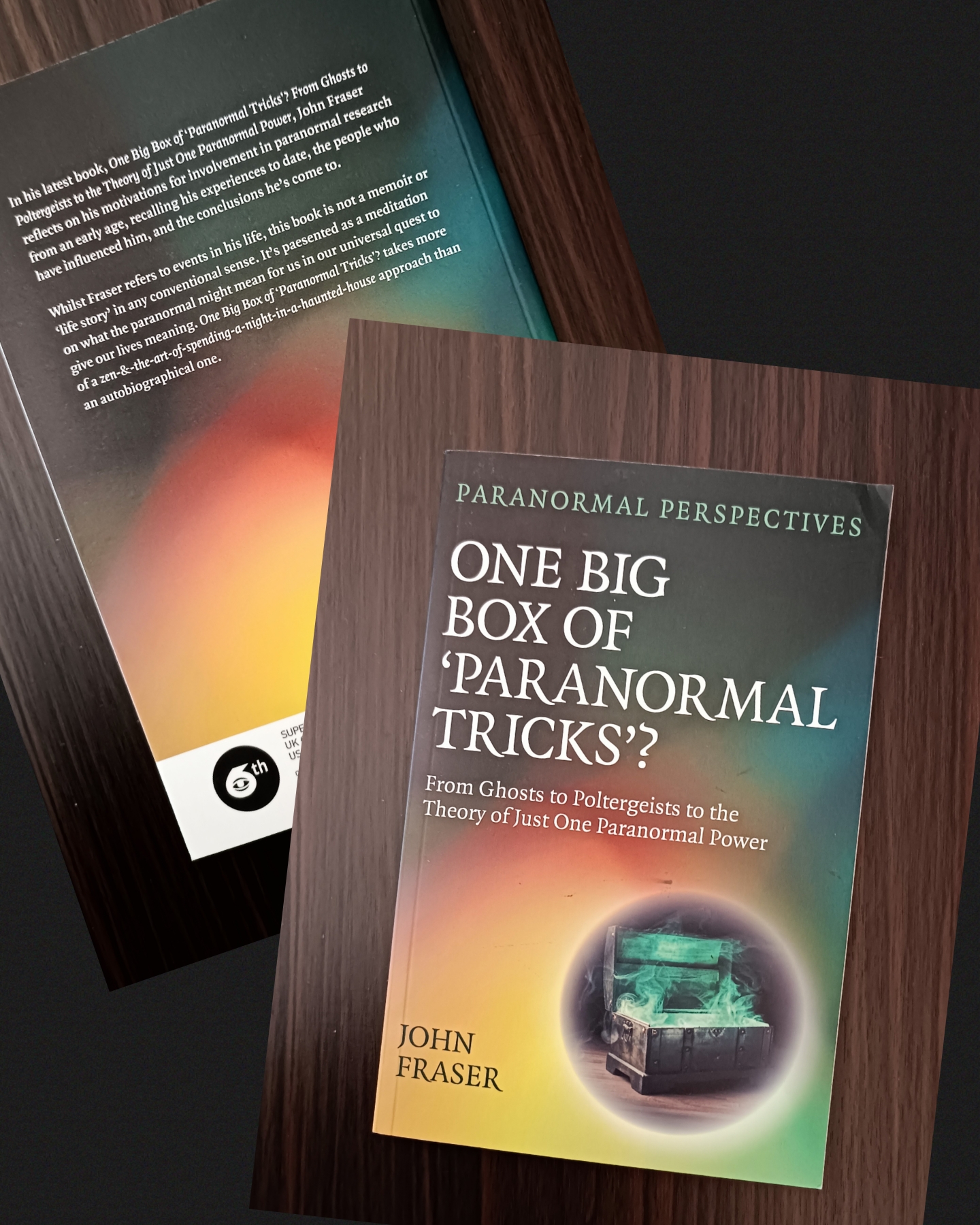
Have you ever wondered if ghosts, poltergeists, and all things that go bump in the night are connected by a single unseen force? John Fraser’s book, “One Big Box of ‘Paranormal Tricks’? From Ghosts to Poltergeists to the Theory of Just One Paranormal Power” dives headfirst into this idea, taking readers on a journey through the unexplained with a perfect blend of curiosity and critical thinking. Whether you’re a seasoned paranormal enthusiast or just stepping into the eerie world of the unknown, this book has something for everyone.
John Fraser is a Council member of the Society for Psychical Research and former Vice Chair for Investigations at the Ghost Club, the two oldest paranormal research groups in the UK. His studies have covered hypnotic regressions, vampire folklore, and conventional paranormal research.
Active in the field since the 1980s, John took part in long-running hypnotic regression experiments and later conducted research into supernatural events at Sandwood Bay. Since 2015, he has been investigating witness testimony related to paranormal activity at The Cage in St Osyth. He has also contributed to media discussions on the paranormal.
John Fraser’s book is part of the ‘Paranormal Perspectives’ series, which seeks to investigate what the paranormal means to a selection of writers from various backgrounds. Fraser explores paranormal phenomena under a unified theory, the theory of ‘one paranormal power’. He does this while detailing his personal journey into the paranormal, from his early sparks of interest as a youngster to his time as a seasoned researcher and Society for Psychical Research Council member. This book has appeal to paranormal believers and sceptics alike, as it is an engaging investigation that offers readers a unique blend of philosophical investigation and memoir.
A Journey Through the Unexplained
Fraser begins by explaining how it all began for him. At university, he studied philosophy and economics. He resigned from his position as an internal auditor and organised a road trip that included stops at several haunted places. He then discusses the important paranormal figures who have impacted him, like Guy Lyon Playfair and Harry Price.
Fraser then explores the nature of paranormal phenomena in chapter three, looking at hypnotic regression, ghosts, poltergeists, and other unexplained events, such as the encounter in Rendlesham Forest. Fraser concludes by discussing his theory of the “One Paranormal Power”, which proposes that there is a single underlying force that underlies all paranormal activity.
What Makes This Book Stand Out?
Fraser has a gift for balancing scepticism with an open mind, something that’s not always easy in the paranormal field. He doesn’t just present eerie encounters and theories; he challenges them, inviting readers to explore every possibility. Are poltergeists separate from ghosts, or could they be different manifestations of the same mysterious force? If there’s just one underlying paranormal power at work, what could it be? These are the kinds of questions Fraser poses, leaving you pondering long after you’ve turned the final page.
His writing style is conversational and immersive, making even the most complex theories easy to digest. Fraser’s account is well-written, thoroughly researched, and adopts an engaging and thought-provoking approach, employing great storytelling to make sure the book is not just informative but also entertaining and easy to read. Every chapter skillfully blends reflective analysis of paranormal phenomena along with personal tales.
One of the most interesting aspects of the book for me is Fraser’s recounting of his initial plunge into the paranormal field, in which he gives vivid accounts of his early experiences. Here, he describes the events and encounters that sparked his interest in the unexplained. These explanations are complemented by his comments on mentors and role models who had a significant impact on his approach and knowledge.
Notably, Fraser honours well-known paranormal individuals such as Harry Price and Colin Wilson, whose pioneering work served as the foundation for his own investigations. I relished the narrative of his interactions with Peter Underwood, which demonstrated their genuine connection and friendship. This examination of his own influences gives readers an understanding of the intellectual heritage that informs his viewpoints.
One of the most intriguing aspects of Fraser’s book is how it subtly engages with the long-standing debate between psychological explanations and supernatural interpretations of paranormal phenomena. While he presents compelling cases for the existence of ghosts and poltergeists, he also acknowledges alternative explanations, such as environmental factors (electromagnetic fields, infrasound, or other environmental conditions), cognitive and neurological perspectives and parapsychological explanations (e.g., psychokinesis—particularly in relation to poltergeist activity).
(Author John Fraser. Image Source: J.Fraser)
This balanced approach makes the book appealing to both believers and sceptics. However, a deeper engagement with scientific and psychological studies on anomalous experiences would have added even more weight to his arguments.
Where the Book Could Go Further
While the book is packed with intriguing insights, some of the scientific explanations could go deeper. If you’re the type who loves diving into parapsychological research, you might find yourself wanting a bit more hard data and experimental analysis. Of course, there are many other books out there already that cover such aspects in more detail that the reader can seek out for further research if required.
If you’re new to the paranormal field, this book is an excellent gateway. Fraser keeps the tone inviting and avoids overwhelming jargon, making it easy to follow even if you’ve never read a book on the subject before. For the seasoned enthusiasts, even if you’ve been delving into the paranormal for years, you’ll appreciate Fraser’s fresh take on long-standing debates. While some sections may feel like familiar ground, the way he ties different phenomena together offers new food for thought.
Final Verdict: A Must-Read for Paranormal Enthusiasts?
Fraser’s Paranormal Perspectives isn’t just a book—it’s an invitation to think, question, and explore. It challenges readers to reconsider what they believe, weigh the evidence, and entertain new possibilities. Whether you’re in it for the eerie case studies, the deep theoretical discussions, or just the thrill of the unknown, this book delivers. So, what do you think—could all paranormal phenomena really be part of one great mystery? Or are we only scratching the surface of something even stranger?
Glastonbury, a town steeped in mysticism and ancient folklore, served as the backdrop for a recent winter expedition that united bloggers, podcasters, and fans of the paranormal. Our journey began at the venerable George and Pilgrim pub, an atmospheric establishment echoing with centuries of history.
George and Pilgrim Pub: An Eerie Prelude
Nestled in the heart of Glastonbury, the George and Pilgrim pub proved to be the ideal starting point for our supernatural escapade.
The George and Pilgrim pub is one of the best surviving pre-reformation inns in England, one that has provided food, drink, and accommodation to pilgrims and visitors to Glastonbury for centuries. Its exact age is unknown, but it is known to have been rebuilt by Abbot Selwood in around 1455 when he oversaw an expansion of the abbey. The building itself comprises three stone storeys with a façade that resembles a small castle with battlements. There are three panels over the front entrance. Two of these contain the coat of arms of the abbey and King Edward IV while the third is blank. This possibly contained the white rose of York and was tactfully removed when King Henry VII came to the throne. The inn was built to accommodate wealthy pilgrims visiting the nearby abbey. The pub is also linked to the abbey by an underground tunnel that begins in the cellar and leads to a point within the abbey walls. It is thought that pilgrims could have used the tunnel to gain secret access to the abbey. Parts of the interior still have the original oak beam ceiling and stone slab flooring. Early carvings, figurines, and statues are still in place in the bar area. The interior is full of historical character, from its beamed ceilings, dark oak furniture, and huge fireplace.
As we convened, exchanging greetings, the air buzzed with anticipation. The pub, with its creaking floorboards and shadowy corners, set the stage for a day filled with eerie adventures.
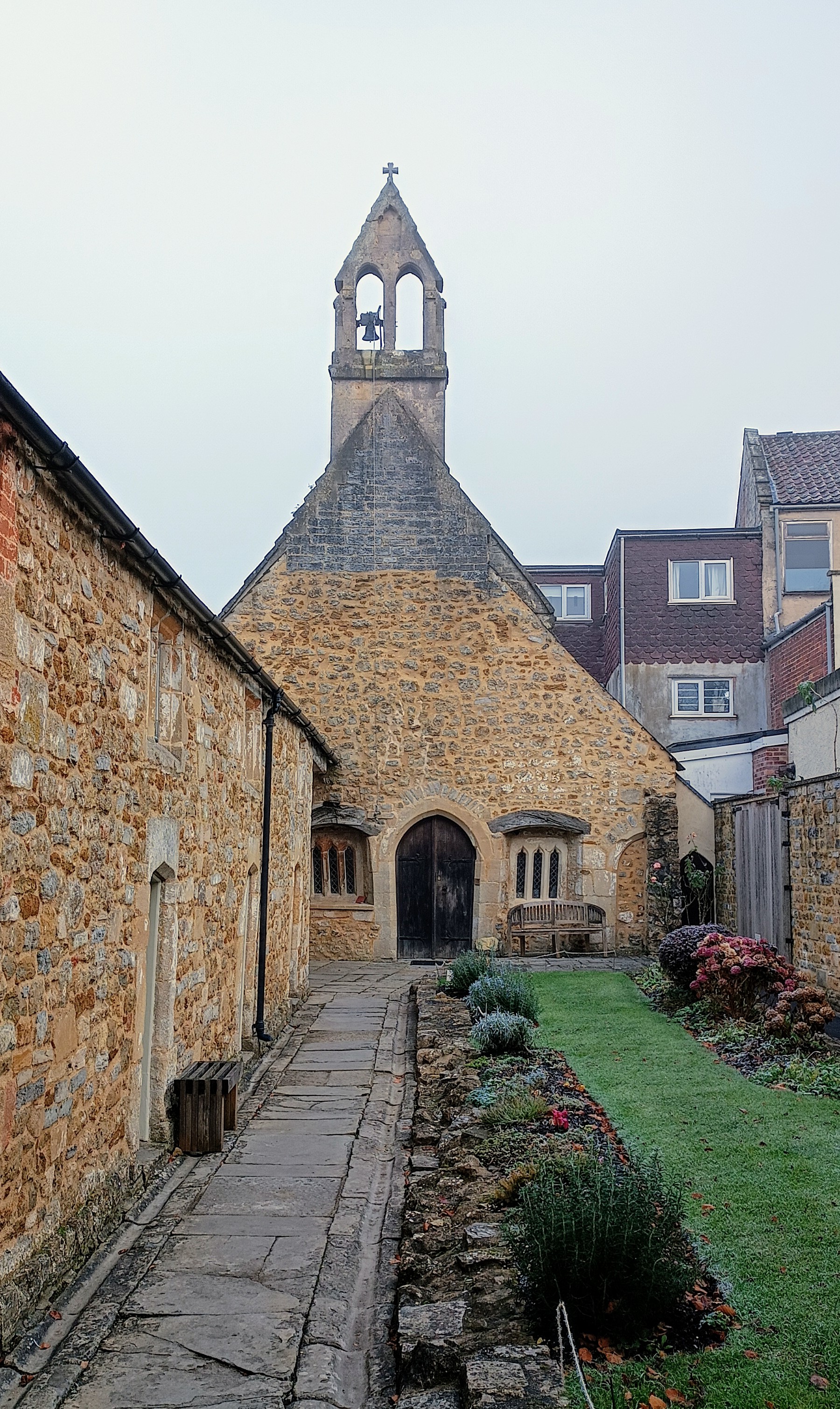
Our first destination to beckon us was St Margaret’s Chapel, a hidden gem of Glastonbury, a retreat away from the bustle of Magdalene Street. This sacred space exuded an otherworldly energy of peace and tranquillity. Built around 1250-70 and founded by Abbot Michael, it was first established as a pilgrim hospital with a chapel at the east end. At this time, it was known as the Hospital of St Mary Magdalene. Tired and hungry pilgrims were fed, washed, and accommodated here while visiting the abbey to view its shrines and relics. It was originally a long infirmary hall with cubicles on either side. The chapel was dedicated to St Margaret who was a Scottish Queen and Saxon princess. The chapel itself has a barrel roof and a now fully restored bell-cote.
By the early 15th Century, the large hall was replaced with two rows of alms-houses used for accommodating aging, poor parishioners. These were in use until the 1950s when one row was finally demolished. The site was rescued by the Quest Community and the Mary and Margaret Charity, who restored it and now care for it.
Here we explored the chapel with its glittering icons and spent some time in quiet contemplation in the gardens before moving on to the next destination on our journey.
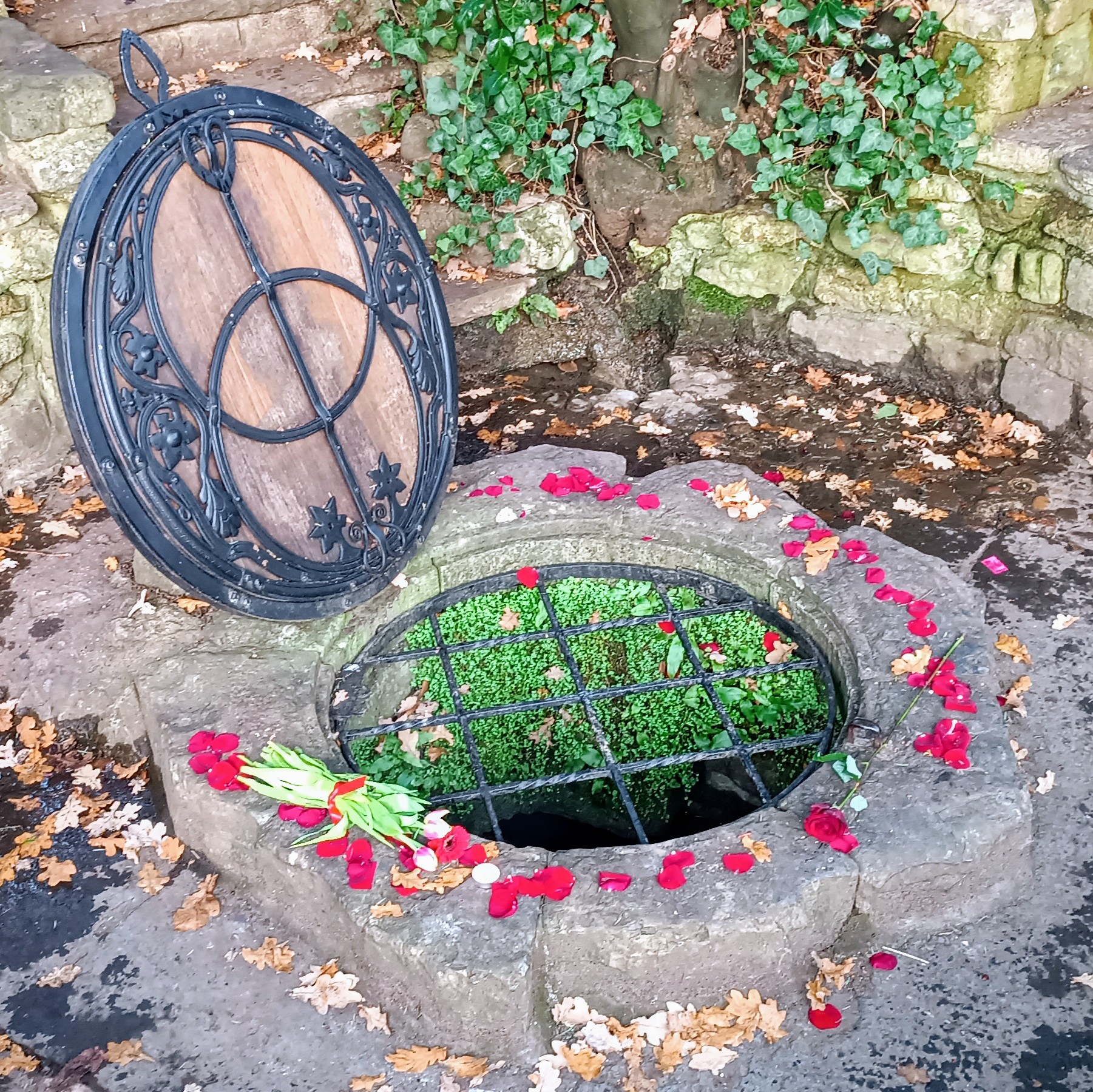
A pilgrimage to Glastonbury wouldn’t be complete without a visit to the Chalice Well, a site brimming with symbolism and ancient charm.
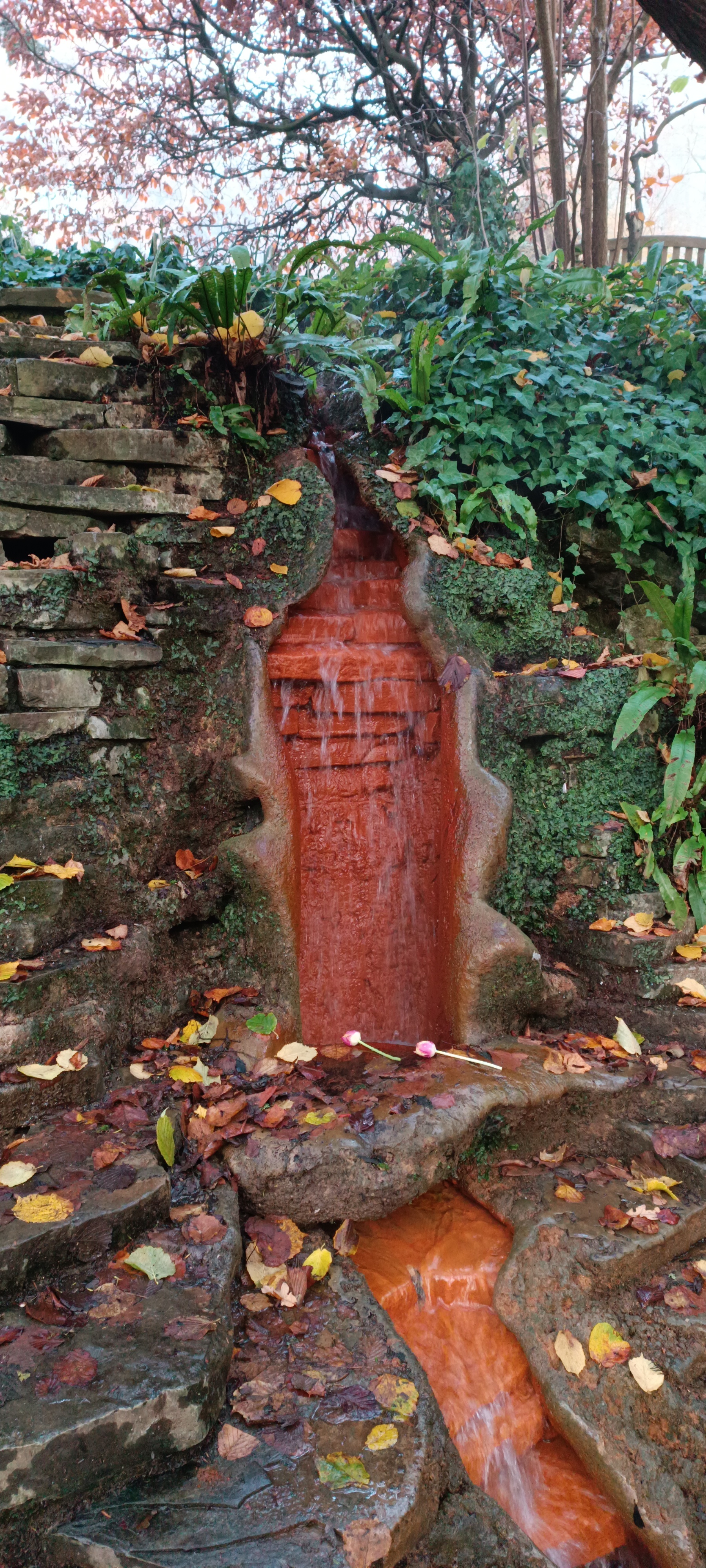
The Chalice Well, lying sheltered between Chalice Hill and the Tor, is an area of gardens arranged around a series of fountains and water features. It was the main supply of fresh water in Glastonbury until the 19th Century and 25,000 gallons of water flow there every day. This holy well is also known as the “Red Spring” or “Blood Spring” due to the red iron deposits the water leaves on everything it touches.
The site is ancient, with a 1961 excavation bringing up Roman pottery and flint. The stump of a yew tree dated to the Roman period was even found in the deep excavation. Yews still grow at the Chalice Well today and have a strong association with the ancient Druids and also Christian churchyard.
Legend has it that Joseph of Arimathea and his followers settled nearby and built the first Christian shrine in Britain and that the earliest baptisms were conducted in the spring. It is said that Joseph brought the chalice or cup used by Jesus in the Last Supper and either buried or washed the cup at the site, causing the water representing the blood of Christ to spring forth from the ground. Due to this, the Chalice Well is linked to the quest for the Holy Grail.
The Chalice Well has also been associated with healing waters for several centuries. In 1582 Dr John Dee declared he had discovered the ‘Elixir Vitae’ at the well and declared the water had healing properties. By the 18th Century, it became fashionable for people to visit the take the waters, with visitors flocking to the well to be healed. In 1750 a man from North Wootton claimed he had had a dream which told him to drink the water on seven consecutive Sundays to cure his asthma. He did this and proclaimed that he had “recovered of his disorder”. By 1751 tens of thousands of visitors came to take the waters, many of whom made sworn testimonies stating they had been cured of all manner of things, including blindness, ulcers, deafness, and scrofula.
Today the Lion’s Head drinking fountain is the only place in the gardens where the iron-rich water is safe to drink. The Chalice Well is now a place of quiet contemplation, peace, and calm, where visitors can revive their spirits and be soothed by nature. My husband and I filled our water bottle here, so we could drink the healing, iron-rich water later.
On Wellhouse Lane outside Chalice Well, leading up to the Tor, there is also a tap where travellers can fill their bottles when the gardens are closed. Directly opposite this lies the White Spring, from which calcium-rich waters flow, which we didn’t visit on this occasion.
The healing waters and vibrant gardens provided a tranquil respite, allowing our group to reflect on the mystical threads connecting Glastonbury’s past and present.
Glastonbury Tor: A Beacon of Mystery
Due to the inclement icy weather, myself and a number of our group decided to forgo climbing up the iconic Glastonbury Tor, preferring to view from a distance from the Chalice Well below. However, two brave members of our group continued their exploration, climbing through the mist and ice to the summit.
The Tor is a towering hill with panoramic views, it is shrouded in legend, rumoured to be the mythical Avalon. The mists rolling off the Levels left only the tower visible, pointing like a beacon towards the heavens; imposing and darkly powerful. The climb to the summit is approximately 158m above sea level, the sides are precipitous, and on a clear day, climbers can see for miles.
In early times the whole area here used to be a wetland and archaeology shows that the early inhabitants of the area built communities on hills or manmade structures, such as at the Lake Villages of Godney and Mere. Therefore, before the Levels were drained, Glastonbury Tor would have been a wetland island, perhaps leading to the myth of the Isle of Avalon. In prehistoric times it certainly would have been a landmark for local inhabitants and travellers.
Archaeological excavation indicates that the site has been inhabited since at least the 6th Century. Pottery and metalwork have been found there indicating the presence of a people of possible importance such as a monastic community. This may have been a sacred place long before Christianity, used by Bronze Age people and perhaps the Celts. The positioning of the Chalice Well and the Tor fits with a Celtic format, perhaps a place of pagan religious importance, later taken over by Christians.
A Norman chapel was built to St Michael on the summit, but destroyed by an earthquake in 1275. It was rebuilt 50 years later and in the 15th Century a tower was added, which remains today as a romantic, lonely ruin.
The Tor is associated with several myths and legends. There is thought to be a cave deep within the Tor, which is said to be a portal into the Otherworld which the Welsh mythological Lord of the Otherworld (Annwn) uses to transport spirits. It is said that on All Hallows Eve, the Lord of the Otherworld rides out from the cave on dark steeds for the Wild Hunt; collecting souls. He is followed by the hounds of hell, Cwn Annwn. The myth remains strong as in 2005 in the early hours of the morning, locals said that a charge of demonic horses could be heard galloping through the town. Four locals stated that they saw riderless black horses thundering up Bere Lane, along Chilkwell Street, and then disappearing in the direction of the Tor. They were lucky to keep their souls, in that case!
There is also a story relating to St Collen and his experience of the Tor. The saint visited Glastonbury but shortly after had a falling out with the local monks. He left for the Tor and made a cell in a quiet spot near the spring at the bottom. Here he is said to have had a vision of the Lord of the Otherworld, also believed to be King of the Fair Folk (fairies), Gwyn ap Nudd. His vision included scenes of revelry at the fairy castle, a fine feast, and music. St Collen sprinkled holy water and the vision vanished, leaving him alone on the Tor summit. Locals say that if the summit of the Tor is covered in mist, Gwyn ap Nudd is holding high revelry there. The members of our group climbed the misty Tor, but as far as I know, were not transported to the Fairy Realm on this occasion.
Return to the Haunted Haven: the George and Pilgrim Pub
After our day of exploring some of the sights of Glastonbury, we reconvened back at the George and Pilgrim pub for dinner and drinks in its atmospheric setting. We spent the evening sharing stories and bonding over our shared interests.
As night fell, many of us chose to brave the haunted rooms of the George and Pilgrim, welcoming the prospect of nighttime encounters with the unknown.
The George and Pilgrim pub has a reputation as one of the most haunted hotels in England. A man in 17th-century clothing is said to walk through the bar, to then disappear. In the Small Bar guests have heard a violent argument in process, only to discover on investigation that there is nobody there.
The bedrooms on the upper floors are said to be haunted by a variety of spirits. Footsteps have been heard moving along the empty corridors and cigar smoke has been smelled by occupants in certain rooms in the early hours. Chambermaids have reported that taps have been turned on, bed covers disordered, and furniture moved by unseen hands.
In one room the spirit of a monk was seen by a lady who awoke in the night. She felt the bed sink as the monk sat on the bed, where he stayed for several minutes talking about the time of Queen Elizabeth I, before fading away. Local legend has it that a monk once completed suicide in that very room.
A married couple once stayed in another room and reported that the wife was woken in the night by footsteps approaching the bedroom door. She looked to see a glimmering light with a tall, thin man in a sports jacket standing at the door. As she went to leap out of bed in fright, he smiled and disappeared.
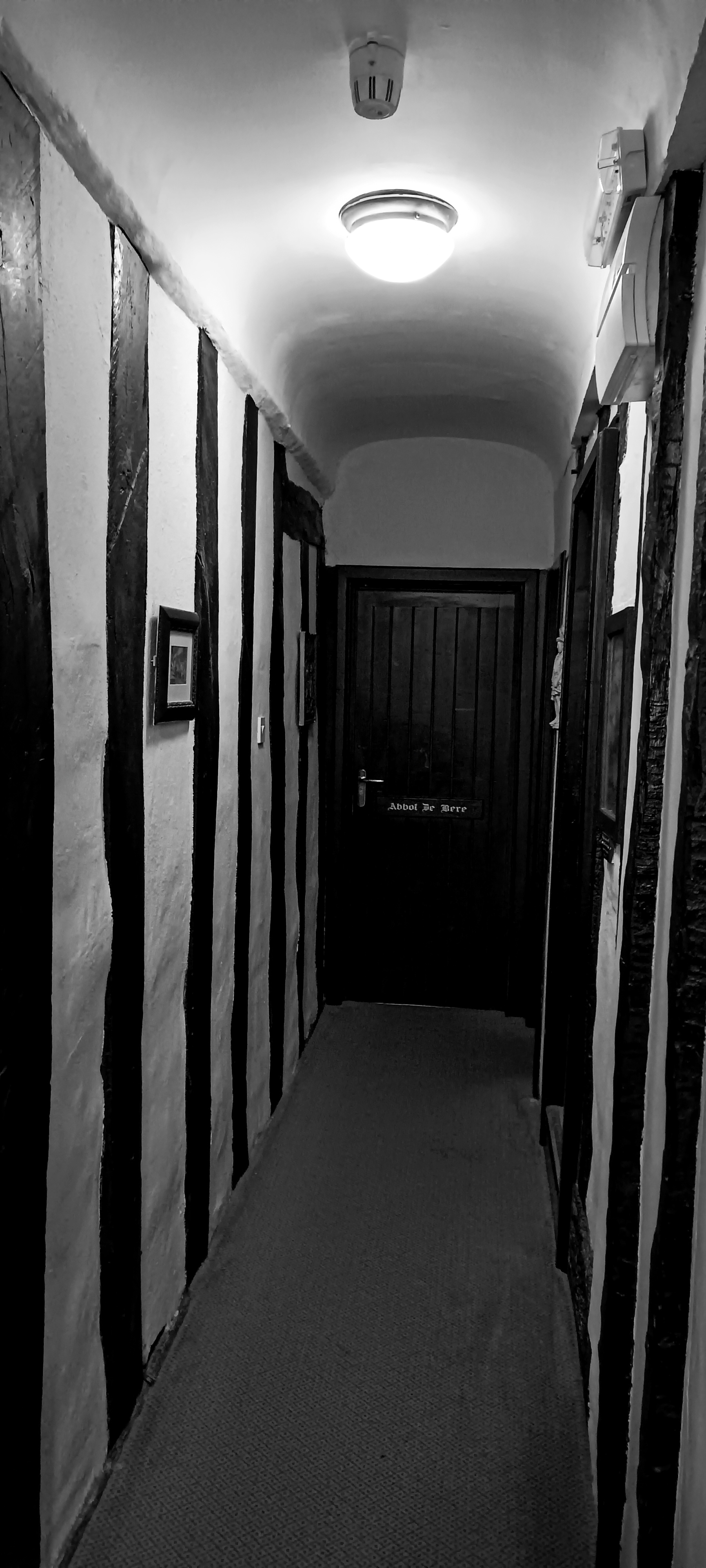
The group decided to meet up in one of the rooms, ‘Abbot Richard Bere’ room, to see if anything spooky could be felt. Abbot Bere was Abbot of Glastonbury between 1493-1524. He began much building on Glastonbury Abbey, from the chapels to the crypts, and also rebuilt the tribunal in around 1500. Although the room was very atmospheric, with its old-fashioned four-poster bed, we did not feel anything unusual in this room.
Several of us retired to bed, but a small group of us including myself peeled off and spent some time in another of the bedrooms. Here we turned out the lights and called out for any spirits to show themselves. We heard some small tapping sounds, but on investigation, these sounds were found to be the radiators heating up.
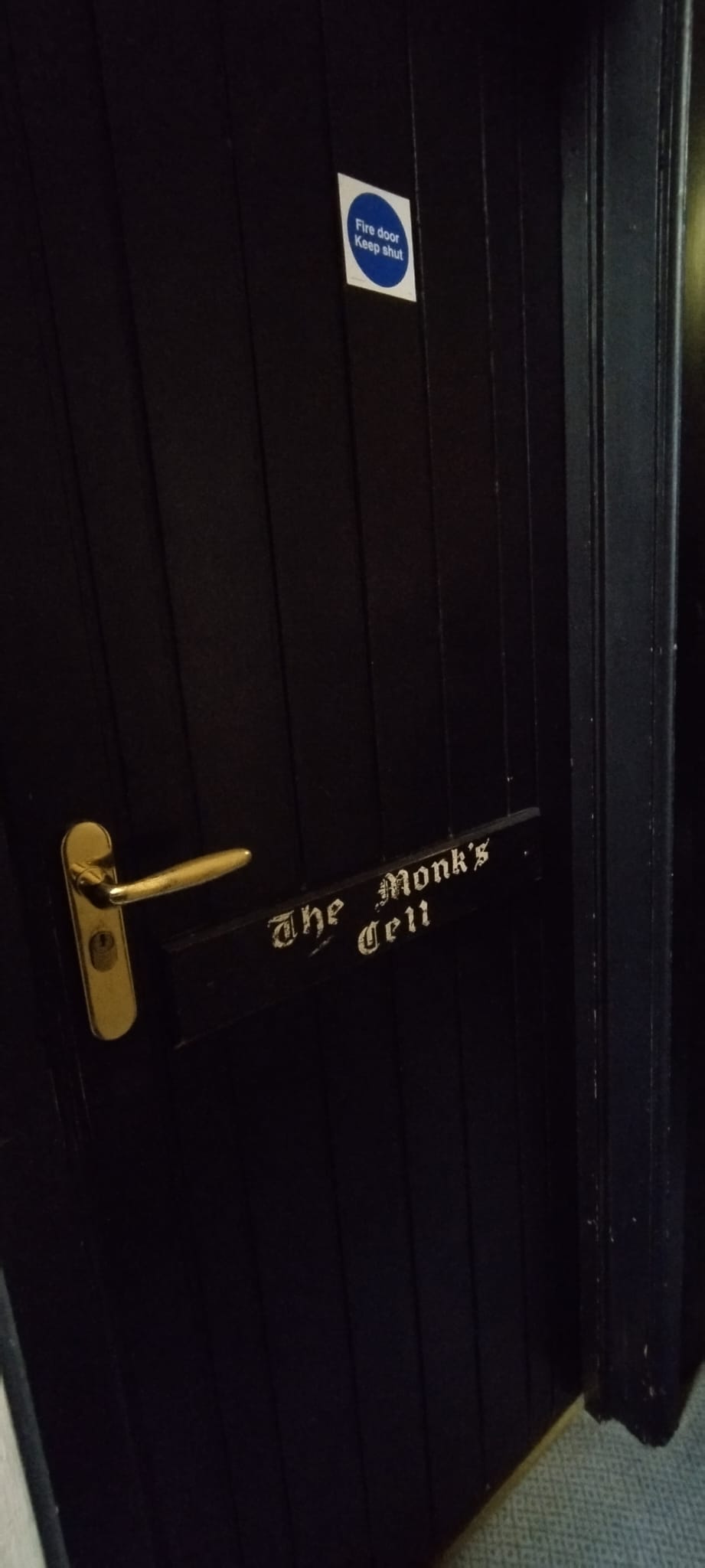
Finally, we called it a night and my husband and I retired to our room, ‘The Monk’s Cell’. This room is believed to be where the Abbot Whiting and his two monks were held on the morning of their execution. Abbot Whiting had been charged by King Henry VIII with robbery at the Bishop’s Palace in Wells after the dissolution of the monasteries. He was found guilty and attached to a hurdle, dragged through town, and eventually was hanged up on Glastonbury Tor alongside two of his monks John Thorne and Roger Wilfred. Whiting was then drawn and quartered and his head hung over the Abbey gateway.
The room had an eerie feel to it, this may just have been due to suggestion because of its old-fashioned style and slightly off-kilter proportions. I slept quite poorly that night, having weird dreams, but this once again may be due to the priming of being in a ‘possibly haunted’ room. My husband slept quite well though.
The next morning, however, provided some spooky hijinks. In the breakfast room, we were entertained by the light-hearted staff as we ate our breakfasts. Several times we noted that breakfast menus fell off the tables, perhaps pushed by spectral hands. Or, just as likely, gravity, of course. The staff claimed that this was the hotel poltergeist, ‘Arkwright’, who caused all kinds of mischief in the kitchen and breakfast room.
A Parting of Ways
Our sojourn through Glastonbury transcended the ordinary, weaving together a collective tale of mystery, and folklore, and shared fascination with the paranormal. As we departed, the ancient energy of Glastonbury lingered, leaving an indelible mark on each of us and a treasury of memories and stories to share with kindred spirits.
Please check out some of my fellow Glastonbury explorers’ podcasts and writing:
Rahtz, P.A. and Watts, L. (2003). Glastonbury: Myth & Archaeology. Tempus Publishing, Limited.
Sedgwick, I. (2023). Glastonbury Tor: The Ancient Entrance to the Fairy Otherworld. [online] Icy Sedgwick. Available at: https://www.icysedgwick.com/glastonbury-tor/ [Accessed 31 Jan. 2024].
Shakeshaft, J. and Beckett-King , A. (2020). S3E51 – Xmas Special: Joseph of Arimathea in Glastonbury. [online] Loremen Podcast. Available at: http://www.loremenpodcast.com/episode-51-s3 [Accessed 31 Jan. 2024].
The Chalice Well Trust (2023). The Chalice Well (visitor’s leaflet).
The Mary & Margaret Charity (2023). St Margaret’s Chapel and Royal Magdalene Almshouses: A Hidden Gem in Glastonbury (visitor’s leaflet).
I’ve been interested in the paranormal since I was a child, even joining an amateur paranormal investigation team in Ireland for a year when I lived in Dublin, though remaining firmly in the ‘sceptic’ camp. The experiences I want to describe to you happened to my mother when I was around 13 years old and it is where my interest in the paranormal began.
My mum has worked as a care assistant and later in managerial roles in elderly people’s residential care homes in Norfolk for most of her adult life. She has had several unusual, creepy and unexplained experiences in several places, but the one that left its mark on her and me the most was in a care home in a busy touristic town on the Norfolk Broads. This care home was in a very old building that had once been part of a landed estate, and it comprised of gardens, a large house with multiple rooms and converted stables/sheds.
My mum worked as a relief assistant manager there for a period and part of the job required that she sleep over night. She had slept in different rooms in the main building before and had odd experiences; she had had her things moved and nightclothes folded and put on the bed on occasion and upon asking no staff had admitted to moving them. She said this room felt safe and friendly, like there was a friendly poltergeist there who wanted to be helpful. In one certain room, she had woken in the night to hear crying from the room above. Upon investigation, she was told that there was nobody in the room above. Although creepy, her experiences in these rooms did not leave her shaken and she was generally happy to sleep in them.
It was however, when my mum was required to sleep in the rooms in the converted stables/sheds that she had the experiences that left her shaken and scared. I remember seeing my mum when she returned from work the afternoon after her first night in that room and she looked awful. She looked exhausted and shaken up but would not tell me what had happened to her. It took her around 3 days for her to finally gain the strength to speak about it as she felt she would not be believed. I believe she experienced something in that room that she could not explain.
My mum told me that she had felt uncomfortable in that room from the first time she went in. She said it felt cold and unfriendly. On that first night she had finished up her tasks for the night and had gone to her room to settle in for the night. She said she had the bedside lamp on and was propped up in bed reading, which is her custom to help her relax before sleep. She said it felt cold in the room and she noticed something odd from over the top of her book. She said she saw a grey mist coalescing near the window and between the end of the bed. She felt frozen with fear and watched the mist grow until around 5ft in height, like figure. The mist seemed to shuffle towards her and this was more than enough for my mum and she told me she shot out of the bed and out of the room. She refused to return that night and slept as best she could in a chair in one of the lounges. She spoke to the night staff and they disclosed that other people had had strange experiences in that room.
Sadly, my mum had to return to that room as part of her job, so she decided she had to live with whatever was in the room. She said following that first incident she experienced knocking and banging on the door, but nobody there and staff confirming nobody had been to her room. She heard knocking and banging inside the room too, sometimes waking her up. She was so frightened she spoke to a local vicar about what to do and began sleeping with a Bible next to the bed and a glass of water to represent life.
Other relief assistant managers also had to slept in that room and at least 2 others disclosed that they had had experiences in there. One lady had felt what felt like someone get in bed beside her and somehow pass through her. Another had felt something pulling the duvet from the end of the bed.
My mum spoke to some locals who said that they believed an Italian prisoner of war had worked on the estate and had died in the stables. Could he still be there trying to get attention?
My mum said throughout the time she worked there she continued to experience things in that room, but they did calm after she spoke to it. She became so fed up with her sleep being disturbed and feeling afraid that she literally spoke to it, or at least to the room, telling it that she wasn’t there to harm it, she had to stay there for her job and if it ceased bothering her, she would not bother it. This seemed to calm things in there somewhat from then on and she was able to sleep with less disturbance.
The building there is no longer a care home for the elderly, but has a similar use, so she prefers to keep the place anonymous as she doesn’t want to cause alarm to anyone who stays there now. I wonder if the entity in that room and the spirits in the other rooms are still active?
A few months ago I was contacted by a family living down in West Cork who were being plagued by the activities of a poltergeist resident in their home. The family lived in an old farm-house on Mizen Head. The family had tried to research the history of the house but found out very little other than it being the old family home of their landlord. Next to the residence is an even older crumbling house, so the land appears to have been in use for a few hundred years.
The word “poltergeist” comes from the German word “poltern”(to “rumble”) and “geist,” which means “spirit.” Poltergeist literally means “noisy spirit”, although a poltergeist is neither a spirit nor a ghost according to parapsychology experts. The nature of poltergeists has long been a subject of debate within paranormal circles and poltergeists are usually described as an invisible force and entity, rather than spirits.
Poltergeists differ from what is normally thought of as ghosts. Ghosts are generally considered to be the spirits of dead people. They can be intelligent and interactive, or merely an imprint playing over events of the past. Poltergeists on the other hand are a different kind of spirit or entity. These particular spirits seem to be able to interact with the material world sometimes with malevolent force, often moving objects, making rapping noises and other activities.
Many in the paranormal investigation field believe that the majority of poltergeist activity is not due to ghosts, but is due to uncontrolled psychokinesis; it is therefore caused by living people. Despite this theory, there is still a small amount of cases that can not be explained naturally and so poltergeist activity may be caused by a ghost manifestation or by a person unknowingly causing psychokinesis effects.
According to the family the house was very active and they felt there may be two spirits occupying it. One of these spirits they feel is harmless and they were happy to live with it, but the other they felt was more sinister and would have liked to have had it cleared from the house.
In the baby’s room they once heard a disembodied voice on the baby monitor saying “Don’t worry, I’ll look after you”.
In the main bedroom they have heard whistling and footsteps, particularly walking around the bed. They have all been in the kitchen and heard these footsteps coming from the bedroom above. The lady of the house had a wrought iron mannequin in this bedroom and saw it move despite it being extremely heavy.
The couple both saw the shadowy outline of a man on the landing. The figure appeared to be tall; around 6ft. They reported being downstairs and seeing legs walk across the top of the landing. They heard walking up and down the stairs.
In May 2010 they experienced the living room door repeatedly opening despite being left closed. They also found the stair gate open several times on this date despite being left closed. A week before this the kitchen door was also opened by itself.
The couple have also felt as if they have been ‘prodded’ by unseen hands and have experienced something blowing near their ear while watching television. Items have also gone missing for several days at a time only to reappear in a place which had already been searched.
The couple have several children and their children have not reported any paranormal activity or become scared. It is unclear as to whether the children were present in the house or not during any incidents mentioned. The lady of the house in particular seemed concerned about the unpleasant entity she felt is present in the house and would like to have a ‘clearing’ if possible. She reported having sleepless nights due to feeling scared.
This residence is very worthy of investigation to see if the poltergeist activity is due to a spirit manifestation or psychokinesis unknowingly caused by a living resident of the house. However, the family have recently and suddenly moved away from the house. Whether this was due to the strain of living in a haunted residence, or other reasons, is not known at present.
I recently had the pleasure to attend Hidden Dublin Walks ‘Haunted History Tour. Although this tour was aimed more towards history and legend, rather than paranormal investigation, it was a throughly enjoyable tour which gave me an overview of some of the well-known sightings of ghosts in the city.
Our guide took us on a tour through the older parts of the city covering places such as Dublin Castle, the site of the Eagle Tavern where the skeleton of a dwarf sacrificed by the Hellfire Club was reputed to have been found, Christchurch Cathedral where a military man was supposedly eaten by rats in the crypt and ending up at the eerie St. Audoens church where the ghost of Darky Kelly wanders and the gates to the catacombs known as ‘Hell’ due to its whorehouses and drug dens.
From a paranormal investigator’s perspective I found the location of St Audoens church very interesting. It is a highly atmospheric and eerie location. I had visited this place previously on another tour, but had not experienced anything particularly notable. However, on entering the grassy area to the side of the church, the guide locking the gates behind us, I felt an eerie presence. It felt very much as if we were being watched.
The guide here told us of some of his personal experiences, where he had heard strange noises and had noticed piles of stones appearing randomly on the path, moving from day-to-day.
Upon leaving this area the guide was alarmed to find the gate unlocked. He seemed sincere in that he believed he had locked it and he stated that this had happened before, hinting at a ghostly lock pick. This of course may have all been an act, part of the tour.After this we proceeded down the 40 steps to the gate of ‘Hell’. I took plenty of photos here as I was aware that Darky Kelly is reputed to haunt the steps. At the bottom of the steps we all complained of feeling watched from the area above, where we had just left, and became startled when we all heard a loud noise or movement coming from that area.
Upon analysing my photos from the tour I found a very unusual shape in one of the photos taken on the 40 steps. I brightened this to see more detail and the shape seems see through. I initially thought it to be a shadow, as it is transparent, but the colour and positioning seems odd. It was also taken with no flash in very little light. Although I cannot say this is a ghost, it is still a very interesting photo indeed and I welcome any ideas of what may have caused it naturally.
All in all I had a very enjoyable and worthwhile experience on the Haunted History Tour and I would recommend it to anyone interested in history, ghosts and the paranormal. I hope to attend a few more Hidden Dublin Walks in future.
I have been interested in the paranormal since I was a young teenager, but have not had any experiences myself until recently. However, I began to become more open to the possibility of ghosts after seeing my mother the morning after she had an experience. She came back from work the day after a sleepover and looked a wreck. She also wouldn’t talk about her experience for several weeks. Here is her story:
It was just an ordinary day at work, I worked as an assistant manager in a small care home for the elderly. I used to start work at 2 pm, sleep in the building in a small flat at night and resume work the next day at 7.30 am.There were 22 elderly residents in the care home and at night two night staff who stayed awake.
One night several years ago I went to bed as usual, in the small flat which had been converted from the old stable block. The building was over 100 years old. It had been a private house, and then a hotel, but had been a care home for at least 50 years.
The bedroom had two single beds, a dressing table and a wardrobe. The window on the right looked over the driveway to the building which was surrounded by trees.
I lay in bed reading a magazine. It was about 1 am. All was quiet. There was no wind and the door to the bedroom was locked, I became aware of a movement in the room and looking over the top of my magazine I saw a grey misty sort of thing in the middle of the room. Well my heart stopped, I am sure! I lowered my mag and watched as the misty grey stuff took on a shape. I was actually paralysed with fear. I am sure my mouth was hanging open, and I felt as if i could not move.
My brain was trying to rationalise the shape. I never smoked in tht room so it was not smoke. ‘Maybe it was car headlights in the drive way, or a reflection from the wardrobe mirror’, I told myself, continually watching as the grey mist took on the shape of a person. I was still staring at it trying to make out what it was when it seemed to take a step forward, or move forward anyway.
Well suddenly nature took over and it as flight or fright and I was out of that bed and fumbling for the key in the lock. As soon as the door opened I was down the stairs two at a time, without looking back and I ran through the downstairs door, ran along the corridor and into ther kitchen where I found a very surprised nightstaff !
The rest of the night Islept in another room and only went back with the nightstaff to get my clothes in the morning. There was no sign of anything unusual in the room.
Wroxham
Later discussing the incident with my collegues, the other assistant said that she had often heard banging and felt odd in that room, and one of the staff said there was presumed to be the ghost of a young Italian stablehand in the flat, as he had hung himself in the stable sometime doing the war. Apparently he was a prisoner of war and did not want to go home, but whether this was true or not I do not know.
Many strange things had been seen and felt in the old building. I had other experiences there: the sound of children crying and things being rearranged while I slept. One of the staff had often felt someone brush past her in the hall and one of the staff would never go up to the flat for any money; she said it was creepy. I took the advice of the local vicar and left a bible by the bed and a glass of water and I was never bothered again, just the occasional odd noise thereafter.









 Ghost Catcher Isles