
When I was a teenager, still in high school, I became very interested in my Irish heritage and began tentatively researching my family tree. My grandfather was from Thomastown in County Kilkenny and married my grandmother after he met her in Norfolk while stationed there with the RAF. Sadly, he died quite young, only a few months before my mother was born. I think not knowing my grandfather was what made me even more determined to look into my Irish roots and the first port of call was talking to my grandaunt Phila, my grandfather’s younger sister. Phila was a fountain of family history knowledge, providing me with a family tree drawn from memory and writing down a few memories and stories about the relatives she remembered. One such story has intrigued me since and has led me to further research and create this blog post.
Lawrence Holohan was Phila’s grandpa, my 2nd great-grandfather. He was born in 1870 in Thomastown in the county of Kilkenny in Ireland. He lived in an area near Bennetsbridge, not far from Thomastown, called Newhouse. Records trace his ancestors back to this area at least until the turn of the 19th century.
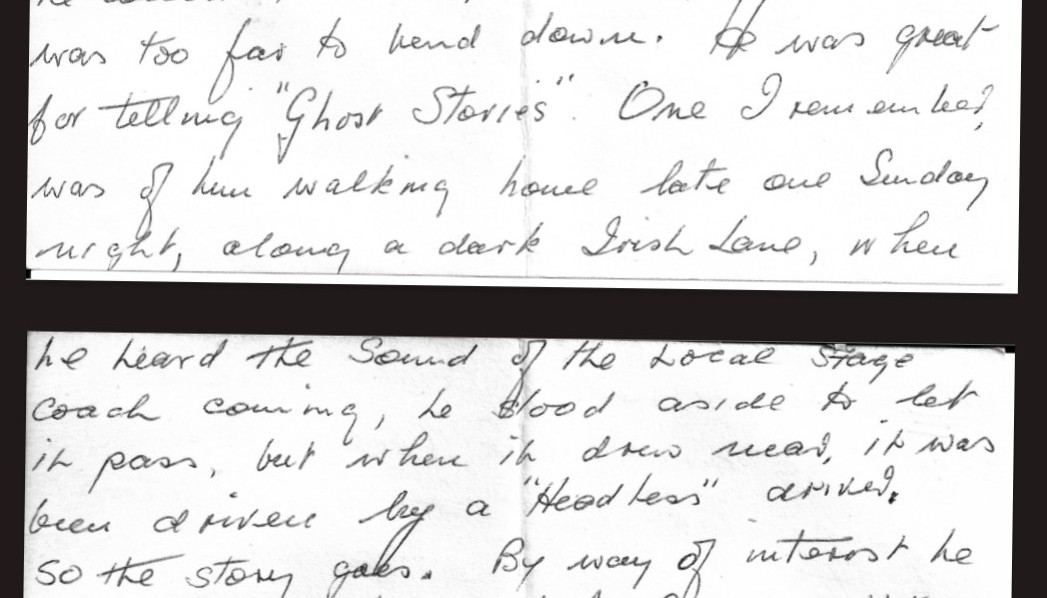
My grandaunt wrote down quite a few of her memories about him, but the one that captivated me the most was this story, as follows:
“He was great for telling ‘ghost stories’. One I remember was of him walking home late one night, along a dark Irish lane, when he heard the sound of the local stagecoach coming. He stood aside to let it pass, but when it drew near, it was being driven by a ‘headless’ driver, so the story goes.”
Lawrence died in 1956 and Phila has also now sadly passed away, so I cannot find out any more information on this wonderful ghost story from them, however, I have been able to look into some of the folklore of Ireland concerning headless coach drivers and headless horsemen.
It seems that stories of the headless coach have some history in the Bennettsbridge area, as I found a story originating from there in the National Folklore Collection, UCD. This was located in their Schools’ Collection and was written by 13-year-old Mary Nolan of nearby Danesfort in 1938:
“Headless Coach
In ancient times the old Irish people believed in many mythical things. They believed in Fairies and the “Headless Coach” and many things like that.
It is said that people in those days saw the ‘Headless Coach’ and this is the description they have of it. The Coach was very big and there was supposed to be dead people on it. The horses that were drawing it had no heads and that is why it was called the ‘Headless Coach’.
In the middle of the night some people heard it and they said it came up the Bennetts – Bridge road and it went down the Stoneyford road and it stopped at the Protestant Church. The people did not know where it came from.
The Coach made great noise as it travelled. Old people say it has to pass along the same way every four years.
People long ago told many stories about the ‘Headless Coach’ and they were kept by tradition.”
Was this the same apparition that Lawrence saw on that lonely lane, making its way to take a soul? It sounds as if the Headless Coach was a regular visitor along the roads he would have walked as a young man and he would have grown up hearing stories of its deathly journeys.
Ireland is a land shrouded in rich folklore, where tales of otherworldly beings and ghostly spectres abound. Among the many fascinating and eerie stories, two figures stand out for their chilling presence and association with death: the Dullahan and the Cóiste Bodhar Death Coach.
The Dullahan: The Headless Horseman

In Irish legend, the Dúlachán or Dullahan is a terrifying figure, often referred to as the “Gan Ceann” or “Headless One.” This malevolent being is said to roam the countryside, heralding imminent death with his appearance. The Dullahan was thought to be a sign of death, similar to the folklore of the banshee. Unlike the Banshee, which is known to warn of a coming death in certain families, the Dullahan does not come just to warn; he is the harbinger of someone’s certain death. The Dullahan is depicted as a headless horseman, carrying his detached head under his arm or holding it high up in the air. The head’s eyes are said to be constantly moving, peering into the distance and revealing the fate of those whose demise is drawing near.
The first mention of the Dullahan appears in Thomas Crofton Croker’s book Fairy Legends and Traditions of the South of Ireland in 1828 and he is described as follows in the tale “The Headless Horseman”:
” ..such a head no mortal ever saw before. It looked like a large cream cheese hung round with black puddings: no speck of colour enlivened the ashy paleness of the depressed features; the skin lay stretched over the unearthly surface almost like the parchment head of a drum. Two fiery eyes of prodigious circumference, with a strange and irregular motion, flashed like meteors.”
Clothed in a tattered, black cloak, the Dullahan wielded a whip made from a human spine, which he used to strike fear into anyone who crossed his path. His horse’s hooves were said to spark flames as they gallop, leaving a sinister trail of fire in their wake. When the Dullahan stopped riding, it was believed that a soul was about to pass into the afterlife. It is claimed that witnesses would hear their name being called out, and if they looked back, they were destined to die.
Despite his forbidding demeanour, the Dullahan was said to be fearful of gold and would avoid areas where these precious metals are present. As a result, people would sometimes leave offerings of gold to protect themselves from the dreaded fate he carried.
Croker’s tale “The Headless Horseman” provides the best depiction of the Dullahan, presented with good humour. The protagonist of the story is Charley Culnane, who while out riding at night witnessed the apparition of a disembodied head of a horse ridden by the figure of a headless spectral rider:
“A figure, whose height (judging as well as the obscurity of the night would permit him) he computed to be at least eight feet, was seated on the body and legs of a white horse full eighteen hands and a half high … his vision failed in carrying him further than the top of the collar of the figure’s coat, which was a scarlet single-breasted hunting frock …]see further he could not, and after straining his eyes for a considerable time to no purpose, he exclaimed, with pure vexation, “By the big bridge of Mallow, it is no head at all he has!
“Look again, Charley Culnane, said a hoarse voice, that seemed to proceed from under the right arm of the figure.
Charley did look again, and now in the proper place, for he clearly saw, under the aforesaid right arm, that head from which the voice had proceeded, and such a head no mortal ever saw before.”
Surprisingly Charley then decided to challenge the headless horseman to a race, much to the delight of the ghostly rider:
“A hundred years it is since my horse and I broke our necks at the bottom of Kilcummer Hill, and ever since I have been trying to get a man that dared to ride with me, and never found one before.”
The horseman disappeared without taking Charley’s life and rewarded him with the promise of supernatural assistance in any future races in which Charley would take part.
There are also legends and tales concerning the “Headless Coach”, or in Irish Cóiste Bodhar, with its driver being the Dullahan.
The Cóiste Bodhar Death Coach: Harbinger of Doom
The Cóiste Bodhar, also known as the “Silent Coach” or “Death Coach”, is by legend a ghostly coach drawn by a team of headless, skeletal horses, and it travels silently through the night to collect the souls of the departed. Like the Dullahan, the Cóiste Bodhar is a harbinger of death and signals the end of a person’s life.
The sight of the Cóiste Bodhar is said to bring an eerie stillness to the surroundings as if nature itself is holding its breath. The coach is often described as being adorned with funereal symbols, and its windows are said to be draped in mournful black. Those who witness the spectral procession may be overcome with a sense of foreboding, as they know that someone’s demise is imminent.
In some versions of the tale, the Cóiste Bodhar is driven by a Dullahan, further intertwining the stories of these two chilling entities. According to WB Yeats in his book Irish Fairy and Folk Tales (1893), the Dullahan drives the coach:
“This is a most gruesome thing. He has no head, or carries it under his arm. Often he is seen driving a black coach called coach-a-bower (Ir. Coite-bodhar), drawn by headless horses. It rumbles to your door, and if you open it a basin of blood is thrown in your face. It is an omen of death to the houses where it pauses. Such a coach not very long ago went through Sligo in the gray of the morning, as was told me by a sailor who believed he saw it. In one village I know its rumbling is said to be heard many times in the year.”
According to Croker, the Dullahan could be heard driving the Death Coach particularly hard on some nights when there were souls to be collected:
“The following account of the Dullahans and their coach was communicated to the writer by a lady resident in the neighbourhood of Cork:–
“They drive particularly hard wherever a death is going to take place. The people about here thought that the road would be completely worn out with their galloping before Mrs. Spiers died. On the night the poor lady departed they brought an immense procession with them, and instead of going up the road, as usual, they turned into Tivoli: the lodge-people, according to their own account, ‘were kilt from them that night.’ The coachman has a most marvellously long whip, with which he can whip the eyes out of anyone, at any distance, that dares to look at him. I suppose the reason he is so incensed at being looked at, is because he cannot return the compliment, ‘pon the ‘count of having no head. What a pity it is none but the Dullahans can go without their heads! Some people’s heads would be no loss to them, or anyone else.”
One compelling story by Croker concerning the Death Coach is that of “Hanlon’s Mill”. The protagonist Michael Noonan was walking back from Ballyduff, Co Cork from his trip to a shoemaker and passed the ruined mill of “Old Hanlon”. The ruin surprisingly seemed to be issuing clacking noises as if it were working away. Mick then met his neighbour Darby who asked him to take the horse and cart back. Mick passed by the River Awbeg and here noticed that the moon reflected on a pool of water had disappeared. When he turned, he then saw, following beside his cart, a black coach drawn by six headless black horses, driven by a headless coachman clothed in black:
“How was Mick astonished at finding, close along-side of the car, a great high black coach drawn by six black horses, with long black tails reaching almost down to the ground, and a coachman dressed all in black sitting up on the box. But what surprised Mick the most was, that he could see no sign of a head either upon coachman or horses.”
The next morning, Mick received news from a local huntsman that Master Wrixon of Ballygibblin had died suddenly after a fit. So, according to legend, the appearance of the “Headless Coach” foreshadowed an imminent death once again.

Another interesting story occurred in 1876 in county Clare, collected by Thomas Johnson Westropp, in his 1910 “A Folklore Survey of County Clare”. Here a servant for the MacNamara family of Ennistymon House was taking a stroll late at night when he heard the rumbling of wheels along the lane. Confused as to what vehicle would be out at such a late time of night, he then realised it must be the Cóiste Bodhar.
The servant then quickly ran and opened the three gates leading to Ennistymon House and threw himself face down on the ground as the death coach hurtled past him. Without stopping at Ennistymon House, it drove into the distance until it was out of sight and no longer heard. A day later news arrived that Sir Admiral Burton MacNamara had died in London.
Despite their fearsome reputation, the Dullahan and Cóiste Bodhar serve as a reminder of the ancient beliefs and superstitions that have shaped Irish culture. Did Lawrence Holohan really witness the Death Coach passing by on its solemn journey? Did it come to take the soul of a family member or friend of his? The answers are now lost in time. However, what we do know is that legend of the Dullahan and the Death Coach continues to captivate and frighten those who hear their eerie hoofbeats or the rumbling of wheels echoing in the darkness, making them two of the most enduring and haunting figures in Irish folklore.
I dedicate this post to my mother Susan Gayfer (01/06/1956-24/07/2023) who passed away suddenly and unexpectedly the on the day I finished writing the first draft and had been excited to read the finished product. She sadly did not live to read it.
References
- dúchas.ie. (n.d.). Headless Coach · Danesfort · The Schools’ Collection. [online] Available at: https://www.duchas.ie/en/cbes/4758535/4752482/5015225. “The Schools’ Collection, Volume 0854, Page 214-215” by Dúchas © National Folklore Collection, UCD is licensed under CC BY-NC 4.0. [Accessed 23 Jul. 2023].
- Johnson Westropp, T. (1910). A Folklore Survey of County Clare: The Death Coach. [online] http://www.clarelibrary.ie. Available at: https://www.clarelibrary.ie/eolas/coclare/folklore/folklore_survey/chapter3.htm [Accessed 23 Jul. 2023].
- Kenneth Spencer Research Library. (n.d.). Kenneth Spencer Research Library Blog» W. B. Yeats. [online] Available at: https://blogs.lib.ku.edu/spencer/tag/w-b-yeats [Accessed 23 Jul. 2023].
- Moynihan, P. (2013). Beware Ireland’s Death Coach | Spooky Isles. [online] Spooky Isles. Available at: https://www.spookyisles.com/irelands-death-coach/ [Accessed 23 Jul. 2023].
- Sutherland, A.D.V. (2020). The History of the Dullahan in Irish Folklore. [online] Doris V. Sutherland. Available at: https://dorisvsutherland.com/2020/06/19/the-history-of-the-dullahan-in-irish-folklore/ [Accessed 23 Jul. 2023].
- The Druid’s Cauldron. (2022). The Headless Horseman and Related Folklore. [online] Available at: https://thedruidscauldron.net/2022/10/05/the-headless-horseman-and-related-folklore/ [Accessed 23 Jul. 2023].
- Thomas Crofton Croker (1826). Fairy Legends and Traditions of the South of Ireland. [T. 1]. [online] London Murray. Available at: https://www.gutenberg.org/cache/epub/39752/pg39752-images.html [Accessed 23 Jul. 2023].
- Webtrade Ltd. – http://www.webtrade.ie (2022). The Dullahan. [online] Rareirishstuff.com. Available at: https://www.rareirishstuff.com/blog/the-dullahan.5539.html [Accessed 23 Jul. 2023].
- Wikipedia. (2023a). Death Coach. [online] Available at: https://en.wikipedia.org/wiki/Death_Coach [Accessed 23 Jul. 2023].
- Wikipedia. (2023b). Dullahan. [online] Available at: https://en.m.wikipedia.org/wiki/Dullahan [Accessed 23 Jul. 2023].
- Yeats, W.B. (1892). Irish Fairy Tales. [online] London: T. Fisher Unwin. Available at: https://www.gutenberg.org/cache/epub/31763/pg31763-images.html [Accessed 23 Jul. 2023].
 Ghost Catcher Isles
Pingback: Unveiling the Dullahan in Celtic Mythology