Welcome to Ghost Catcher Isles, chronicling the weird, wonderful and eerie of the isles of Great Britain and the Republic of Ireland. Come with me on my adventures into the strange and paranormal
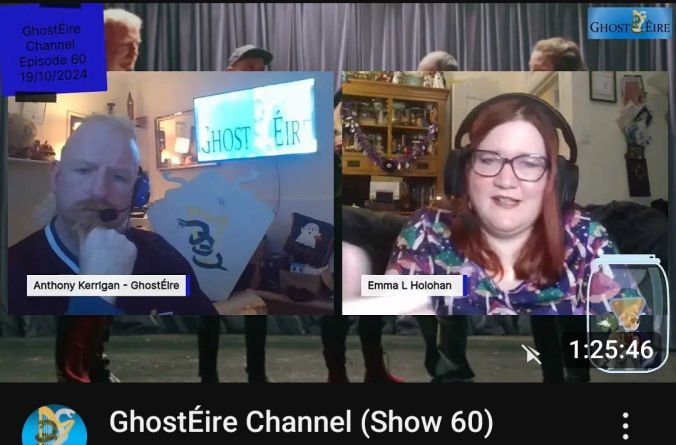
(GhostÉire interview with Ghost Catcher Isles. Image Credit: GhostÉire Channel)
If you’re someone who feels the tantalising pull toward the strange and supernatural, then this one’s for you. Picture this: a quiet Saturday night, lights dimmed, a flickering candle perhaps—and there I was, live on the GhostÉire Channel, diving headfirst into the world of the paranormal. Together with my incredible host Anthony Kerrigan, we opened the door to stories, historic sites, and legendary mysteries. Members of the “Uncanny Community” and paranormal enthusiasts tuned in, sharing in the experience as we wandered through tales of ancient landscapes and whispered legends. But if you missed it, don’t worry: the full recording is waiting for you, ready to be explored at your own pace.
A Bond Forged Through an Uncanny Curiosity
We kicked off the night by discussing my passion for the podcast Uncanny and the amazing ‘Uncanny Community’ it has fostered. There’s something powerful about this community: a place where like-minded individuals gather to share their strange encounters, eerie experiences, and shared fascination with the unknown. The support, curiosity, and friendship are inspiring, making it the perfect place for those drawn to the mysterious to connect.
Mysteries Carved into the Earth: The Uffington White Horse and Wayland’s Smithy
Our next stop on this haunted journey took us to one of Britain’s most iconic sites: the Uffington White Horse, a massive chalk figure etched into an Oxfordshire hillside that has withstood nearly 3,000 years of history. There’s a sacred stillness to it, a feeling that resonates with something far older than we’ll ever know. Is it a mark of ancient ritual, a tribute to old gods, or simply a beacon carved to guide travellers of the past? Each theory adds a layer of wonder to this timeless mystery.
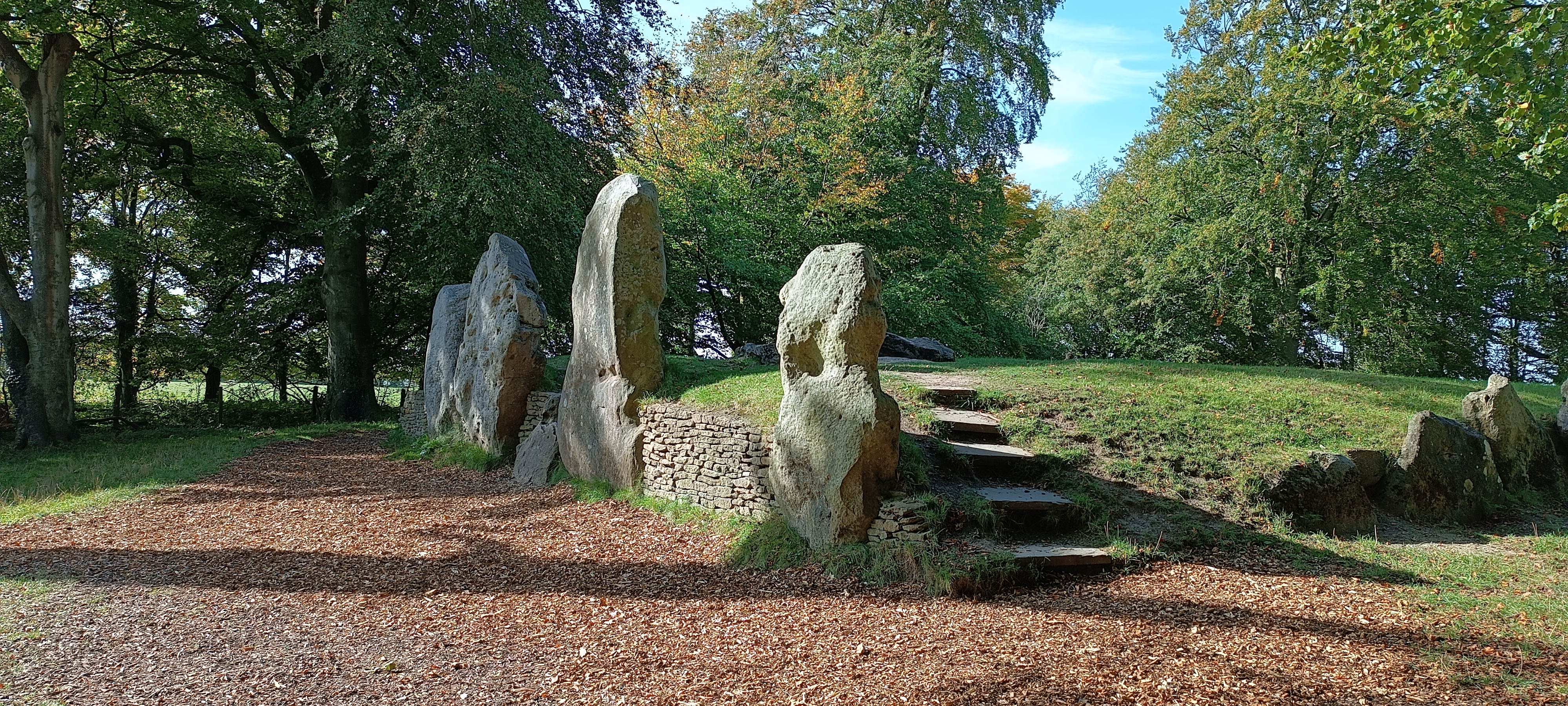
(Wayland’s Smithy. Image Credit: E.Holohan)
And just a stone’s throw away lies Wayland’s Smithy, an ancient burial site nestled within this mysterious landscape. It’s a place that buzzes with mystery. Standing there, surrounded by earth that’s seen so much, you can’t help but wonder what these ancient builders believed and what secrets they took with them.
The Haunting Sounds of the Whispering Mummies
(The Crypt under St Michan’s. Image Credit: E.Holohan)
Our final topic was one that feels both spine-tingling and sombre: the Whispering Mummies of St. Michan’s Church in Dublin. Interred in crypts beneath this centuries-old church, the mummified remains have become legend, and some say that if you listen closely, the mummies themselves seem to whisper secrets of a bygone time. There’s a strange, haunting beauty here, where history and the supernatural meet in the stillness. The whispers, or maybe just the echoes of centuries, remind us that death is a mystery we all ponder, and yet, here we are, side-by-side with those who came long before us.
Join Us on a Journey Into the Unknown
If you have a passion for the paranormal or a love for history that holds shadows and secrets, this conversation is an invitation to journey with me and my host Anthony. Each story shared brought its own sense of wonder, its own question that lingered in the air. So, wrap up in a blanket, dim the lights, and join us in exploring these mysteries. Watch the full recording on the GhostÉire Channel and step with us into a world where every answer brings another question; and where the unknown is always just a little closer than we think.
Are you fascinated by the paranormal? Intrigued by folklore and eerie legends? Then you won’t want to miss my exclusive live vlog interview on the GhostÉire Channel, where we explore the unknown and the mysterious. It’s time to sit back, relax, and join me and my host Anthony Kerrigan as we delve into the world of the paranormal.
On this episode, Anthony will be speaking to me about my passion for all things paranormal. This includes ghostly tales, mystical sites, and everything in between. We’ll discuss my blog, Ghost Catcher Isles, where I explore strange and eerie stories from across the UK and also the Republic of Ireland.
Here’s a sneak peek of what we’ll cover:
Uncanny Podcast and the ‘Uncanny’ Community
We’ll kick things off by talking about the hit paranormal podcast and documentary series, Uncanny. It first aired on BBC Radio 4 in 2021, it’s now a cult favourite. The podcast was created by Danny Robins and it dives deep into real-life supernatural encounters. It features key witness interviews and expert analysis from experts in the field such as Dr. Ciaran O’Keeffe, Professor Chris French, and Dr. Evelyn Hollow. Uncanny recently had a TV adaptation and also experienced a successful live tour across the UK and Ireland. Consequently, the Uncanny phenomenon continues to grow. But where do I stand—Team Believer or Team Sceptic? Or somewhere in between? Tune in to find out!
The Mystery of the Uffington White Horse
Next, we’ll journey to Oxfordshire, England, to explore the ancient chalk hill figure known as the Uffington White Horse. Dating back to the late Bronze Age, this enigmatic figure has sparked centuries of fascination. Is it a tribute to Epona, the Celtic goddess of horses, or linked to Rhiannon of Welsh myth? I’ll share my experience of visiting this iconic site and reveal whether the surrounding landscape holds any paranormal secrets.
The Whispering Mummies of St Michan’s
Our final topic takes us to the eerie vaults beneath St Michan’s Church in Dublin, home to mummified remains preserved for centuries. From the mysterious ‘nun’ to the six-foot-five ‘crusader,’ these mummies have their own strange stories to tell. We’ll dive into the chilling reports of ghostly whispers and invisible hands that haunt this crypt. And yes, we’ll also discuss the tragic fire of June 2024 that destroyed several of these ancient remains.
Want to ask a question? Feel free to send in your questions live about any of the topics we’ll cover—or anything related to the paranormal!
The live interview will last approximately 90 mins. Feel free to join for the full interview. You can join and leave as you wish. You have the flexibility to dip in and out at any time during the live broadcast.
Don’t miss out on this spine-tingling discussion! This show is open to over 18’s only
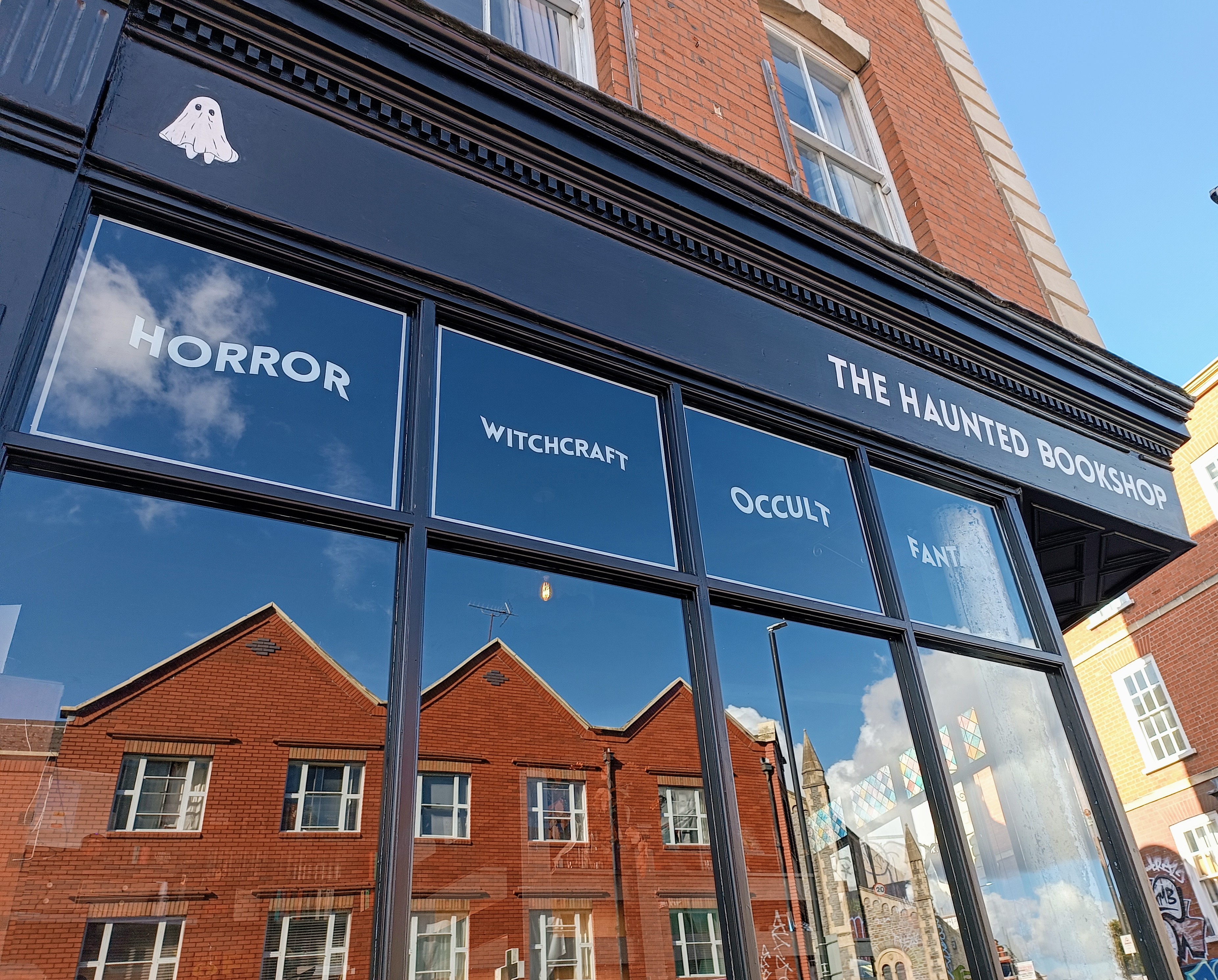
On a mild autumn afternoon, I found myself standing in front of a brand-new gem in Bristol’s literary scene: the Haunted Bookshop. From the moment I saw its name gleaming on the sign above the shop, I knew I was in for something special.
“Step into a world of spine-chilling tales, mystical splendours, and ancient folklore as you explore our carefully curated collection of horror, fantasy, and witchcraft books,” the shop website says; “Whether you’re seeking spine-tingling thrills, fantastical adventures, or a deeper understanding of the occult, our shelves are brimming with stories sure to enchant you.”
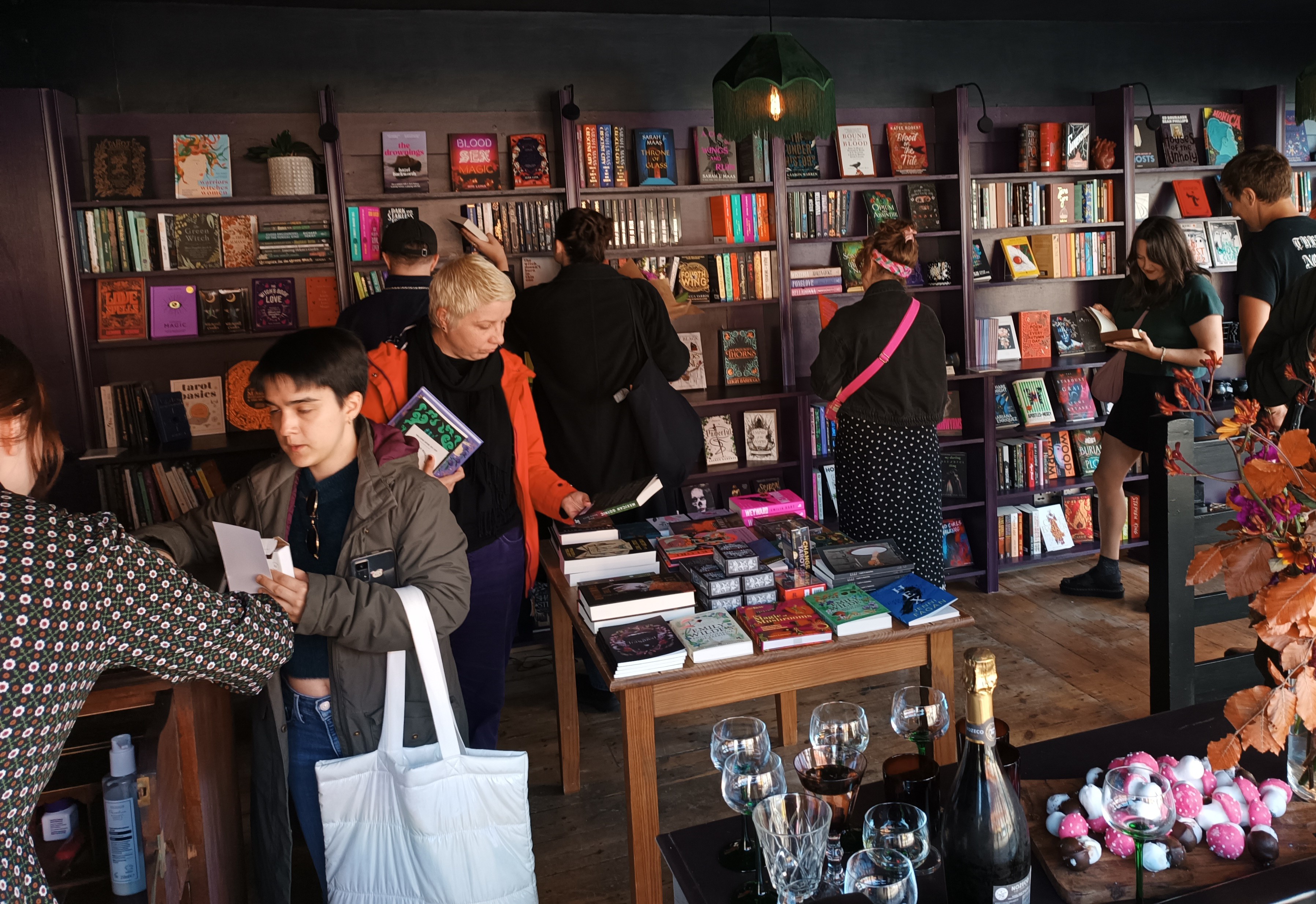
As soon as I stepped inside, it was as if I’d been transported to another realm. Dim lighting and wooden bookshelves lined with volumes of witchcraft, folklore, fantasy, and horror greeted me warmly.
I started with the books, of course. Being an unashamed lover of the weird and the wonderful, I couldn’t resist diving into their collection of witchcraft tomes, folklore books, and horror novels. Each shelf seemed to whisper promises of untold stories and ancient wisdom. After some delightful browsing, I settled on two books: one on folklore and another on modern witchcraft. Both felt like treasures in my hands, and I couldn’t wait to dig in and lose myself in their pages.
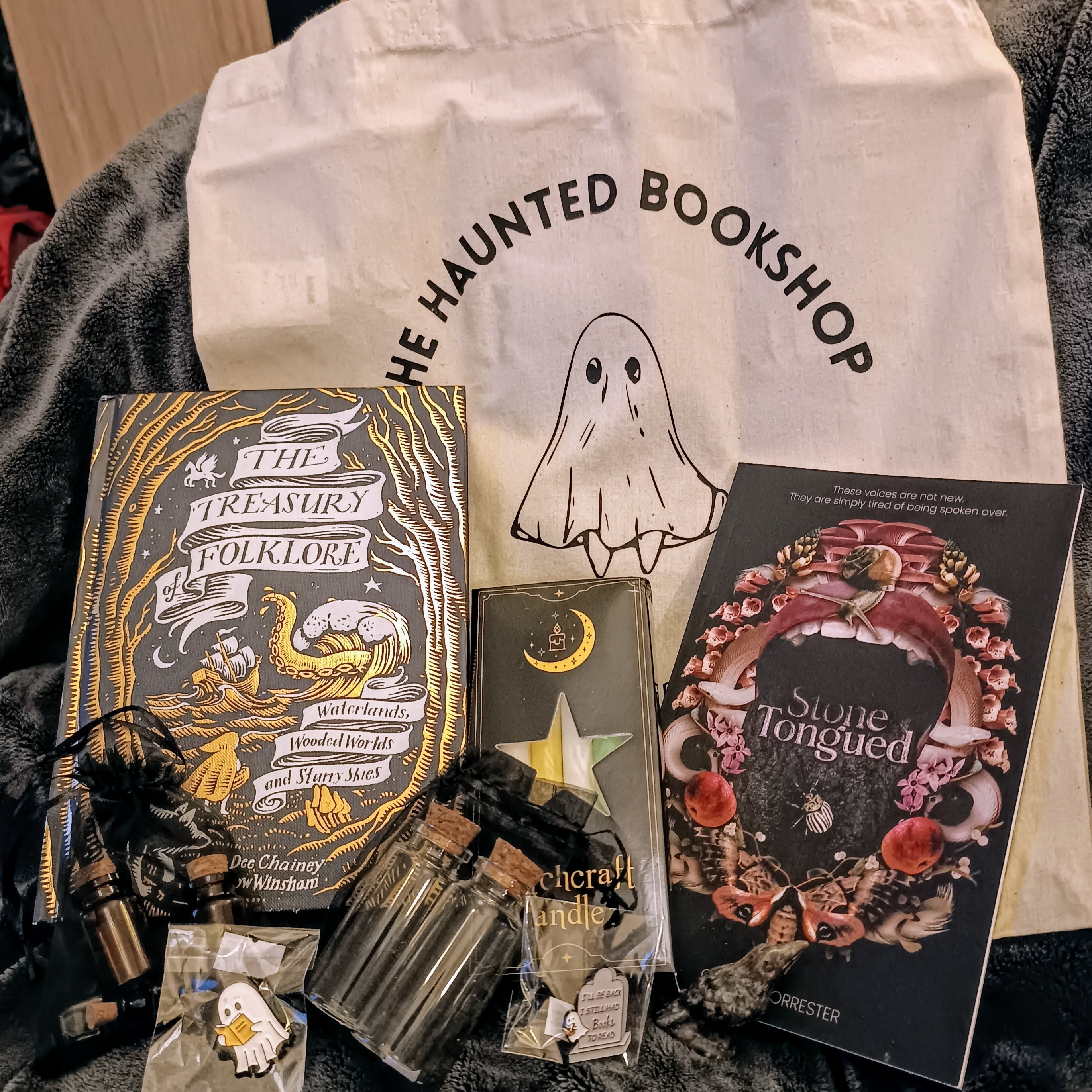
But the Haunted Bookshop wasn’t just about books. It was a haven for all things witchy and mystical. Scattered throughout the shop were displays of witchcraft supplies: delicate candles in deep purples and blacks, bundles of sage tied with twine, and shelves gleaming with crystals of every color. I was immediately drawn to a striking crow-shaped crystal, charcoal grey and glossy, which seemed to call out to me from across the room. It felt right in my hand, and before I knew it, it was mine. Along with a tote bag (because who can resist a good bookish tote?), and some adorable ghost-themed metal pin badges—perfect little nods to the spooky vibes.
One of the highlights of the visit was chatting with the shop’s owner. Monika had a warm, earthy energy, the kind you’d expect from someone who truly believes in the magic of what they’re doing. We talked about the inspiration behind the shop, her love for esoteric books, and how important it is to create a space where people can explore these topics freely.
In her recent interview with Bristol24/7 Monika said: “I’ve always read horror and fantasy books and liked spooky things, Halloween is my favourite time of the year, so I just wanted to stand out.”
Monika credits her grandmother as being the one to have instilled a passion for books in her, having grown up spending a lot of time in her grandmother’s bookshop. Downstairs, Monika said she plans on opening a comfy seating area ready to start hosting events such as horror book clubs, tarot card readings and more.
As we chatted, she handed me a glass of prosecco to toast the opening. I sipped and soaked it all in; this cozy, mystical bookshop, where like-minded souls could gather and find a little magic of their own.
And just when I thought the experience couldn’t get any better, I was towards a plate of mushroom-shaped biscuits, which felt like a whimsical finishing touch to the whole evening. Slightly sweet, slightly earthy, and deliciously unique; just like the shop itself.
Leaving the Haunted Bookshop felt like stepping back into the real world after a brief, enchanted escape. But as I walked out into the bustle of Stokes Croft, my bag filled with books, a crow crystal, and other witchy goodies, I couldn’t help but feel that I had taken a piece of that magic with me. There’s something comforting about knowing that spaces like this exist, where the curious and the mystical meet in such a beautiful, welcoming way.
The Haunted Bookshop is sure to become one of my favorite haunts (pun intended), and I can’t wait to go back, especially as the colder months draw in. There’s just something about autumn, witchcraft, and folklore that feels so perfectly intertwined. If you’re ever in Bristol and want to indulge in a little magic, mystery, and literary wonder, this is the place to be. And who knows—maybe you’ll even leave with your own bit of enchanted treasure.
Open Tuesday to Saturday, from 12-6pm, you’ll find The Haunted Bookshop at 43 Stokes Croft, Bristol BS1 3PY.
Reference List
Case, C. (2024). A Horror-Themed Bookshop For Ghost Stories, Folk Tales & Witchcraft Has Opened In Bristol. [online] Secret Bristol. Available at: https://secretbristol.com/haunted-bookshop/ [Accessed 11 Oct. 2024].
Online Store. (2024). The Haunted Bookshop – a bookshop and venue in Bristol. [online] Available at: https://thehauntedbookshop.co.uk/ [Accessed 11 Oct. 2024].
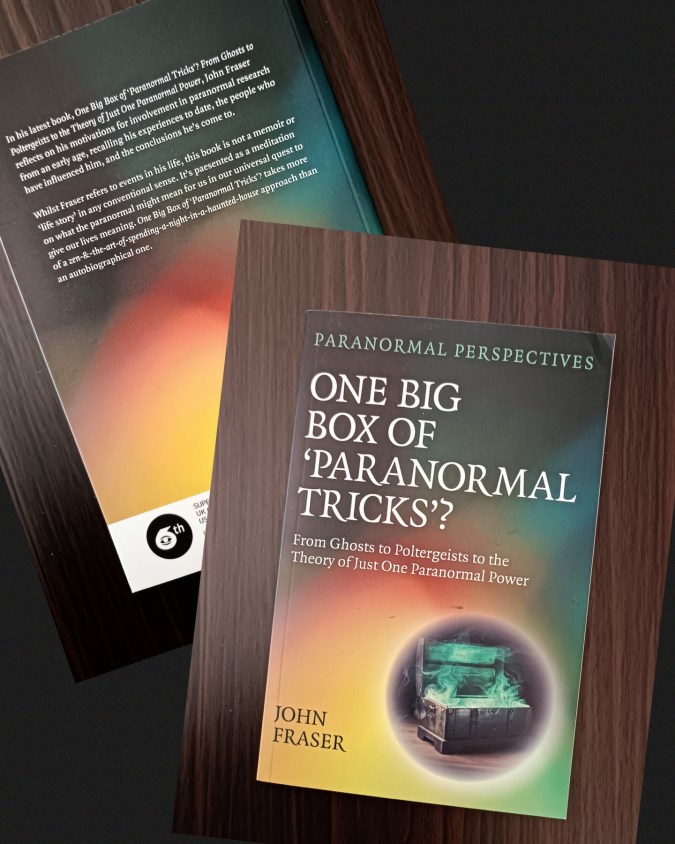
John Fraser’s book, “Paranormal Perspectives,” explores the interconnectedness of paranormal phenomena through his theory of “One Paranormal Power.” Blending personal experiences with scepticism, Fraser invites…
UncannyCon 2024, held at Southbank Centre in London, brought together experts and enthusiasts to explore unexplained phenomena. The event featured chilling testimonies, intense debates, and…
The GhostÉire interview with Ghost Catcher Isles explores captivating themes of the paranormal and ancient mysteries. Notable discussions include the Uffington White Horse and Wayland’s…
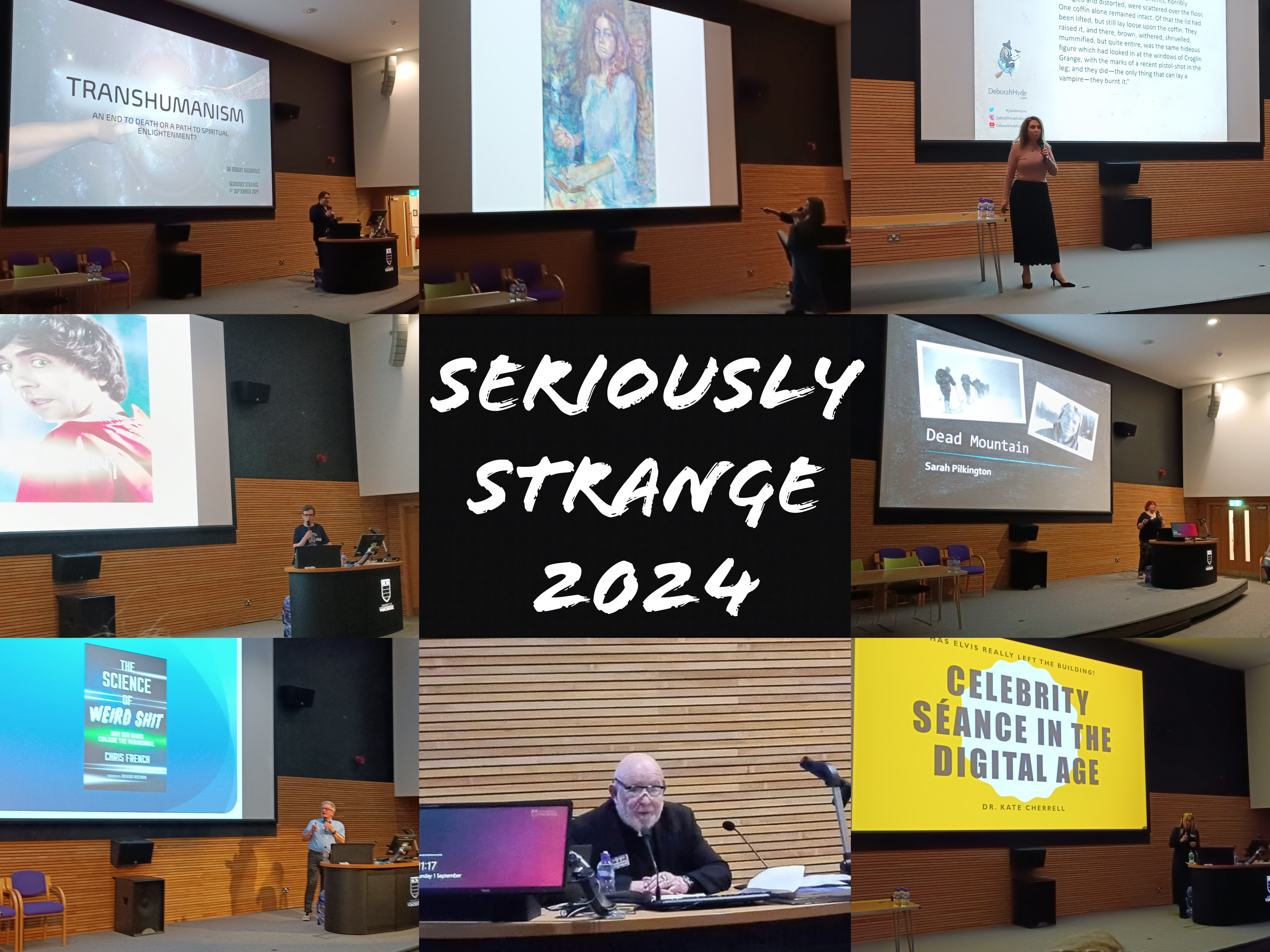
Winchester, with its rich history and timeless charm, has always had an air of mystery about it. This past weekend, that mysterious allure was dialled up several notches as paranormal enthusiasts from all corners of the UK—and even beyond—gathered for an unforgettable Seriously Strange Conference. The event, run by The Association for the Scientific Study of Anomalous Phenomena (ASSAP) as its yearly conference, spanned two jam-packed days, filled with thought-provoking talks by top speakers in the field on topics such as ghosts, vampires, poltergeists, cryptozoology and UFOs that left attendees both spooked and inspired.
The conference kicked off on Friday evening with a hauntingly atmospheric Winchester city ghost walk from The Theatre of Dark Encounters. Winchester, with its centuries-old architecture and dark past, proved the perfect setting to explore the unknown. As we strolled through the ancient streets, our guide led us into the heart of the city’s ghost stories—some dating back hundreds of years. Whispered tales of restless spirits haunting Winchester Cathedral, eerie footsteps in hidden alleyways, and unexplained phenomena at The Eclipse Inn had us all on edge, yet enthralled.
On the walk, we heard about the spectral monks who are said to haunt Winchester Cathedral. These brown hooded figures, disappearing at the knees, have reportedly been seen walking on what is believed to have been the original floor of the building. As recently as 1957, a family from Wolverhampton visited the cathedral while on holiday and happily took some snaps for the family album. Nothing strange or unusual was noticed while at the cathedral by them, however upon their return home, they developed their photos to discover several male figures dressed in medieval clerical dress pictured near the high altar. The family claimed there were no other people around that day and were unable to explain what caused the unsettling image.
Another point of interest on the ghost walk was The Eclipse Inn, which dates from the 16th century and was formerly the rectory of St Lawrence Church. The Eclipse is reputed to be haunted by a grey lady, who has been seen in an upper-story room of the building. The spirit is said to be that of Lady Alice Lisle who was beheaded in 1685 in the marketplace, accused of harbouring traitors during the Monmouth Rebellion. Lady Lisle is said to have spent her last evening on earth in the upstairs room which she now reportedly haunts.
One especially chilling story recounted on the walk was that of the starving woman of Hyde Tavern. The Hyde Tavern is another ancient Winchester inn and can trace its origins back to when monks still resided at Hyde Abbey. The current tavern building dates from the 19th century and has been known for its rowdy patrons, even at one point having to close down in 1860 when the landlord was prosecuted for allowing bare-knuckle fighting on site. As the story goes, several hundred years ago an impoverished woman was turned away from the tavern during a bitterly cold night. Her cold, frozen body was found on the doorstep the next morning, and soon after strange occurrences began to happen. It is said that her spirit took revenge on the landlord of the tavern by taking up residence in the building to cause bother to his patrons forever more. Her angry spirit is said to pull off the bedding from sleeping guests. Other patrons have felt a frozen hand placed on their arm or shoulder while drinking in the bar. If only that landlord had been more charitable and allowed the woman warmth and a bed, she would not perhaps have remained to manifest her vengeance at the tavern to this day.
Despite the occasional chill in the air, the ghost walk provided a fantastic opening to the weekend. It was immersive, spine-tingling, and set the tone for what was to come.
Saturday: Talks, Stalls, and the Conference Gala
Saturday was the heart of the conference, with a full day dedicated to speakers, stalls, and, of course, the highly anticipated evening gala. The conference centre was abuzz with excitement as attendees made their way through an array of stalls showcasing everything from paranormal themed notebooks, needle felted Lovecraftian horrors and paranormal books from several of the speakers.
The speakers on Saturday were nothing short of captivating. Among the most notable talks were:
Kristian Lander: “The Secret of the Nightcrawlers”
Kristian Lander is an independent researcher, writer, filmmaker, and host of ‘Rabbit Hole That Is Reality’ radio podcast. He presented a talk and showing of his recreation of the Nightcrawler videos. Here he showed a video of his beginners guide to creating your own Nightcrawler and showcased his homemade ‘Nottingham Nightcrawler.’ I had only heard of the Fresno Nightcrawler in passing before this talk, so I enjoyed learning more about the videos, and its fandom and watching Kristian debunk the supposed cryptid by recreating a Nightcrawler video himself
Deborah Hyde regularly speaks and writes about religion and belief and for 10 years was the editor of ‘The Skeptic Magazine’. More recently she has appeared as an expert for ‘Team Skeptic’ on the BBC podcast ‘Uncanny’. Deborah presented a well-researched talk on the story of ‘The Croglin Vampire’. Deborah delved deep into the legend, the history of the people involved, and the locations mentioned, to try to examine the legend’s validity and to find out if there was a grain of truth behind it. This was a truly intriguing talk, showing how legends and folklore can be produced from religious and political upheaval.
Dr Kate Cherrell: “Has Elvis Really Left the Building? A History of Celebrity Séance.”
Dr Kate Cherrell is a writer and academic specialising in spiritualism and popular séance. She is the creator of “Burials and Beyond”, a website exploring the stranger sides of life, death, and beyond. She co-hosts “Loopholes”, a sceptical but light-hearted podcast, and also co-hosts Discovery’s “Haunted Homecoming Unexplained: Caught on Camera.” Kate presented a fun and engaging talk on celebrity seances, which discussed modern séance and spirit box sessions with famous people such as Princess Diana, Queen Elizabeth II, Elvis Presley, and John Lennon. We heard about how these types of ‘pay-per-view’ seances developed over time in the digital age. Kate’s talk was delivered with such passion and humour, that it kept me engaged throughout, wanting to learn more.
Matt Arnold: “The Epworth Haunting Revisited”
Matt Arnold is the editor of ‘The Christian Parapsychologist Journal’ and author of ‘The Invisible Dimension: Spirit Beings, Ghosts and the Afterlife.’ Matt talked about the fascinating case of the ‘Epworth Haunting’, from his early fascination with the case during the pandemic lockdown to his research and later visits to the site. He sought to build a chronological reckoning of the haunting that happened to the Wesley family, to check whether these now famous events are in source materials and that these correspond with witness recollections and eyewitness statements in the letters between the family. The family discussed is that of John Wesley, the father of Methodism, who was sadly not present during the haunting. It was however experienced by his parents, siblings, and their servants. This was an intriguing case that was well-researched and presented with skill and a spot of humour. Top marks for providing additional handouts to the audience too!
Other speakers included Neil Nixon (“Today Winchester, Tomorrow the Cosmos”), Dr Ann Winsper (“Are Ghosts All in the Mind? Evidence from Animals.”), John Fraser (“My Very First Ghost Hunt.”) and Professor Chris French (“The Psychology of Coincidences”), all presenting their talks on their topics with ease, enthusiasm, and expertise. There was also a panel discussion that I sadly missed, but which I heard was fascinating, which was hosted by Matt Arnold and included Deborah Oakes, Dr Paul Rogers, Professor Chris French, Dr Ann Winsper, Dr Kate Cherrell, and Deborah Hyde.
Each speaker brought their unique expertise, but what tied them all together was a shared fascination with the unknown. The audience was equally diverse, from seasoned ghost hunters to curious newcomers, all united by a common interest in exploring the mysteries that lie beyond our current understanding.
As the day turned to night, the excitement peaked at the Conference Gala. Attendees arrived in style, many on a Cliff Richard’s style ‘Summer Holiday’ red double-decker bus, dressed in their finest summer holiday-themed attire. It was a chance to unwind, share stories from the day, and mingle with some of the event’s biggest names. The atmosphere was merry, with an underlying sense that, even at a party, the spirits of Winchester might be lingering close by.
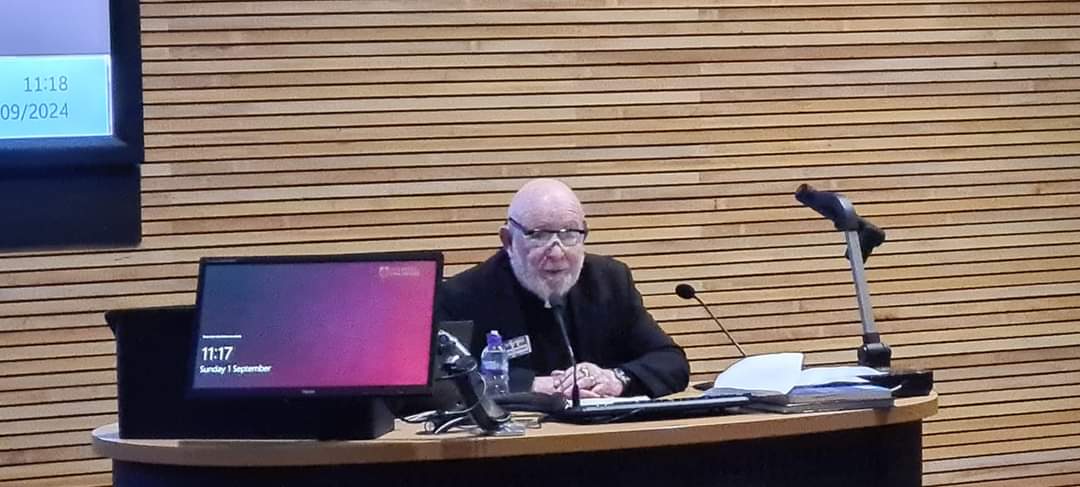
Sunday was another day of fantastic talks, but there was no denying that the highlight was the appearance of none other than Reverend Lionel Fanthorpe, a legend in the paranormal community. With his decades of experience investigating the unexplained, Rev. Fanthorpe’s talk was a masterclass in storytelling and intrigue where he talked about his 60-plus years of examining unsolved mysteries. He effortlessly captivated the room with tales of unsolved mysteries, uncanny prophecies, and the strange experiences he has had or witnessed throughout his life. My favourite stories were that of the Pedlar of Swaffham, having grown up hearing that story as a child in Norfolk, and his personal story of the spirit of a recently departed friend apparently appearing to him to pass on a message from the spirit realm.
Reverend Fanthorpe’s warmth and wisdom brought depth to the conference, offering not just ghost stories but a reflection on the nature of belief, the afterlife, and how we, as humans, connect with the unseen world.
For me, this was also the chance to see one of my childhood heroes speak, having grown up watching ‘Fortean TV’. I even lingered nervously in the foyer with a copy of one of he and his wife’s books so that I could meet him and ask him to sign it, but sadly he left by another door. Maybe next time.
In addition to his talk, other notable speakers on Sunday explored topics such as poltergeists, UFO sightings, and Transhumanism. The stand-out talks for me on this day were:
Karin Beasant: “Jamaica Inn, A Story Through Time”
Karin Beasant has been investigating the paranormal for over 17 years. She runs her own paranormal team, ‘South Bristol Paranormal’ and has been part of the ‘Jamaica Inn Paranormal Team’ for 9 years. She has been involved in television documentaries, including as acting as assistant producer on ‘My Ghostly Footsteps’. Karin has a passion for history and research and this very clearly came through during her talk about the history of the Jamaica Inn, where she revealed her research around the land, the building, and some of the notable characters involved with this haunted location. Karin really drew you into the history and I was left wanting to visit and explore the Jamaica Inn myself one day.
Dr Paul Rogers: “The Dodleston Poltergeist and Messages: Overview & Examination”
Dr Paul Rogers is a freelance researcher and Visting Research Fellow at The University of Northampton. He is currently researching ‘The Dodleston Messages’, the topic of this talk.
For me, this was one of the standout cases discussed at the Conference. Paul talked about the fascinating and creepy experiences of Debbie Oakes and Ken Webster when they lived in Meadow Cottage in Dodleston, Cheshire. Debbie was also a Conference attendee, having spoken on the panel on Saturday, however, she sat back to enjoy the talks today. Debbie and Ken experienced many strange poltergeist-like occurrences in the cottage, such as stacking of cans, footprints up the wall, and stacking of furniture by seemingly unseen hands. More curiously the unknown entity appeared to begin communicating with the couple via messages typed mainly on various borrowed computers. Over 16 months there were approximately 300-400 messages. These seemingly came from a previous occupant of the cottage from the 1500s. As the story unfolded, and more evidence was presented, it became more and more incredible, even weaving in possible contact from a time traveller. This suggested that some type of portal or interdimensional communication device linked the location at different points in time. This was a very compelling case and although I remain sceptical and cautious, I was left wanting more and my husband darted off to the stalls to buy one of the remaining signed books, “The Vertical Plane” by Ken Webster.
Dr Robert Radaković: “Transhumanism- An end to death or a path to Spiritual Enlightenment”
Dr Robert Radaković is a writer, speaker, scholar of the paranormal and the occult, and a Council member of the Ghost Club. Robert’s talk was on ‘Transhumanism’, a philosophical movement that promotes technological advancement to enhance both human longevity and cognition. He mapped this philosophy from the Age of Enlightenment to its current modern incarnation, discussing the ultimate goal of this which is to live forever, to maintain cognitive ability as almost a separate species, technological singularity, and the ability to mind upload. He found commonalities with this philosophy with paranormal phenomena, religion and esoteric spirituality, and universal connectedness. This was a really mind-blowing talk, that brought to mind ideas from William Gibson’s cyberpunk books.
Patti Keane is a writer and artist who first came to the paranormal community’s attention when her experience of living with a poltergeist was aired in the first series of Danny Robin’s ‘Uncanny’ podcast in 2021, ‘The Haunting of Tanfield House’. Patti presented her story and recollections of her life with the poltergeist at Tanfield House via a series of drawings, artworks, and diary entries she made at the time of her experiences. Patti was a captivating speaker who brought her experiences alive with her art and snippets of writing. I found the painting of her with the figure of the poltergeist behind her, claws resting on her shoulder, particularly chilling.
Other talks were given by Dr Mark Newbrook (“Scientific linguistics and amateur claims & theories about Language”), Sarah Pilkington (“Dead Mountain: The Dyatlov Pass Incident”), and Michaela Ford (“UK UFO Sightings and Associated Data 2020-2024”) all of which were fascinating and delivered with skill.
Craig Williams should also be noted for his opening and closing of the two days of talks and for his introduction of all the fine speakers.
It was a day that left attendees both reflective and curious, eager to learn more and apply their newfound knowledge to their own explorations of the paranormal.
The Verdict: A Must-Attend Event for Paranormal Enthusiasts
As the conference came to a close, there was a palpable sense that Winchester, with its ancient walls and deep history, had once again woven its magic over us. The ASSAP Seriously Strange Conference wasn’t just about ghost stories and haunted locations—it was a celebration of curiosity, a space for believers and sceptics alike to explore the mysteries that surround us.
For anyone with an interest in the paranormal, this conference is a must-attend. Whether you’re a seasoned investigator, a sceptical researcher, or just someone with a passion for ghost stories, Winchester provides the perfect backdrop to immerse yourself in the unknown. Between the ghost walk, fascinating speakers, and the opportunity to meet like-minded individuals, it’s an experience that stays with you long after the weekend ends.
As I left Winchester, I couldn’t shake the feeling that perhaps, just maybe, the city’s ghosts had followed me home. And you know what? I’m not so sure I mind.
Encounters, G.W. from T. of D. (n.d.). Winchester Ghost Walk and Ghost Tours from Theatre of Dark Encounters. [online] ghost-walks.com. Available at: https://ghost-walks.com/ghost-tours/winchester-ghost-walk [Accessed 8 Sep. 2024].
Feldwick, M. (2006). Haunted Winchester. History Press (SC).
Last weekend myself and my husband embarked on an exciting adventure into the realms of the paranormal at ParaMeet South 2024. Held at the historic Leigh Park Hotel in Wiltshire, this weekend event delivered a fascinating lineup of talks, encounters, and esoteric discoveries.
Myself on the left (Ghost Catcher Isles), my husband (centre), and Emma Heard on the right (Weird Wiltshire) with the Haunted Magazine guys
The event was organised by the folks behind HAPRC (Haunted Antiques and Paranormal Research Centre) from Hinckley, Leicestershire, and was part of a series of GPN (Ghost Planet Network) ParaMeet events taking place in different venues in the North, Midlands, and South of England.
This was a two-day event offering both weekend passes and day tickets and I opted on this occasion to attend on the Saturday only so I could sample the event.
The Venue: Leigh Park Hotel in Bradford-on-Avon, Wiltshire
Nestled in the picturesque town of Bradford on Avon, just a stone’s throw away from Bath, the Leigh Park Country House Hotel & Vineyard beckons with a warm embrace to all who seek refuge within its historic walls. Surrounded by five acres of landscaped gardens that overlook the beautiful Wiltshire Downs, this classical Georgian country house hotel exudes charm and character. The original house here was gifted to Elizabeth I by the Earl of Leicester in 1571. Since then, it has been used as a private home, a hospital, and now a luxury hotel. From the moment you step through its doors, you’re enveloped in an atmosphere where hospitality and history intertwine, promising an unforgettable experience: the perfect venue for exploring a day of action-packed paranormal events.
The Day’s Highlights
Emma Heard (Weird Wiltshire Blog)
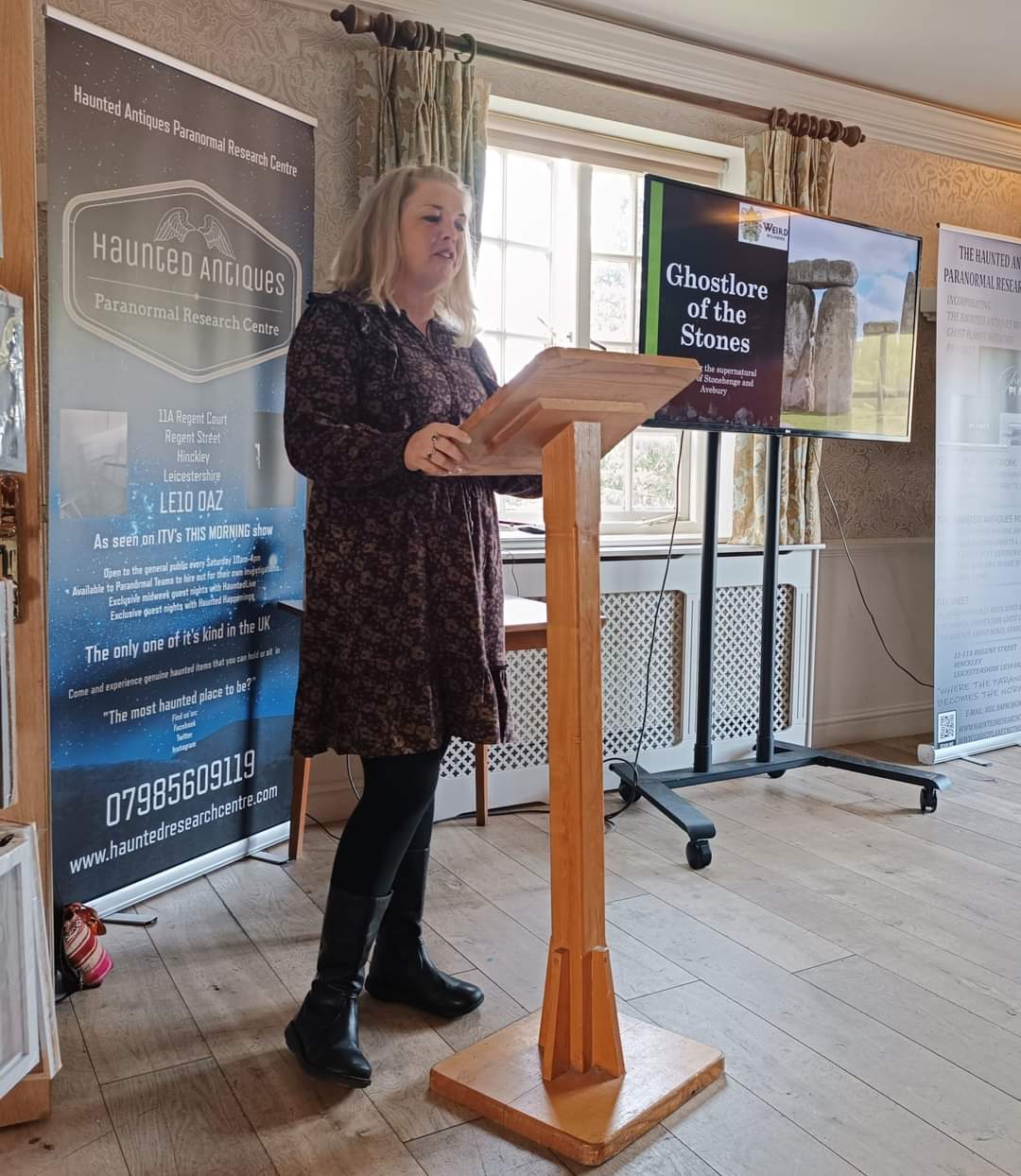
Following a welcome from the organisers, our day commenced with a captivating presentation by my chum Emma Heard, known for her insightful musings on the supernatural through her Weird Wiltshire blog. Emma delved into the mysteries surrounding Stonehenge and Avebury stone circles, weaving tales of ancient folklore and eerie encounters that left us spellbound.
Throughout the day, we were treated to a variety of talks, each offering a unique perspective on the paranormal. Barrie John, renowned for his appearances on ‘Most Haunted’, illuminated the audience with insights into mediumship, while Rachel Hayward, a seasoned paranormal investigator, and consultant, shared her intriguing research on a lesser-known Forest of Dean witch, Ellen Hayward.
Historian and writer Neil R. Storey
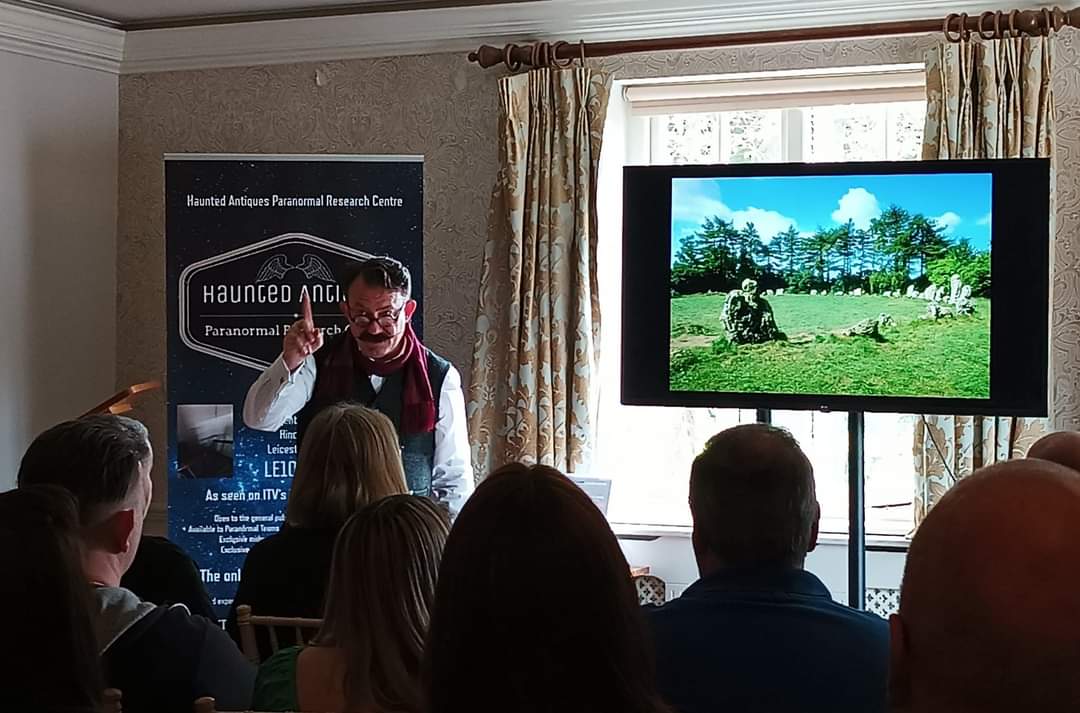
One highlight of the event for me was a presentation by Neil R. Storey, a distinguished historian and writer, whose discussion on an unsolved 1940s Warwickshire witch persecution-related murder from his book “The Blackout Murders” provided a chilling glimpse into a dark chapter of history.
Amidst the enlightening talks, we took the opportunity to peruse the stalls adorned with esoteric treasures. From cool ghost gear to arcane artifacts, every vendor had something that made you think, “Hmm, maybe there’s more to this world than meets the eye.” It was here that we had the pleasure of geeking out with the Haunted Magazine crew, chatting about all things spooky and supernatural.
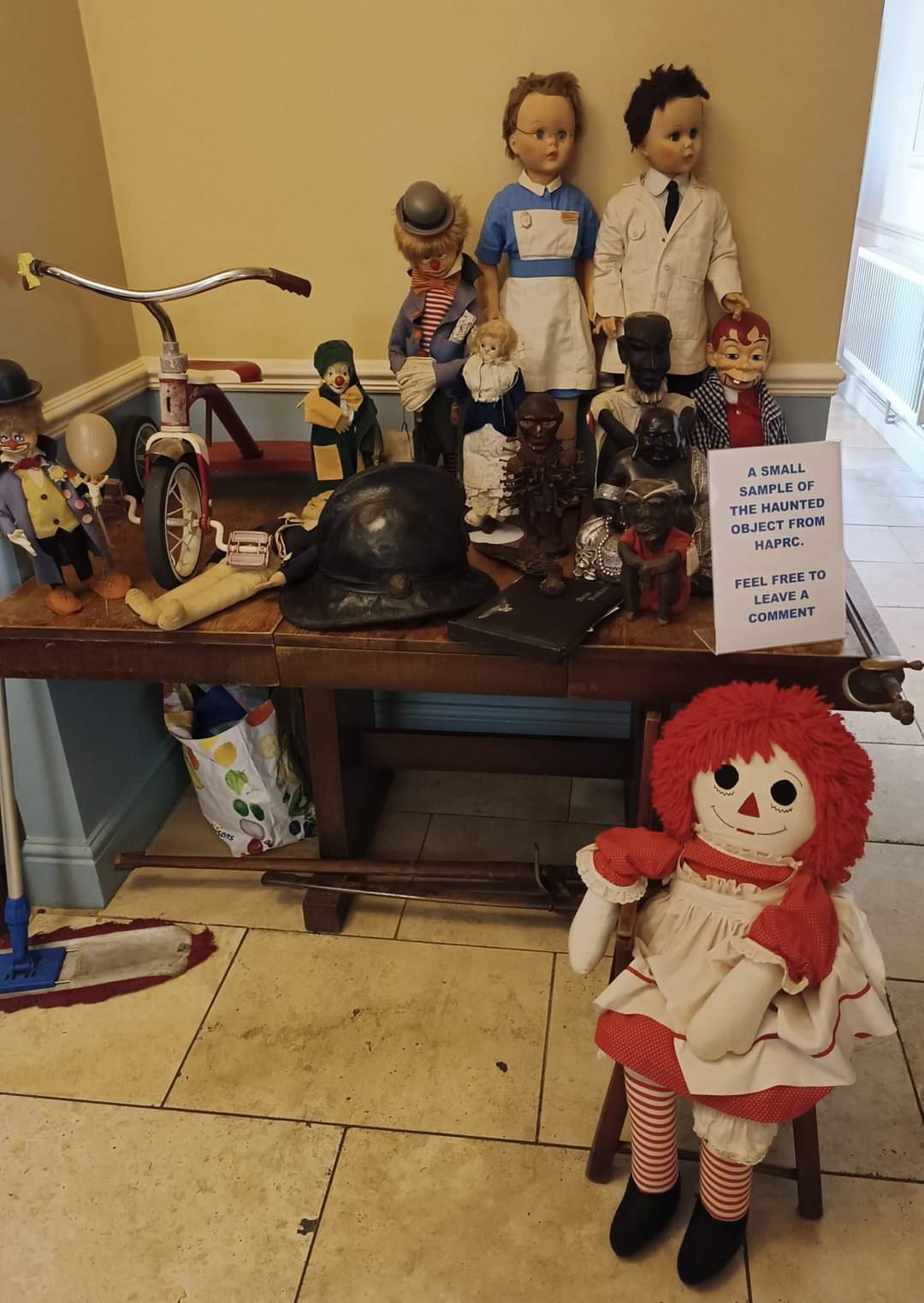
Haunted Items from HAPRC
Also on offer throughout the day were ghost hunt experiences in a haunted room, past life regression sessions, Tarot readings, and mediumship readings. We could also check out a selection of haunted objects from HAPRC, including some extremely creepy dolls.
Although we regrettably couldn’t stay for the evening events, our day at ParaMeet South was nothing short of exhilarating. The friendly atmosphere among fellow attendees, the wealth of knowledge shared by the excellent team of speakers, and the allure of the paranormal made for an unforgettable experience.
Glastonbury, a town steeped in mysticism and ancient folklore, served as the backdrop for a recent winter expedition that united bloggers, podcasters, and fans of the paranormal. Our journey began at the venerable George and Pilgrim pub, an atmospheric establishment echoing with centuries of history.
George and Pilgrim Pub: An Eerie Prelude
Nestled in the heart of Glastonbury, the George and Pilgrim pub proved to be the ideal starting point for our supernatural escapade.
The George and Pilgrim pub is one of the best surviving pre-reformation inns in England, one that has provided food, drink, and accommodation to pilgrims and visitors to Glastonbury for centuries. Its exact age is unknown, but it is known to have been rebuilt by Abbot Selwood in around 1455 when he oversaw an expansion of the abbey. The building itself comprises three stone storeys with a façade that resembles a small castle with battlements. There are three panels over the front entrance. Two of these contain the coat of arms of the abbey and King Edward IV while the third is blank. This possibly contained the white rose of York and was tactfully removed when King Henry VII came to the throne. The inn was built to accommodate wealthy pilgrims visiting the nearby abbey. The pub is also linked to the abbey by an underground tunnel that begins in the cellar and leads to a point within the abbey walls. It is thought that pilgrims could have used the tunnel to gain secret access to the abbey. Parts of the interior still have the original oak beam ceiling and stone slab flooring. Early carvings, figurines, and statues are still in place in the bar area. The interior is full of historical character, from its beamed ceilings, dark oak furniture, and huge fireplace.
As we convened, exchanging greetings, the air buzzed with anticipation. The pub, with its creaking floorboards and shadowy corners, set the stage for a day filled with eerie adventures.
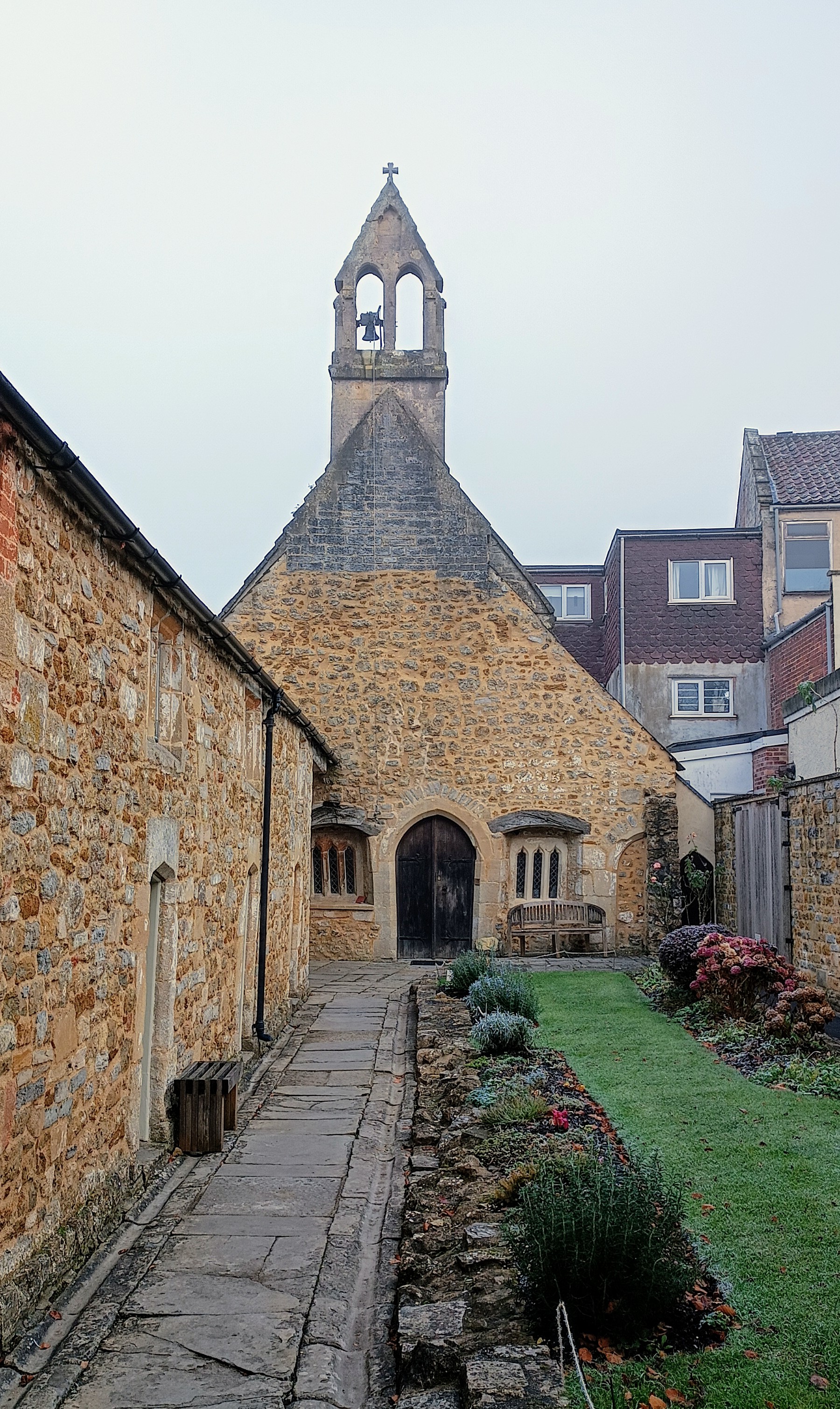
Our first destination to beckon us was St Margaret’s Chapel, a hidden gem of Glastonbury, a retreat away from the bustle of Magdalene Street. This sacred space exuded an otherworldly energy of peace and tranquillity. Built around 1250-70 and founded by Abbot Michael, it was first established as a pilgrim hospital with a chapel at the east end. At this time, it was known as the Hospital of St Mary Magdalene. Tired and hungry pilgrims were fed, washed, and accommodated here while visiting the abbey to view its shrines and relics. It was originally a long infirmary hall with cubicles on either side. The chapel was dedicated to St Margaret who was a Scottish Queen and Saxon princess. The chapel itself has a barrel roof and a now fully restored bell-cote.
By the early 15th Century, the large hall was replaced with two rows of alms-houses used for accommodating aging, poor parishioners. These were in use until the 1950s when one row was finally demolished. The site was rescued by the Quest Community and the Mary and Margaret Charity, who restored it and now care for it.
Here we explored the chapel with its glittering icons and spent some time in quiet contemplation in the gardens before moving on to the next destination on our journey.
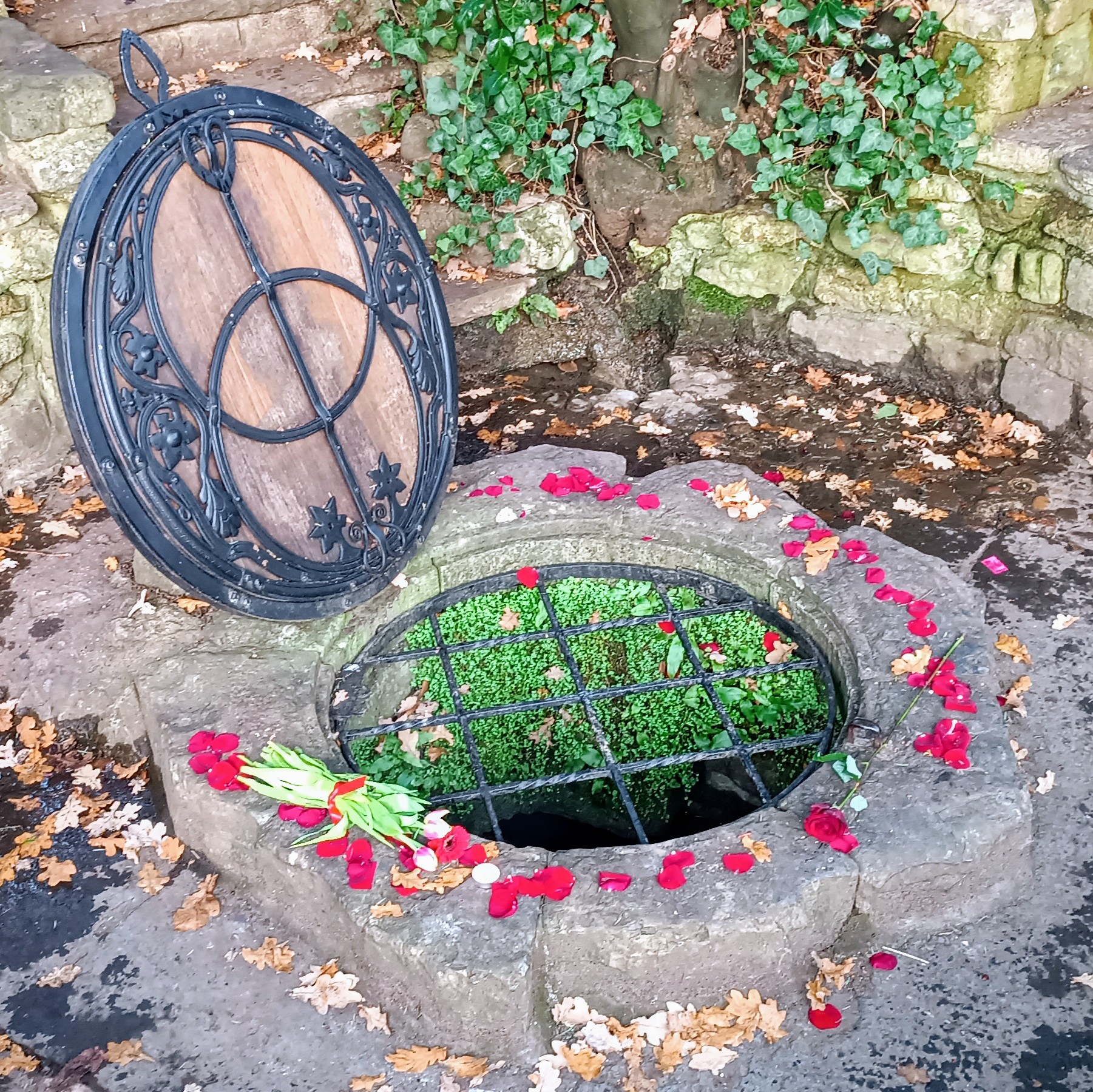
A pilgrimage to Glastonbury wouldn’t be complete without a visit to the Chalice Well, a site brimming with symbolism and ancient charm.
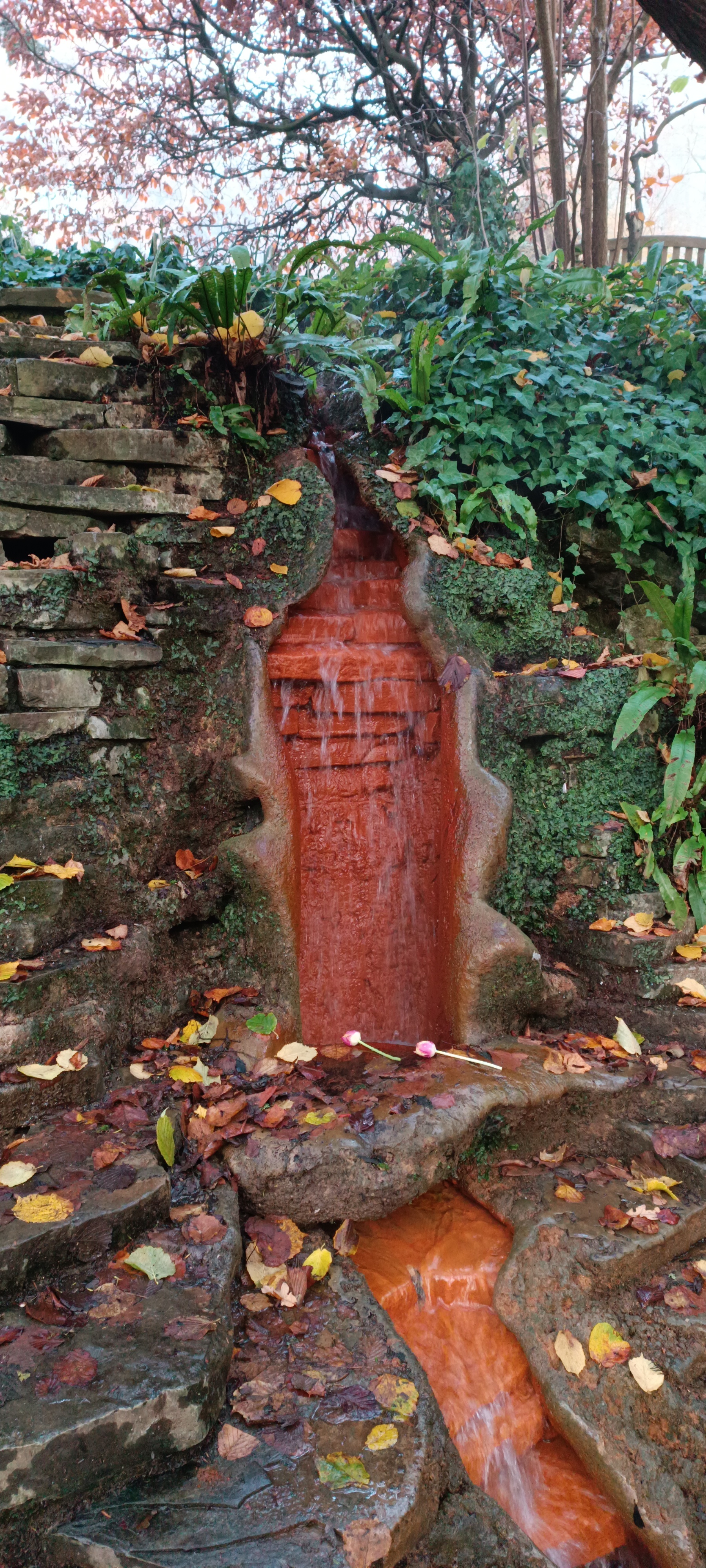
The Chalice Well, lying sheltered between Chalice Hill and the Tor, is an area of gardens arranged around a series of fountains and water features. It was the main supply of fresh water in Glastonbury until the 19th Century and 25,000 gallons of water flow there every day. This holy well is also known as the “Red Spring” or “Blood Spring” due to the red iron deposits the water leaves on everything it touches.
The site is ancient, with a 1961 excavation bringing up Roman pottery and flint. The stump of a yew tree dated to the Roman period was even found in the deep excavation. Yews still grow at the Chalice Well today and have a strong association with the ancient Druids and also Christian churchyard.
Legend has it that Joseph of Arimathea and his followers settled nearby and built the first Christian shrine in Britain and that the earliest baptisms were conducted in the spring. It is said that Joseph brought the chalice or cup used by Jesus in the Last Supper and either buried or washed the cup at the site, causing the water representing the blood of Christ to spring forth from the ground. Due to this, the Chalice Well is linked to the quest for the Holy Grail.
The Chalice Well has also been associated with healing waters for several centuries. In 1582 Dr John Dee declared he had discovered the ‘Elixir Vitae’ at the well and declared the water had healing properties. By the 18th Century, it became fashionable for people to visit the take the waters, with visitors flocking to the well to be healed. In 1750 a man from North Wootton claimed he had had a dream which told him to drink the water on seven consecutive Sundays to cure his asthma. He did this and proclaimed that he had “recovered of his disorder”. By 1751 tens of thousands of visitors came to take the waters, many of whom made sworn testimonies stating they had been cured of all manner of things, including blindness, ulcers, deafness, and scrofula.
Today the Lion’s Head drinking fountain is the only place in the gardens where the iron-rich water is safe to drink. The Chalice Well is now a place of quiet contemplation, peace, and calm, where visitors can revive their spirits and be soothed by nature. My husband and I filled our water bottle here, so we could drink the healing, iron-rich water later.
On Wellhouse Lane outside Chalice Well, leading up to the Tor, there is also a tap where travellers can fill their bottles when the gardens are closed. Directly opposite this lies the White Spring, from which calcium-rich waters flow, which we didn’t visit on this occasion.
The healing waters and vibrant gardens provided a tranquil respite, allowing our group to reflect on the mystical threads connecting Glastonbury’s past and present.
Glastonbury Tor: A Beacon of Mystery
Due to the inclement icy weather, myself and a number of our group decided to forgo climbing up the iconic Glastonbury Tor, preferring to view from a distance from the Chalice Well below. However, two brave members of our group continued their exploration, climbing through the mist and ice to the summit.
The Tor is a towering hill with panoramic views, it is shrouded in legend, rumoured to be the mythical Avalon. The mists rolling off the Levels left only the tower visible, pointing like a beacon towards the heavens; imposing and darkly powerful. The climb to the summit is approximately 158m above sea level, the sides are precipitous, and on a clear day, climbers can see for miles.
In early times the whole area here used to be a wetland and archaeology shows that the early inhabitants of the area built communities on hills or manmade structures, such as at the Lake Villages of Godney and Mere. Therefore, before the Levels were drained, Glastonbury Tor would have been a wetland island, perhaps leading to the myth of the Isle of Avalon. In prehistoric times it certainly would have been a landmark for local inhabitants and travellers.
Archaeological excavation indicates that the site has been inhabited since at least the 6th Century. Pottery and metalwork have been found there indicating the presence of a people of possible importance such as a monastic community. This may have been a sacred place long before Christianity, used by Bronze Age people and perhaps the Celts. The positioning of the Chalice Well and the Tor fits with a Celtic format, perhaps a place of pagan religious importance, later taken over by Christians.
A Norman chapel was built to St Michael on the summit, but destroyed by an earthquake in 1275. It was rebuilt 50 years later and in the 15th Century a tower was added, which remains today as a romantic, lonely ruin.
The Tor is associated with several myths and legends. There is thought to be a cave deep within the Tor, which is said to be a portal into the Otherworld which the Welsh mythological Lord of the Otherworld (Annwn) uses to transport spirits. It is said that on All Hallows Eve, the Lord of the Otherworld rides out from the cave on dark steeds for the Wild Hunt; collecting souls. He is followed by the hounds of hell, Cwn Annwn. The myth remains strong as in 2005 in the early hours of the morning, locals said that a charge of demonic horses could be heard galloping through the town. Four locals stated that they saw riderless black horses thundering up Bere Lane, along Chilkwell Street, and then disappearing in the direction of the Tor. They were lucky to keep their souls, in that case!
There is also a story relating to St Collen and his experience of the Tor. The saint visited Glastonbury but shortly after had a falling out with the local monks. He left for the Tor and made a cell in a quiet spot near the spring at the bottom. Here he is said to have had a vision of the Lord of the Otherworld, also believed to be King of the Fair Folk (fairies), Gwyn ap Nudd. His vision included scenes of revelry at the fairy castle, a fine feast, and music. St Collen sprinkled holy water and the vision vanished, leaving him alone on the Tor summit. Locals say that if the summit of the Tor is covered in mist, Gwyn ap Nudd is holding high revelry there. The members of our group climbed the misty Tor, but as far as I know, were not transported to the Fairy Realm on this occasion.
Return to the Haunted Haven: the George and Pilgrim Pub
After our day of exploring some of the sights of Glastonbury, we reconvened back at the George and Pilgrim pub for dinner and drinks in its atmospheric setting. We spent the evening sharing stories and bonding over our shared interests.
As night fell, many of us chose to brave the haunted rooms of the George and Pilgrim, welcoming the prospect of nighttime encounters with the unknown.
The George and Pilgrim pub has a reputation as one of the most haunted hotels in England. A man in 17th-century clothing is said to walk through the bar, to then disappear. In the Small Bar guests have heard a violent argument in process, only to discover on investigation that there is nobody there.
The bedrooms on the upper floors are said to be haunted by a variety of spirits. Footsteps have been heard moving along the empty corridors and cigar smoke has been smelled by occupants in certain rooms in the early hours. Chambermaids have reported that taps have been turned on, bed covers disordered, and furniture moved by unseen hands.
In one room the spirit of a monk was seen by a lady who awoke in the night. She felt the bed sink as the monk sat on the bed, where he stayed for several minutes talking about the time of Queen Elizabeth I, before fading away. Local legend has it that a monk once completed suicide in that very room.
A married couple once stayed in another room and reported that the wife was woken in the night by footsteps approaching the bedroom door. She looked to see a glimmering light with a tall, thin man in a sports jacket standing at the door. As she went to leap out of bed in fright, he smiled and disappeared.
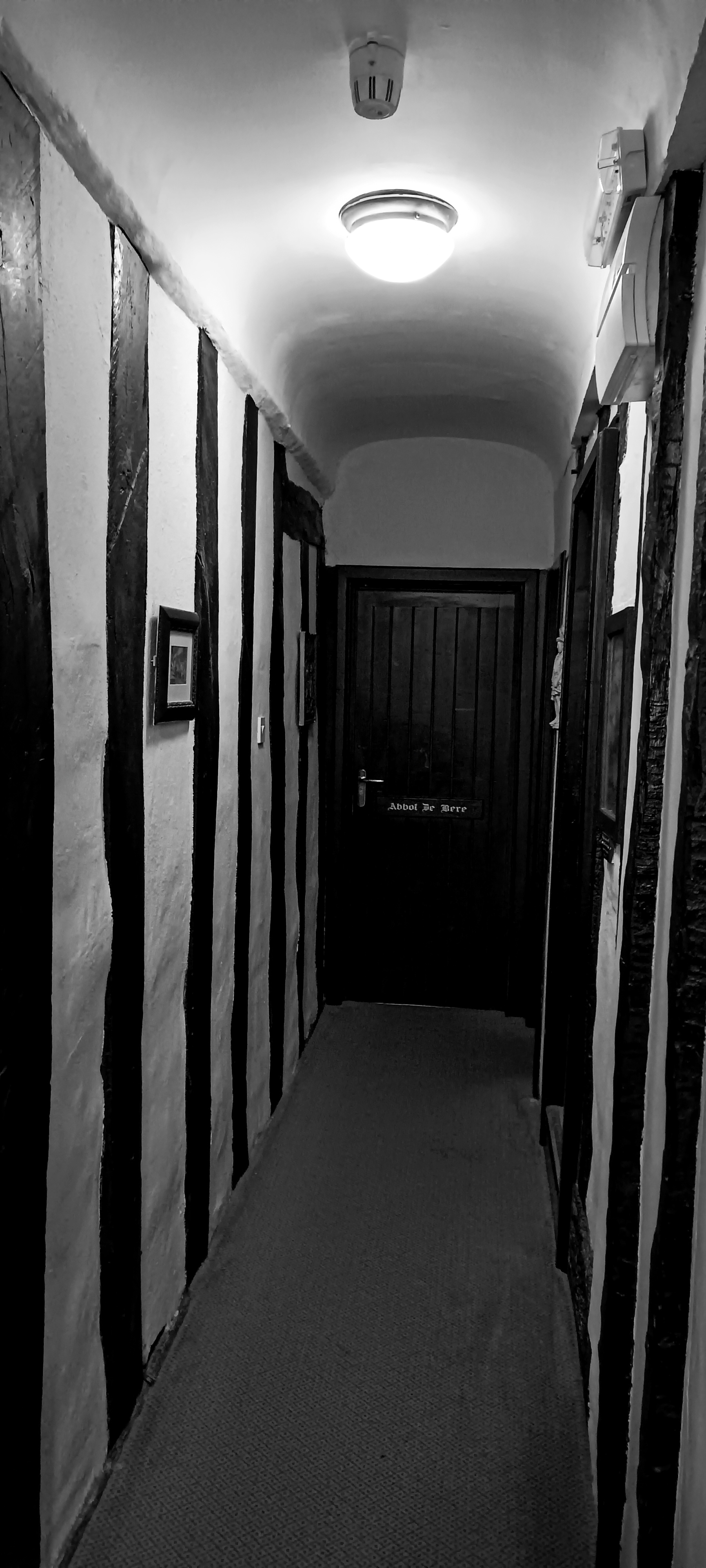
The group decided to meet up in one of the rooms, ‘Abbot Richard Bere’ room, to see if anything spooky could be felt. Abbot Bere was Abbot of Glastonbury between 1493-1524. He began much building on Glastonbury Abbey, from the chapels to the crypts, and also rebuilt the tribunal in around 1500. Although the room was very atmospheric, with its old-fashioned four-poster bed, we did not feel anything unusual in this room.
Several of us retired to bed, but a small group of us including myself peeled off and spent some time in another of the bedrooms. Here we turned out the lights and called out for any spirits to show themselves. We heard some small tapping sounds, but on investigation, these sounds were found to be the radiators heating up.
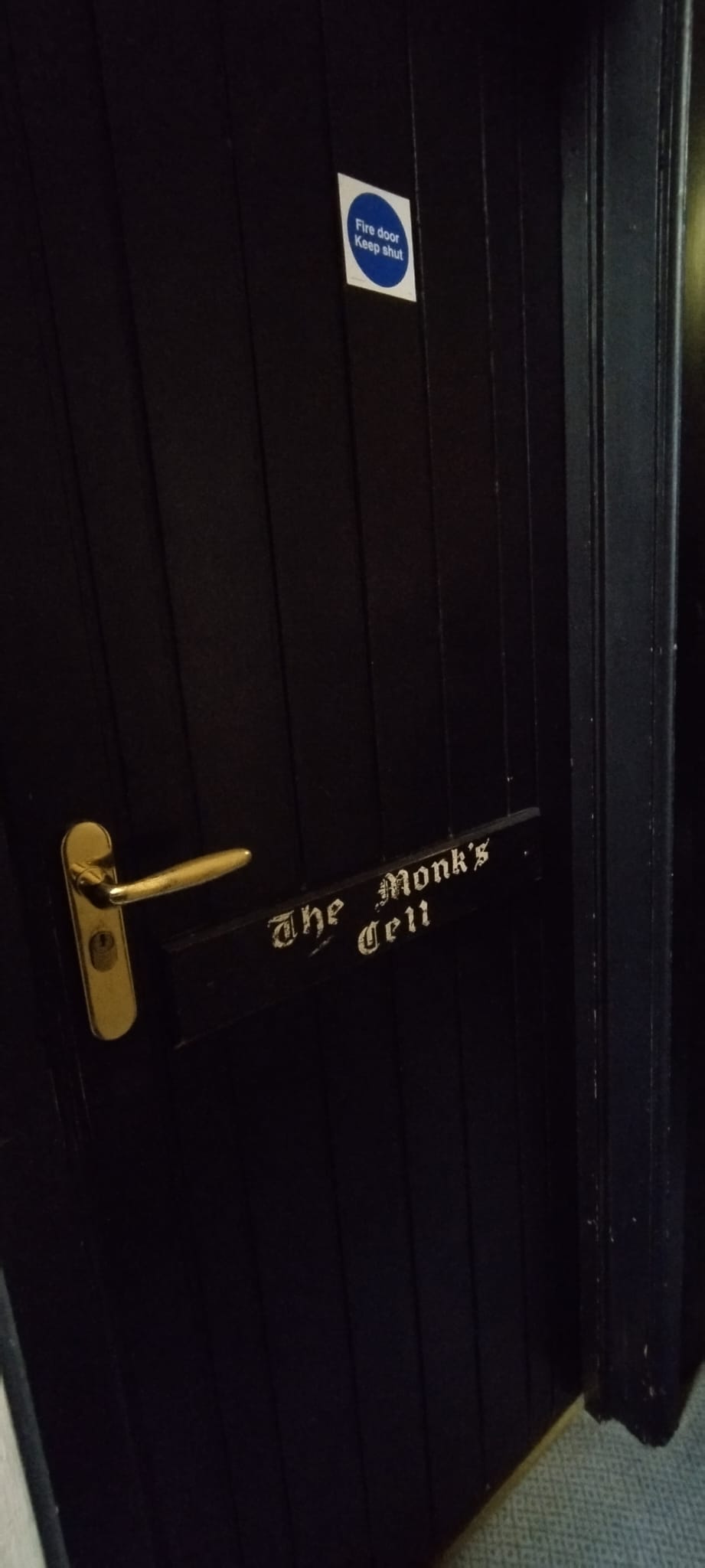
Finally, we called it a night and my husband and I retired to our room, ‘The Monk’s Cell’. This room is believed to be where the Abbot Whiting and his two monks were held on the morning of their execution. Abbot Whiting had been charged by King Henry VIII with robbery at the Bishop’s Palace in Wells after the dissolution of the monasteries. He was found guilty and attached to a hurdle, dragged through town, and eventually was hanged up on Glastonbury Tor alongside two of his monks John Thorne and Roger Wilfred. Whiting was then drawn and quartered and his head hung over the Abbey gateway.
The room had an eerie feel to it, this may just have been due to suggestion because of its old-fashioned style and slightly off-kilter proportions. I slept quite poorly that night, having weird dreams, but this once again may be due to the priming of being in a ‘possibly haunted’ room. My husband slept quite well though.
The next morning, however, provided some spooky hijinks. In the breakfast room, we were entertained by the light-hearted staff as we ate our breakfasts. Several times we noted that breakfast menus fell off the tables, perhaps pushed by spectral hands. Or, just as likely, gravity, of course. The staff claimed that this was the hotel poltergeist, ‘Arkwright’, who caused all kinds of mischief in the kitchen and breakfast room.
A Parting of Ways
Our sojourn through Glastonbury transcended the ordinary, weaving together a collective tale of mystery, and folklore, and shared fascination with the paranormal. As we departed, the ancient energy of Glastonbury lingered, leaving an indelible mark on each of us and a treasury of memories and stories to share with kindred spirits.
Please check out some of my fellow Glastonbury explorers’ podcasts and writing:
Rahtz, P.A. and Watts, L. (2003). Glastonbury: Myth & Archaeology. Tempus Publishing, Limited.
Sedgwick, I. (2023). Glastonbury Tor: The Ancient Entrance to the Fairy Otherworld. [online] Icy Sedgwick. Available at: https://www.icysedgwick.com/glastonbury-tor/ [Accessed 31 Jan. 2024].
Shakeshaft, J. and Beckett-King , A. (2020). S3E51 – Xmas Special: Joseph of Arimathea in Glastonbury. [online] Loremen Podcast. Available at: http://www.loremenpodcast.com/episode-51-s3 [Accessed 31 Jan. 2024].
The Chalice Well Trust (2023). The Chalice Well (visitor’s leaflet).
The Mary & Margaret Charity (2023). St Margaret’s Chapel and Royal Magdalene Almshouses: A Hidden Gem in Glastonbury (visitor’s leaflet).
My step-uncle Gerald lived in the village of Hickling, nestled in the heart of the Norfolk Broadlands. He was one of the few remaining reed cutters, a job with a long, proud tradition in the area but sadly dying out as fewer people needed thatch for their homes.
It was back in the mid-1990s that my step-uncle spent his day on Hickling Broad, the local body of water, slicing through reeds as the sun dipped below the horizon. One evening, the air grew cold and he witnessed a spectral figure gliding across the Broad.
(Hicking Broad, Norfolk. Image Source: John Fielding)
Now, being Hickling born and bred and from a family whose ancestry here stretched back as far as the Norse settlers, Gerald realised in horror that he was witnessing a local legend recreating its ethereal journey across the Broad.
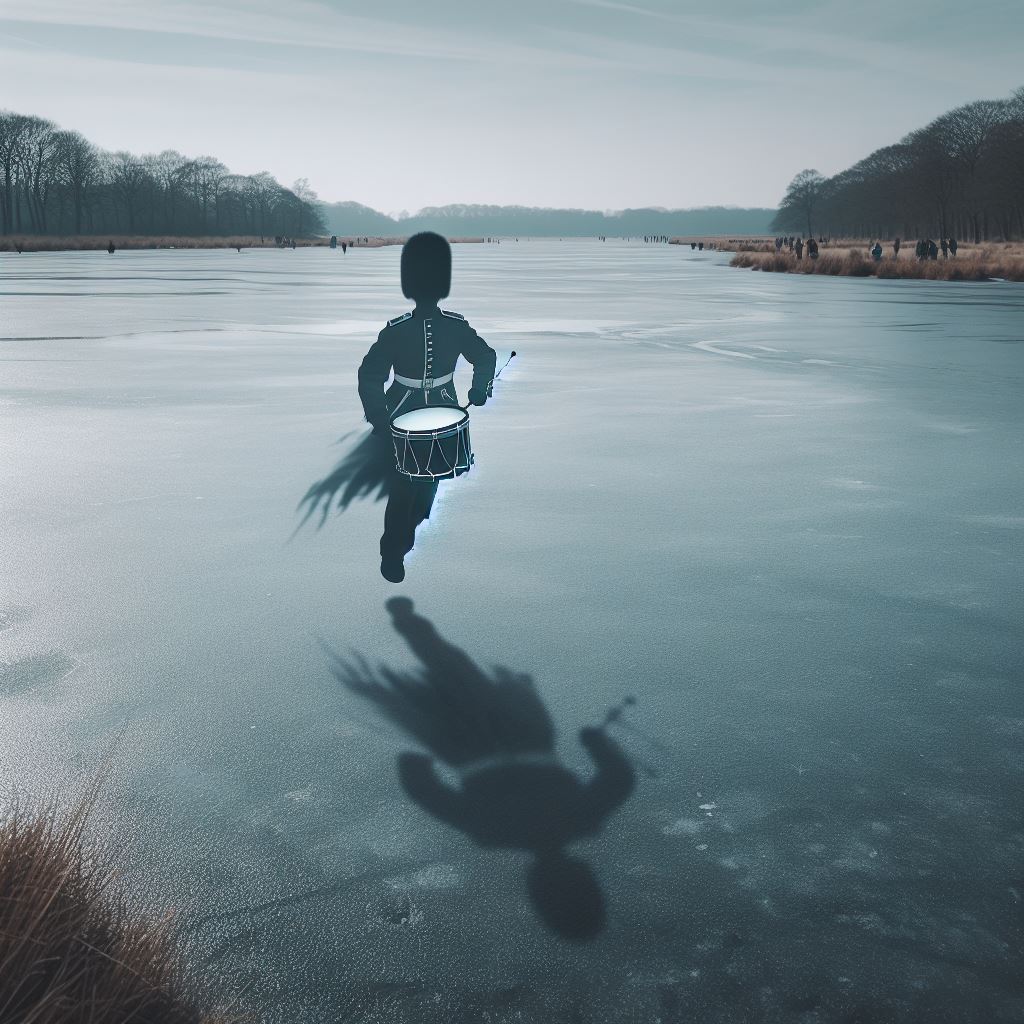
Local folklore has it that during the winter of 1815, shortly before the battle of Waterloo, a local drummer boy from Potter Heigham returned home on leave. While back he fell passionately in love with a local girl from a wealthy and influential family. The girl’s father, knowing the drummer boy was poor, refused to allow the relationship and any thought of marriage.
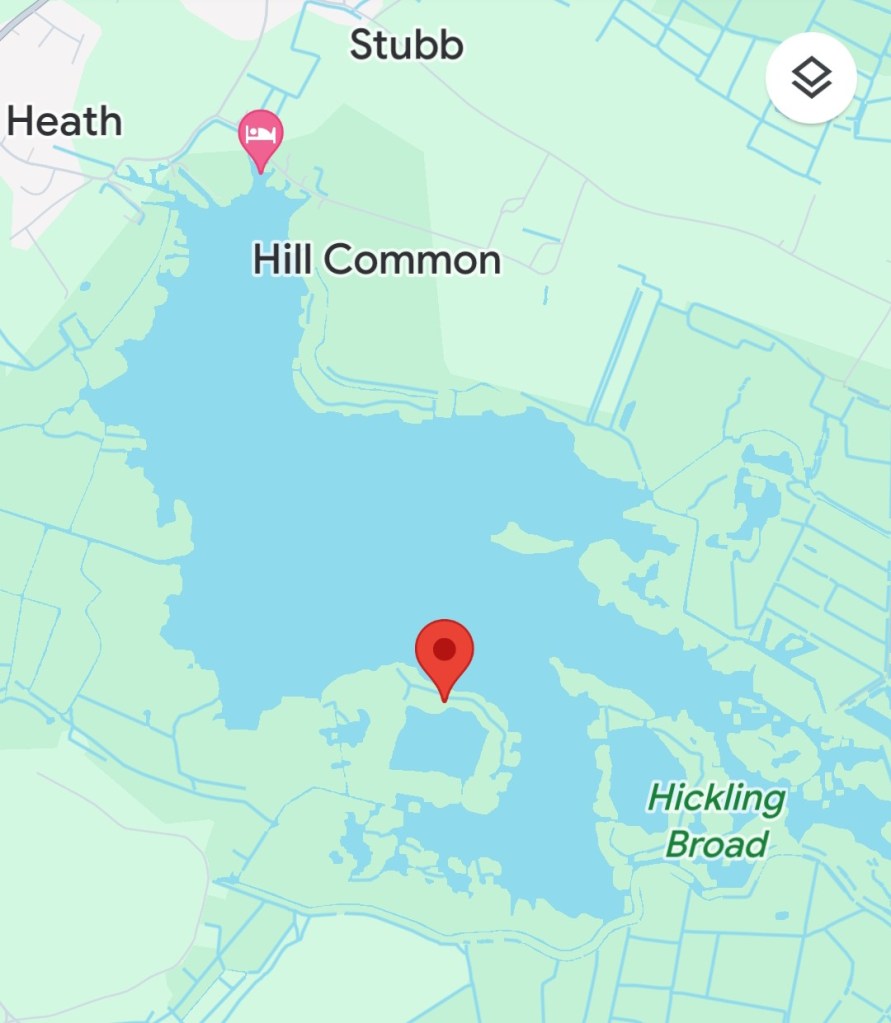
Undeterred by this, the star-crossed lovers continued to meet in secret every night in a little hut at Swim Coots on the edge of Hickling Broad. When the winter turned icy and the Broad froze over, the drummer boy skated over the ice, wearing his bright yellow scarlet trimmed coat, and would beat his kettle drum to signal his approach.
One frozen February evening the girl waited at Swim Coots as usual and listened out for the drum beat of her paramour. But this time the drum beat suddenly stopped and there was an eerie silence. The ice had cracked and the drummer boy had plunged through and drowned in the freezing waters of the Broad.
It is said that the girl rushed to the edge of the frozen Broad to find her lover and was relieved to see the shivering boy skating towards her. As she held out her hands to help him ashore, she felt his icy touch and the drummer boy disappeared.
The unfortunate drummer boy was not found for several days when a lifeless body was pulled from the Broad clad in a yellow coat with scarlet trim.
(Hickling Broad with Swim Coots marked. Image Source: Google Maps 2023)
Since then, it is said that on some cold winter nights in February, the eerie sound of a rhythmic drum tattoo and the swishing of skates can be heard, as the ghostly drummer boy tries to keep his date with his sweetheart.
After observing in shock the gliding figure, Gerald quickly downed his tools and fled back to the village where he decided to visit the Greyhound Inn for a stiff, nerve-settling drink. As Gerald recounted the haunting sight of the ghostly drummer boy to the sceptical pub patrons, the line between reality and spirits blurred. Was it the ethereal presence of the supernatural he witnessed, or a distorted vision fuelled by the spirits from his glass?
The locals in the pub dismissed his tale, attributing it to his well-known predilection for whisky. However, Gerald couldn’t shake the chilling memory, leaving him wondering if the haunting beats of the drummer boy would forever echo in his consciousness or fade away like the dissipating spirits in his empty whisky glass.















 Ghost Catcher Isles